
On October 16, 1834, a fire broke out at the Palace of Westminster. Officials wanted to get rid of medieval wooden tally sticks, notched accounting sticks that had been used to record financial transactions for centuries. They decided to burn them in the stove beneath the House of Lords.
It didn’t go as planned. Charles Dickens later described the disaster in a speech:
The stove overgorged with these preposterous sticks, set fire to panelling; the panelling set fire to the House of Lords; the House of Lords set fire to the House of Commons; the two houses were reduced to ashes.
It was London’s greatest catastrophe since the Great Fire of 1666.
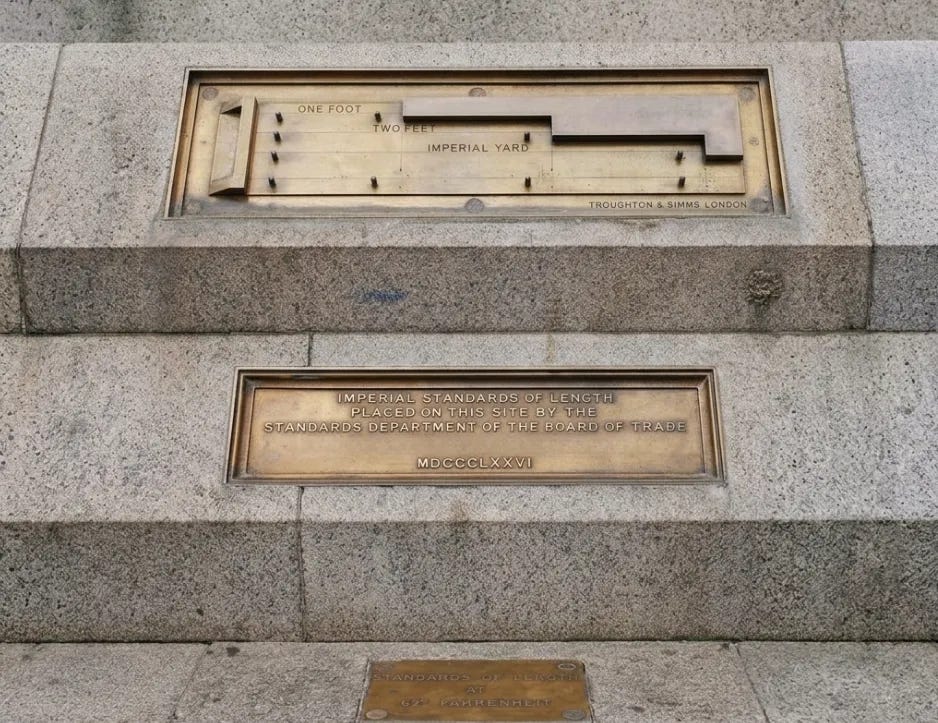
But the fire destroyed more than just the Palace of Westminster, it also wiped out Britain’s official standards of measurement. How long was a yard? A foot? An inch? Suddenly, no one could say for certain.
A commission was appointed to create new official standards, and to ensure they would never be lost again, public copies were installed in three locations across London: Guildhall, the Royal Observatory in Greenwich, and Trafalgar Square.
Mounted on a wall in Trafalgar Square, one of these bronze plaques served as a giant ruler. It displayed the official lengths of the time, including the yard, foot, inch, and chain. Its purpose was simple: if a merchant, architect, or engineer doubted the accuracy of their own ruler, they could compare it against the government’s official standard.
According to legend, the yard was originally defined as the distance from King Henry I’s nose to the tip of his outstretched middle finger. It may sound strange now, but for centuries many units of measurement were based on the human body.
Beneath the ruler are two more bronze plaques. The lowest bears the inscription “at 62° Fahrenheit”, a fascinating reminder that even official measurements depend on temperature. The standards were calibrated at 62°F (approximately 17°C), taking into account the way metal expands as it warms.
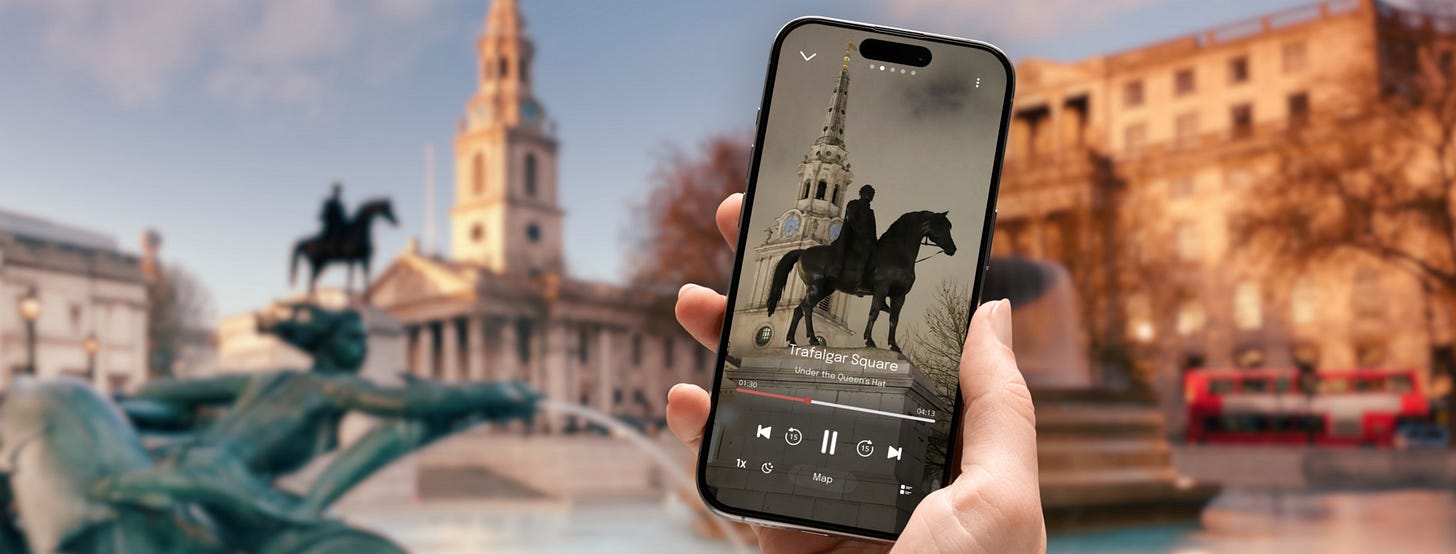
Sometimes, the smallest details we walk past, often without even noticing, are the most enduring traces of a city’s history. Just like a simple ruler that became the legacy of one of London’s greatest disasters...
Want to explore cities without missing the hidden details and everyday stories that make them unique? Download Piri app now! Piri guides you along the best routes, tells the stories behind the places you see, and recommends great spots to take a break along the way.
Planning a trip to London? Don’t forget to check out our five London tours: The Modern World’s Stage, Under the Queen’s Hat, The Tale of the Silver River, The Green Gem on the Crown, and Wisteria Walk.
If you’re getting this newsletter, it’s either because you recently used Piri Guide or you subscribed to it yourself. If you don’t want to get these newsletters anymore, you can unsubscribe at any time. We appreciate your time. 😇
Stay inspired and explore more on our Instagram and TikTok! Follow us for travel tips, behind-the-scenes stories, and more adventures!✨
Have a great weekend, everyone! See you next week!👋🏼
Comments
Nothing yet. Say the first thing.
Sign in to join the conversation.