
Nearly 150 years before computers existed, Lyon’s silk weavers were already “programming” machines. The Jacquard loom, controlled by punched cards, introduced an idea that would later become the foundation of computer programming.
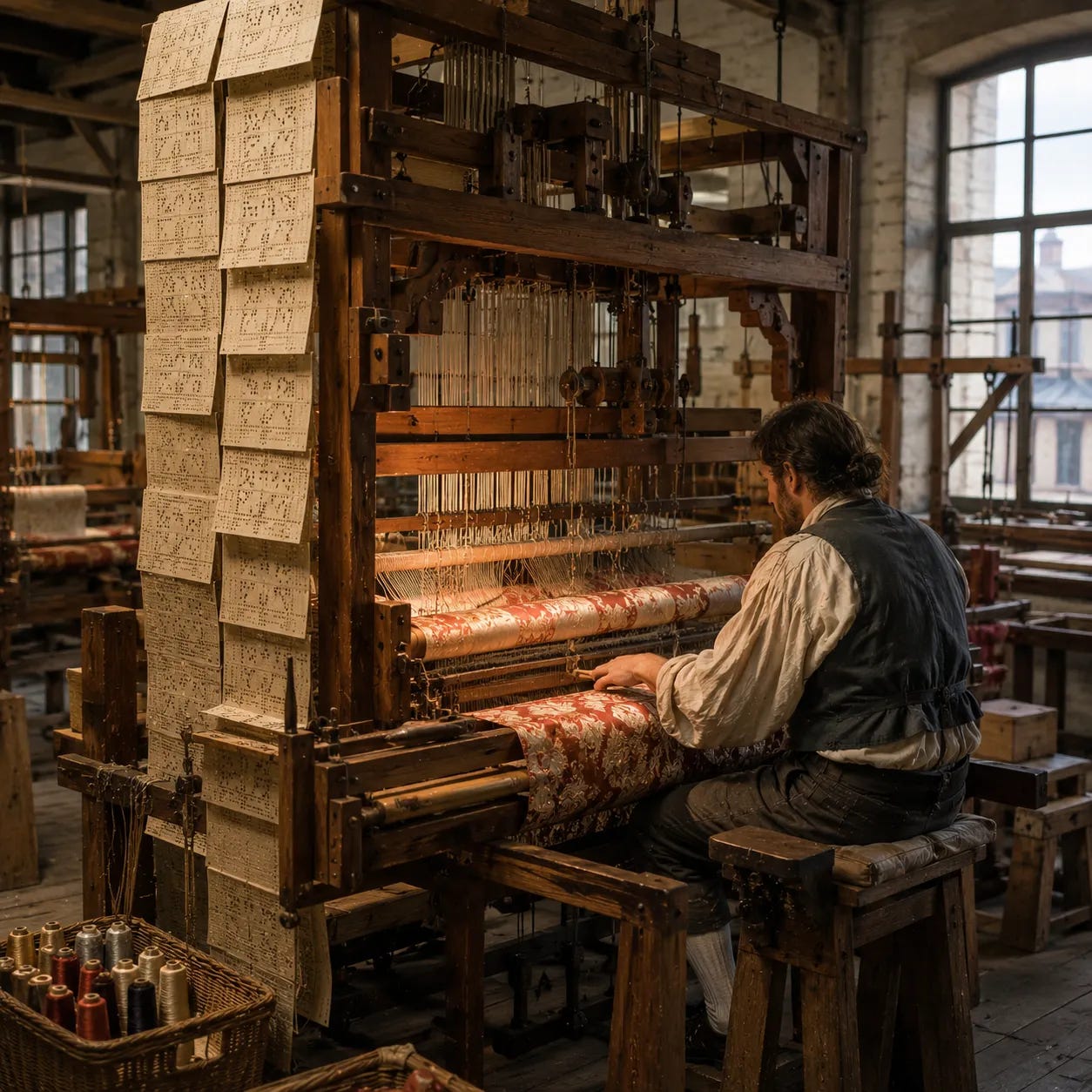
In 1536, King Francis I invited Italian silk masters to Lyon and granted the city exclusive rights to produce silk. Raw silk arrived from the Far East, while spinning, weaving, and dyeing all took place in Lyon.
By the late 18th century, the city was home to more than 14,000 looms and around 6,000 workshops. More than half of Lyon’s population worked in the silk industry.
The silk workers were known as the Canuts, a name believed to come from the French word canette, meaning “bobbin”. They worked 10 to 15 hours a day and were often paid only after completing an order. The people weaving Europe’s most luxurious fabrics lived in some of its harshest conditions.
In 1831 and again in 1834, they took to the streets. They built barricades, raised black flags, and marched under a slogan that became legendary:
Live working or die fighting.
The Canut Revolts are considered among the first major workers’ uprisings of the modern era, inspiring labor movements across Europe for decades to come.

It was during this period that Joseph Marie Jacquard perfected his automatic loom powered by punched cards. The concept was brilliantly simple: a hole in the card lifted a thread; no hole left it down, remarkably similar to the binary logic of 1s and 0s used by modern computers. A task that had previously required two weavers could now be done by one, even for the most intricate patterns.
Jacquard’s punched cards became one of history’s earliest forms of programmable technology. Decades later, IBM adopted the same principle for its punched-card computing systems.
King Louis XIV was the man who introduced Lyon silk to the world. Versailles ordered its curtains, upholstery, and royal garments from Lyon. The royal court became such an influential customer that Italian and English competitors struggled to keep up, establishing Lyon as Europe’s undisputed silk capital.
But the city’s greatest fashion influencer was Marie Antoinette. Whatever she wore quickly became the latest trend across Europe. Weaving a single gown for the queen could take up to two months, requiring hundreds of shades of silk and extraordinary attention to detail.
Even the color blue owes part of its royal reputation to this era. Although blue was one of the easiest colors to dye onto silk, producing it was expensive. When King Louis XVI and Marie Antoinette embraced it, blue became a symbol of nobility and prestige.

Lyon’s narrow streets hide secret passageways known as traboules. The Canuts once used these covered corridors to protect valuable silk from the rain as they carried it across the city. Centuries later, the very same passageways became hidden escape routes for members of the French Resistance during the Nazi occupation.
Lyon is full of stories like these. And don’t worry, we’ve gathered the city’s most fascinating landmarks and hidden stories in Piri’s newest audio tour. Download Piri app✨, search for “The Little Prince’s First Stop”, and start exploring.
If you’re getting this newsletter, it’s either because you recently used Piri Guide or you subscribed to it yourself. If you don’t want to get these newsletters anymore, you can unsubscribe at any time. We appreciate your time. 😇
Stay inspired and explore more on our Instagram and TikTok! Follow us for travel tips, behind-the-scenes stories, and more adventures!✨
Have a great weekend, everyone! See you next week!👋🏼
Comments
Nothing yet. Say the first thing.
Sign in to join the conversation.