
For years, we’ve been told that work should be our purpose. That the right job will make us feel whole. That if we just hustle hard enough, climb high enough, find the perfect role, we’ll unlock some deeper sense of fulfillment. But as the world of work shifts, more and more people are realizing: that we got it wrong.
It’s not that meaningful work doesn’t matter. It does. But the idea that our careers should be the defining source of identity, self-worth, and belonging? That’s where things fall apart. And it’s why so many professionals across Europe, and the world,—particularly Millennials and Gen Z—are feeling burned out, disillusioned, and disengaged.
So, what’s next? If work alone isn’t the answer, how do we redefine purpose in a way that actually sustains us?
A 2024 study in the Netherlands found that 44% of professionals feel emotionally drained due to a misalignment between their personal values and workplace expectations.
This isn’t just about long hours. It’s about the overidentification with work—when our entire sense of self is built around a job title, a company, or a career path. And when that structure shifts—a layoff, a leadership change, an industry disruption—it doesn’t just feel like losing a job. It feels like losing yourself.
A career built on external validation will always be at risk of collapse—because true fulfillment comes from something deeper, something more internal than any job title can provide.
“Bring your whole self to work,” they say—authenticity in the workplace is often dismissed as a buzzword, ideal for corporate branding and social media posts, because still too often when you do bring your whole self—your emotional range, your moods, your menstrual cycle—we hear: “not that much, leave it at the door.” But true authenticity is a core human need—one that directly impacts our well-being, confidence, and ability to thrive at work.
Gabor Maté, a physician and expert on trauma and human development, frames this as the tension between authenticity and attachment. As children, we have two basic needs: the need for attachment (being accepted, belonging to a group) and the need for authenticity (staying true to ourselves). When these needs conflict, attachment almost always wins—because survival depends on belonging.
This doesn’t just apply to childhood—it plays out in the workplace, too. Many professionals sacrifice their authenticity to fit into rigid corporate cultures, align with expectations, or maintain job security. They learn to mute parts of themselves, suppress opinions, or adopt a work persona that feels safe but inauthentic. And over time, this disconnection from the true self leads to stress, burnout, and even physical illness.
A 2024 study from Utrecht University found that professionals who feel free to express their authentic selves at work report significantly higher job satisfaction and lower stress levels. The reason? When we don’t have to perform or mask parts of ourselves, we conserve energy, build real connections, and feel a deeper sense of alignment.
This is what’s missing in so many traditional workplaces: the freedom to evolve.
Authenticity isn’t about sticking to one version of yourself forever—it’s about honoring the fact that who you are and what you need from work will change over time.

The old career model—one job, one company, one industry for life—is fading fast. In its place? A more flexible, multidisciplinary approach to work. The idea that success means climbing a single corporate ladder is being replaced by a new reality: professionals are crafting careers that blend multiple roles, industries, and income streams.
While portfolio careers are harder to quantify due to their fluid nature, studies show that non-traditional career paths are on the rise. According to a 2024 European job market survey, multiple job-holding rates are highest in Nordic countries, ranging from 6% to 12%, while the European average stands at around 4%. Additionally, a 2024 survey found that 54% of young professionals (ages 18-34) in Europe aspire to have a portfolio career at some point.
Financial security in uncertain times – Relying on one employer feels riskier than ever. Portfolio careers spread income streams, making professionals more resilient in times of economic uncertainty.
Creative and intellectual freedom – More people are rejecting the idea of being boxed into a single role. Instead, they’re exploring different industries, working across disciplines, and developing new skills.
Greater autonomy – Instead of shaping their lives around work, professionals are designing careers that fit their lifestyles, values, and personal goals.
For professionals from the global majority, this shift might be even more significant—and this is what we’re seeing in the Omek community, too. Portfolio careers aren’t just about flexibility; they’re a strategic response to traditional employment barriers. Whether it’s facing bias in hiring, limited leadership opportunities, or feeling like corporate spaces don’t fully embrace their identities, many of us are taking matters into our own hands.
From building businesses, freelancing, and working across industries— we’re creating professional identities that are as diverse as our lived experiences.
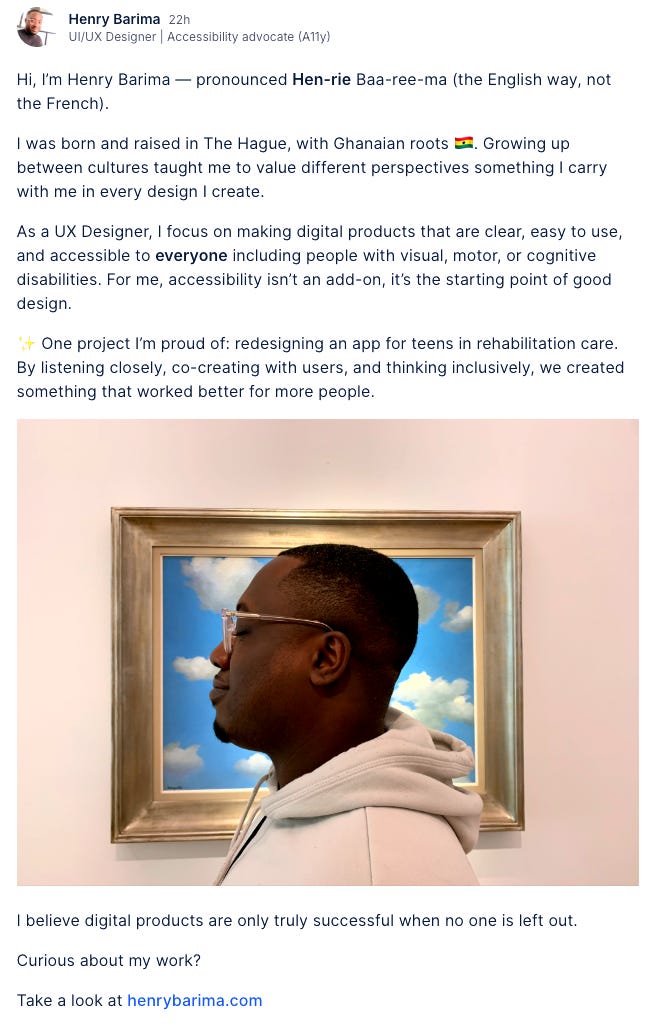
Take a look at one of our recent members, Henry Barima:
If careers are becoming more fluid, so is the way we think about belonging. In the past, professional identity was tied to a single employer, industry, or city. But today?
Belonging is about having the freedom to move between spaces: 62% of professionals feel a stronger sense of belonging when engaging with multiple professional and cultural communities. Rather than anchoring their identity in a single employer or industry, many are cultivating networks that span freelance projects, start-ups, and community organizations.
This shift is especially powerful for bicultural professionals—those who navigate multiple identities. Belonging doesn’t have to mean squeezing yourself into a predefined category. It can mean creating your own space, on your own terms.
And in this new corporate age, success won’t just be measured by job titles or salaries—it will be defined by how fully we can live our truths, across every space we call home.
Bridging Worlds by Omek is a space for bold conversations on what it means to lead, build, and belong as bicultural professionals, entrepreneurs, and brands. Join the community
No posts
Comments
Nothing yet. Say the first thing.
Sign in to join the conversation.