
Every jam session I’ve walked into has fallen into one of two variations: the kind that opens its musciking arms, and the kind where on your first note, people check whether you belong. That second kind pushed me into building my own version of the first, and of the strange horse I rode in on to do it.
One of my earlier posts entailed how it felt going to three different jam sessions over three successive evenings. In it, my main focus was on calling for skeptics and shrinking violets to participate in a tradition which takes many shapes and forms and hosts a variety of crowds and like-minded artistic minds. However, this was mostly for the purpose of practicing one’s playing by way of jumping into the deep end of the pool and during “online” participation (the kind that happens unplanned, right on the stage). Granted, it’s a great quality that I personally admire about jam sessions, but there’s much more to look into when musicking with strangers. So I went ahead and started my own line of jam sessions.
I called it “Raar Paard,” which translates to “strange horse” from Dutch. I don’t speak the language, myself, but it came out in a brainstorming session with a creative colleague (it was either that or “goat,” and “Raar Geit” didn’t bear as much of a “zing”). This was back at the end of 2024, and by May of 2025, I had hosted its first edition at Skek Amsterdam on one of the city’s oldest streets, Zeedijk. Since then, I have hosted a few more editions, with future ones coming up soon (I hope).
Now, what about it is so strange? What makes this horse weird? Well, that was me plotting to steer clear of any genre confinements. As detailed in my previously mentioned entry, jam sessions tend to revolve around specific styles, which carry with them certain musicians and etiquettes of performance; for each setting, there are clear do’s and don’ts. For example, a minimal electronic jam wouldn’t generally welcome a Gibson-clad blues guitar shredder because, chances are, the respective participants’ musical choices will not align within what the theme of the night requires. Appropriately, it’s unlikely that a blues guitarist would step into such a setting, ready to whip out their best Philip-Glassisms (granted, if they are bonafide blues musicians). I know, it’s quite the harsh generalization, since it suggests that all musicians are bound by specific genres, but that’s exactly the sort of worldview that “Raar Paard” was made to help musicians break free from.
To set the right stage and mood for the first edition, my first step was to pick a house band, which was right under my nose. Since 2024, I have been a member of Supermarkt - An experimental/art-punk/no wave/noise/Anatolian/dance-rock group that’s based in Amsterdam. I agree, that list of genres is a doozy, but one can get an understanding of how readied the ground was just by looking at it. Supermarkt’s wide palate of influences had much to do with how we shaped our sound, wrote, and performed, with names such as Machine Girl, James Chance, Stevie Wonder, Neşe Karaböcek, Swans, Lucio Battisti, Talking Heads, and many others coming up regularly in conversations about the subject.
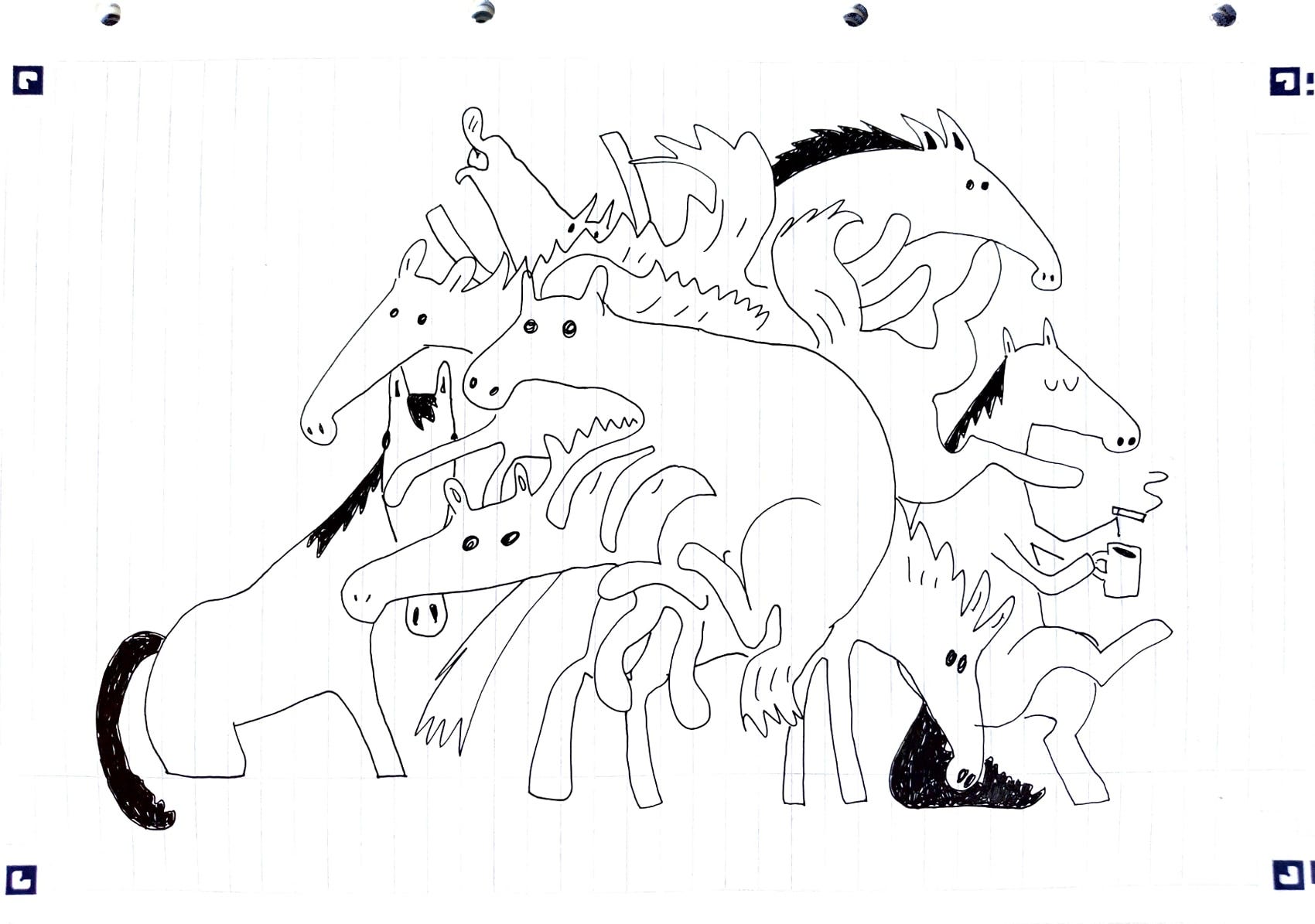
From there, the guiding line was simple: Keep the atmosphere ambient, but groovy at the same time. After a short opening set, meant to establish the sonic direction for the rest of the night, crowd members were welcomed to join in and take the reins. To me, it felt like a welcoming and amicable statement that would open the floor to any levels of musicality and experience. Those who are comfortable with textures and melodies were encouraged to man the ambient-focused positions, and those who were more percussive and corporeal could invest themselves in the rhythm section, though roles were challenged and swapped regularly. At one point, the acoustic piano was drumming harder and steadier than the drum kit. More importantly, the idea was not to be confined to any specific genres. On that first night, participants were playing no wave, Afrobeat, cumbia, krautrock, funk, surf, industrial, and the list goes on. What’s wonderful about places like Skek is that its modest size allowed for the crowd and the performers to sit and share the space together, which made for an even more immersive experience. Looking back, I appreciated how me and my partners managed to blur the lines between the attendees, and considering how more editions have been encouraged since then, I’d say May 4th, 2025 was a success. Weirdness was achieved.
Jam sessions are good for practicing. They’re also good for bridging between musical communities. Aaaand much of a performance’s natural development may rely entirely on its participants, with slight changes in dynamics and volume having the power to influence the soundscape of the whole evening. These, I find, are all perfectly good reasons to participate in them on whatever form of regular basis. But then, why did I initiate my own event? Well, it’s really because I hate jam sessions.
I mean I really hate jam sessions. A while before going to any of the other ones I wrote about, I went to a specific one in Amsterdam which was much bigger in scale and popularity. It had similar rules in that the groove must persist, covers were not allowed, and respect was a must on stage. So, not only did it prove to be another profile for technical wankery, but they were also quick to dismiss anybody from the stage who tried to steer the atmosphere towards anything that wasn’t the most common-denominator, bland, neo-soul-esque, Instagram-aesthetic muddle that’s been dominating the ring for as far as I can remember. Not to mention the way they randomly halted the jam halfway through to let some “secret artist” play a 15 minute set for a full room of people who did not come to see her play. Literal bait-and-switch. When I finally took the stage with my friends, and we managed to rile everyone up with dance-punk intensity, most of the usuals on stage refused to play along with our performance, and were quick to shoo us away as soon as the number was done.
A strong community is all about camaraderie, mutual respect, and patience. I don’t remember many large-scale jam sessions like the one I wound up in offering any of those. Thus, I opted to take off the gloves and stage my own jam session, where my vision could rule.
A close friend and frequent collaborator, who had been to every single Paard I’ve organized, recently told me that it was the only jam session she remembers not feeling anxious or put off by, and that it re-kindled her passion for playing guitar. That was worth everything.
My greatest music teachers were friends who spent time jamming and practicing with me; do not dismiss casual collaborations and the advice of friends. It all goes into the pool of influences and lessons you pick up along the way, and any help that goes between hands can go such a long way.
“‘I think print media is incredibly open. You can hand it to someone, you can read it together,” Obara says, calling mobile phones ‘very insular’”.
✘ Yeah, I agree. It does feel inimitable to hold a piece of media, be it zines, cassette tapes, DVDs, or even stickers. Let’s get off of streaming services, shall we?
“With some session musicians claiming to have been on the record – or having played the Barbican or the Hollywood Bowl under the misapprehension that they were on the original – are these players being dishonest for a quick buck, or has a collective amnesia come over the British equivalent of the Wrecking Crew?”.
✘ Gainsbourg’s seminal concept album has long been shrouded by questions as to who participated in its recording sessions way back. Up until recently, at least. I’ve personally enjoyed tracking these session guys’ credentials and piecing it together (listen to Dave Richmond’s bass performances on both Gainsbourg and Walker’s tracks).
“Having gone to concerts since the age of 13, I had always admired the commotion from afar but never felt ready enough to dive in. I was TERRIFIED to truly lose myself in a mosh pit”.
✘ I was never a fan of these, either. Though it’s not because I hate fun. It tends to feel forced almost every time I see it happen, to be honest. However, I found this article valuable for viewing the practice positively, and through a communal lens, I can condone it happily.
“Improvised song writing, when done right, is the most authentic way to write lyrics. Each word rises straight from the depths of the subconscious mind with no time for filtering. Authenticity is a necessary ingredient in great art. Improvised song writing can, and has, produced great art”.
✘ Big improvisation fan, here. I don’t write lyrics, I usually only play. Even then, I rarely write down a part beforehand. Something about spontaneity is so deliciously visceral that I don’t even need to wonder why I’m always drawn to it so much.
You know how Talk Talk made “It’s My Life” and “Life’s What You Make It”? And how they were synth-pop megastars in the 80s? Well, their last two albums were released following that commercial peak, and they contain some of the bleakest, darkest, yet prettiest and touching material I can recall knowing. 1991’s “Laughing Stock” has become one of my all-time favorites, and is considered an early foundational stone for post-rock as we know it today. It’s also worth mentioning how a lot of the channels on this album were repurposed from hours upon hours of improvisations orchestrated by frontman Mark Hollis for this purpose, with over 40 musicians involved in the process.
Comments
Nothing yet. Say the first thing.
Sign in to join the conversation.