
A few years ago, Cherie Hu sketched out how music and gaming could actually fit together. Games, she argued, are tools for creativity and storytelling, and the real opportunity for music sits well beyond landing a sync or a placement. Fans could be brought inside the work. Music could become part of how a game tells its story and how it lands. I keep waiting for it to show up at scale.
Looking at where the energy goes in the last couple of years, Mat Ombler’s MusicEXP newsletter reads like a weekly tally of the field, and the picture he paints is one of a real moment. Recent highlights are sold-out orchestral tours for games like Stardew Valley and Clair Obscur: Expedition 33, Forza Horizon 6 launching with more than two hundred licensed tracks, a single sync in the indie game Dispatch sending the artist Bershy past thirty-four million streams in half a year, and a steady run of star cameos like Korn for Diablo or Lana Del Rey for the new Bond game. This involves real revenues and actual reach for artists and composers.
Almost all of it, though, runs on the same old logic that Cherie also exposed, where the game is a channel and the song is something you drop into it. The music gets exposure, sure. The game gets a marketing beat, yes. Mat, however, puts his finger on the limit himself, noting that plenty of studios still treat an artist collaboration as a marketing bolt-on, and that the interesting shift is toward artists writing into games under the wing of in-house audio teams, which is, in his words, “how the magic happens.” That deeper version is exactly the part of Cherie’s framework the field keeps missing. And when music and gameplay are developed together, it works.
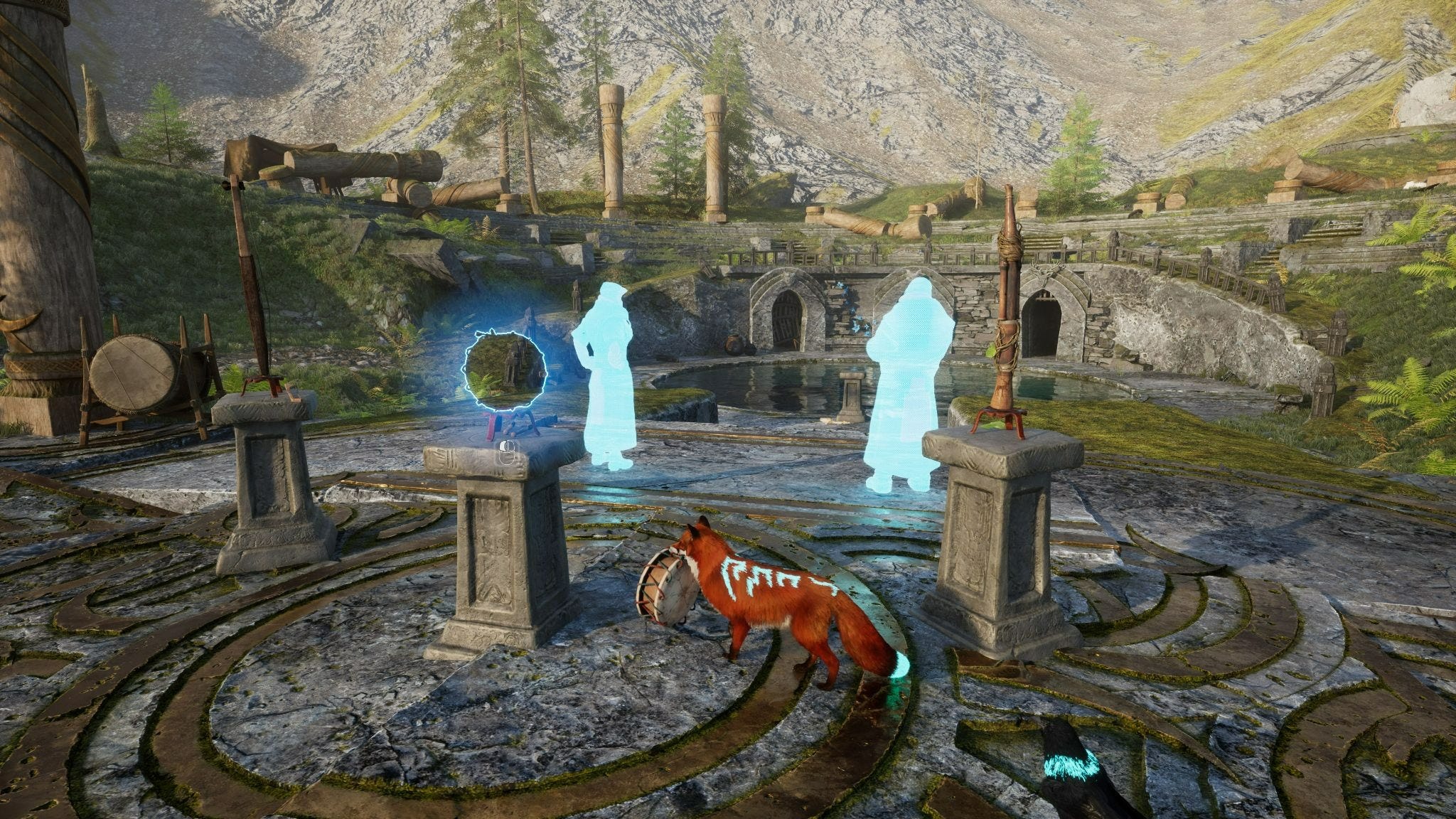
All this brings me to an indie game about a fox. Spirit of the North 2 comes from Infuse Studio, which is basically two environment artists, Jacob Sutton and Tayler Christensen, who built the first game largely on their own. There is no spoken dialogue and almost no interface, so the landscape and the score have to carry everything the player understands. That constraint is the engine. When music has to do the storytelling, it becomes the material the game is built from. The music resonates with players, and it helps build the story.
Pav Gekko, who scored the game, joined Infuse during storyboarding, before the team had settled what the game was about, so the music became one of the tools for working that out. The clearest evidence is the ending. A wordless adventure still needs a climax, and the obvious one was a final fight in which the fox, the lead character, and the gathered guardians destroy the antagonist, Grimnir.
The score pulled the team somewhere gentler, toward a theme of healing in which even Grimnir is released rather than defeated, and Tayler was blunt about the dependency when we spoke. The story “would never have found its conclusion without the music being discovered in parallel. It is one design.”
That reverses the running order of the conventional tie-in, the kind Cherie described, where a label books an eight-week campaign and gives a developer six weeks to wrap music around a track. The song in that arrangement is a substitutable guest similar to when a song lands as a sync in a game. At Infuse the score arrived with the first storyboard and carries the load that dialogue and cutscenes carry elsewhere. The working relationship ran like a band, with Pav giving notes on level design while the designers shaped scenes around his motifs. The composer is used to working inside Unreal Engine and behaves, in Jacob’s words, like a developer who specializes in audio, which is what lets the integration go this deep.
The technical heart of the game showcases what this integration makes possible. Working in the Wwise audio engine, Pav and Tayler built a system in which any area of the world can be tagged with an emotion, such as sympathy or heartwarming, or with an environmental quality like ancient or tribe. The engine reads those tags and assembles a matching mix on the fly, folding in automatic factors such as time of day, so a level designer can shape the emotional arc of a place without the composer touching the implementation. Pav writes and loads the music, and the world calls up the right version of it as the player moves through it. He has since published the design online, written articles about it and received nominations for awards such as Music+Sound.
This is, on an indie budget, the adaptive idea Cherie singled out as gaming’s underused gift to music. It is also the album-as-software that Jeremy Morris described a decade ago, here turned toward feeling rather than friction, since the music is genuinely unfixed and reassembles differently on every playthrough. The instrumental choices follow the same storytelling logic, with recognizable, culturally grounded instruments marking the tribes the fox passes and a deliberately unplaceable, reverb-heavy layer (carried by the Scandinavian herding call kulning, sung by Aleksandra Kowalczyk) reserved for the spiritual world. That a score this committed to interactivity also draws openly on Björk and Sigur Rós is a detail that kind of closes Cherie’s loop, since those are the artists she named, with Biophilia and Tónandi, as the unfinished promise this kind of work was always meant to fulfil.
That philosophy carried into the commercial moment that usually drags a project back toward the old model. For the game’s first anniversary, Laced prepared the 93-track soundtrack and asked Pav for bonus material. He offered ten finished tracks that were written for the game and then cut when they never found a home. Tayler and Jacob built them into a free update called Lost Melodies. They reverse-engineered a small quest from the finished music, a job Tayler said he found easier than writing from a blank page, and players can collect the tracks as “memories” woven into the existing lore.
Album-as-software usually means splintering the music into paid add-ons and microtransactions. Infuse ran SOTN2 on that same software premise of updatable layers and collectibles, but then took the opposite ethic and gave Lost Melodies away. It also sets this music x gaming collab into a framework where music earns its place in the lore instead of bolting on a famous name as a cameo.
The fans had a hand in the rest of it, too. Long before any official release, players recorded their playthroughs and ripped audio from the game to build their own playlists, some running five or six hours. Because interactive music has no single fixed version, with the layers shifting as you play, Pav mastered the definitive album by working from those fan playlists, keeping the layers listeners had already chosen and finishing them to studio standard, so the audience effectively became the record’s first editor.
That openness runs through the whole studio. Infuse talks with its community directly on Discord with no one filtering the exchange, and watches playtesters closely on the understanding that a developer can never fully feel what a player feels.
The dominant version of music and gaming still treats the song as something you attach to a finished game, counts the result in streams and reach, and keeps producing the thin outcomes we already know. Cherie told us years ago there was a richer path, where music helps build the world and the people who love it help build the music. Spirit of the North 2 is proof that this path is more than just a nice idea. The score resonates with players because it was made with them in mind, and it carries the story because it was there before the story had an ending. Lost Melodies then hands the whole thing back to those players for free. That is definitely harder to pull off than a sync, but is also much more durable and long-lasting. As the music industry still mostly asks what gaming can pay, a small game about a fox shows us what gaming can actually do with music.
“The venture’s flagship product became SingFit, an app that brings the joy and benefits of singing to individuals facing various forms of cognitive decline such as dementia and Alzheimer’s. First introduced to the public 12 years ago, SingFit guides sufferers and their caregivers through a rotating collection of songs, prompting them line-by-line for a stress-free experience. Trivia, movement, and more assist in stimulating the body and soul.”
✘ There are many benefits to music and helping people touch their humanity is one of them. It remains difficult to get music therapy for many people undergoing cognitive decline. I can only hope SingFit gets us one step closer again.
“The overall decline in investment has been driven almost entirely by a contraction in the funding of companies at growth-stage, which has fallen from a total of £114m in 2021 to just £10m in 2025. Larger, later stage deals have become significantly rarer as investor appetite for scaling stage companies has cooled. Similarly, there is a decline in the volume of deals of companies at growth stage – from a high of six in 2022, only two were recorded in 2025.”
✘ Plenty of ideas, not enough execution - and execution needs money to be done well. This insight from the report, created by MTUK, bears repeating again and again if you ask me.
“Each age group’s music preferences predominantly take shape during their teen years. Consequently, the resurgence of those preferences can be anticipated years later — when that age group has children. For example, if a person born in 1985 develops their musical tastes between 1997 and 2003, a nostalgic resurgence of music from those years can be anticipated to materialize largely during the 2020s, including the prominence of new Y2K-era acts such as Addison Rae and PinkPantheress.”
✘ This premise is so simple that I’m amazed it’s become a whole report. But if it bears repeating, it bears repeating.
“A group of independent record labels has invested £250,000 (approx. USD $334,000) in Cantilever, a curated streaming app for independent music.”
✘ If you hadn’t heard or read this yet, now you have. This is such an indie ecosystem power move. I’m very much behind it.
“Google’s AI overviews work nothing like traditional search results, the court argues. The AI rewrites and judges results “in its own words and according to its own structure,” the ruling says. In the case at hand, for example, it opened with confident claims like “Yes, [company] is known for dubious business practices,” then built its own structure with a summary, red flags for the alleged scam, and tips for users.”
✘ As Warner acquired Sureel to figure out attribution this ruling applied to music opens up a whole interesting can of worms when it comes to questions of copyright, ownership, and, indeed, attribution. One to follow beyond this German court ruling.
Speedy J is in my all time favourite artists list. His A Shocking Hobby is one of the best techno records, if not records full stop, ever made. After years of making lots of great music around his STOOR moniker he has released a new record: Walkman. It’s an hour and half, because walkman, of stunning music. It’s a journey, for sure. And it goes from techno to off kilter beats and from evocative to melancholy. Probably best listened to out on a walk, but really any time, any place.
Comments
Nothing yet. Say the first thing.
Sign in to join the conversation.