
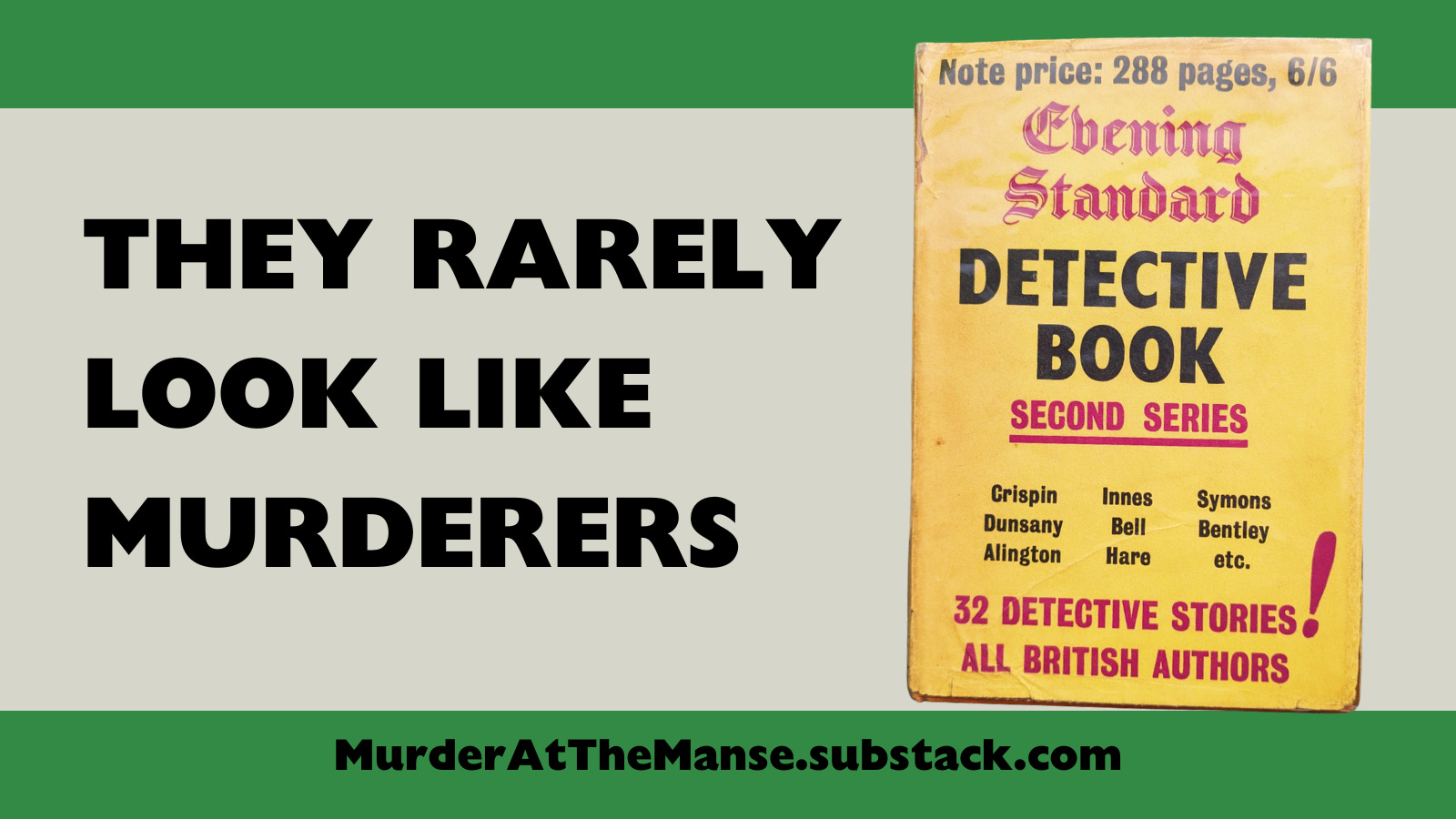
A few years ago, I picked up an excellent anthology entitled The Evening Standard Detective Book, which contains 32 stories by British authors, all previously published in the Evening Standard newspaper. It had a top-tier selection of contributors, including Cyril Hare, Freeman Wills Crofts, Leo Bruce, Edmund Crispin and Anthony Gilbert. In the words of the Manchester Daily News, it’s “a rich feast at a knock-down price”.1 I’d highly recommend getting a copy if you can, though it may no longer be at “a knock-down price”.
Recently, I’ve been perusing the follow-up volume, The Evening Standard Detective Book: 2nd Series, as published by Gollancz in 1951. It again contains 32 stories previously published in the newspaper, and it proudly proclaims on the cover that the story writers are “all British authors”. Due to their common origin, the stories are of similar length, averaging 6-10 pages. Sequels can be a tricky business, and in The Evening Standard’s case, I would say the quality of stories is overall lower than in its predecessor, although there are some gems as well.
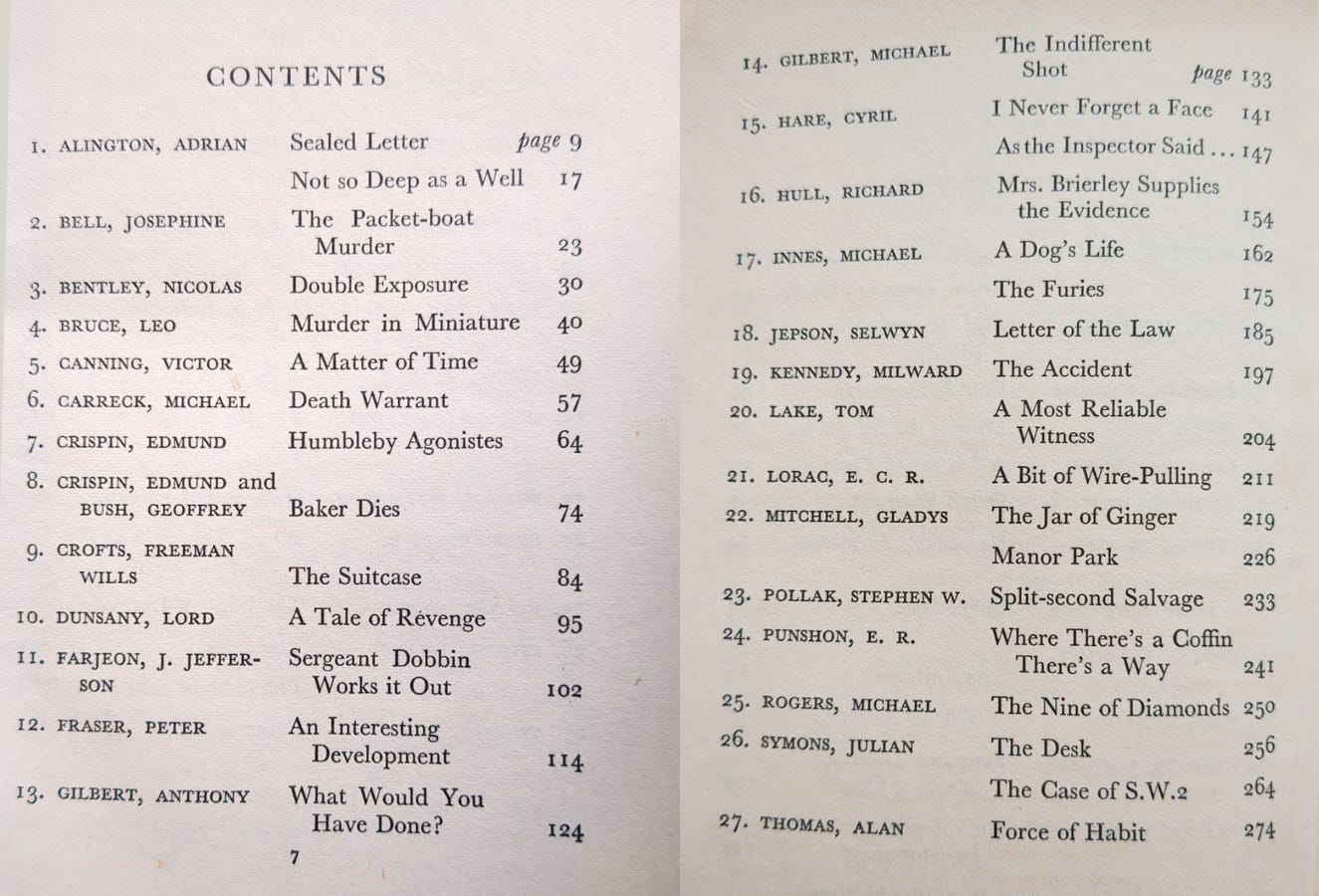
Alongside the familiar names, there are a few more obscure authors, three of whom are apparently unknown to the internet outside of these stories. Michael Carreck’s “Death Warrant” features a young man who has to decide how to deal with his intolerable Aunt Mabel. Michael Rogers’ “The Nine of Diamonds” involves a card game at Franchetti’s cafe. Tom Lake’s “A Most Reliable Witness” is one of the highlights of the collection, so I’ll discuss that in more details below.
As an added point of interest, this anthology contains the only short story Richard Hull ever wrote, “Mrs. Brierley Supplies the Evidence”. This was later reprinted by Ellery Queen’s Mystery Magazine in 1952. I have had mixed experiences with Hull: at his best, he is superb, but he is not always at his best. Sadly, this story is in the latter category. I still wish he had written more short stories, though. It would have been interesting to see Hull’s inventiveness deployed in short story form.
Barzun and Taylor’s Catalogue of Crime describes the anthology’s stories as “mostly short and many good”. They add a few annotations: a co-authored story by Edmund Crispin and Geoffrey Bush is “clever”, the two Michael Innes entries are “both Appleby and good”, Milward Kennedy’s contribution is “very neat” and Gladys Mitchell’s stories are “both above par for G. M.”2 They don’t, however, highlight my four favourite stories, which I’ll describe in more detail below…
Overall verdict: ⭐⭐⭐ (3/5)
Having produced hundreds of short stories across his career, Michael Gilbert is a staple author in crime fiction anthologies, including those published by the British Library. Of the BL anthologies I’ve read so far, my choice Gilbert selections would be “Old Mr. Martin” from The Long Arm of the Law (2017) and “Deep and Crisp and Even” from Crimson Snow (2017). To this list of favourites, I would now add “The Indifferent Shot”, first published in the Evening Standard and later collected in the Gilbert compendium Even Murderers Take Holidays.
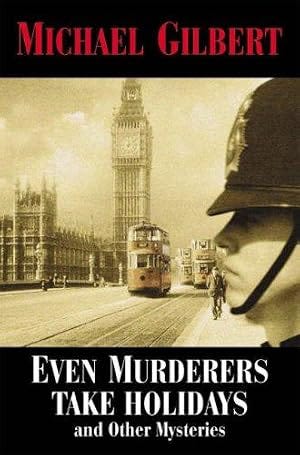
Drawing on Gilbert’s wartime experience in the Royal Horse Artillery, “The Indifferent Shot” follows the exploits of Gunner Whittaker, who is serving ineffectively in north Germany with the 15th Regiment.3 Whittaker is “small, white-faced, untidy, self-pitying and perennially unsuccessful”. In other words, he is an unlikely murderer, as the striking opening lines inform us:
Gunner Whittaker did not look like a murderer, although a competent psychiatrist might have sounded a warning. He might have pointed out that murderers very rarely do look like murderers.
We soon learn that Whittaker’s enemy is Captain Graham, a demanding perfectionist who is unimpressed with Gunner’s slackness. When his hope of home leave is frustrated by a requirement to display competence in musketry, Whittaker determines to kill the Captain. And with a sense of poetic justice, he decides to use a rifle as his murder weapon.
The ensuing plot is excellent, with a delicious twist at the end and a perfect final line. Whittaker is a well-written character, and it is interesting to follow his thought processes as he determines to kill. There are also some wonderful descriptive sentences, which are doubtless informed by Gilbert’s experiences. I especially enjoyed the mention of Whittaker slouching along, “his beret at that indescribable angle at which only a thoroughly unhappy soldier can wear a beret”. A beret good story.
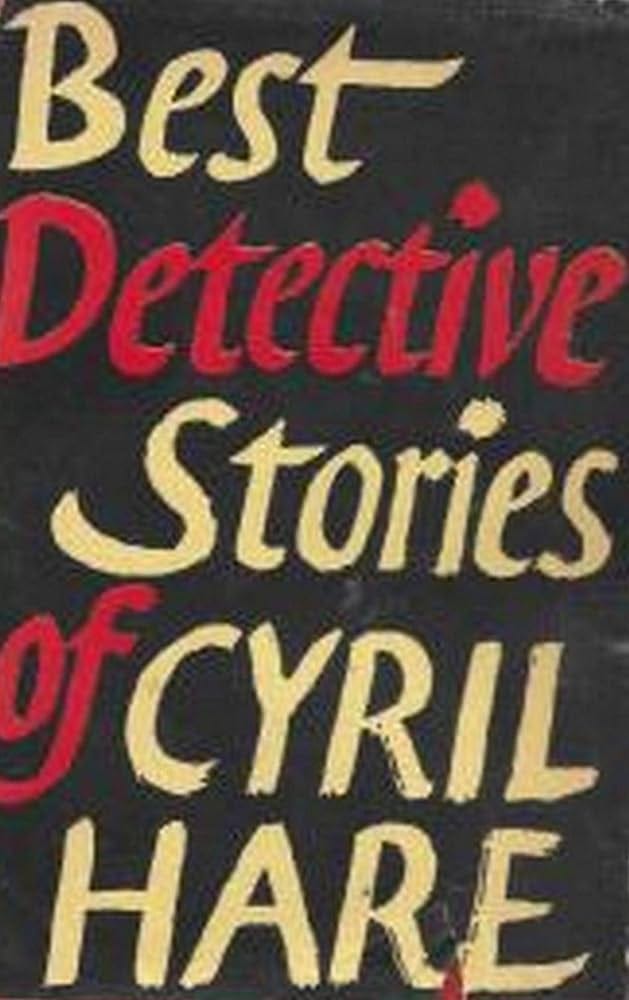
County court judge Cyril Hare was a regular contributor to the Evening Standard in the 1950s, and many of these stories were later included in the 1959 collection Best Detective Stories of Cyril Hare (edited, as it happens, by Michael Gilbert). The second Evening Standard anthology selected two of Hare’s stories, which are both excellent: “I Never Forget a Face” and “As the Inspector Said…” The latter of these is an inverted crime story involving Charles and Sonia’s ill-conceived plot to kill Sonia’s husband Robert. The former is a bit more unusual in its premise.
“I Never Forget a Face” opens with the narrator boasting that he never forgets a face, though he is very bad at names. And when he says he never forgets a face, he is insistent: “I can pass a chap in the street one day and recognise him again months after, though we’ve never so much as spoken to each other.” One evening, travelling home from the office by train, he finds himself seated in a carriage with a man he recognises from his home town. But, frustratingly, he can’t remember anything about the body attached to the face:
The annoying thing was that I couldn’t place the fellow, if you know what I mean. His face said Bardfield to me, as plain as print, but that was all it did say. I couldn’t hang it on to any particular thing in Bardfield—not the golf-course, nor the Red Lion, nor any of my usual haunts.
Perhaps this doesn’t sound like a very interesting premise for a story. But Hare’s narration makes it utterly compelling. It’s not a very meaty story but it is an entertaining one. Hare has taken a simple idea and executed it brilliantly; it’s the kind of story that I will probably remember a long time hence. I really should get a copy of his Best Detective Stories.4
I first encountered the Jepson family last year when I read Edgar Jepson’s novelisation of the stage play Arsène Lupin, as part of my “Century of Crime” project. Selwyn was Edgar’s son and he followed in his father’s literary footsteps, writing a number of thriller novels, short stories and screenplays. In 1984, he summed up his career with the comment: “I have never pretended to write anything more serious than fairy stories for grownups.”5 “Letter of the Law” became perhaps his best-known short story, as it was adapted for television for a 1965 episode of The Alfred Hitchcock Hour, starring Richard Johnson, who once turned down the opportunity to be James Bond.6
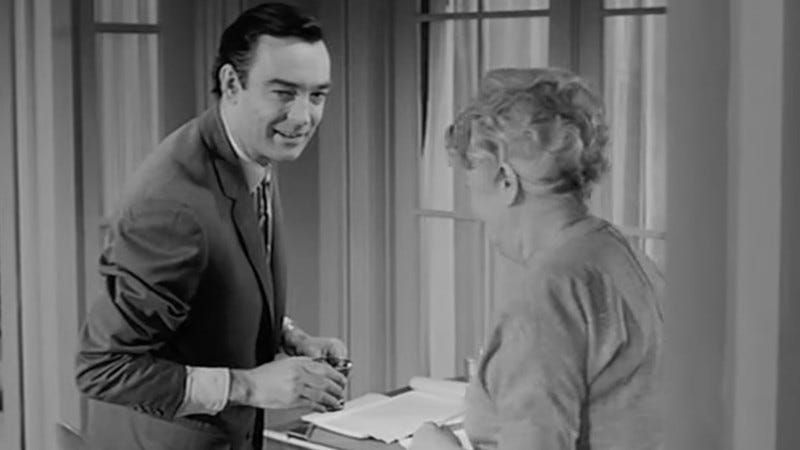
The story’s title is a play on words, as the narrative is presented as the contents of a letter written to “My dear Mrs Browne” in August 1950. The opening paragraphs refer to the “dreadful death” of Mrs Browne’s sister, and allude to a difficult “moment of decision” that the letter-writer has faced. She wants reassurance from Mrs Browne on the course she has taken:
You can help me, if you will, by telling me that I did right. Please, if you are not alone, take this letter to your room and lock the door. And, of course, you will destroy it as soon as you have read it.
It is not immediately clear what part the writer has played in connection with Mary’s death, but in the following pages we discover exactly why her conscience is troubled.
Epistolary stories are difficult to write in a convincing and engaging way, but Selwyn Jepson proves himself ready for the challenge. The narration works well in a letter style, and I was drawn into the letter-writer’s predicament. We are led through a number of different developments before the concluding “yours sincerely”. Without hearing Mrs Browne’s response, the situation is left somewhat unresolved, which adds to the story’s impact. Will Mrs Browne agree that she did right? I guess we will never know.
Tom Lake is one of the more obscure writers in this anthology. In fact, I am unable to find out anything about him except for the fact that he wrote this story. “A Most Reliable Witness” was later reprinted in The Saint Detective Magazine in 1954, with the unenlightening blurb:
English writers are noted for their objective and analytical handling of stories about crime and criminals. This new, little story needed that sort of treatment, and Tom Lake, being British, shows just how it should be done.
The story opens with a weekly Friday night argument about detective fiction involving Simon Enterprise and Hall Radley, in the company of fellow club members. This Friday, however, the usual discussion is interrupted by a manufacturer of woollen goods called Bunthorpe, who makes an intriguing intrusion in the opening lines:
“It is quite possible to commit a perfect murder,” said Bunthorpe. “I might even say simple. The trouble is that, in addition to cleverness and craftsmanship, the murderer needs a degree of omniscience that no one possesses this side of heaven.”
Within the first two pages, we hear Bunthorpe’s confession that he is a murderer, that he has killed Henry Haylton for being “too far too friendly” with his wife, and that this was a perfectly executed murder. The gathered crowd listens as Bunthorpe outlines his plans for Henry’s murder and his attempt to create the perfect alibi. And when it comes to an alibi, Bunthorpe insists: “I think you chaps will agree I was cleverer than most.”
I enjoyed the unusual narrative perspective in this story. The account is written in the first-person by a club member who recounts Bunthorpe’s words. I’ve read many stories that begin with a detective retelling the history of a crime to a friend, but Tom Lake offers an interesting twist by making the murderer tell the story instead. This makes it harder to predict how the story will unfold, and when the ending comes, it is a clever one. This all leaves me wondering: Who was Tom Lake, and did he only write this one story?
Have you read any good anthologies recently? Let me know in the comments!
Quoted on the inside pages of the second book.
Jacques Barzun and Wendell Hertig Taylor, A Catalogue of Crime (Revised edition, 1989), page 573.
In contrast, Michael Gilbert was in the 12th Regiment Royal Horse Artillery and served in a distinguished way. I’m sure any resemblance to real people, living or dead, is a coincidence.
We are still awaiting its sequel, Worst Detective Stories of Cyril Hare.
Quoted in his entry in Twentieth-Century Crime and Mystery Writers, 3rd edition (St James Press, 1991), 601.
No posts
Comments
Nothing yet. Say the first thing.
Sign in to join the conversation.