
This week on Murder at the Manse, I’m continuing my long-term project of reading one crime novel from each year of the 20th century, in order, with no author repeats. You can read about my progress so far here.
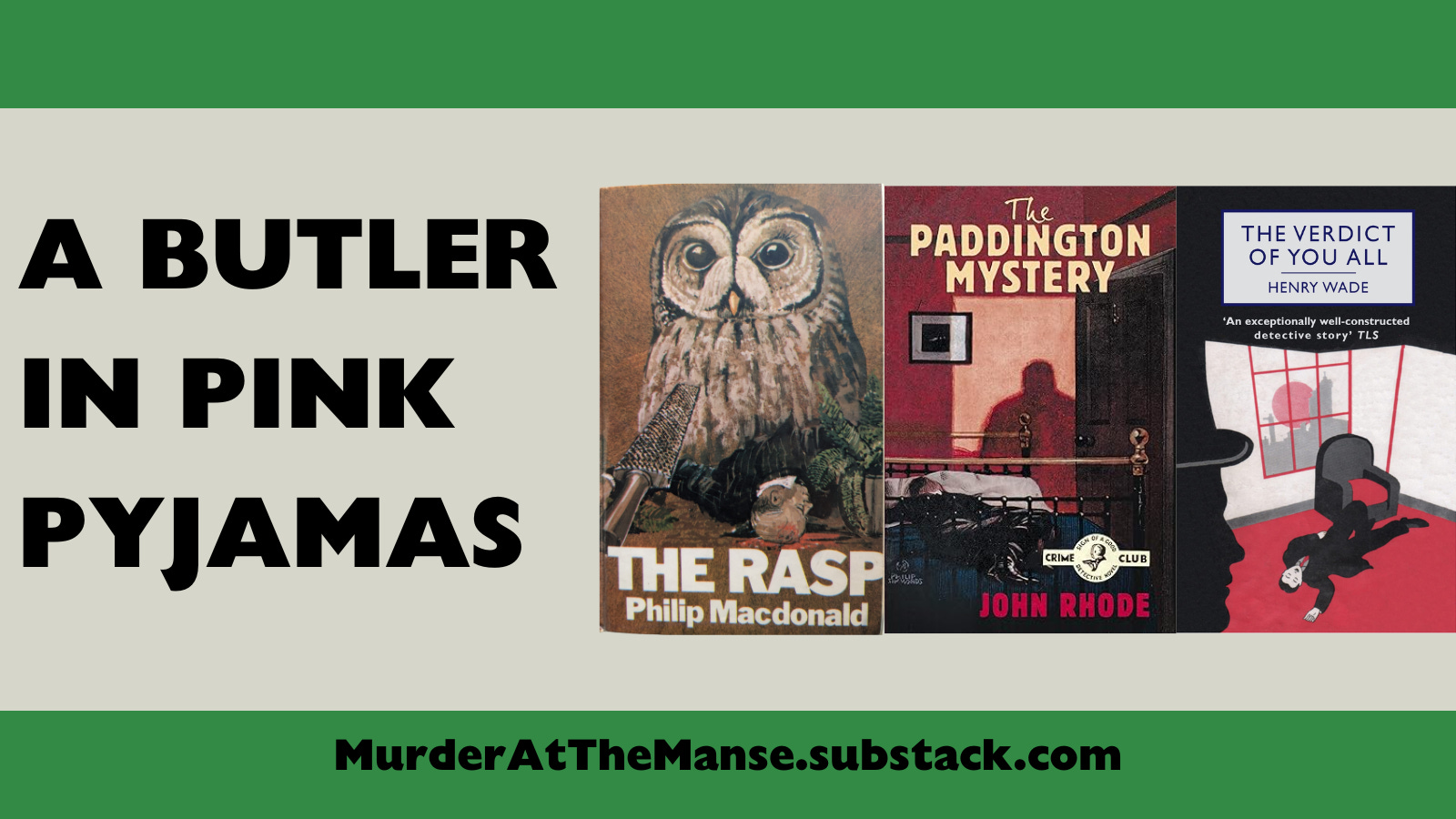
We are currently in the mid-1920s, the era of the first appearance of the Shipping Forecast on British radio (1924), the opening of the world’s first motel in California (1925) and Agatha Christie’s 11-day disappearance (1926). This was also the period in which Philip MacDonald, John Rhode and Henry Wade produced their debut mysteries: The Rasp (1924), The Paddington Mystery (1925) and The Verdict of You All (1926). And one of them features a butler in pink pyjamas.
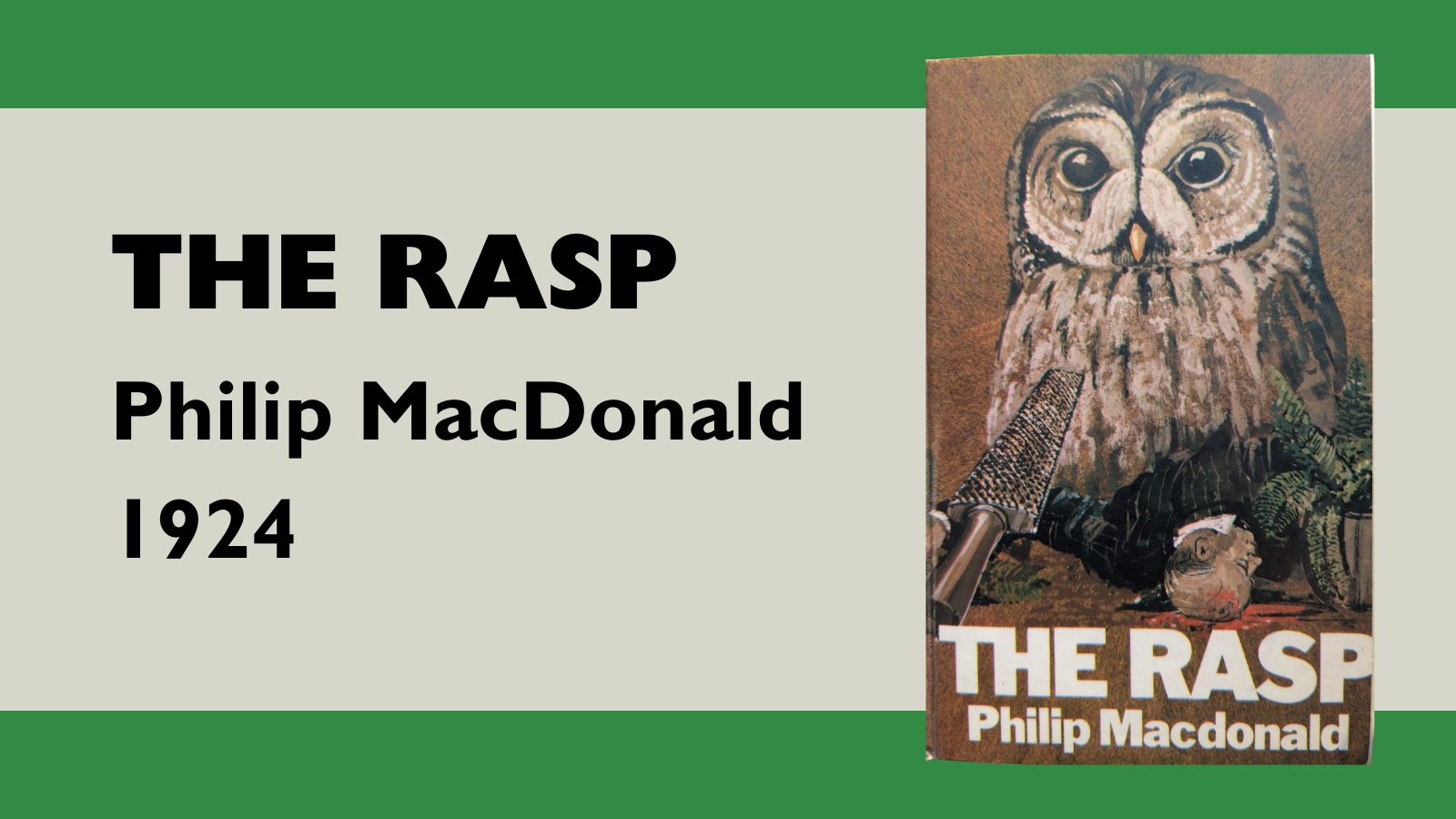
I’ll be honest: I misunderstood the meaning of this title before I read the blurb. I assumed the titular rasp was a raspy voice, when in fact it’s a carpenter’s tool. The tool in question has been misused for the purposes of murder, claiming as its victim the Minister of Imperial Finance, John Hoode, who is found dead in his locked study. Anthony Gethryn, an ex-Secret Service agent who’s at a loose end, is sent to cover the case for weekly newspaper The Owl. The editor hopes that Gethryn can help to catch the murderer and thus improve The Owl’s distribution figures. Hoode’s private secretary Archibald Deacon becomes the prime suspect, but Gethryn is convinced he is innocent. With some careful investigation and a bit of romance, Gethryn succeeds in his mission of providing The Owl with a sensational scoop.
The Rasp is often cited as a classic of the genre, appearing on the Haycraft-Queen Cornerstones list and featured in Martin Edwards’ The Story of Classic Crime in 100 Books.1 It was MacDonald’s debut as a solo author; he had previously co-written two books with his father Ronald MacDonald (no, not that one). It was also the debut case for MacDonald’s series detective Colonel Anthony Gethryn, who appeared in 12 books in total. As well as his detective novels, MacDonald became a successful Hollywood screenwriter and wrote many short stories, which earned him two Edgar Awards.2 The Rasp was later turned into a film, directed by Michael Powell, but this film is sadly lost. In their review, Kine Weekly said, “the atmosphere is refreshingly English, and there remains sufficient to entertain the unsophisticated.”3
Colonel Gethryn is a genteel amateur sleuth, reminiscent of E. C. Bentley’s Philip Trent. He has been successful in various different fields: in fact, we are told, “from his birth he proved a refutation of the adage that a Jack-of-all-Trades can be master of none.” Based on the initial outline of his CV in chapter two, I was concerned that I would find him extremely irritating, but actually he was an enjoyably energetic detective (except for his susceptibility to falling in love with suspects). He has a respectful relationship with the official investigator, Superintendent Boyd, who “showed none of the chagrin commonly attributed to police detectives when faced with the amateur who is to prove them fools at every turn.”
The plot is a classic detection puzzle, narrated with a brisker pace than some of MacDonald’s contemporaries. Or, at least, the pace is engaging until the penultimate chapter, which contains Gethryn’s letter of explanation. This covers 52 pages (!) in the edition I read, a full sixth of the novel. And then there’s a sickeningly saccharine final chapter. But the preceding mystery is enjoyable, and I appreciated the multiple self-conscious references to detective fiction. “Ever read detective stories, Boyd? They’re always killed in studies. Always! Ever notice that?” Or, my favourite exchange:
“As I asked you before, d’you ever read real detective stories? Gaboriau, for instance?”
“Lord, no, sir!” smiled the real detective.
Verdict: ⭐⭐⭐⭐ (4/5)
Read in the 1978 Remploy hardback edition
Scavenger Hunt item: Bird
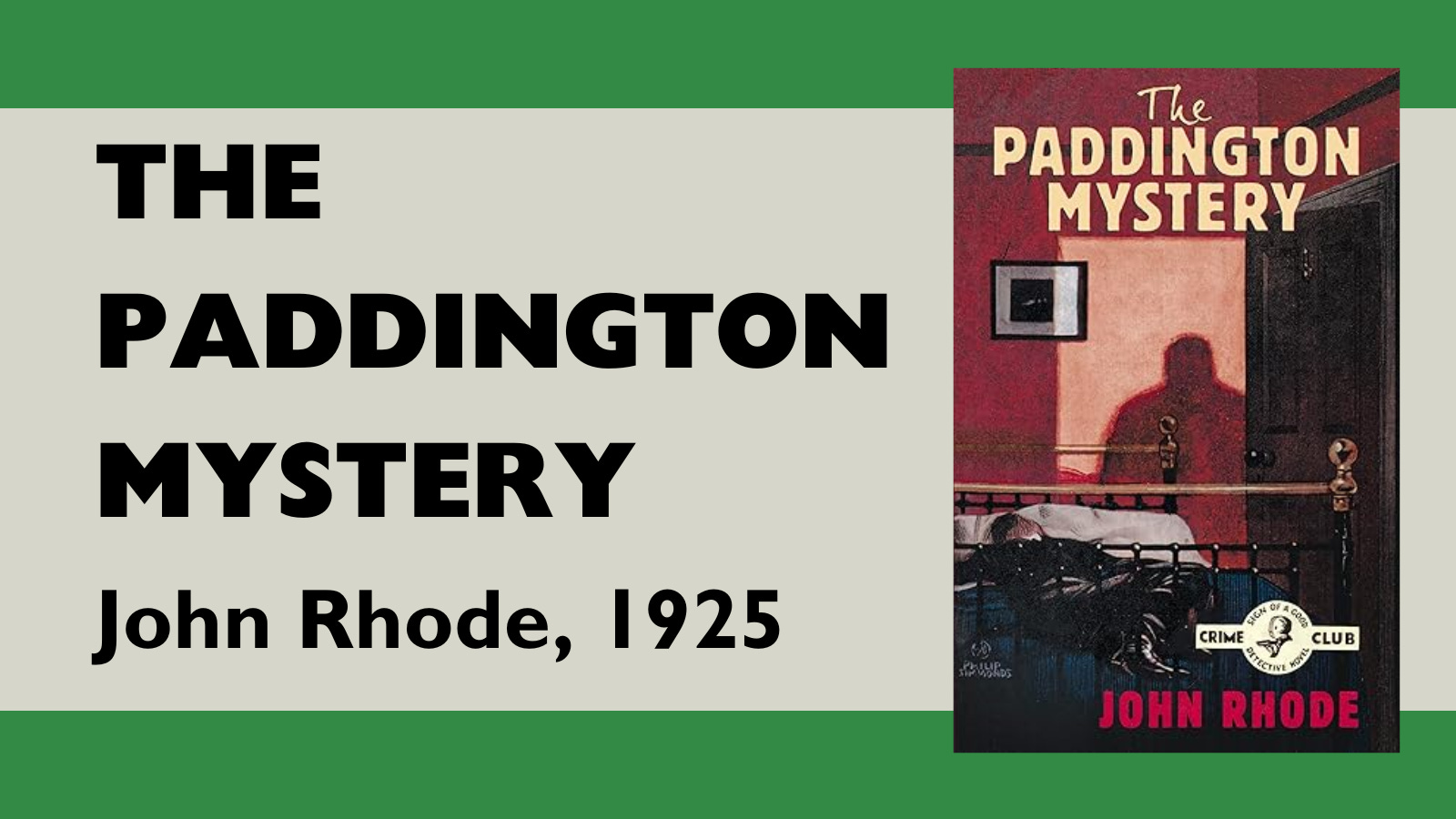
Another entry on the Haycraft-Queen Cornerstones, The Paddington Mystery describes a mysterious death at 16 Riverside Gardens, Paddington, the home of Harold Merefield. Arriving home at 3am, Merefield discovers a very wet dead man lying in his bed. He does not recognise the man, and nor do others who view the body. Understandably, a cloud of suspicion hangs over our friend Harold, who solicits the assistance of Professor Lancelot Priestley. The Professor is intellectually the right person to help, but he happens to be the father of Merefield’s former fiancée, which is a bit awkward. Priestley, however, is unfazed by the potential awkwardness, and succeeds in clearing up the Paddington Mystery.
John Rhode was one of the pseudonyms of Cecil Street, whose pre-detective career included working as a propagandist for MI7.4 The Paddington Mystery was his first detective novel, introducing the world to Lancelot Priestley. Rhode clearly enjoyed writing novels, because he produced almost 150 of them, 72 starring Priestley.5 Among his other achievements, he created the Detection Club mascot Eric the Skull, which has been used in the initiation ceremony for new members.6 Street devised many technically ingenious murder plots, one of which involved using a hedgehog as a murder weapon.7 His writing style was denigrated by critic Julian Symons, who branded him a “master of the humdrum”, but the humdrum label has been redeemed by Curtis Evans, who credited Street (and his contemporaries F. W. Crofts and J. J. Connington) with “producing some of the finest works in the classical, puzzle-oriented style of the Golden Age of the British detective novel.”8
The Paddington Mystery, though, is not among these “finest works”, even in the view of John Rhode’s defenders. I’ll be honest, I’m not typically fond of armchair geniuses who solve cases with brute logic, and in this case the deduction unfolds in the midst of a fairly dull plot with limited action and several large dumps of information. Various aspects of the solution become obvious to the reader before the clever Professor reveals them. And, seeking to outdo Anthony Gethryn, the Professor reveals the whole truth in an extended explanation that covers almost 50 pages (out of 174 in total), with periodic interjections from his daughter. “Rather, Daddy!”
The main interest of the novel lies in Rhode’s descriptive writing. He gives us vivid depictions of poorer London districts in the 1920s. Inkerman Street, for example:
… had obviously been designed by its optimistic builder as a residential neighbourhood of the middle class. Its houses, though jerry-built, had at one time worn the stucco of respectability, and might have attracted the careful minds of conscientious clerks with inconveniently large families. But if such tenants had ever inhabited these rather featureless houses, they had departed long ago, and the neighbourhood had fallen from its early promise. Most of the stucco had peeled off, leaving ugly scars of dirty brickwork; the landlords, deriving what income they could from letting off rooms to the poorest classes, had very little to spend on paint…
There are a few interesting characters in these neighbourhoods, including Merefield’s Communist landlord. Sadly, though, the cast is tainted by antisemitic tropes. I should probably give Rhode another chance one day; recommendations welcome. At the very least, with all its weaknesses, reading The Paddington Mystery did add a new phrase to my vocabulary: “As cunning as a bagful of monkeys”.
Verdict: ⭐⭐ (2/5)
Read in the 2019 Collins Crime Club paperback reprint.
Scavenger Hunt item: Door
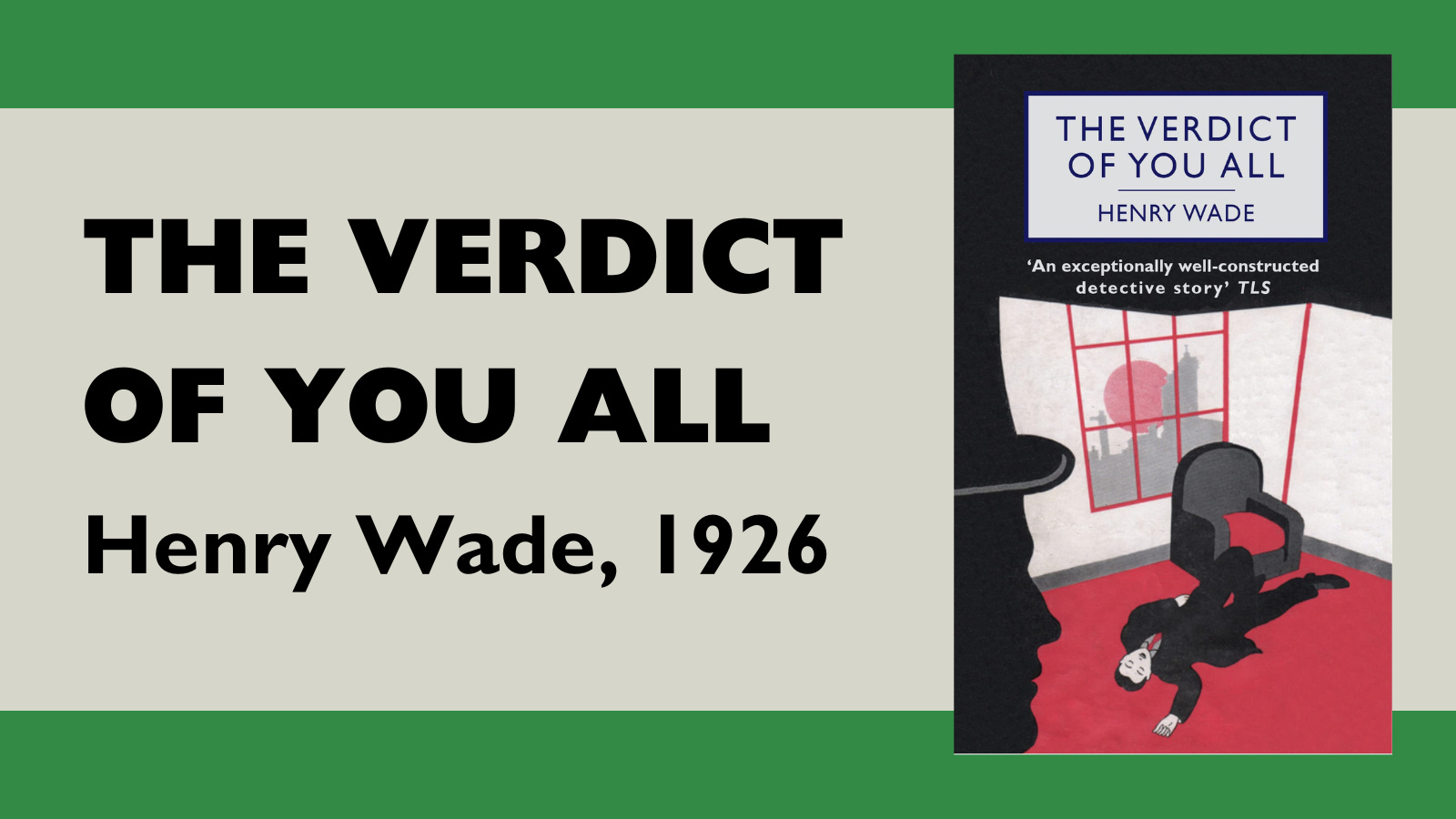
On patrol in St John’s Wood early one morning, PC Raffles is accosted by an elegant butler wearing a silk kimono and pink pyjamas. Gasping for breath, the butler announces that his master, Sir John Smethurst, has been murdered in his study. As Inspector Dobson takes up the case, two key suspects come to light. Dobson ends up favouring one suspect, while his superior officer Superintendent Fraser favours the other. One of these suspects is tried before an Old Bailey jury — but what will the verdict of them all be?
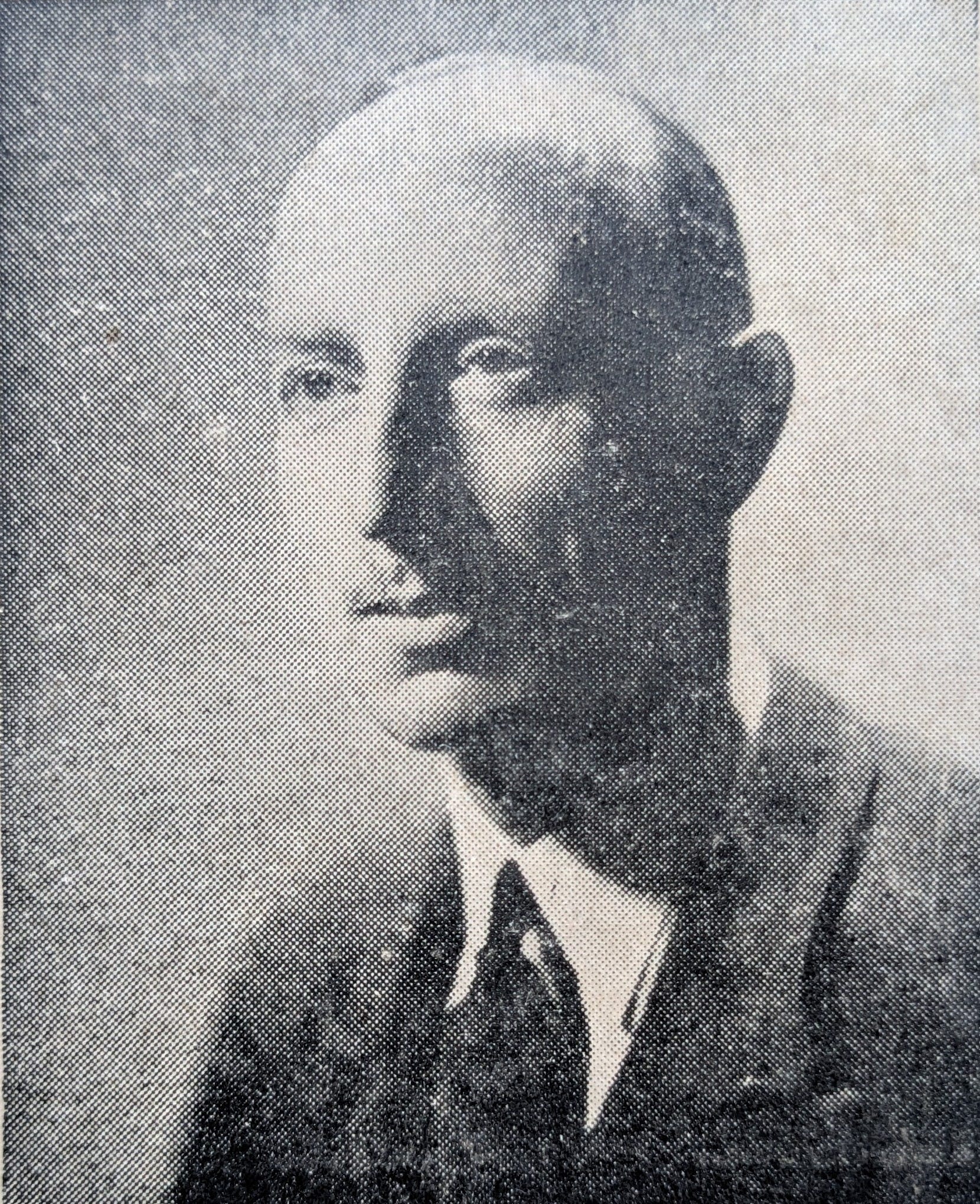
Henry Wade was the pen-name of Major Sir Henry Lancelot Aubrey-Fletcher, 6th Baronet KStJ CVO DSO, who served as Lord Lieutenant of Buckinghamshire from 1954 to 1961. With a name like that, one would guess he was no stranger to the types of country houses that regularly feature in mystery novels. During the First World War, while serving in the Grenadier Guards, Wade attended a talk on detective fiction given by author and war correspondent Valentine Williams in Belgium.9 Not long after the war, Wade decided to take inspiration from this talk, entering the crime fiction arena in 1926 with The Verdict of You All, which was praised in the Times Literary Supplement as “an exceptionally well constructed detective story.”10 This was the first of 21 novels that flowed from the Major Sir’s pen, seven of which featured his series detective Inspector Poole.
I enjoyed the double detection aspect in The Verdict of You All, as the two Scotland Yard figures pursue their different lines of inquiry. Inspector Dobson is described as “normal… in everything except his powers of observation”. In contrast, when it comes to Superintendent Fraser, “the word ‘normal’ could be applied neither to his brain nor to his body.” Dobson is an active and methodical investigator, while Fraser’s desk-based inactivity means “his figure had become enormous”, leading to him being labelled as “the Super-abundant”. I do think Henry Wade could have made greater use of this professional rivalry, but it was still an effective plot device, which left me guessing (incorrectly) whose conclusions would be vindicated.
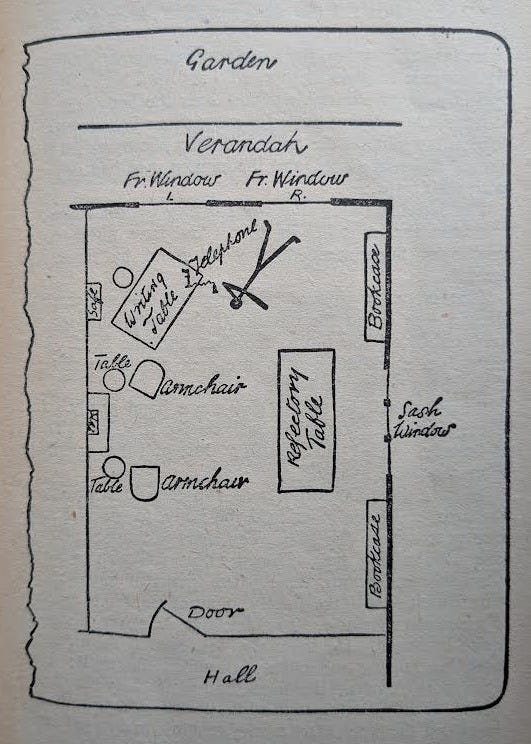
The mystery moves at a brisk pace, with short, focussed chapters leading to an excellent finale. I agree with the comparisons Martin Edwards made in The Life of Crime: the plot is “engineered with the care of Freeman Wills Crofts” and the ending is “worthy of Berkeley”.11 As a bonus, Wade gives us some excellent characterisations. We encounter people like Algernon Hopladdy, Mr Deeping Waters and Herbert Wollop, the latter being “a small person, of a cheerful countenance and an odour redolent of the soil”. This is a very good debut novel and I look forward to wading through other parts of the author’s bibliography.
Verdict: ⭐⭐⭐⭐ (4/5)
Read in the 1947 Penguin paperbacks reprint.
Scavenger Hunt item: Scarf/Cravat/Necktie
Join me again soon for Part 10 of A Century of Crime, featuring The Murder at Crome House by GDH and Margaret Cole (1927), The Greene Murder Case by S. S. Van Dine (1928) and The Studio Crime by Ianthe Jerrold (1929). And then we’ll be on to the 1930s!
Maigret is the only detective I can think of who has appeared in more novels (75). Are there others? Let me know.
According to Tony Medawar’s introduction.
Curtis Evans, Masters of the “Humdrum” Mystery (McFarland, 2012), pages 7-8.
Martin Edwards, The Life of Crime (2022), page 132.
From the inside back cover of the Penguin paperback edition
Martin Edwards, The Life of Crime (2022), page 132.
No posts
Comments
Nothing yet. Say the first thing.
Sign in to join the conversation.