
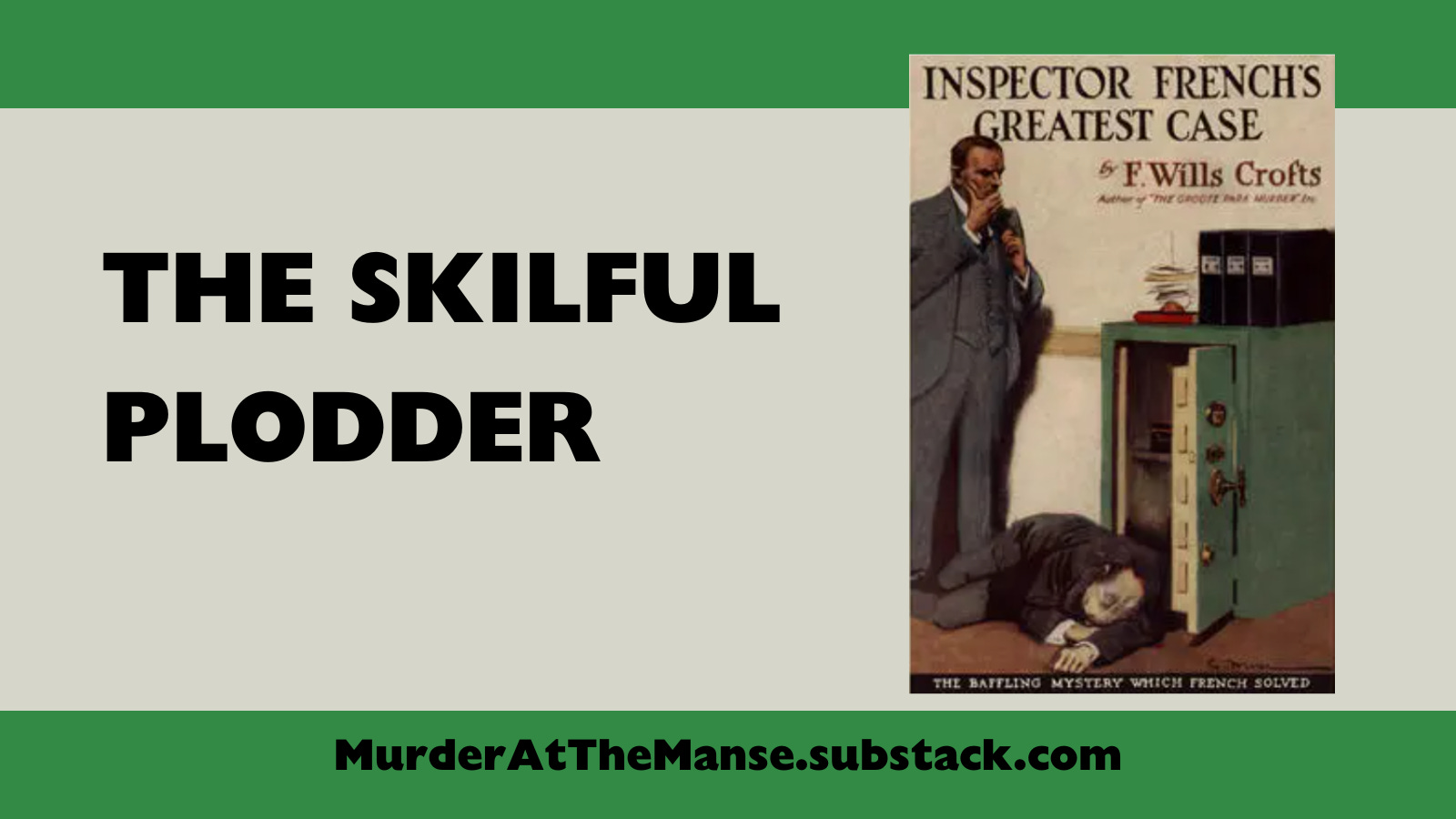
Earlier this year, I completed my chronological read-through of the 23 Dr Gideon Fell novels by John Dickson Carr (full ranking here). It’s now time to move on to a new detective, and I’ve decided my regular companion over the next few years will be Inspector French, the creation of Freeman Wills Crofts. I’ve read eight of the French novels before; I will skip those I’ve read recently, but will revisit others that I have less memory of. As with Dr Fell, I’ll be following the series chronologically, from 1924 to 1957. And maybe I’ll do some short stories at the end as well.
Today’s post will feature a general introduction to the series, as well as a review of the debut novel, Inspector French’s Greatest Case.
Freeman Wills Crofts was an Irish-born writer, the son of an Army surgeon who also happened to be called Freeman Wills Crofts.1 A railway engineer by training, he wrote his first novel during a long period of illness in his late 30s, with the encouragement of his doctor.2 The result was The Cask (1920), which proved to be a very successful debut. Reviewing a reprint in the 1960s, American author Anthony Boucher offered high praise:3
Possibly the most completely competent first novel in the history of crime (and I am not forgetting Ira Levin), it is the definitive novel of alibis, timetables and all the absorbing hairsplitting of detection so beloved by Jacques Barzun and, I trust, traditional men.
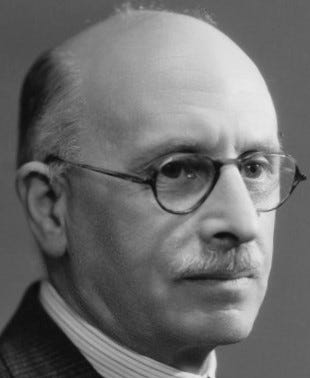
With his fifth novel, Crofts introduced the character that would become his series detective, Inspector French. The Inspector appeared in all 30 of Crofts’ remaining novels, including the 1947 juvenile adventure Young Robin Brand, Detective (in which Robin Brand is mentored by the older sleuth). Crofts also included French in many short stories, eighteen original radio plays, three radio adaptations of short stories and a stage adaptation of Sudden Death.4
In 1929, when his fifth Inspector French case was published, Crofts ended his 30-year engineering career and moved to the Surrey village of Blackheath, near Guildford, to become a full-time writer. Outside of books, he had a love of music, and on Sundays, you might have found him playing the organ or directing the choir in his local Anglican church. He continued writing throughout his life; his final novel was published the year he died, aged 77. He bequeathed the copyright for his works to the Royal Society of Arts, of which Crofts had been made a fellow in 1939, directing subsequent profits to be shared with authors in need.5
In a slightly tongue-in-cheek 1935 essay, Mr Crofts gave some background to his creation of Inspector French:6
Anyone about to perpetrate a detective novel must first decide whether his detective is to be brilliant and a ‘character,’ or a mere ordinary humdrum personality. When French came into being there seemed two good reasons for making him the second of these. One was that it represented a new departure; there were already plenty of ‘character’ detectives, the lineal descendants, most of them, of the great Sherlock. The other reason was much more important. Striking characteristics, consistently depicted, are very hard to do.
French is, of course, brilliant and striking in his own way, excelling in the more prosaic characteristics of perseverance and attention to detail. Melvyn Barnes aptly summed up French as “a skilful plodder” — rather than sudden moments of brilliance, French pursues his investigations in a thorough and methodical way, inexorably persisting through setbacks to catch the culprits.7 Crofts does not make the job easy for his creation, as French often heads down dead ends, pursues false leads and encounters unobservant witnesses. As readers, we are privy to the whole investigative process and follow French’s trains of thought. There are no cryptic utterances or mysterious musings, just fairly-clued policework.
Crofts became well-known for his creation of seemingly unbreakable alibis that then get cleverly broken through the Inspector’s obsessiveness. Crofts also continued his professional interest in railways, providing realistic travel itineraries and detailed timetables. The realistic detail extended to geography too: the books use real locations, which the author sometimes visited with a camera and notebook to ensure accuracy.8 I recognise that for some readers, the investigative thoroughness is overwhelming. But for French fans, the detail is engrossing, and the author still manages to surprise readers with unexpected twists. In his 1944 essay “The Simple Art of Murder”, Raymond Chandler described Crofts as “the soundest builder of them all when he doesn’t get too fancy.”9 The fitting assessment of Crofts’ style by Melvyn Barnes is also worth quoting:10
It may well be pedantic, it may well be mechanical, it may well be too ponderous for the reader requiring faster action, but it is tremendously enjoyable to accompany French on the job.
Alongside the detail, the French novels contain some good humour, reflected in the 1935 essay I quoted above. In this essay, describing how he overcame his ignorance of CID and Scotland Yard procedure, Crofts drily comments, “I build on the great rock which sustains so many of my profession: if I knew nothing of my subject, well, few of my readers would know any more.” And on the question of French’s family, the author (surely not seriously), says: “It’s like a dream to me that in one book children were mentioned, and that in another their existence was denied. But as I can’t find either reference, I can only note the point as one to be avoided.”11
Inspector French’s first published case begins in Hatton Garden, where the head clerk of Duke & Peabody’s, the diamond merchants, is found dead in front of an empty safe. There are a few possible leads, including the fact that the not-so-safe should have contained a significant quantity of diamonds. When these appear in the possession of money-lenders, suspicion focusses on the loanee, a Mrs Chauncey S. Root from Pittsburg.12 Whatever her involvement in the case, she clearly has some questions to answer. The search for the truth leads Crofts on a multinational pursuit, involving impersonation, double lives and a ham omelette.13
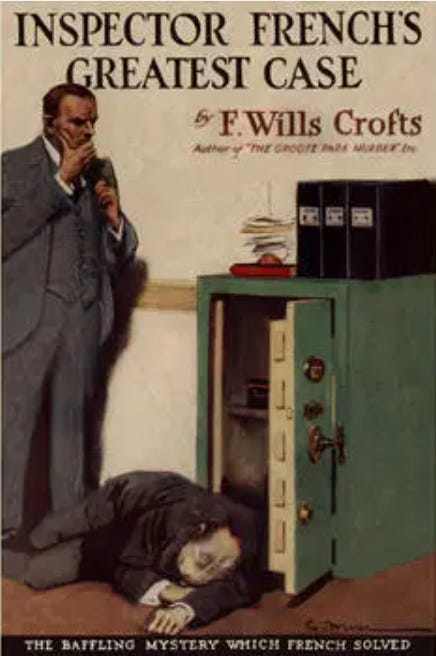
French’s investigative approach is clear from the very beginning of this first case. Although his dark blue eyes “twinkled as if at some perennially fresh private joke”, French takes his task very seriously. He reaches the crime scene at a late hour, but insists on a meticulous three-hour inspection of the premises before returning home. And he still turns up on time at work the next day. He is definitely no armchair detective, but a trusted “man of action”, who takes his time but gets results.
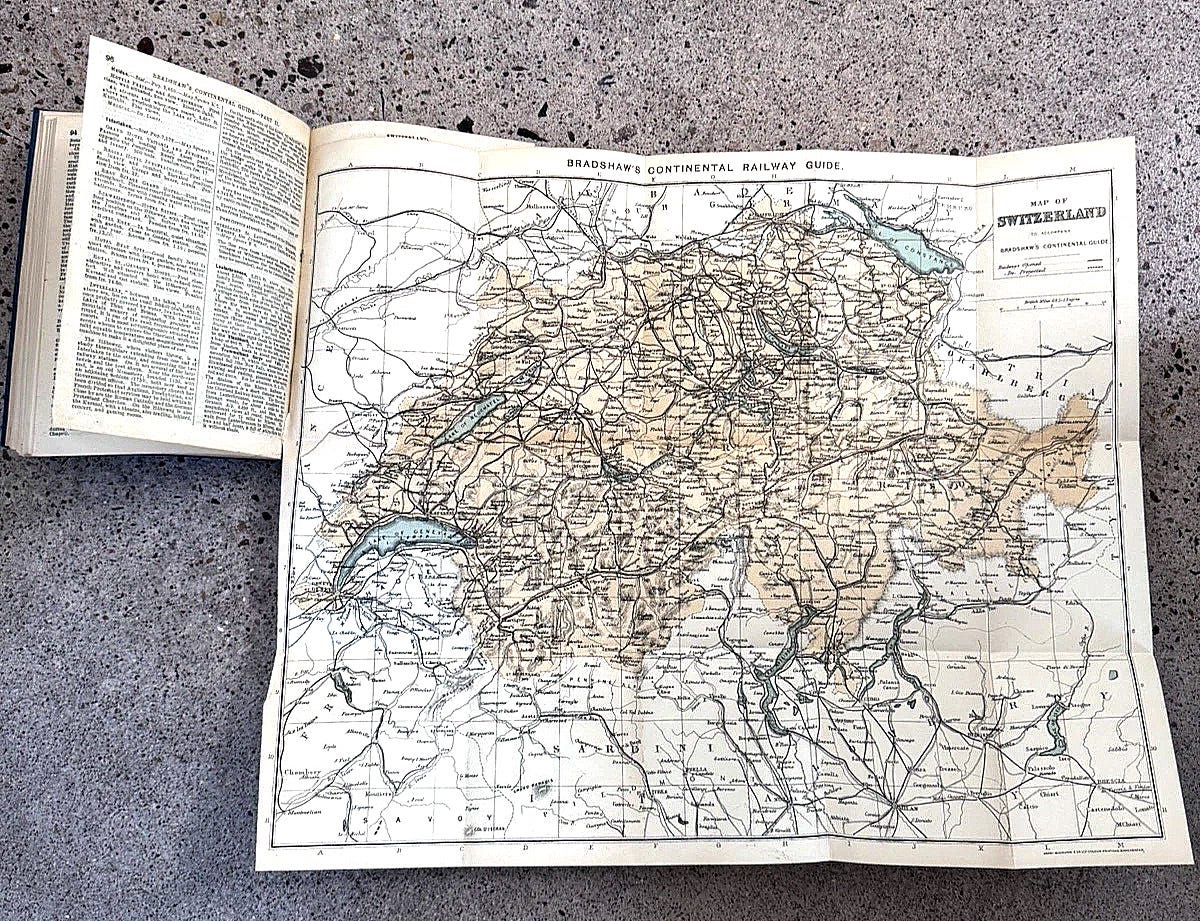
Crofts gives Inspector French several opportunities for international travel in this novel. I enjoyed his dogged pursuit of potential suspects, even if the itineraries were overly detailed. Do we really need to know every station the train stopped at? (“Of course you do!” I can hear Crofts reply.) His investigations take him to no fewer than five countries on the continent, which is quite an adventure for someone described as “a comparative stay-at-home”.14 We are told on more than one occasion that this case opened up new vistas for the Inspector: “The journey from Savoy to Spain seemed endless, the distances incredible, the expanse of country between himself and home illimitable.”
Mr French is assisted in a minor way in his investigations by Mrs French. Their domestic vignettes are very enjoyable, although I don’t know how much his wife will appear in the rest of the series. We discover that Mrs French is often subjected to her husband’s recitals of evidence and theories, while she gets on with her sewing, occasionally warning him “to be careful not to knock over the small table beside the piano.” In this case, she contributes a (somewhat obvious) insight, which helps move the investigation forward. Crucially, Mrs French also ensures her husband is well-fed. At one point, when the Inspector is about to respond to an evening caller, she urges him to stay at the table: “It’s not so urgent as your supper. Just let him wait.”
It was a brave marketing decision for Freeman Wills Crofts to describe the first in a new series as Inspector French’s greatest case. The title definitely aged like milk, because this is not his greatest case, either in terms of its contents or the quality of writing. It’s still a good case, which introduces many of the key ingredients that continue through later books. But French is frustratingly slow on the uptake at points and the final chase sequences drag somewhat. I was also not a fan of the eight pages of codebreaking discussion. Looking back at previous notes, I enjoyed this more the first time I read it back in 2021. Despite a modicum of disappointment on my re-read, though, it’s still an enjoyable opener. I look forward to the rest of the series, knowing from experience that there are greater cases still to come.
Verdict: ⭐⭐⭐ (3/5)
Read in the 2016 Crime Club reprint.
Scavenger Hunt item: Dead body
The next Inspector French cases are Inspector French and the Cheyne Mystery (1926), Inspector French and the Starvel Tragedy (1927), which I’ve already reviewed here and won’t re-read, The Sea Mystery (1928) and The Box Office Murders (1929). See you again soon for more adventures with the skilful plodder!
In my experience, the NHS no longer offer this advice, sadly.
From the Freeman Wills Crofts entry in Twentieth-Century Crime and Mystery Writers, 3rd edition (St James Press, 1991).
Mentioned in the Oxford Dictionary of National Biography.
From the Freeman Wills Crofts entry in Twentieth-Century Crime and Mystery Writers, 3rd edition (St James Press, 1991).
In this first book, we learn that French and his wife did have at least two children; his oldest son died in the First World War.
As was not uncommon at the time, this is how the city is spelt in the book.
“Garnished with chip potatoes and onions, together with coffee and delicious rolls and butter.”
The five countries are the Netherlands, Switzerland, Spain, France and Portugal. I’m making a note to see how many Eurovision participants French covers across the series.
No posts
Comments
Nothing yet. Say the first thing.
Sign in to join the conversation.