

I think I end the week by discussing my timeline for the U.S. recession and for (the third wave of) the Global Financial Crisis. What I noted at the end of my Wednesday piece—that I would not have a proper guess-estimate for the onset of the U.S. recession (and thus the financial crash)—is not entirely accurate. Or, maybe it was at that time, but it got me thinking about it more deeply. While this may seem like far-fetched prediction, I will provide you my estimate for the timing of the crisis based on the first U.S. financial crisis, the Panic of 1819.
Little less than a year ago, in Into the Debt Crisis, Part II, I detailed the reasons behind the (now fast) approaching global recession. The main problem is the massive money conjuring the central banks have been engaged since November 2008, when the Fed launched its first quantitative easing, or QE, program.
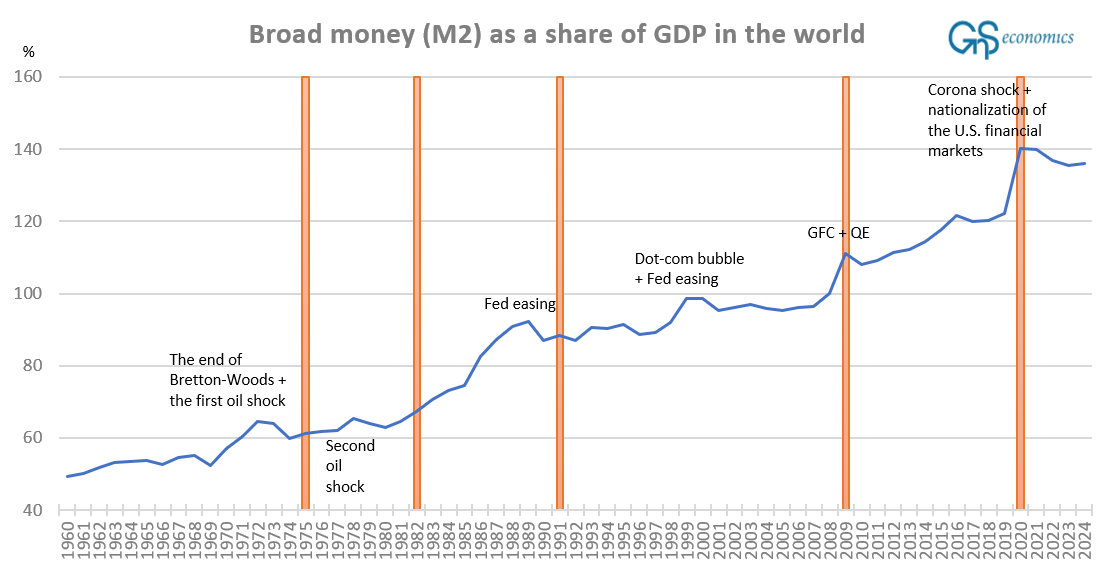
Thereafter, central banks across the world launched an incredible and highly damaging money creation spree, which continues even today (in the sense that the money created has not really been withdrawn). For example, the balance sheet of the four largest central banks—the Bank of Japan, the European Central Bank, the Federal Reserve, and the People’s Bank of China—grew by an insane $24 trillion between 2008 and 2023. Figure 1 summarizes the growth of money in the world from 1960 until 2024 with global recession periods.
Comments
Nothing yet. Say the first thing.
Sign in to join the conversation.