
On August 14, the New York Federal Reserve Bank announced that it will not conduct any “reserve management purchases” for the period of one month (until September 14). The Fed had actually scaled back its monthly purchases from $40 billion to $25 billion in April-May and further to $10 billion in May-June.
Figure 1 reproduces the graph I presented on August 10, adding green bars to mark the dates when the Fed scaled back its Treasury Bills purchases.
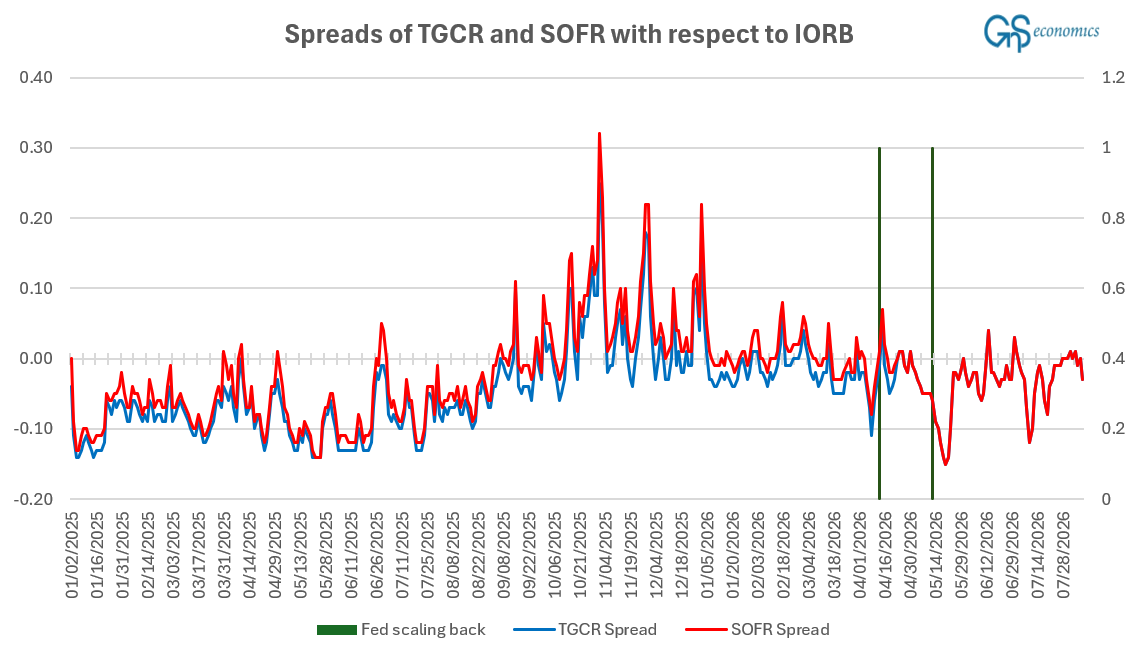
The timing of the scaling backs corresponds almost perfectly to the disappearing of the stress in the repo markets. This is further proof that the repo-stress, not the (excess) central bank reserves, which have not really budged, was the actual reason for the “not-QE” II. From The Road to Perdition, Part V:
The last time when the Fed suddenly started to buy Treasury Bills in “not-QE” was after the near-collapse of the repo market in September 2019. From the October 11, 2019, statement:
In light of recent and expected increases in the Federal Reserve’s non-reserve liabilities, the Federal Open Market Committee (FOMC) directed the Desk, effective October 15, 2019, to purchase Treasury bills at least into the second quarter of next year to maintain over time ample reserve balances at or above the level that prevailed in early September 2019.
Notice the wording? “Ample reserve balances.” At this stage, this is a code word for the looming (catastrophic) breaking of trust within the financial system.
In mid-September 2019, the trust had already collapsed, when the Fed started its first “not-QE.” This time, the bailout was preemptive, which is rather worrying by itself. What I mean by this is that the Fed started to save the U.S. financial system before a crisis was visible. This can only be justified if the Fed foresaw the risk of a financial collapse.
In Is Private Credit the source of the stress in repo? (December 3) I argued that the source of the stress in repo would emerge from the private credit sector. This would be problematic for the Fed, because:
The second is that the ability of the Federal Reserve to fix it would be likely to be limited to the extreme. It cannot fund or provide liquidity to private companies or investment funds. All it can do is to provide liquidity through the repo and other facilities directed at the banks in the hope that the stress eases. This strategy would essentially mean the Fed flooding the financial system with money (through QE) in the hope that by doing so it would buy time for the investment funds to “heal” themselves.
Have we now witnessed such a “healing of the wound” of Private Credit? I seriously doubt it.
First of all, the Reserve Management Purchases program remains in place (there was no formal announcement of the program’s discontinuation). This implies that the Fed is not satisfied “with the level of bank reserves”. Secondly, the stress in the private credit sector is growing. Summarization by Grok:
Fitch’s U.S. Private Credit Default Rate (trailing 12-month) reached a record ~6.0% at end-Q2 2026 and ~6.1% as of July (up from prior highs; more weighted toward middle-market/smaller issuers, with 17 unique defaulters in July alone). Maturity extensions under stress became a leading driver.
Other measures are lower: Proskauer’s index (senior-secured/unitranche) at 2.51% for Q2 2026 (slightly down from Q1); KBRA DLD Direct Lending Index around 2.3% (matching a prior high, with expectations of further rise toward ~3.5% by year-end). Smaller/mid-market borrowers have seen higher rates historically.
Thirdly, the U.S. recession looks to be just around the corner, which is likely to spell serious trouble for Private Credit and hence the U.S. financial system. From the November Black Swan Outlook of GnS Economics:
Now, combining the above leads us to three highly detrimental outcomes of Private Credit, which can manifest in a recession:
Withdrawal of the only credit line of a company in a recession will almost certainly lead to a liquidation of the company (bankruptcy).
Private-credit-funded companies able to survive a recession are likely to be considerably fewer than bank-funded companies, because private credit has fostered unprofitable and zombie lending.
As large investment funds hold a large share of credit lines of companies, #1 and #2 imply that a recession can lead to a deluge of private-credit-funded corporate bankruptcies.
And so, if my original hypothesis is correct, we have seen just a (minor) prelude to the financial troubles lurking below the surface of the now Fed-calmed U.S. financial system. More so, we can assert that the relief in the U.S. financial plumbing is only temporary, because liquidity cannot fix solvency issues.
More financial pain, most likely, is on its way.
Tuomas
The information contained herein is current as of the date of this entry. The information presented here is considered reliable, but its accuracy is not guaranteed. Changes may occur in the circumstances after the date of this entry, and the information contained in this post may not hold true in the future.
No information contained in this entry should be construed as investment advice nor advice on the safety of banks. Neither GnS Economics nor Tuomas Malinen can be held responsible for errors or omissions in the data presented. Readers should always consult their own personal financial or investment advisor before making any investment decision or decision about the banks in which they hold their money. Readers are solely responsible for the risks associated with using this post.
Readers must assess the risks and legal, tax, business, financial, or other consequences of their actions. GnS Economics and Tuomas Malinen cannot be held i) responsible for any decision taken, act, or omission or ii) liable for damages caused by such measures.
No posts
Comments
Nothing yet. Say the first thing.
Sign in to join the conversation.