
I wrote this blog post in response to this tweet:
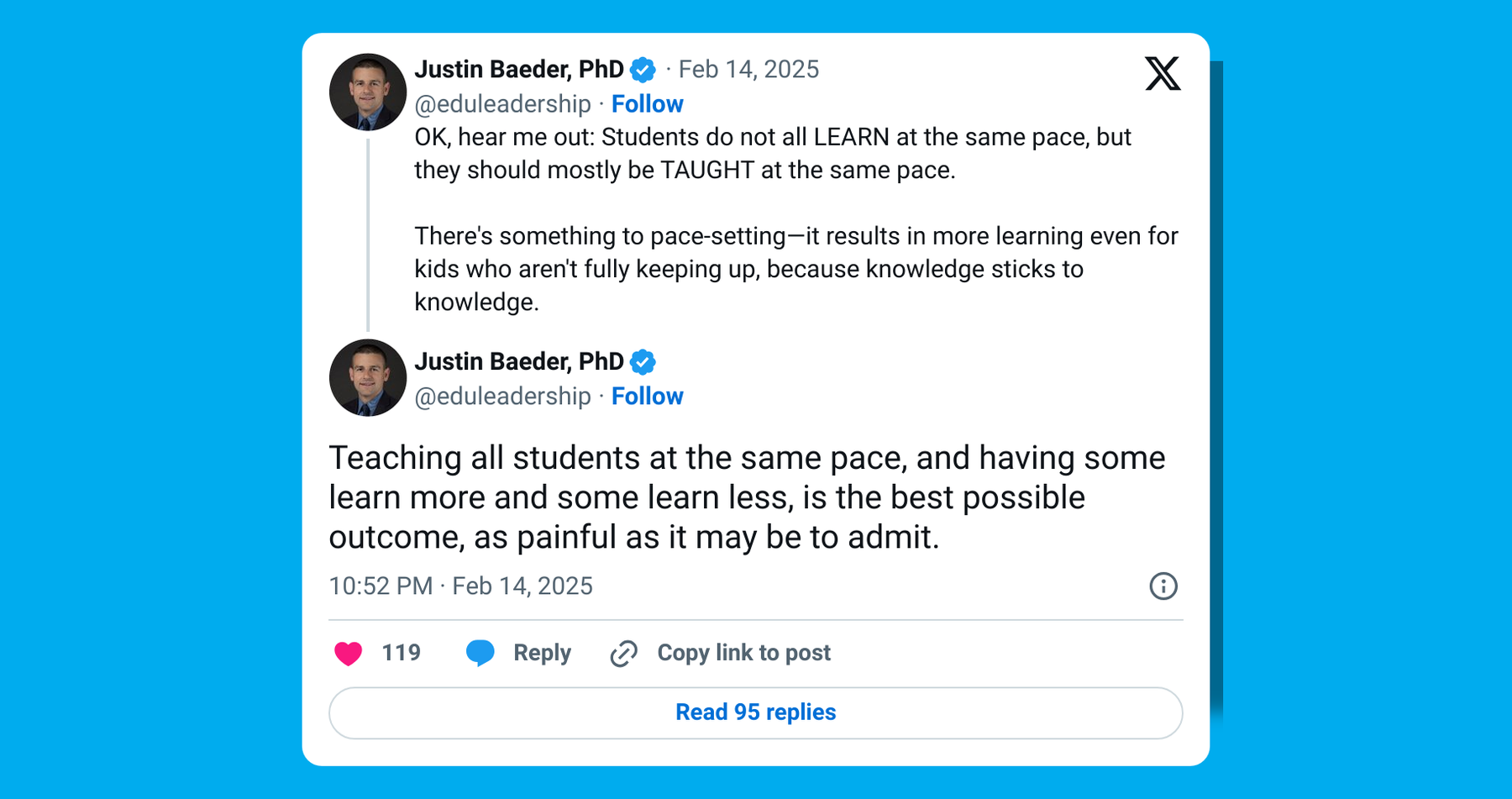
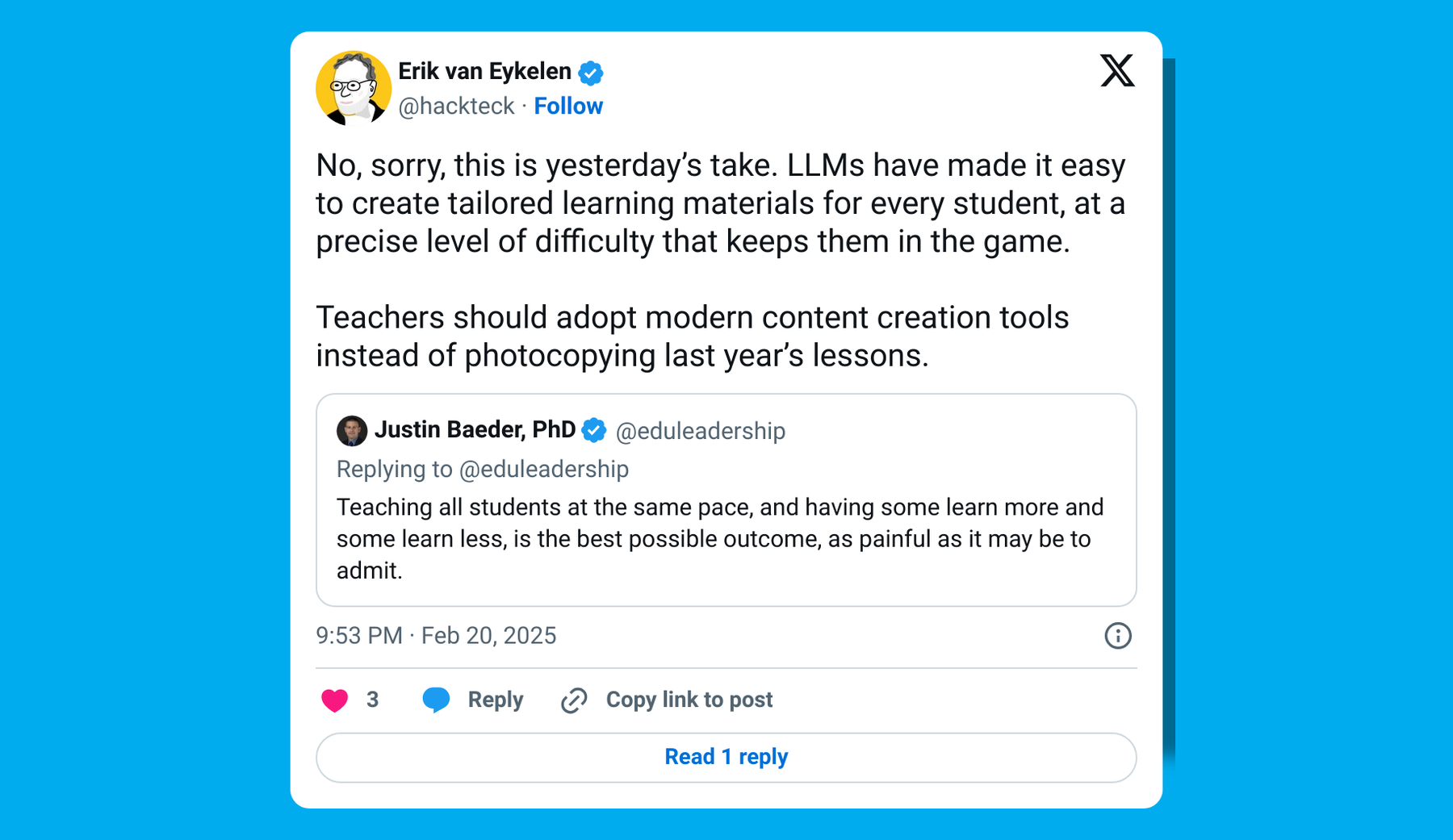
I responded by writing:
Introduction
Traditional education follows a one-size-fits-all approach, where every student is taught at the same pace, regardless of their individual learning needs. However, with the rise of AI-driven tools, particularly large language models (LLMs), we now have the ability to create personalized learning experiences without increasing the burden on teachers. This post explores practical ways LLMs can be used to improve student learning by generating customized educational content, providing real-time feedback, and supporting self-paced learning.
1. Personalized study guides and summaries
Not all students grasp concepts at the same speed. LLMs can generate customized study guides based on individual progress and comprehension levels.
How it works:
A student struggling with a topic can request a simplified explanation, while an advanced student can get a more detailed or challenging version.
LLMs can generate concise summaries of lessons, tailored to a student’s preferred learning style (text, bullet points, or visual representations).
Interactive quizzes can be generated based on past performance, reinforcing weaker areas.
2. Real-time adaptive practice questions
Rather than assigning the same exercises to all students, LLMs can create adaptive questions that adjust to each student’s skill level.
Example:
A student struggling with algebraic equations can receive progressively easier problems with step-by-step guidance.
A student excelling in the topic can be given complex, real-world problem-solving tasks to stay engaged.
If a student makes repeated mistakes, the system can provide hints, re-explain concepts, or suggest related topics for review.
3. AI-powered writing feedback and language coaching
LLMs can act as writing assistants, giving instant, detailed feedback on essays, reports, and short-answer responses. This allows students to improve their writing skills without waiting for a teacher’s review.
How it works:
Grammar and syntax corrections, with explanations of errors.
Style and clarity suggestions, tailored to the student’s reading level.
Real-time language translation and support for students learning in a second language.
4. Customized learning paths for different student needs
Instead of having all students progress at the same pace, LLMs can help create personalized learning paths based on their strengths and weaknesses.
Example:
A student who excels in science but struggles with reading comprehension can get AI-generated reading assignments with simplified vocabulary or additional explanations.
If a student is interested in a particular subject, LLMs can generate supplementary materials, keeping them engaged beyond the standard curriculum.
5. AI-assisted tutoring without human intervention
One of the biggest challenges in education is providing one-on-one support to every student. LLMs can act as an always-available tutor, answering questions, explaining concepts, and guiding students through problem-solving processes.
Practical implementation:
Chat-based AI tutors that students can use to ask questions in real time.
AI-generated interactive lessons that adapt based on a student’s progress.
Voice-enabled AI tutors for younger students or those with learning disabilities.
6. Subject-specific AI adaptation
AI can gauge a student’s abilities and tailor learning experiences accordingly by starting at an appropriate difficulty level and gradually increasing complexity. I like to provide some practical examples:
Maths and physics
AI can assess algebra and geometry knowledge by posing targeted questions using text and diagrams:
Solve for
x:x + 3 = 8Solve for
x:2x + 5 = 15What is the sum of the interior angles of a triangle?
Solve the quadratic equation
2x² - 7x + 3 = 0using the quadratic formula.
Based on the correct answer to the most challenging question, the AI will determine the appropriate starting point.
The AI adapts its instruction based on the student’s performance. If a student successfully answers a question, the AI presents progressively more challenging problems. However, if the student struggles with the initial questions, the AI starts by breaking down the simplest problem, providing a detailed explanation of concepts and solution steps.
The AI can identify when students consistently avoid challenging themselves by remaining at easier difficulty levels. At this point, teacher intervention becomes essential to understand the student’s hesitation and provide personal encouragement to explore more advanced material.
Biology
AI can, for example, devise an interactive game where students learn classification systems:
Class, order, family, genus: arrange different species into the correct categories
Identify the kingdom of various living organisms.
Match an animal to its appropriate biological classification.
Since AI can generate code, creating educational games is now both rapid and straightforward. AI can produce personalized mini-games tailored to each student’s needs and learning goals—a level of customization that traditional e-learning tools could never achieve.
Geography
AI can generate a multiple-choice test based on initial skill assessments:
Where is the Sahara Desert located?
Which country has the largest population?
What is the capital of Canada?
An AI learning tool can create an interactive map-based game where students answer geography-related questions. With each new lesson, the AI generates a different map, ensuring students learn about diverse regions, landmarks, etc. The game can adapt to skill levels, gradually increasing complexity by incorporating topography, climate zones, and historical contexts.
Language classes
AI can start with basic questions to assess a student’s level and then build a tailored lesson plan:
How do you say “hello” in French?
What is the past tense of
manger(to eat)?Can you list three common French verbs?
Science
AI can ask students open-ended questions to explore their knowledge:
What do you already know about science?
Can you explain the basic principles of the scientific method?
How does philosophy relate to scientific discovery?
Students can interact naturally with AI through text or speech, creating a more engaging and personalized learning experience. This direct dialogue allows for immediate feedback and support, making learning feel more like working with a personal tutor than using traditional educational software.
7. Structural changes in education with AI integration
With AI-driven learning, the traditional school model can evolve significantly:
Fewer (or at least not more) teachers needed: class sizes can be increased beyond the traditional limit of 30 students (as is common in the Netherlands), because classical teaching is replaced by individual and small-group learning.
Larger, simpler classrooms: instead of many small classrooms, fewer but larger learning spaces suffice, as long as students have areas to read, write, and collaborate with peers and teachers. You will need “library” sections where you’re not allowed to talk.
Subject-matter experts as roaming educators: instead of rigid class structures, teachers can move between larger groups of students, assisting different classes and age groups as needed—eliminating traditional grade-year distinctions.
Teachers as AI navigators: educators must become fluent in LLM usage and prompt engineering to guide students effectively. These skills are easy to acquire for any teacher.
Comprehensive learning records: schools will need integrated environments to store student progress and learning materials throughout their entire education journey, ensuring continuity and personalization over the years.
Conclusion
The argument that all students should be taught at the same pace because hiring more teachers is impractical is no longer valid. With the help of LLMs, we can offer personalized education without increasing the number of educators. These AI-powered tools can provide tailored explanations, generate adaptive exercises, and offer instant feedback, helping students learn at their own pace while maintaining high educational standards.
By leveraging these technologies, we are not replacing teachers—we are enhancing their ability to provide individualized learning experiences, ensuring that no student is left behind or held back by rigid educational structures.
PS: Example
To demonstrate how students can interact with AI for language learning, here’s a quick example I created using ChatGPT:
I’ll help you learn the conjugation of “être” (to be) in French for both present and past tense. Let me break this down clearly for you.
Present Tense (Le Présent) The present tense of “être” is irregular and must be memorized:
Je suis (I am)
Tu es (You are - informal singular)
Il/Elle/On est (He/She/One is)
Nous sommes (We are)
Vous êtes (You are - formal or plural)
Ils/Elles sont (They are - masculine/feminine)
Past Tense (Le Passé Composé) In French, the most common past tense is “le passé composé.” For “être,” it’s formed using “avoir” as the auxiliary verb:
J’ai été (I was/have been)
Tu as été (You were/have been - informal singular)
Il/Elle/On a été (He/She/One was/has been)
Nous avons été (We were/have been)
Vous avez été (You were/have been - formal or plural)
Ils/Elles ont été (They were/have been - masculine/feminine)
Practice Examples:
Present: “Je suis étudiant” (I am a student)
Past: “J’ai été malade” (I was sick)
Would you like to practice with some examples? We can work through sentences using both tenses to help you master them.
I answered “yes”
Great! Let’s practice both tenses with some simple exercises. I’ll give you a sentence in English, and you try to translate it to French. After you respond, I’ll provide the correct answer and explanation.
Here’s your first sentence to translate:
“I am happy today” (Try to write this in French using the present tense of être)
After you provide your answer, I’ll give you the correct translation and we can move on to more examples, including past tense. Would you like to try this first sentence?
Remember:
For present tense, you’ll need “je suis”
Focus on word order and any necessary adjective agreements
Please provide your translation, and then we’ll check it together!
I replied with “je suis heureuse aujourduis” (sic)
Good attempt! Let me help you with some small corrections:
The correct spelling is: “Je suis heureuse aujourd’hui”
Let’s break down what you did well and what needs adjustment:
✅ “Je suis” is perfect!
✅ “heureuse” is correct if you’re female. If you’re male, it would be “heureux”
❌ “aujourduis” → “aujourd’hui” is the correct spelling
Now, let’s try a past tense sentence:
“I was happy yesterday”
Remember:
For past tense, you’ll need “j’ai été”
“Yesterday” in French is “hier”
Give it a try!
Comments
Nothing yet. Say the first thing.
Sign in to join the conversation.