
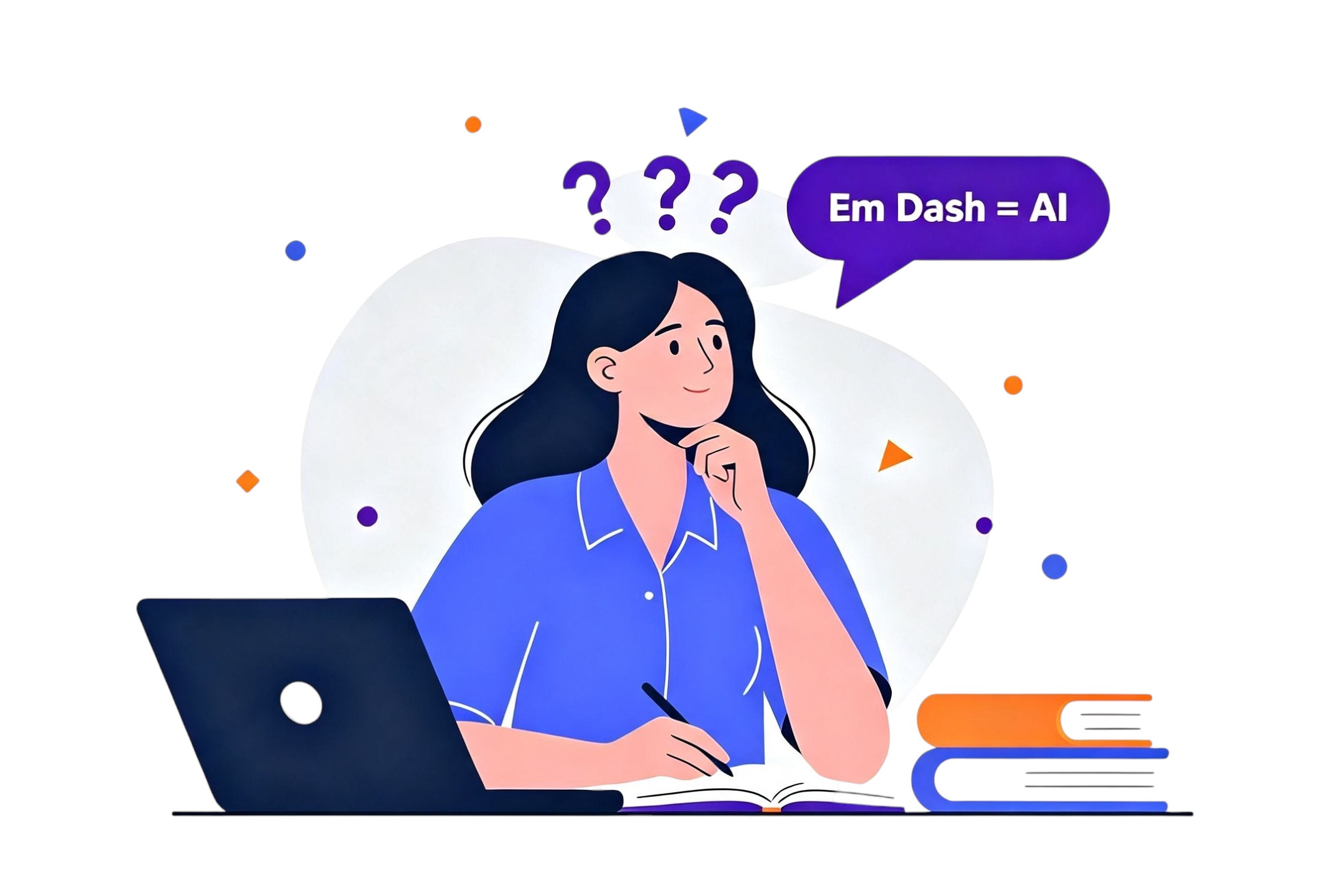
That's the question a number of writers, editors and teachers have been asking this past year but the answer as with most things on the internet, is more nuanced than it appears. If you've ever scrolled through Twitter within the last year, you've probably witnessed someone confidently stating
"This must be an AI-generated text, look, an em dash!"
This has become an almost meme-like trope used by people who want to sound smart, but the reality is that the em dash existed in writing long before it was popularized in the digital space.
Let's explore why that's the case.
To be fair, there is reason this myth even exists to begin with. Large language models do have a noticeable tendency to overuse em dashes, even compared to traditional human writing, which makes it easy for people to jump to accusations. This becomes a problem when an educator sees an essay written by a student and automatically assumes that the student used some sort of AI to help them write their essay.
This also becomes a problem for a freelance writer whose client becomes suspicious of their work. The result was a culture in which human writers were being penalized for using a single legitimate punctuation mark.
Avoiding a valid tool simply because computers tend to overuse it is not logical. Computers also tend to overuse commas and periods, so why aren't we accused of writing entire paragraphs with just comma splices and run-on sentences?
The em dash is simply a punctuation mark used to indicate a break in a sentence, usually for the sake of emphasis or to add additional information, similar to a more drawn-out comma or less-dramatic colon. It has been used and encouraged by formal and informal writers for centuries, and is still widely taught and used today. The proof of this can be found in places that are unrelated to the controversy surrounding AI-generated writing.
For example, the Microsoft Style Guide has a section dedicated to the technical writing use of em dashes to indicate a pause or add emphasis in a sentence.
Google also did the same thing. Google's Developer Documentation Style Guide has an entire section dedicated to how dashes, including the em dash, should be used.
If you're trying to find proof of the legitimacy of the em dash, look no further than companies that actively promote the use of correct English.
Consider this if companies that promote proper grammar writing and punctuation are teaching people to use em dashes, then they can no longer be considered something exclusive to AI.
This isn't just writers getting in their head about how em dashes prove AI-generated writing—respected institutions have officially debunked this claim as well.
The AP Stylebook , one of the most prestigious writing authorities in the country, has officially responded to the idea that
"...some people have begun to believe that if writing includes an em dash, it must be AI."
An editor at AP Stylebook named Anna Jo Bratton pushed back against this idea, arguing that it was simply a way for people to get attention. Her main argument was that people wanted to believe that there was an easy way to spot AI-generated writing, however that wasn't an accurate view.
Think about what she said. The AP Stylebook, one of the most well-respected writing authorities in the world, went on record saying that the reason people thought that em dashes indicated AI generated writing, was because they wanted to believe so. This is a near—unanimous agreement from multiple credible sources that the em dash is just a legitimate punctuation mark, and not some sort of secret indicator for AI-generated writing.
If you want more proof, look no further than Grammarly's article about em dashes. Grammarly basically agrees with everything the Stylebook said and even expands on it, stating that writers have used em dashes for emphasis before AI tools became popular, and that while AI tends to use them a lot, that didn't mean that every piece of writing using them was generated by AI. The truth is, while AI-generated writing does use the punctuation frequently, that doesn't mean it's an indication of AI-generated writing. It's all about context
If you're looking to absolutely decimate this conspiracy theory, all you have to do is look at literature. Specifically, look at any book that was published before the concept of an AI even existed.
Emily Dickinson used em dashes extensively in her work, and it was one of her most distinguishing characteristics as a writer. James Joyce also used them heavily in his book Ulysses while Virginia Woolf and Charles Dickens used them often in their writing as well Jane Austen, while less consistent with her punctuation in general, also used em dashes from time to time. All of these writers were writing long before the invention of anything capable of generating text, let alone an AI.
If the theory behind em dashes indicating AI-generated text holds any water, then we must also assume that Emily Dickinson, James Joyce, and hundreds of other writers across centuries were also using ChatGPT, which is obviously ridiculous.
If you're still not convinced, take it from the people who have studied it the most.
There has been research done discussing how writing with em dashes has changed amongst preprints since large language models' rise to prominence, as well as a discussion about how that has affected the writing itself. Simply put, the use of em dashes has increased as large language models became more popular, which seems to indicate that they really are used more by AI than humans
However, the part that most people who bring up this research conveniently forget is that the researchers stated that this was only a population-level change, and not an indicator for any specific piece of writing being generated by an AI. You can read more about this in this study hosted on ArXiv.
All this really means is that as a whole, the body of writing using em dashes grew, rather than any one piece being generated by an AI having more dashes than one generated by a human. Overall, the evidence on the prevalence of em dashes in AI writing is weak at best, and the best way to combat the conspiracy theories around it is to appeal to logic and existing, unbiased sources.
You can also join our little community of writers where we share our works in here!
Comments
Nothing yet. Say the first thing.
Sign in to join the conversation.