

Last week, when I wrote about John Dowland, it became clear that quite a few readers either hadn’t come across him before or didn’t know much about him. I’m not entirely surprised. Although I knew quite a lot of Dowland’s music, I couldn’t have told you much about his life before I started writing the newsletter.
I can’t call myself a fully fledged Baroque specialist, but I’ve certainly been exposed to a lot of early music over the years, and I generally just really love it. I find it some of the most relaxing music within the classical music world, although, as you’ll see, the stories attached are not always particularly calming.
Exposure is generally how I get to know a composer. I’d love to tell you that I spend my evenings looking over old manuscripts and searching through archives, but it usually starts much more casually. I hear a piece I’ve never come across before, often in a performance that I find particularly engaging. Then I find the album, listen to something else, and work my way from there.
So this week’s selection is less the result of serious research and more a collection of composers and pieces I came across and think are worth knowing. Some are famous within the classical-music world, others really aren’t, but all, in my opinion, are worth discovering.
I’d be very surprised if any non-musician readers could tell me much about Giacomo Carissimi. I’d be very surprised if any musicians could, frankly. I certainly couldn’t. When I was 16, I joined a choir and his best-known work, Jephte, landed in my lap. Carissimi was an important Italian composer of the early Baroque and spent most of his career as chapel master at Sant’Apollinare in Rome, a position he kept until his death in 1674. He was very much respected during his lifetime and was even considered as a possible replacement for the perhaps much better-known Monteverdi at St Mark’s Basilica in Venice, but he stayed put in Rome and apparently never left Italy.
Carissimi is mostly known for helping to establish the oratorio. These are vocal musical works that, unlike opera, are performed without scenery, costumes or acting, and are often based on a religious story. It gave composers like Carissimi, working in the Church, the opportunity to put on something dramatic but keep it church-friendly. Jephte tells the story of the military leader Jephthah, or Jephte here, who vows that, if he returns from battle victorious, he will sacrifice the first person who comes out to greet him. It’s a really bad promise. The first person who comes to greet him is his only daughter. It raises the moral question: do you save your daughter or keep a promise? Jephte chooses the latter. The work ends with ‘Plorate, filii Israel’, as the women of Israel mourn the death of Jephte’s daughter. You don’t need to understand the Latin to hear how heavy this is. Carissimi manages to make the voices sigh together, with each line carrying the grief. The whole oratorio is well worth hearing, but this final chorus is really its devastating emotional centre.
There is a yellow-covered book called 24 Italian Songs and Arias that will be familiar to anyone who has studied singing in the past 30 years. It contains so many of the songs singers learn early on, including one by the previous composer, Carissimi’s ‘Vittoria, mio core’, and ‘Caro mio ben’, which even Beyoncé seemed to know, inserting a few lines from it into her last album, Cowboy Carter.
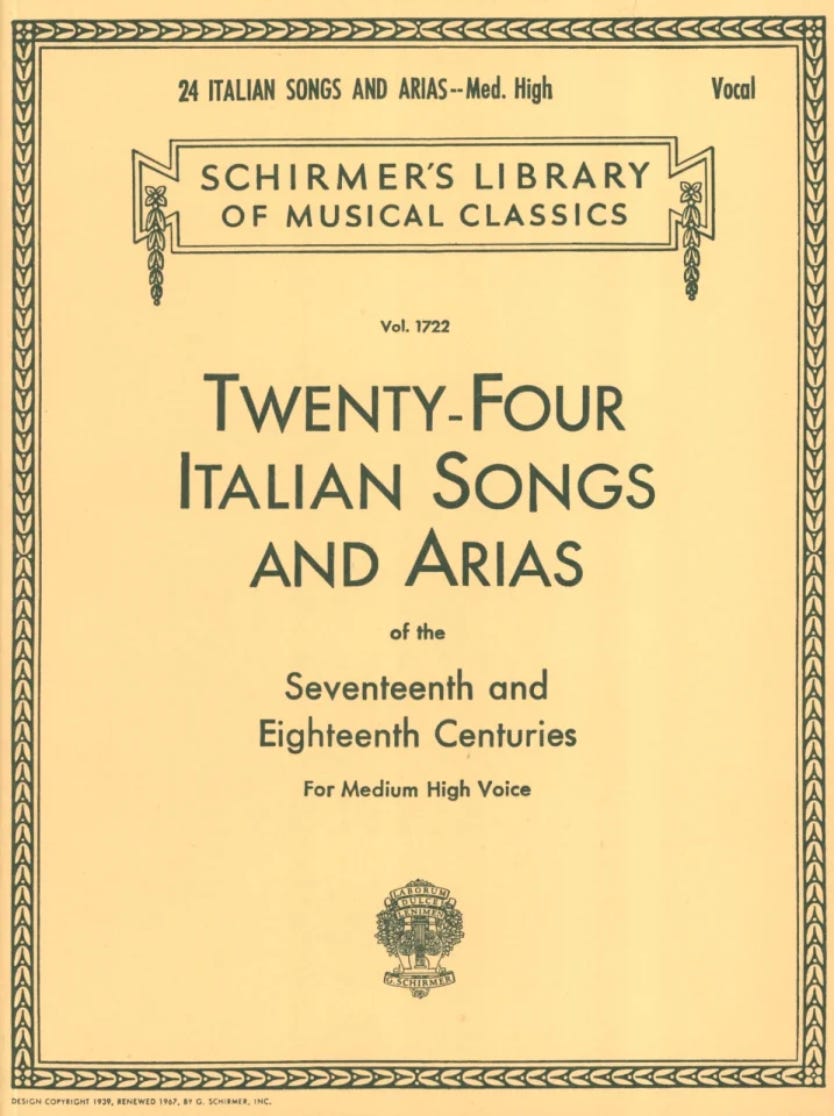
These songs aren’t really about how extensive your range is or about showing off. They teach the basics: how to connect one note to the next smoothly, sustain a phrase, sing faster passages and give you simpler opportunities to connect text to music. Because singing relies so much on muscle memory, going back to music that you learnt as a beginner can also bring back the technical struggles and bad habits of your younger self.
The Italian mezzo-soprano Cecilia Bartoli was up for the challenge. On one of her first albums, Arie antiche, released in 1992, she decided to record so many of these familiar student songs and approached them with the same care she would give anything else she chose to sing thereafter. My interpretation is that she was making a point. She didn’t need showy arias to impress us; she could do it with these simple songs, although some were definitely not that simple. And her recording of Giulio Caccini’s ‘Amarilli, mia bella’ absolutely did. Caccini, who was both a composer and a well-known singer in his time, wrote this song for voice with a simple accompaniment, probably played on a plucked instrument. Bartoli records it with piano, not the ‘right’ instrument, but she gives the song so much life and uses all her vocal abilities to create so many delicate moments that the music never feels like the exercise it had seemed to me all those years ago. Once I heard her version, it was as though the song suddenly made sense. This was how it was always supposed to sound.
Josquin des Prez is the earliest composer of this bunch and takes us into the Renaissance. Born around the middle of the 15th century, he became one of the most admired composers in Europe. He became one of the first composers to remain famous after his death, and because his music was able to spread much more widely after the invention of music printing, his name became so valuable that publishers sometimes printed it on pieces he probably didn’t write. What made him special was his ability to create very complex music from several vocal lines and use them to make words sound incredibly expressive. There’s no need to follow every line. You hear how the voices enter one after the other, then cross, gather and merge until they form something much larger.
I knew Josquin des Prez by name but really came to know much more of his music through Josquin the Undead, an album by the Antwerp-based ensemble Graindelavoix. This group specialises in historical vocal music, but the way they approach performance is very different from the smooth, spotless sound we sometimes associate with Renaissance choirs. The voices are very much individual, sometimes even grainy and mostly, well, human. You hear them breathing, you hear tension and different vocal colours rather than just one perfectly blended front. This is music written more than 500 years ago, but Graindelavoix makes an incredibly convincing case for it. It’s not a dusty relic; it’s undead.
Marin Marais also reached me through a performance. A track by the German viola da gamba player Hille Perl landed in my ears and I was immediately hooked. Marais was a French composer and one of the great players of the viola da gamba, serving at the court of Louis XIV. The gamba looks like the modern cello and is also held between the legs, but this is where the similarity pretty much ends. It has 6 or 7 strings and a much softer sound. Like so many of these early instruments, the magic isn’t so much in the volume. Because it isn’t meant to project over a large modern orchestra, it feels a lot more intimate.
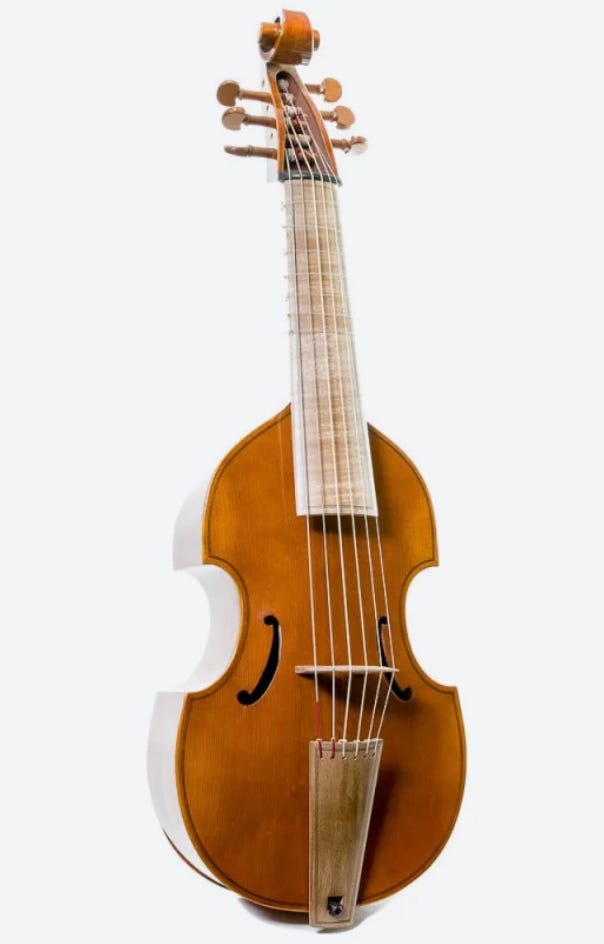
Marais wrote hundreds of pieces for the instrument, and Hille Perl is one of its leading players today. What first attracted me was how rich she made the instrument sound, but also how almost other-worldly it seemed. There’s often a gentle creak when playing the viola da gamba. At first, when you hear it, it sounds like a mistake, but it’s part of the beauty of the instrument, almost as though each note is being extracted. Marais’ music, like the viola da gamba, is elegant and a bit strange at the same time. There’s tenderness and drama, sometimes within the space of a few minutes. This was a chance discovery that opened a door for me to an entirely new sound world.
Telemann is probably the best-known composer in this selection, although he still somehow tends to be in the shadow of Bach and Handel. During his lifetime, though, that wasn’t really the case. He was one of the most celebrated composers in Europe and was extraordinarily prolific. He wrote operas, church music, orchestral suites, concertos and chamber music for almost every combination of instruments available to him. He was also a friend of Handel and godfather to Bach’s son Carl Philipp Emanuel. There is so much Telemann that knowing where to begin can be the difficult part.
My choice, in this case, is really about the performer: the Swedish recorder player Dan Laurin. Many of us first encountered the instrument at school and left, children and parents alike, with quite the scar. The fact is, it’s brutally honest. You blow too hard and the sound becomes shrill. The sound has to be constantly controlled by the air, and if you mess this up, everyone in the room knows it. What Laurin is able to produce is completely different. His control is breathtaking, and it never feels like a technical demonstration. In this quick, celebratory piece, the notes move with complete security, while the sound is, to me, almost honey-like. It is a useful reminder that the recorder isn’t just an instrument given to children because it’s easy to carry. In the right hands, it’s completely magical.
There are so many composers to uncover, but that’s part of the fun, I guess. One day you come across something unexpected, and a whole journey starts. Is there anyone you think I should hear?
Have a good Sunday! x
No posts
Comments
Nothing yet. Say the first thing.
Sign in to join the conversation.