
Author’s Note: This article is part of a series of articles introducing you to the Centaurs. In this series of posts, I’m going to talk about a body named after the daughter of the mythological Chiron and his wife Chariklo.
The Centaur Okyrhoe was discovered on September 19, 1998 at 24°35’ Pisces. The Sabian symbol for that degree is: “After drastic reforms a purified clergy officiates anew,” and one of the qualities of this degree that Dane Rudhyar gives is “True vision.”1 Dictionary.com defines vision as “the act or power of anticipating that which will or may come to be,”2 which seems to be one of the astrological influences of Okyrhoe.
Due to the precession of the Earth’s axis, part of the tropical sign Pisces currently coincides with part of the sidereal constellation of Pegasus, and the 24th degree of the tropical sign happens to be the location of the fixed star 51 Pegasi. If the name of that star sounds familiar, this is probably because it was the first Sun-like star found to have a planet orbiting it3 — a discovery that opened up a whole new field of astronomy on extra-solar planets. The planet around this star has been given an official name, Bellerophon, after the Greek hero who tamed Pegasus, the winged steed. As you will see, it is quite fitting for Okyrhoe to be discovered in the sign of the flying horse.
Most Centaurs have a very unstable orbit, but the orbit of Okyrhoe is one of the exceptions. It’s locked into resonance with Jupiter, so we are able to accurately calculate its position for several thousand years, past and future. When closest to the Sun (perihelion), Okyrhoe almost reaches Jupiter’s orbit; when at its farthest distance (aphelion), this Centaur actually goes out past the orbit of Saturn. One could easily see Okyrhoe as a link or bridge between those two bodies, much as Chiron’s orbit bridges those of Saturn and Uranus.
It takes Okyrhoe 24.2 years to make one complete, rather elliptical orbit through the signs,4 moving more quickly through some than through others. In recent years, it has been moving most rapidly through Leo and Virgo, and taking the longest time to travel through Aquarius and Pisces.
Okyrhoe’s orbit of approximately 24 years echoes another cycle: Every 8 years, the Sun and Venus return to the same relation with each other on approximately the same date. (For example, if you were born with the Sun at 15° Gemini and Venus at 15° Cancer, they would be at about the same positions on your 8th birthday, your 16th, and every 8 years thereafter.) Those years, when our solar return coincides with our Venus return, are times when we focus on discovering what is really important to us. And the Okyrhoe returns at ages 24.2, 48.4, and 72.6 all occur in years following those twin returns, as we are in the middle of the search for what we truly value.
The first Okyrhoe return is particularly significant. Gail Sheehy turned us on to its importance almost 40 years ago in her book Passages: Predictable Crises of Adult Life. She termed the years around the 24th birthday “The Trying Twenties” and wrote that our focus during this period was on “mastering what we feel we are supposed to do.”5 “One of the terrifying aspects of the twenties,” she stated, “is the inner conviction that the choices we make are irrevocable.” While these choices may not be irreversible, they do set in motion a chain of events that establishes a pattern for the next few decades of our life.
From October 2026, The Mountain Astrologer will be free to account holders. Sign up for a free account and receive TMA every two months.
Recent research shows that there is an actual physical reason behind this age being so significant. Scientists now say the “18 equals adulthood” maxim that is prevalent in our society is inaccurate, declaring that 24 is in fact the age when we become adults. According to research published by the U.K.’s Lancet, it’s at age 24 that our brains stop maturing. Only then, the researchers say, do our brains become less prone to be easily influenced by “exciting or stressful conditions which adults are better able to resist,” and can finally assess risk rationally.6
So, the first Okyrhoe return is a stage of life when we are ready to make adult decisions for the first time, and we feel that what we decide now may be the most momentous choices we will ever make! The brain has stopped maturing, but this is only the beginning of new experiences.
The second Okyrhoe return signals the beginning of middle age. Many women go through menopause at this time, while their male counterparts also go through major hormonal changes that some have termed “andropause.” And the third Okyrhoe return around age 72 1⁄2 seems to coincide with the beginning of old age.
Each return of Okyrhoe marks a stage in the maturation process. Since Saturn is the planet said to represent aging, it makes sense that, once each cycle, Okyrhoe briefly crosses the orbit of the Ringed Planet.
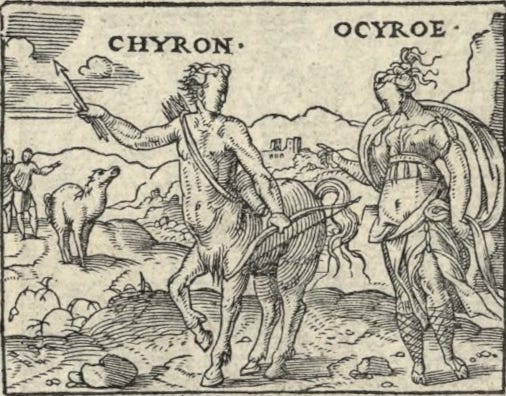
Her name, Okyrhoe or Ocyrrhoe, means “Swift-Flowing,” since she was born at the edge of a river. But it could easily refer to the stream of prophetic words that flowed from her mouth. Her parents were Chiron, wisest of all centaurs, and the nymph Chariklo. There are two different stories about Okyrhoe, but both end with her experiencing a similar fate.
1. Unguarded Words. Almost from birth, the young Okyrhoe had the gift of prophecy. When her father brought the baby Aesculapius to his cave to train him, Okyrhoe was there and, upon seeing the child, burst forth into a prophecy:
Grow strong, dear boy, Healer of all the world. Often men shall owe [you] health and life, and yours shall be the right to win again departed souls, and, though you dare this once in heaven’s despite, Jove’s [Zeus’s] bolt will thwart that gift a second time. You, now divine, shall be a lifeless corpse, and from a corpse become divine again, and twice you shall renew your destiny.7
The myths about Okyrhoe speak of the power in revealing the truth and of the consequences that may follow.
Thus, she predicted that the baby would grow up to be one of the greatest healers ever known, able to bring even the dead back to life. But in doing this, he would eventually anger the gods, who would strike him down; yet, he would be reborn as a god himself, taking his place in the pantheon.
But it was a prophecy she made later in her life that sealed her fate. The gods had enjoined her not to reveal certain truths, but there came a time when she could not stop the words from pouring from her and seeming to have a life of their own. She began to prophesy that her father, an immortal, would be granted death by the other gods because the pain of a serpent’s venom would torment him. However, she was able to speak only part of the prophecy:
More prophecies remained, but then she sighed, sighed deeply, and as tears rolled down her cheeks she cried, “Fate forestalls me! I’m forbidden to tell you more. My power of speech is stopped. My arts — oh! never worth so much! — have brought Heaven’s wrath upon me. Would I’d never known the future! Surely now my human shape is stolen away ...”
With this, Zeus ordered Apollo to turn her into a mare as punishment for revealing the plans of the gods to humankind. And from that moment on, she was called Melanippe, which means “Black Mare.” Some say she was then placed in the heavens as the constellation Pegasus.
2. A Well-Kept Secret. In the second tale,8 Okyrhoe was enamored of a young man named Aeolus and spent much time with him. One day, she realized that she was pregnant and, terrified that her condition would be discovered, fled into the forest to hide from her father. She believed that Chiron would deem it a great dishonor, since he thought she was still a virgin.
Chiron, upon discovering that she was missing, felt great heartache and started looking for her, and Okyrhoe knew it was only a matter of time before the resourceful centaur would find her. So, she prayed, with all her heart, that she be transformed into a mare. Artemis granted her wish, and she was placed among the stars.
The myths about Okyrhoe speak of the power in revealing the truth and of the consequences that may follow — and the consequences of obeying, or disobeying, the rules. In one myth, she was silenced by the gods for telling the truth about her father, while in another, she asked to be transformed so that the truth would not be found out by Chiron. As you will see when we look at Okyrhoe astrologically, these themes occur quite frequently.
© 2013 Zane B. Stein – all rights reserved
Join us for an exclusive weekend at the LSA for the Chiron: Returning Home fundraising weekend with Zane B. Stein
Zane B. Stein Zane B. Stein is an American astrologer (although now lives in Australia) and is known particularly for his focus on Chiron. He received the Canopus Award For Excellence in 1998. His book, Essence and Application: A View From Chiron, has been called truly groundbreaking. In 2022, he published Chiron – Healer and Wholemaker, which picks up where Essence left off. Zane has specialized in studying the many bodies discovered since Chiron, such as the many other Centaurean bodies like Pholus, Nessus and Chariklo, and TNO’s like Eris, Orcus and Sedna. He has lectured worldwide in person and online. He works with astrologer Lynette Malone to help grow the online community, Astrology Collective astrologycollective.org and his website is zanestein.com.
Zane will be joining the LSA on 17–18 October for the Chiron: Returning Home fundraising weekend.
To receive a discounted place, please visit londonschoolofastrology.com/courses/chiron50 and add the word Chiron to 'Have a Coupon?' at the payment page.
Subscribe to The Mountain Astrologer
Salomon, Bernard dit le Petit Bernard, B. Gallus ou Gallo, Public domain, via Wikimedia Commons
(All URLs, here and in the body of the article, were accessed in August 2026, unless otherwise noted.)
Dane Rudhyar, The Astrology of Personality, Aurora Press, 1991, p. 304.
Quotes are from Gail Sheehy, Passages: Predictable Crises of Adult Life, E. P. Dutton, 1976, pp. 120 & 123.
Pseudo-Hyginus, Astronomica 2, 18 (trans. Grant), see Melanippe page cited in Note 7 above.
Comments
Nothing yet. Say the first thing.
Sign in to join the conversation.