
The past week and a half a lot finally clicked into place for me. Some things came through repetition followed by sudden realization, while others needed a good bit of extra research.
First off, I logged another 8½ hours of sailing. In the beginning, it was hard to grasp everything happening on the boat. On top of the fact that it was all foreign to me, the vocabulary was new (and in my second language!). Thankfully, with each class the maneuvers and basic roles have become easier to follow and participate in.
All of the instructors I’ve sailed with so far compete in races, and because of that, they put a lot of emphasis on efficiency. A couple of seconds gained or lost can make or break you. While that ramps up the pressure, it’s been great for learning how to fall into a good rhythm with the rest of the crew. One of my teachers mentioned that a strong team hardly needs to talk — aside from standard maneuver calls — because everyone should know what needs to be done and be able to step into their role almost instinctively.
The video above shows us performing one of the simplest but most important maneuvers in sailing — tacking. This refers to when the bow (front of the boat) turns through the wind, switching the sails to the opposite side. It’s the upwind turning maneuver, generally safe and controlled. Jibing/Gybing, by contrast, brings the stern (back of the boat) through the wind while sailing downwind. In a jibe, the main sail and thus the boom (the big metal bar attached to it) swings forcefully across the boat, making it a more complicated and potentially risky maneuver if you’re not careful.
This week we also practiced techniques for slowing down or even stopping the boat while sailing. One method involves turning the bow directly into the wind, putting the boat ‘in irons’. With the sails trimmed in (pulled tight), they can’t generate much power, which slows the boat to a crawl. This is also the standard position for lowering the sails, since they’re at their most depowered and easiest to manage.
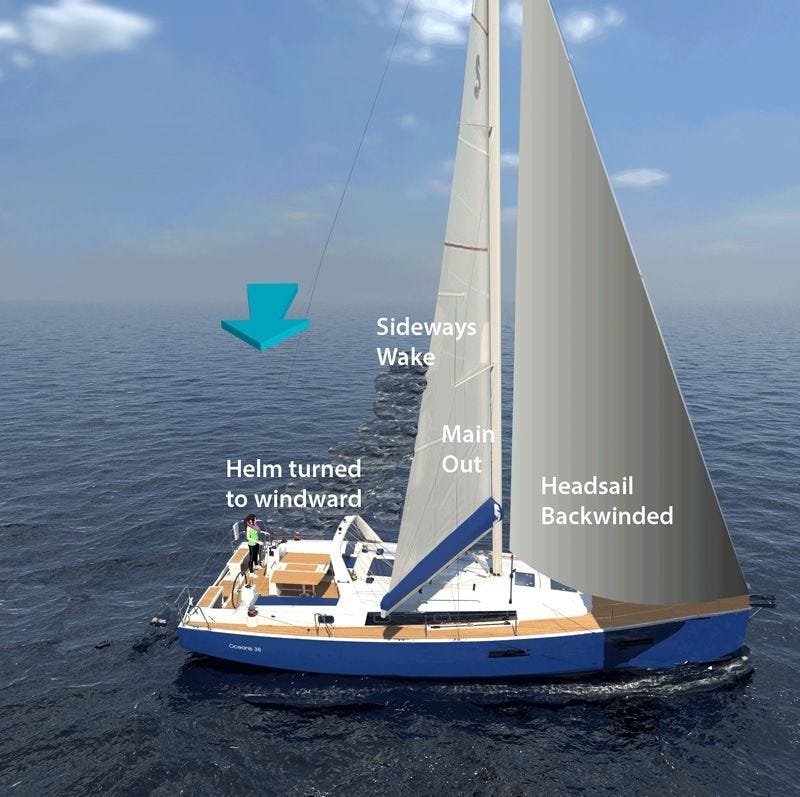
However, going into irons usually won’t bring the boat to a full stop. That led us to learning about heaving-to, a maneuver designed specifically to pause the boat in a stable position. There are a couple different ways to do it, but the most common technique involves cinching the jib with the wind hitting it at a 90 degree angle and easing the mainsail all the way out. This sets the jib and main at odds with each other. When the jib tries to push the bow downwind the mainsail provides a counter force from the wind beginning to hit it as well. This opposition balances out and leaves the boat holding steady and drifting slowly. It’s essentially putting the boat in neutral, which is called punto muerto in Spanish (literally “dead point”).
I also got the chance to practice some more basic hitches and knots.
Bowline
This knot is commonly used to attach the sheets (ropes) to the clew (bottom left corner) of the jib sail. See what I mean about vocabulary? I’m sure there’s a good reason for it, but there really is a specific name for EVERYTHING in sailing!
Clove Hitch


Both hitches and knots can be used to attach rope to something else, the difference lies in the fact that hitches rely on that something else to hold their shape. We used the clove hitch to tie the fenders to the boat when docking.
Cleat Hitch
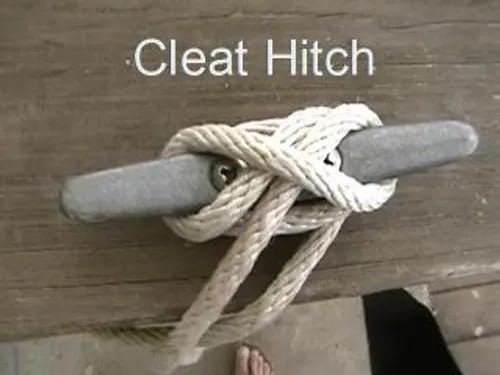
This is probably the most recognizable rope tie in all of sailing. Quick, easy, and quite pretty, it’s become fundamental for good reason. We’ve tied and untied all three of these every time we enter or leave the marina, and it’s been great for repetition!
Because I’ve been connecting the dots between Spanish and English terms and digging into the physics of sailing many things have started to make much more sense. At first it felt like I was palming around in the dark, so it was nice to have a small breakthrough this week. It’s a good reminder that keeping at it and putting in extra research hours outside of classes will go a long way!
Unfortunately, ‘Mr. Chippy’ (the boat I’ve been sailing on) will be leaving the bay after next week. I’ll only be in Uruguay through Christmas, so it’s not a big loss, but it seems like I won’t be able to get much or any sailing in the last two weeks of the month. My goal is to get another 4 lessons in before the hiatus.
Still, there’s still plenty more to look forward to a-do with sailing! When I first started, the sailing school was competing in a regatta (race) here in the Punta del Este bay. I’ve just heard that they’re now purchasing a larger boat to enter into the annual ‘Rolex Circuito Atlántico Sur’ (Rolex South Atlantic Circuit) held every January. The regatta is made up of two parts. First, a long leg departing from Buenos Aires, Argentina all the way to Montevideo, Uruguay and finishing in Punta del Este. Then afterwards, many short distance races in the local area and around the Isla Gorriti landmark. The entire race runs for about a week and spans almost 200 nautical miles. Unfortunately, the timing overlaps with when I’ll be in Japan working on other courses, so I wouldn’t be able to take part. Still, it’s exciting to know that there will be a real world opportunity to put everything I’ve learned to the test!
Japanese (8hrs)
Spanish (2hrs)
English Classes Taught (11)
Guitar (1hr)
Chess (1hr)
Workout (5x)
Finished ‘The Stranger’ by Albert Camus

Finished ‘The Richest Man in Babylon’ by George S. Clason

Finished ‘The Merry Wives of Windsor’ and started ‘Venus and Adonis’ by William Shakespeare

Although I’m pretty satisfied this week, I’ve been procrastinating on some things that I really need to get done. My phone definitely plays a part in it. This upcoming week I’m instilling some stricter rules and schedules to keep myself on track.
Here’s to doing even better next week! - Morgan Senna
Comments
Nothing yet. Say the first thing.
Sign in to join the conversation.