
“We’re only as sick as the secrets we keep.” — Maria Nemeth
A gentle note before reading: I usually don’t share many of the specific details of my eating disorder because I never want my story to become someone else’s comparison point or trigger. In writing this, I tried to focus much more on what the illness felt like—the secrecy, isolation, fear, anxiety, and loss of myself—rather than the numbers attached to it. I intentionally do not discuss my weight, calorie counts, or other specific numbers because, frankly, I think they are irrelevant to the part of the story that actually matters. A number cannot tell you how sick someone is, how much they are suffering, or what is happening inside their mind. This is my experience, not a blueprint for what an eating disorder has to look like. Please take care of yourself while reading and skip anything that doesn’t feel helpful to you.
The iPad came out. Everyone was obsessed with Angry Birds. Lady Gaga wore a dress made of meat to the VMAs because apparently cotton had become too predictable. Inception had everyone arguing about whether Leonardo DiCaprio was still dreaming, and Bruno Mars was on every radio station singing “Just the Way You Are.” The song was basically one giant lesson in self-acceptance, and I remember listening to it wondering whether I would ever be able to accept myself exactly as I was. Also, respectfully, Bruno, what did you know about my situation?
At the time, I was deep in an eating disorder. As my body became more deprived, my world became smaller. I stopped seeing friends because being social suddenly felt complicated. Friends meant restaurants, coffee shops, spontaneous plans, photographs, and interruptions to the rigid routines I had created for myself. Every invitation required a new excuse, and eventually keeping track of my own lies started to feel like a full-time administrative position I had never applied for. Avoiding everyone became easier.
After a while, people stopped asking me to hang out. At first, that felt like relief. Nobody was questioning me. Nobody was interfering with my routines. Nobody was forcing me to explain something I barely understood myself. But what felt like freedom was actually isolation. Slowly, I started choosing my eating disorder over everything else.
My thoughts became darker and more obsessive. I became increasingly convinced people were judging me, talking about me, or secretly disliked me. Leaving the house became anxiety-provoking. Crowds made me feel trapped. Panic became familiar. Happiness, on the other hand, started to feel foreign. I remember wondering whether I would ever feel genuinely excited about anything again. My illness had consumed so much of my life that I had forgotten what life felt like without it.
That is one of the things I wish more people understood about eating disorders. They are not simply about wanting to look a certain way. They affect the brain, the body, emotions, decision-making, concentration, digestion, sleep, hormones, temperature regulation, and the way you interpret the world around you. When the brain and body are consistently undernourished, the brain begins operating in survival mode. It becomes harder to think clearly, regulate emotions, and challenge obsessive or anxious thoughts.
Researchers have also studied differences in reward pathways and anxiety in people with anorexia. In simple terms, the illness can create a bizarre neurological contradiction where something necessary for survival begins to feel frightening, while harmful behaviors can temporarily feel calming or rewarding. My brain was essentially pulling the fire alarm and then congratulating itself for keeping me safe. Terrible security system. Zero stars. Would not recommend.
In the spring of 2010, my parents planned a family cruise. My mom bought me several bathing suits and left them on my bed to try on. I already hated bathing suit shopping. Even without an eating disorder, bathing suit fitting rooms are arguably one of society’s crueler inventions. Whoever decided fluorescent ceiling lights should shine directly onto a half-dressed person trying to feel confident really misunderstood the assignment.
Historically, bathing suit season had always meant criticism for me. I would stand in front of the mirror and immediately catalog everything I believed was wrong with my body. I had absorbed the idea that summer required some improved version of myself, as if your body needed to pass an entrance exam before being allowed near a beach. I remembered Tyra Banks standing on television years earlier and fiercely defending her body against people criticizing it. I admired that confidence and wondered what it would feel like to live inside your own body without constantly negotiating with it.
That night, I picked up one of the bathing suits and caught sight of myself in the mirror. Something strange happened. For just a moment, the distorted lens lifted. I saw that I was sick. Not imperfect. Not failing some imaginary beauty test. Sick. I started crying. I remember thinking, Morgan, what did you do? For months, my brain had somehow managed to reinterpret warning signs as evidence that I was doing something right. But in that moment, I saw the truth.
The most frightening part wasn’t realizing something was wrong. It was realizing that I didn’t know how to stop. Almost immediately, the eating disorder started negotiating with me. I told myself I could fix things just enough so nobody would worry, but still remain in control. Apparently I believed recovery could be managed like adjusting a thermostat two degrees and then walking away. That is, unfortunately, not how recovery works.
During this period, my parents didn’t fully understand what was happening either. They had suspicions, but suspicion and acceptance are two very different things. Sometimes families don’t overlook things because they don’t care. Sometimes they overlook them because acknowledging what they are seeing feels unbearable.
One night, my mom came into my room and asked directly if I had an eating disorder. My stomach dropped. “No. Of course not. Why would you even think that?” I responded immediately and defensively. The conversation ended almost as quickly as it began. At the time, I believed that if I refused to name the problem, maybe the problem wasn’t real. Denial became another layer of protection.
The bathing suits made that denial harder. Most of them didn’t fit the way my mother expected they would, and I panicked. If she noticed, she might understand what was happening. My secret might become visible. I eventually brought most of the bathing suits downstairs and told her I simply didn’t like them. Technically, that wasn’t a lie. I hated bathing suits. But it wasn’t the whole truth either.
The whole truth was that I was terrified someone might see what I had been hiding.
That is the thing about eating disorders: secrecy can become part of the illness. It thrives behind closed doors, changed subjects, avoided conversations, oversized clothing, and carefully crafted excuses. The more secrets I kept, the easier it became for the illness to continue. I guess that is why I’m so outspoken about my recovery today—after a while, you get sick of keeping secrets.
For a long time, I also avoided the scale. People sometimes assume everyone with anorexia weighs themselves constantly, but that wasn’t my experience. I was terrified of knowing. A number could confirm something I wasn’t ready to admit. The scale had stopped representing simple information anyway. It had become tangled up with worth, failure, success, control, and shame. I did not want to be sick, I did not want to be labeled as sick, I did not want to die. I just didn’t know how to get myself out without gaining weight or telling people.
Shame is funny that way. Not funny ha-ha, more funny wow, this is incredibly inconvenient. It can attach itself to almost anything—a number, a picture, a clothing size, a meal, or some random comment someone made three years ago. Suddenly, ordinary things become evidence in an imaginary courtroom where you are permanently on trial.
Sometimes I wonder whether I was really trying to make my body smaller or whether I was trying to make my shame smaller. Maybe I believed that if I could change enough physically, eventually I would become someone I could tolerate emotionally. But shame does not disappear when a body changes. It simply moves the goalpost.
By then, my body was sending increasingly obvious signals that something was wrong. I was constantly cold. My concentration suffered. My energy disappeared. My body was trying to conserve resources and protect itself. Still, I continued convincing myself that my habits were healthy and that I was disciplined. I thought following every rule my illness created meant I was in control. In reality, those rules were controlling me.
As the illness progressed, hiding it required more work. I dressed in layers partly because I was freezing and partly because clothing made me feel safer. Teachers noticed I was cold constantly. One day, my science teacher approached me and said, “Morgan, it’s warm in here. Are you still cold?” I insisted it was freezing. She hesitated and started to tell me about someone she knew who had an eating disorder. I cut her off almost immediately and blamed an imaginary open window.
She stared at me for a moment and then said she would see if someone could turn up the heat.
She had come very close to saying something I wasn’t ready to hear, so I slammed the conversational door shut. Looking back, I think about that moment often. Denial does not necessarily mean concern is misplaced. Someone saying “I’m fine” isn’t always proof that they are fine. Sometimes “I’m fine” really means, Please don’t take away the thing I currently believe is keeping me safe.
School became increasingly difficult. My body was sitting in the classroom, but my brain was somewhere else. Food thoughts, body checking, comparison, rules, fear, and mental calculations consumed enormous amounts of attention. I could stare directly at a teacher speaking and absorb almost nothing. The eating disorder had become background software running every second of the day and using approximately 97 percent of my brain’s processing power. Chemistry was fighting for the remaining three percent.
Gym class was especially difficult because changing in the locker room made me feel exposed. I became strategic about where I stood, how quickly I changed, and how much of myself other people could see. I assumed everyone was looking at me, when in reality most teenagers in the locker room were probably doing the exact same thing I was doing—worrying about themselves. Eating disorders have a way of convincing you that you are permanently standing beneath a spotlight.
One day during gym, something happened that scared me. I was sitting with friends while the teacher explained the lesson when suddenly my heart started pounding strangely. I grabbed my chest and blurted out, “Whoa.” Everyone looked over, which of course immediately added embarrassment to an already unpleasant situation.
One of my friends asked if I was okay. I told her it was just nerves. She smiled and told me to relax because everything was fine.
I smiled back.
“Yeah.”
But somewhere inside me, I knew everything wasn’t fine.
Things were getting worse.
And still, I kept the secret.
When I look back at that version of myself now, I don’t think about the size of my body. I don’t think about numbers, food, or clothing sizes. I think about how alone I became. I spent so much energy protecting my eating disorder from everyone else that I didn’t realize the eating disorder was separating me from the very people who could help me.
That is the cruel irony of secrecy.
I thought I was protecting myself.
Really, I was protecting the illness.
Eating disorders thrive in silence because silence allows the illness to become the loudest voice in the room. There is nobody there to challenge it. Nobody to say, That thought is not telling you the truth. Nobody to remind you that anxiety is not intuition, guilt is not morality, hunger is not failure, and your body is not an emergency that needs to be fixed.
If someone you love seems different—more withdrawn, anxious, rigid, isolated, exhausted, preoccupied, or simply not like themselves—you do not need dramatic proof before you are allowed to care. Ask the question. And if they tell you they are fine but something in you still feels concerned, keep the door open.
You might not get the truth the first time.
My mother didn’t.
My teacher didn’t.
My friends didn’t.
Sometimes the beginning of recovery isn’t someone confidently declaring, “I have an eating disorder and I need help.” Sometimes it begins much earlier, with another person quietly communicating, I see you. I’m paying attention. You don’t have to hide from me.
And maybe that is how secrets begin to lose their power.
Not because someone suddenly becomes fearless enough to tell the whole truth, but because they finally realize they don’t have to carry it alone.
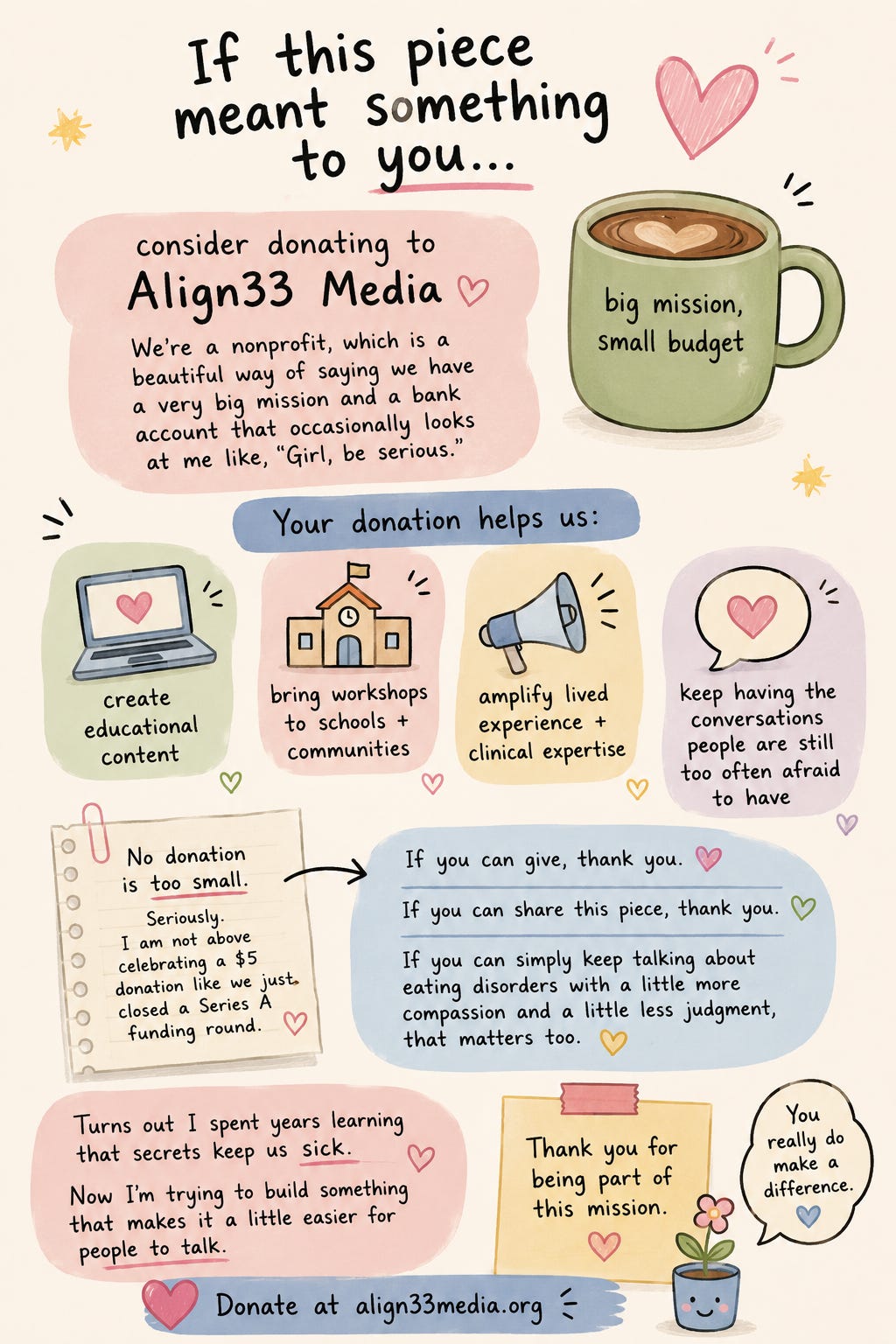
And now for the least graceful transition in Substack history: if this work means something to you, consider donating to Align33 Media. We’re a nonprofit, which is a beautiful way of saying we have a very big mission and a bank account that occasionally looks at me like, Girl, be serious.
Your donation helps us create educational content, bring eating disorder and mental health workshops into schools and communities, amplify lived experience alongside clinical expertise, and keep having the conversations people are still too often afraid to have. No donation is too small. Seriously. I am not above celebrating a $5 donation like we just closed a Series A funding round.
If you can give, thank you. If you can share this piece, thank you. If you can simply keep talking about eating disorders with a little more compassion and a little less judgment, that matters too.
Turns out I spent years learning that secrets keep us sick.
Now I’m trying to build something that makes it a little easier for people to talk.
No posts
Comments
Nothing yet. Say the first thing.
Sign in to join the conversation.