
A gentle warning: This essay discusses eating disorder history, weight, pregnancy, and medical appointments. It is written with humor, but the experiences behind it were very real.
Dear doctors, clinicians, nurses, medical assistants, and anyone else who has ever walked into an exam room while aggressively typing on a computer,
Let me start by saying this: I know your job is hard. You are working in a healthcare system that often gives you twelve minutes to assess an entire human being, document seventeen things, answer six portal messages, battle an insurance company, refill someone’s prescription, eat half a granola bar over a trash can, and somehow remain emotionally available. That is absurd.
I recognize that many of you are overworked, understaffed, exhausted, and being pressured to see more patients in less time. We are living in a system that sometimes appears more interested in productivity metrics than whether anyone is actually getting healthier. I get it. This is not entirely your fault.
However, I have a few minor tweaks—tiny fairy sprinkles for the suggestion box. Think of this as a Yelp review, except instead of complaining that the mozzarella sticks arrived cold, I am offering a few cheerful notes that might make medical appointments feel a little safer, kinder, and less like an unexpected episode of Survivor: Annual Physical.
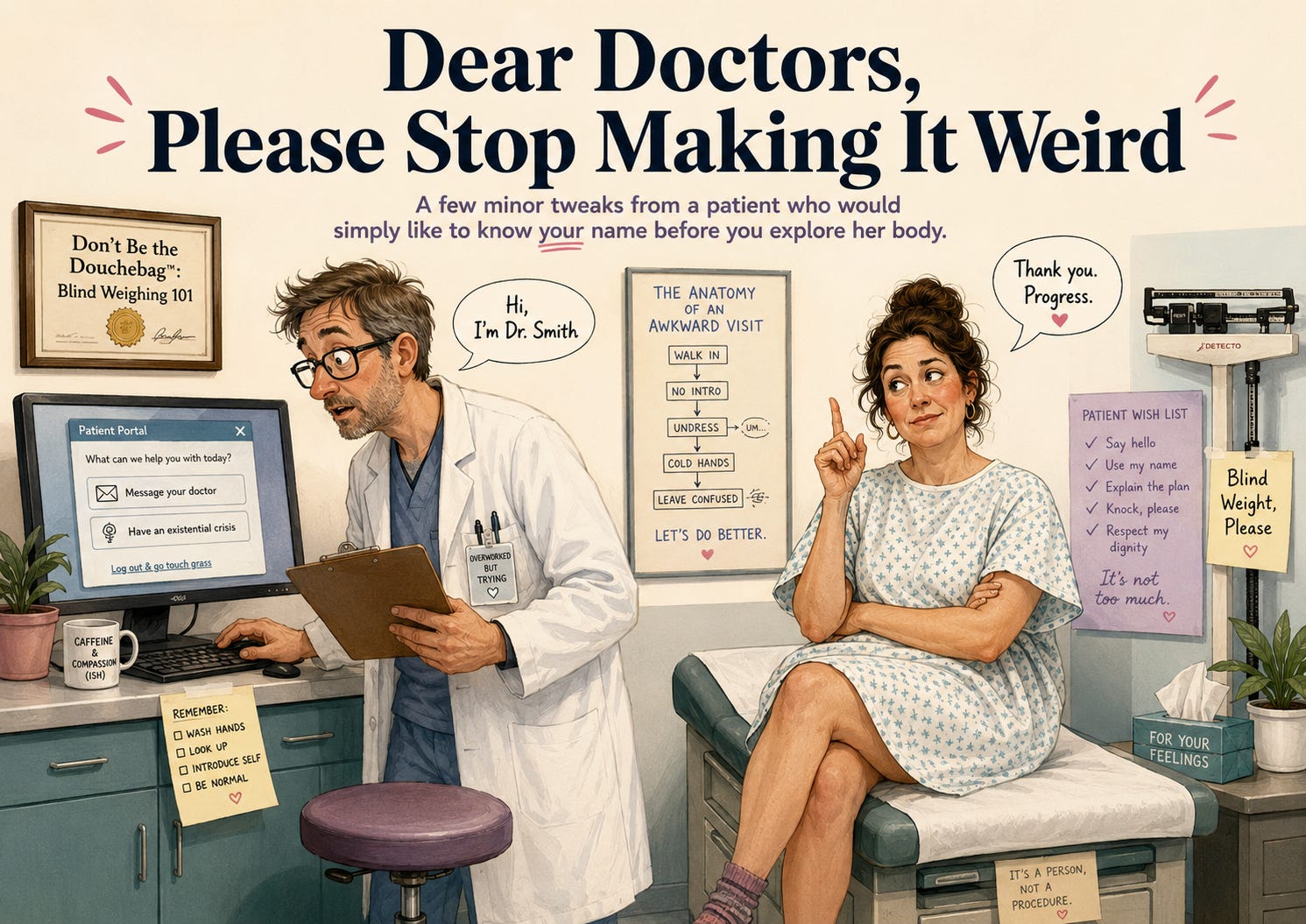
First: please introduce yourself. If you walk into a room and we have never met before, I would love to know your name. Call me demanding, but I prefer knowing someone’s identity before they begin examining my breasts, pressing on my abdomen, asking when my last bowel movement was, or requesting details about my menstrual cycle. Just a quick, “Hi, I’m Dr. Smith.” Amazing. Groundbreaking. Five stars. Gold star. Chef’s kiss.
And maybe—this is ambitious—look at me. I understand the computer has become the third person in every medical relationship, but sometimes I feel like I should introduce myself to the computer first. “Hi, I’m Morgan. I see you already know my entire medical history, my childhood address, and apparently something I told an allergist in 2007. Wonderful to finally meet you.”
But the patient sitting in front of you is still a person. We have stories, experiences, families, fears, jobs, children, and deeply unhealthy relationships with WebMD. Some of us have also spent years rebuilding trust with our bodies, which brings me to eating disorders.
If I tell you, “I have a history of an eating disorder,” please do not react like I just announced there is a raccoon loose in the exam room. You would be surprised how many healthcare professionals suddenly become deeply fascinated by their keyboards. “Oh.” Typing intensifies. Sometimes they cough, choke on their own saliva, quickly change the subject, or—my personal favorite—tell me about someone they know who lost weight.
I mention an eating disorder and suddenly I am hearing about someone’s cousin’s gastric bypass surgery. Respectfully, I did not ask about Cousin Linda. I hope Linda is thriving. I hope Linda has found love, peace, reasonably priced groceries, and a fantastic moisturizer. But this is not about Linda.
If a patient tells you they have an eating disorder history, try asking, “How is your relationship with food and your body now?” That’s it. You do not need a fellowship in eating disorder medicine to ask one compassionate follow-up question. Be curious. Be genuine. Be kind. And if you truly do not know what to say, “Thank you for telling me” works beautifully. No choking required.
Now let’s discuss the scale: the tiny rectangular platform capable of causing more emotional chaos than most ex-boyfriends. If you say, “Hop on the scale,” and I say, “I’d rather not,” please do not immediately respond, “Why?” Because I said no. That’s why. That was the whole sentence. You do not need to launch an FBI investigation. I am not concealing nuclear launch codes. I just do not want to be weighed.
If my weight is medically necessary, explain why. I am a reasonable adult. If you tell me, “We need your weight because this medication is dosed based on weight,” okay, great, now we have context. If it is not medically necessary, perhaps we can all continue with our day and you can move on to asking whether I feel safe at home for the ninth time this year.
There are obviously situations when weight is medically relevant. Pregnancy was one of those situations for me, and I understood that. What I did not understand was how almost nobody in my OB-GYN’s office seemed to know how to perform a blind weight correctly. So, naturally, I accidentally developed a professional certification program.
I call it Don’t Be the Douchebag™: Blind Weighing for Healthcare Professionals. It was not accredited. There were no continuing education credits. There was no graduation ceremony. Frankly, there should have been. I trained that office myself while pregnant and hormonal. “Everyone in the hallway now!” is basically how orientation began. Exactly the peaceful prenatal experience every woman dreams of.
Because apparently I had appointed myself Dean of the College of Please Stop Showing Patients Their Weight, here was the curriculum: when a patient requests a blind weight, have them step onto the scale backwards. When the number flashes, wait until it disappears before telling them to get off. Write the number down privately. Do not announce it. Do not leave it on a Post-it directly in front of them. Do not swivel your screen around while the number is glowing like the New Year’s Eve countdown in Times Square.
And please—PLEASE—think about where weight appears in the online patient portal. This is one of those things people sometimes misunderstand about eating disorder recovery. A person can be doing incredibly well. They can be eating, living, working, having relationships, becoming a parent, building a career, paying taxes, remembering to buy toilet paper before it runs out—all the markers of a functioning adult—and there can still be certain pieces of information their brain does not need.
I once specifically requested not to know my weight. Then I opened my online chart, and there it was, front and center. It might as well have said: WELCOME TO YOUR PATIENT PORTAL! Would you like to message your doctor, view test results, schedule an appointment, or HAVE AN EXISTENTIAL CRISIS?
I saw the number and immediately started crying. Then I called my therapist in a panic. That call did not need to happen. I did not need to spend my afternoon regulating myself because someone designed a patient portal like ESPN statistics for my body.
My therapist just wanted a manicure that day. She was already stressed, and now she was calming me down while getting a gel manicure. In the middle of trying to help me regulate, she accidentally picked “lily” instead of “lilac” from the nail-polish color chart. So now she was sitting there with one hand under the gel lamp, talking me through a crisis, while staring at nails that were the wrong shade of purple. Honestly, nobody won that day. I was crying. She hated her nails. Technology had emerged victorious.
And while we are discussing weight, I would like to formally retire several phrases from the medical profession. “Wow, packing on the pounds!” No. “Eating well, huh?” Absolutely not. “Someone’s been enjoying themselves!” Sir. I am here because I have a sinus infection. Why have you turned this into a roast?
I cannot understand why commenting on someone’s body is still considered acceptable medical small talk. You have no idea what is happening in that person’s life. You do not know whether they are recovering from an eating disorder, taking a medication that causes weight changes, dealing with hormones, grief, illness, pregnancy, depression, menopause, thyroid problems, chemotherapy, stress, or simply inhabiting a human body that changes over time because bodies are bodies, not marble statues installed at the Met.
And you have no idea what that person will do with your comment once they leave. You might forget what you said thirty seconds later while walking into the next exam room. They might remember it for ten years. That is one of the strange imbalances in healthcare: a clinician can make one passing comment while reaching for the blood pressure cuff and never think about it again, while the patient stores it permanently in the part of their brain reserved for embarrassing middle-school memories and things people said about their body.
So no, I am not asking healthcare professionals to become therapists. I am not asking you to perfectly understand every eating disorder. I am not asking you to eliminate medically necessary weigh-ins. I am asking for something much simpler: pause, look at the human being, ask before assuming, explain before insisting, and respect boundaries whenever medically possible.
And please stop treating weight like conversational small talk. You would never finish listening to someone’s lungs and casually say, “Wow, those kidneys are looking THICK this year!” You would not inspect someone’s ear and say, “Someone’s eardrum has really let itself go.” You would not palpate an abdomen and whisper, “The spleen has been enjoying the holidays.” So perhaps we can extend that same restraint to people’s bodies.
Medicine has incredible power, and healthcare professionals have incredible power. Sometimes what makes a patient feel safe in an exam room is not a groundbreaking new intervention. Sometimes it is simply, “Hi, I’m Dr. Smith. Would you prefer not to know your weight? Thank you for telling me about your eating disorder history. How are you doing with that now?”
Four sentences. No advanced certification required.
Although graduates of Don’t Be the Douchebag™ will still receive an imaginary diploma, a sticker, and my eternal gratitude.
And if this essay made you laugh, nod aggressively, or remember a medical appointment where you thought, Did a healthcare professional really just say that out loud? please share it with a friend, a doctor, a nurse, a therapist, an OB-GYN, or Cousin Linda. Especially Cousin Linda. She has been through enough.
And if you’d like to support the work we’re doing at Align33 Media, please consider making a donation. We’re a nonprofit creating education, storytelling, workshops, advocacy, and media around eating disorders, body image, and mental health—essentially trying to make these conversations more informed, more compassionate, and significantly less weird.
Your donation helps us keep doing this work, reaching more people, educating more professionals, and hopefully preventing someone else from having to create Don’t Be the Douchebag™: Blind Weighing for Healthcare Professionals in the middle of their prenatal appointment.
Please donate to Align33 Media, share this with someone who needs to read it, and send it to your favorite healthcare professional. Consider it free continuing education.
No posts
Comments
Nothing yet. Say the first thing.
Sign in to join the conversation.