
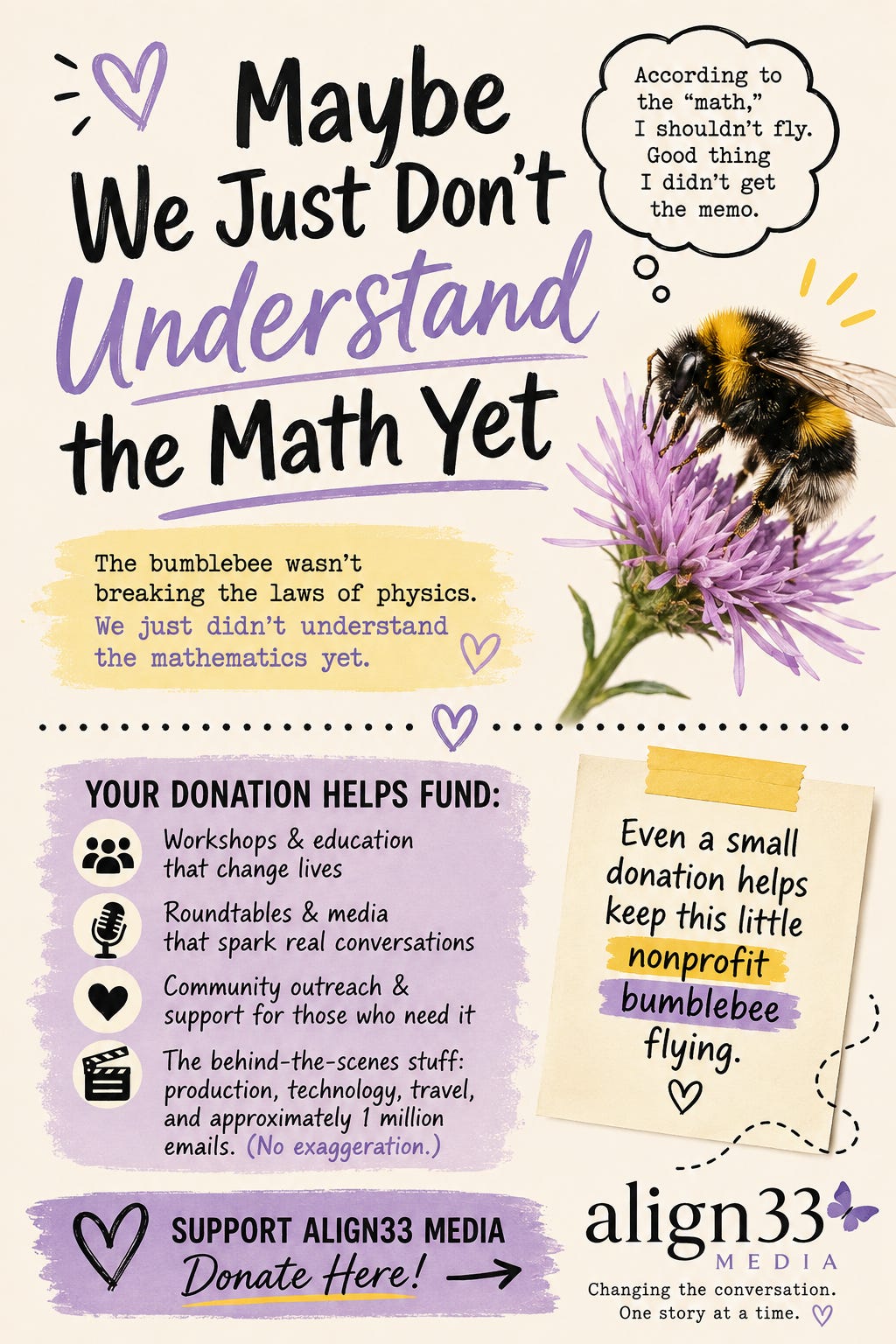
There’s an old saying that, according to the laws of physics, a bumblebee shouldn’t be able to fly. Technically, that isn’t true. Scientists eventually figured out that the problem wasn’t the bumblebee. The problem was the way people were trying to understand how it flew.
Early calculations treated the bee too much like a tiny airplane. Its body seemed too heavy. Its wings seemed too small. The math didn’t add up. Except there was one fairly significant problem with the theory: the bumblebee was flying.
It wasn’t breaking the laws of physics. We simply didn’t understand the mathematics yet.
I think about that a lot because, for most of my life, I have felt a little like the bumblebee.
I grew up with a learning disability. Back then, I was diagnosed with ADD because apparently ADHD needed a rebrand sometime in the 2000s. I had an IEP, a 504, occupational therapy, extra help, accommodations—the whole academic alphabet soup. At some point I’m pretty sure I had more acronyms attached to my education than a government agency.
School was hard for me. Really hard.
I could study for six hours for a test and get a 70 while someone else studied for twenty minutes, somehow watched television at the same time, and got a 95. And when you are a kid, you don’t necessarily understand that your brain processes information differently. You just look around the classroom and think: Everyone else can do this. Why can’t I?
And slowly, “I learn differently” becomes “I’m stupid.”
That is a dangerous equation for a kid to start believing.
People saw the result. They didn’t always see how hard my wings were flapping underneath it.
I struggled with reading. Processing. Organization. Sitting still. Remembering things. Taking tests. Doing things in the exact format school had decided meant you were intelligent. Apparently intelligence could be accurately measured by how well you could sit under fluorescent lighting for seven hours and remember something someone told you three weeks earlier. Excellent system. No notes.
But put me somewhere creative? Put me in front of people? Give me an idea and tell me to build something? Ask me to improvise, connect dots, tell a story, or figure something out when there is no instruction manual?
Different kid.
Maybe I was never bad at learning.
Maybe people just didn’t understand the mathematics of how my brain learned.
That distinction matters because when we don’t understand something, humans have a terrible habit of deciding the thing itself is broken instead of considering that maybe our model is incomplete.
And lately, I keep thinking about this in relation to eating disorders.
For all that we know about eating disorders today, there is still an enormous amount we do not understand. We know they are complex illnesses involving biology, genetics, psychology, environment, culture, temperament, and countless factors that can look completely different from one person to another.
And yet sometimes we still talk about treatment as though we have solved the equation.
This method works.
That method doesn’t.
This is what recovery is supposed to look like.
This person responded to treatment, so this person should too.
But what if we don’t fully understand the mathematics yet?
What if two people can have the same diagnosis on paper and completely different things happening underneath? What if something that helps one person is ineffective—or even harmful—for another? What if neurodivergence matters more than we have historically recognized? What if trauma matters differently? What if genetics matter in ways we haven’t discovered yet? What if the questions we are asking are based on an incomplete understanding of the illness itself?
That doesn’t mean treatment doesn’t work.
It doesn’t mean science is wrong.
It means science is supposed to evolve.
The bumblebee wasn’t proof that physics was useless. The bumblebee was proof that the model being used to explain it wasn’t complete yet.
That is a very different thing.
And I think we need more humility like that in eating disorder treatment.
Because behind every treatment protocol is a human being. A human being whose brain, biology, environment, experiences, identity, family, learning style, fears, and history cannot possibly be reduced to one neat formula. Human beings are annoyingly complicated that way. We refuse to fit nicely into spreadsheets.
I spent years thinking something was wrong with my brain because it didn’t perform the way the educational system expected it to. I don’t want us making the same mistake with people who have eating disorders.
If someone isn’t responding the way we expected, maybe the first question shouldn’t always be: What is wrong with them?
Maybe sometimes it should be: What are we missing?
Maybe the treatment isn’t failing because the person is difficult.
Maybe the student isn’t failing because they aren’t intelligent.
Maybe the bumblebee isn’t flying incorrectly.
Maybe we haven’t completely understood how the wings work yet.
There is something incredibly hopeful about that to me, because “impossible” is a dead end.
But “we don’t understand it yet” is an invitation.
It tells researchers to keep researching. Clinicians to keep questioning. Educators to keep adapting. Parents to keep listening. And people who have spent their lives feeling like they don’t fit the equation to stop assuming that they are the mathematical error.
Sometimes the equation is incomplete.
Sometimes the measuring tool is wrong.
Sometimes the system was built around one type of brain, one type of body, one type of patient, or one definition of success.
And sometimes the little fuzzy creature everyone is analyzing has been flying the entire time.
Maybe we should stop telling the bumblebee what should be possible.
And start paying attention to how it actually flies.
And if you believe we need more conversations like this—ones that question old assumptions instead of forcing people into equations that don’t fit—consider supporting Align33 Media. Your donation helps fund workshops, educational resources, Roundtables, community outreach, and the media we create around eating disorders and mental health. It also supports the less glamorous necessities: production, technology, travel, and a truly unreasonable number of emails.
No posts
Comments
Nothing yet. Say the first thing.
Sign in to join the conversation.