
I recently had something go viral on instagram. This is my first time of watching my voice not just resonate but really travel. In the clip from a panel at a conference, I am expressing deep concern about climate change and the trade offs we seem to be making around AI. At one point, my voice cracked, and it was perhaps that, above all, which connected. The comments are largely people saying “thank you for expressing what I have been thinking; I am so scared”. I have been inundated with direct messages to this effect: “I am scared too”. “I am so afraid”. “What have we done?”
The experience has left me thoughtful. I was expressing a sentiment I meant and I felt needed saying, especially in that context, where a bizarre magical thinking positivity pervaded the event. I am not surprised people on the internet also responded. There is relief in feeling less alone in our overwhelm. I have experienced the weird, robust comfort in honesty, in an invitation to come in for a moment from denial and distraction and look where we are in the face. I do not, exactly, regret posting it.
However. My viral moment has shown me, personally, what I already knew theoretically. Fear travels on these psychologically astute, precision targeted platforms. Perhaps sometimes it needs to. Strategically, if I was mainly interested in “building a platform” it is really clear what I would do next. I would feed all these new followers more of the same, more outrage, more tech-bro-blaming, more anxiety. I am fairly sure I could have thirty thousand followers in a few weeks with that approach and you can do a lot with a platform like that. As someone trying to make a living in this work, hoping one day to publish another book, it would make a lot of sense, career wise.
Sadly, certainly for my career, I can’t do it. I can’t keep pumping more fear into the system. That is not my calling. It would poison my soul first. All my chat about trying to live my values, to become someone the world needs now would shrivel beneath my feet. Because fear is no place to root ourselves. It is bad soil for the soul.
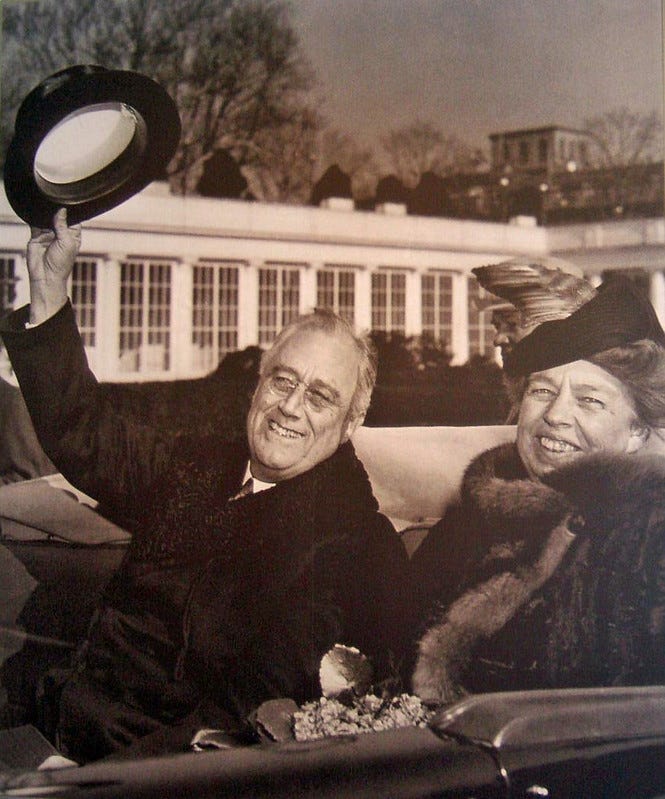
In 1933 Franklin D. Roosevelt gave a famous inaugural speech. He set out his plan for his presidency (which would go on to be widely seen as the most ambitious and effective political programme of any modern leader) not with policy points or economic plans. He started by addressing the inner lives of the nation, putting his finger on an emotion which he clearly thought could hold back his plans for renewal.
So first of all, let me assert my firm belief that the only thing we have to fear is fear itself —nameless, unreasoning, unjustified terror which paralyzes needed efforts to convert retreat into advance
Going back to it, it is that word “paralyses” which strikes me. FDR did not say “there are no risks or threats, everything will be ok.” Yes, that “unjustified” was a bit annoying, I imagine, if you were a mother failing to make enough money to feed your children, or pay medical bills, but this was not a patronising “calm down, dear” to the populace. He hones in on fear because of its effects on us and our ability to move forward. Fear paralyses, and we need not to be paralysed.
In the background of the speech was a threat that nations paralysed by fear are too often prone to welcome. As the New York Times lays out
It was a time of existential crisis for the country, more so than any other time since the Civil War…The Great Depression had buried its teeth in the neck of the nation; nearly one quarter of Americans were out of work, banks were on the verge of collapse, farms had been foreclosed and factories shut down. Democracy and capitalism, many believed, had failed, both at home and abroad.
The situation had grown so dire that there was serious discussion about whether to try dictatorship modeled along the lines of Benito Mussolini’s Italy or even Adolf Hitler’s Germany, where the Reichstag fire just a week before Roosevelt’s inauguration would be used to sweep aside democracy. Republicans and Democrats alike talked about investing great power in the president. “If this country ever needed a Mussolini,” one Republican senator declared, “it needs one now.”
When we are fearful, anxious, destabilised we can reach for things that look like solutions but will make everything worse.
No one really knows where FDR got his famous fear line from. Some point to Thoreau, who had “Nothing is so much to be feared as fear” in his journals, and was himself riffing on something philosophers down the centuries have gestured to. Perhaps he was aware of the early research into fight-or-flight, which had been identified in the 1920s. Or perhaps, he like me, was steeped in the Christian and Jewish scriptures which say something like “do not be afraid” many hundreds of times, over and over, like a leitmotif.
This fact has long puzzled me. When “don’t be afraid” comes up in normal conversation we usually translate it as “there is nothing to be afraid of” or “the thing you are worrying about won’t happen”. This makes it jarring for anyone who knows in their bones, in the words of poet Joshua Luke Smith, that “what you fear most may happen”. For some of us, it already has.
I have come to realise that when this warning comes up in the bible, or philosophy, or from a President, it is not a sort of prosperity gospel, manifestation-style claim of mind over matter. It is not a hollow promise that all shall be exactly as we would wish, and soon. It is about character. It is because our states of minds create the state of the world, and vice versa, as my Larger Us colleague Alex Evans is always saying. If we are people who are interested in justice and healing and peace, conserving what can be saved, moving towards each other rather than allowing our worst selves to be in charge, fear needs naming but then it needs taming, not feeding.
When you think of a wise person, they are probably not someone off their head with anxiety. Discernment, courage, creativity, collaborative problem solving, basically all the things we are going to need to come through this; they all require a certain steadiness.
There are biological reasons for this. Fight-or-flight is also known as fight-flight-freeze or “amygdala hijack”, and Alex Evans lays out its effects in this piece with the helpful subtitle: “why your nervous system is the new front line”
Here’s the thing. Your amygdala doesn’t just react to [real, immediate threats] . It can also decide to trigger fight-flight-freeze in the face of anything else that it perceives as threatening……
Rage or terror can descend over us like a mist.
We become less empathetic, more aggressive.
We focus on our individual self-interests, not the common good.
Or we lock into our in-groups and start ‘othering’ anyone we see as different from us.…..
Fight-flight-freeze is ground zero for the toxic state of our politics, and it’s very much an equal opportunity affliction. None of us is immune. Everyone everywhere is freaking out. And so it is that something that starts in our private thoughts ripples out into the world, and helps to create the chaotic reality that we’re all inhabiting.
Everyone, everywhere is freaking out, including, some days me. I do not pass on these warnings against fear from a place of judgement, as someone who has cracked this. I whisper them to myself. Some people battle with the temptation to unhealthy anger, others unhealthy sadness. Anxiety is my poison. I have thought so deeply about this because I have had to. I have, also, developed some strategies that help move me back to steadiness, to a place where I have a chance of being some use, feeling other things too. Like joy. Here are mine, please share yours in the comments:
Awareness and intention
Reminding myself of all the above is where I start. Noticing when I am clenched and snappy or numbing and distracting. I try and become aware of it, then restate my baseline: Yes, the world is scary and destabilising, but maybe it always has been. Living in terror is not how I want to spend my one wild and precious life. It makes me a worse mother, wife, community house mate. Not to mention my spirituality explicitly commands me not to. This can sometimes give me the kick up the backside I need to do something about it.
Practices of attention and contemplation
There is a reason these show up in every great wisdom tradition. Whether it is mindfulness, meditation or meditative prayer (I do centring prayer), the habit of returning to the moment we are in, on repeat, is immensely powerful. Being still and breathing seems such a soft, silly thing to recommend in the face of global challenges but they function like a protective spell against terror. If you are too ADHD- adjacent to be able to sit still, really noticing helps too. The colour of a leaf, the shape of a cloud, the taste of toast on your tongue. It brings us back to our bodies, our actual surroundings when we are tempted into all kinds of lurid imagined futures. There is good evidence that this kind of inner work makes us more able to learn and change through increasing neuroplasticity, that it reduces “amygdala reactivity” and leads to “improved emotional regulation, cognitive function, and stress resilience”. When I’m thinking about the kind of people the world needs now, smart, emotionally regulated and resilient to stress sounds pretty close1.
Make meaning with stories.
Philosopher Charles Taylor says we are “storied selves”, and part of the psychological disorientation is provoked by the old stories of progress and reliable human reason breaking down. We need to find different stories to tell about the world, about our place in it. For me, the New Testament is already an apocalyptic text. It never promised that life would be easy or safe. In fact the early Christian communities experienced massive persecution and social rejection, lived through the fall of Jerusalem, the fall of Rome. They had no health care, sky high infant morality rates, famines and plagues. Some of them still, sometimes, managed to live by the better angels of their nature, to love their neighbours and even their enemies, to lay down their lives for their friends. It is a set of stories that roots me and grounds me in a vision of a beautiful life which did not rely on stability, lets me hope that love might, after all, be stronger than death.
What story could you use to help you make meaning of these times? It doesn’t have to be a faith frame, though I think they are likely uniquely effective because they gesture to a reality beyond this one. Dr Sharon Blackie offers a huge wealth of myths and fairy tales which many have found steadying and liberating. You could also go looking in more modern literature. Like sitting still and breathing, stories are not soft, not irrelevant for how we find wisdom. We are made for them and made by them. Find yourself a story to live inside.
Other people
Finally, I am risking boring you by saying the thing I am always saying: move towards other humans. Whether you believe we are made in the image of a relational god or are just hyper-social animals, we need each other. We are made to be each others safety. Time together, in our bodies, is medicine. Collective ritual is so steadying, but so are meals together, making art together, enjoying art together (just a circle of people in the park reading poems and singing songs would do it). Casper ter Kuile has a lovely piece this week about collective singing in particular being a powerful way to let hard feelings move through us. If there is not already a choir or a congregation you can show up to, be the brave one and gather people. I would be astonished if you don’t feel better after.
And finally, a couple of beloved poems to remind ourselves of:
When despair for the world grows in me
and I wake in the night at the least sound
in fear of what my life and my children’s lives may be,
I go and lie down where the wood drake
rests in his beauty on the water, and the great heron feeds.
I come into the peace of wild things
who do not tax their lives with forethought
of grief. I come into the presence of still water.
And I feel above me the day-blind stars
waiting with their light. For a time
I rest in the grace of the world, and am free.
I worried a lot. Will the garden grow, will the rivers
flow in the right direction, will the earth turn
as it was taught, and if not how shall
I correct it?
Was I right, was I wrong, will I be forgiven,
can I do better?
Will I ever be able to sing, even the sparrows
can do it and I am, well,
hopeless.
Is my eyesight fading or am I just imagining it,
am I going to get rheumatism,
lockjaw, dementia?
Finally I saw that worrying had come to nothing.
And I gave it up. And took my old body
and went out into the morning,
and sang.
https://pubmed.ncbi.nlm.nih.gov/39595177/
Comments
Nothing yet. Say the first thing.
Sign in to join the conversation.