
“If my big kids don't need me to monitor them anymore, why does part of me still seem to be doing it?” (Esther Joy Goetz)

Two weeks, one of my kids was traveling. Far. Away. Like overseas far away.
I won’t tell you which one because that child already thinks I worry too much.
Actually, if we’re being honest, all four of them think I worry too much.
At some point, every mother of big kids has heard some version of it.
“Mom, relax.”
“I’m fine.”
“Stop worrying.”
And if you’ve heard it enough times, you begin to wonder if they’re right.
Maybe you are worrying too much. Maybe you should be able to let things go more easily. Maybe everyone else has figured out how to enjoy their big kids without mentally tracking their whereabouts, waiting for texts, checking weather reports in cities they don’t even live in, or noticing that it has been just a little longer than usual since you’ve heard from them.

The day my child was traveling, I wasn’t consciously worried. I went about my day. I answered emails, met with clients, watered flowers, and made dinner.
But somewhere in the background of my mind, there was a tiny open tab.
You know the kind.
The one that’s running even when you’re focused on something else.
A small awareness that one of your children is in an airport. Or driving home late. Or waiting for test results. Or moving to college. Or navigating a hard conversation. Or out with friends. Or simply living a life that no longer includes your moment-to-moment supervision.
The tab stays open.
Not in the front of your mind. Not loudly. Just there. Running quietly in the background while you fold laundry, answer emails, pull weeds in the garden, meet a friend for lunch, or watch a show with your husband.
Until the text arrives. The plane lands. The interview ends. The fever breaks. The problem resolves.
And only then do you realize how much energy that little tab was using.
Years ago, when my children were little, this made perfect sense. Back then, my attention mattered. I needed to know where they were. I needed to remember who had soccer practice and who had a dentist appointment. I needed to notice fevers and coughs and moods and friendships and the subtle differences between “I’m tired” and “something is wrong.”
I can still remember standing in the doorway of a dark bedroom listening for breathing. I remember knowing which child was crying before I even reached the room. I remember carrying allergy information, phone numbers, schedules, medications, favorite stuffed animals, fears, friendships, and a thousand tiny details that made up the lives of four children.
Their lives depended on my paying attention.

But these days, these are actual able-to-take-care-of-themselves people. Capable, intelligent, resourceful.
Which raises a question I’ve been wondering about lately:
If they don’t need me to monitor them anymore, why does part of me still seem to be doing it?
A few months ago, I stumbled across the word matrescence.
I’d heard it before, but this time I lingered with it.
Matrescence describes the transformation a woman undergoes when she becomes a mother. In the same way adolescence changes a teenager, matrescence changes us. Not just emotionally, but physically and neurologically.
Researchers have discovered that motherhood actually reshapes the brain.
The maternal brain becomes more responsive to emotional cues, more attuned to relationships, more aware of potential threats, and more capable of noticing subtle changes in the people she loves.
In other words, motherhood doesn’t simply teach us to pay attention. It builds paying attention into us.
As I sat with that idea, I felt something unexpected: relief.
Because for years I’ve occasionally judged myself for still worrying. For still wondering. For still checking my phone one last time before bed. For still feeling a flutter of concern when a child’s name appears on my screen at an unusual hour.
I assumed those responses meant I hadn’t learned the lesson yet. That I still needed to let go. Trust more. Detach a little better.
But what if that’s not the whole story?

What if part of what we’re experiencing is the lingering imprint of motherhood itself?
What if the brain that once listened for breathing through a baby monitor doesn’t entirely forget?
What if the woman who spent decades paying attention cannot simply wake up one day and become someone who doesn’t?
Perhaps that’s why becoming the mother of big kids can feel so strange.
The responsibilities change long before the wiring does.
Our children move into adulthood while part of us is still carrying the instincts that helped them survive childhood. Not because we’re controlling. Not because we’re unhealthy. Not because we’re failing.
Because we loved them.
And love, it turns out, leaves traces.
Deep ones.
Visible ones.
Even in the architecture of the brain.
I don’t know that mothers of big kids need another lecture about letting go. Most of us are already doing that every single day. Every time we resist giving advice. Every time we trust them to solve their own problems. Every time we stay quiet when we’d rather intervene. Every time we release them to their own lives again and again and again.
Maybe what we need instead is compassion.
Compassion for the woman whose brain spent decades standing watch.
Compassion for the mother who still notices.
Compassion for ourselves when the old instincts rise up.
Because maybe you’re not crazy.
Maybe you’re carrying a brain that was shaped by love.
And maybe understanding that is its own kind of peace.
From my matrescent mama heart to yours,
Esther
💬 Mom-to-Mom Reflection:
What "open tab" are you carrying for one of your children right now? Or anything else you want to share, because I love comments!!
Anyone else rolling their eyes or cry-laughing or just me?

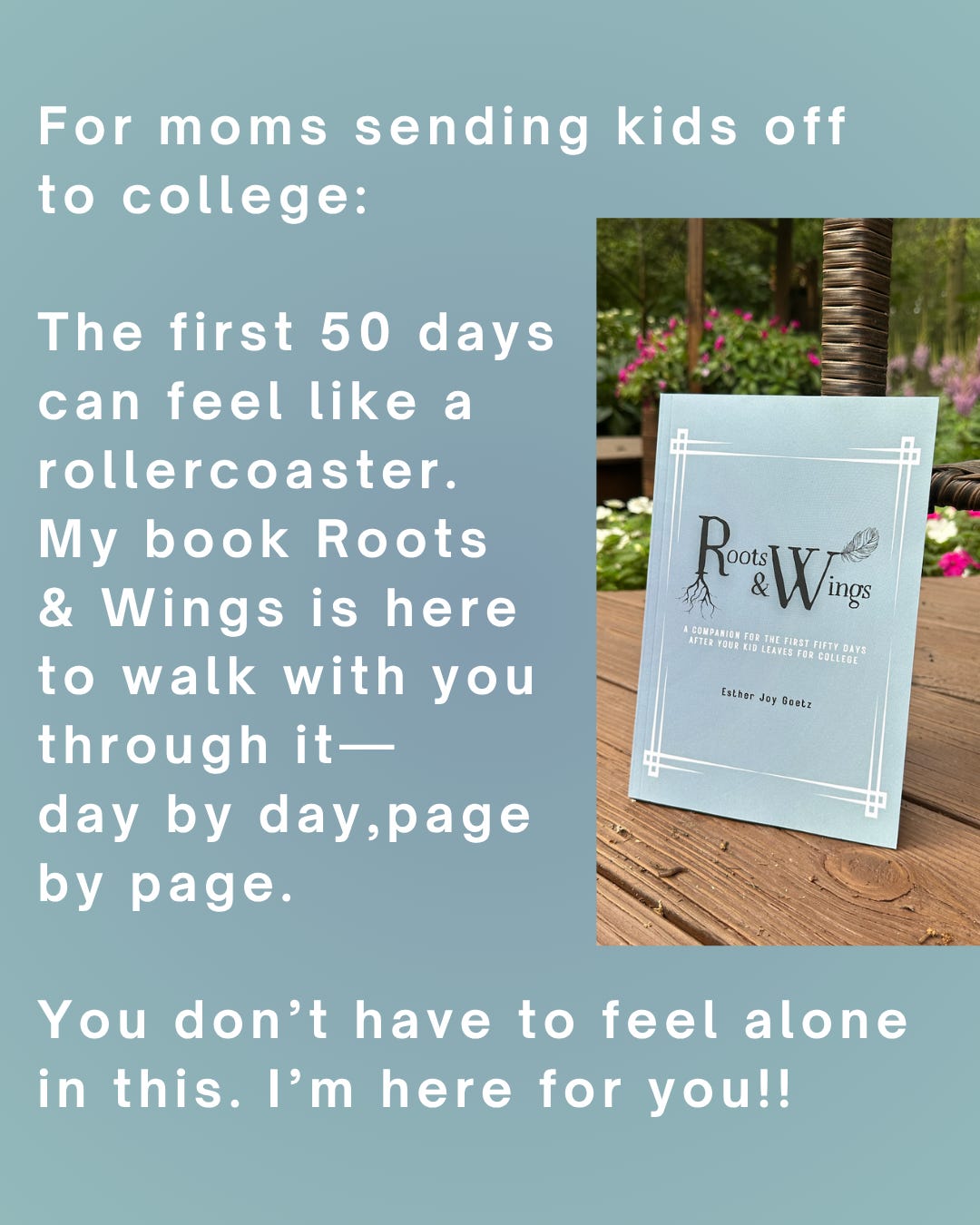
I’m now offering Mom-to-Mom Coaching (and it’s not crazy expensive like so many coaching spaces) — a simple, honest, judgment-free space to talk about big kids, changing roles, boundaries, worry, pride, grief, and everything in between.
If you’ve been thinking, “I wish I had someone to talk this through with,” this is for you.
FIND OUT ALL THE DETAILS HERE!
👉 Book a FREE 15-minute consult to see if it’s a good fit. No pressure, no commitment — just a real conversation.
💌 If this made you feel seen, share it with another mom who might be struggling and she isn’t quite sure what to do about it.
No posts
Comments
Nothing yet. Say the first thing.
Sign in to join the conversation.