
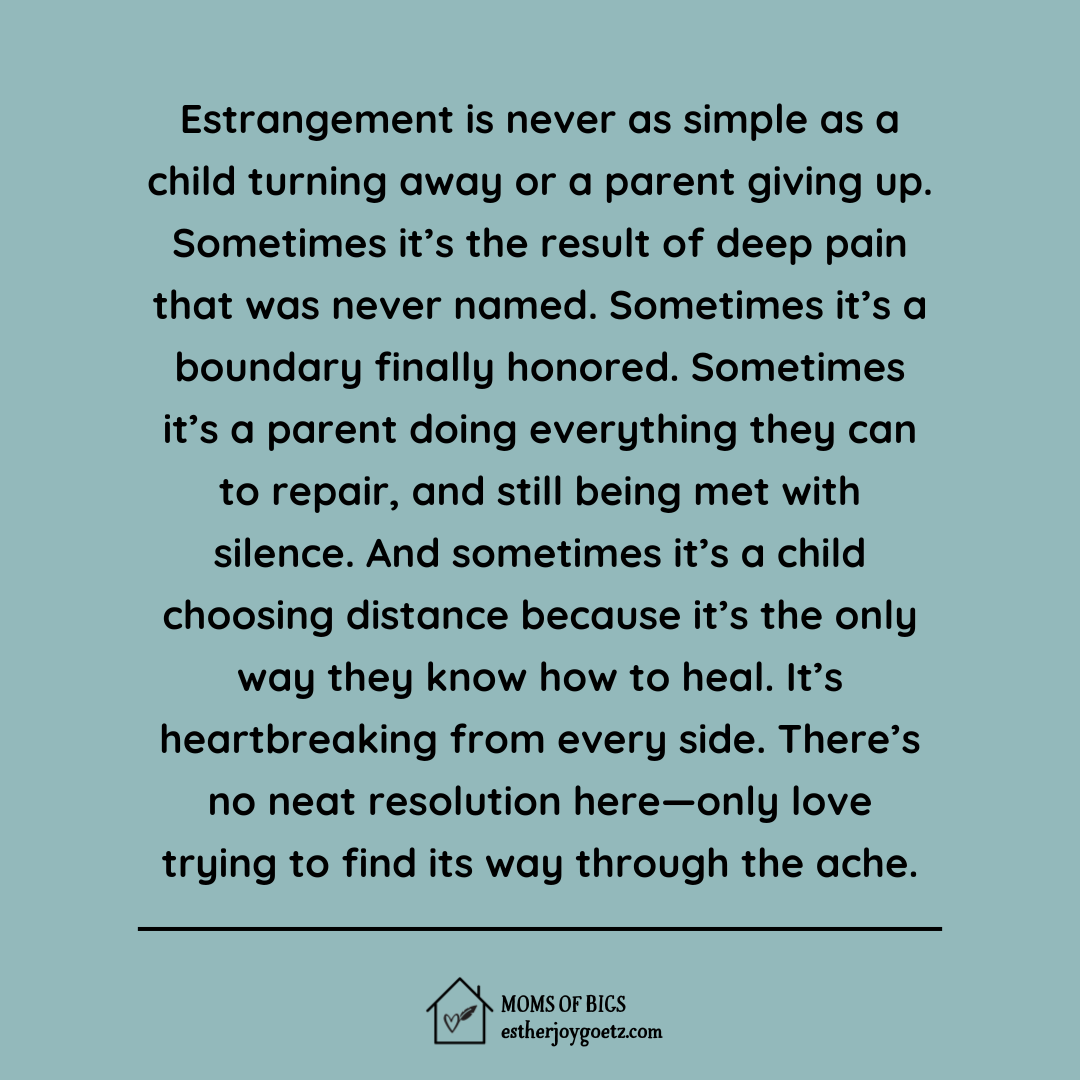
“Estrangement isn’t always about selfish kids or bad parents. Sometimes it’s about pain that hasn’t healed, boundaries that weren’t honored, or love that had to find a safer distance.” (Esther Joy Goetz)
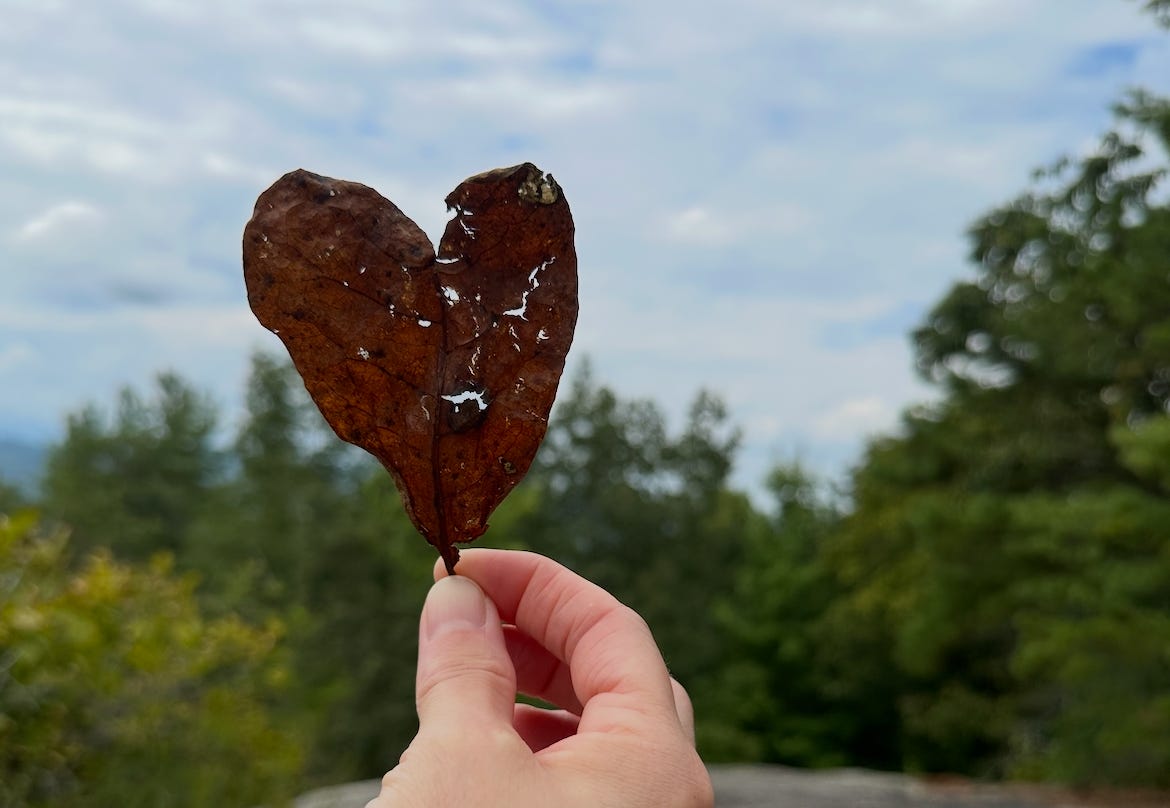
An estimated 25 million Americans are estranged from a parent.
I had to read that statistic twice.
Twenty-five million people carrying some version of this grief. Twenty-five million people navigating birthdays, holidays, grandchildren, milestones, and ordinary Tuesday afternoons with a relationship that has been fractured, paused, or lost altogether.
We often talk about estrangement as if it’s a cultural trend or a generational phenomenon. But behind every statistic is a family. And behind every family is a story that is almost always more complicated than it appears from the outside.
Three people in my family have had to sever ties with their mothers. I know several more outside my family who have felt they had to do the same.
Not over petty disagreements. Not because of mismatched personalities or the normal push and pull of growing up and becoming your own person. Not even because of political opinions or religious differences, though those things often found their way into the conflict.
These are stories rooted in deeper pain. Stories of manipulation, unhealed trauma, repeated boundary violations, and relationships that became increasingly difficult to sustain. In one case, the situation became so severe that a restraining order was necessary.
The outward disagreements were often visible. Arguments about faith. Politics. Parenting choices. But more often than not, those conflicts seemed to be symptoms of something much deeper. They were the cracks that finally appeared after years of strain beneath the surface.
Researchers consistently find that estrangement is most often connected to longstanding relational pain, unresolved trauma, repeated boundary violations, or deeply conflicting values—not simply a single disagreement or difficult season.
This is not the kind of thing anyone wants.
And yet, I see it everywhere.
On my Moms of Bigs social media pages, I’ll post something about boundaries or trust or respect between parents and adult children, and someone will inevitably comment,
My child doesn’t even talk to me anymore. It’s this estrangement generation. They don’t want to work things out. They just cut people off.
There’s something in me that aches every time I read those words.
Because beneath them, I rarely hear entitlement. Most often, I hear heartbreak. I hear the bewilderment of loving someone deeply and not knowing how to reach them anymore. I hear the grief of a parent whose picture of the future no longer matches the reality they are living.
No one becomes a parent imagining a future where their child grows up and walks away.
We imagine family gatherings and video chats and goodnight texts and grandchildren running through the house. We imagine relationships that change and evolve over time but remain intact. We assume there will be opportunities to repair misunderstandings, to grow together, to keep writing the story.
Estrangement is the opposite of what most parents hoped for.
But when I hear the phrase “estrangement generation,” I find myself wondering if it oversimplifies something profoundly human and painfully complicated.
What if, sometimes, it isn’t about selfishness or unforgiveness?
What if, sometimes, it’s about survival?
What if this moment invites us not to defend ourselves or explain ourselves, but to become curious?
Curious about our own patterns. Curious about the ways we may have contributed to pain, even when it was never our intention. Curious enough to ask questions that many of us would rather avoid.
Did I invalidate their feelings when they tried to tell me their truth?
Did I center my own hurt instead of staying present with theirs?
Did I react with control when compassion might have been more helpful?
Did I dismiss conversations about healing, therapy, boundaries, or growth because they felt uncomfortable or threatening?
These are often brutal and difficult questions. But sometimes the questions that make us the most uncomfortable are the ones that create the possibility for healing.
If we’ve hurt our children, intentionally or unintentionally, we may need to go first. Not with guilt trips. Not with pressure. Not with repeated reminders of how much we miss them. But with humility, accountability, and a willingness to repair what can still be repaired.
Because the truth is that there are real reasons people cut ties with a parent.
From my mom coaching and spiritual direction practices, the stories are rarely about one disagreement or one bad holiday dinner.
And while they vary from story to story, many of them sound something like this:
Ongoing emotional, verbal, or physical abuse—past or present
Narcissistic or controlling behavior, where the child’s autonomy was never honored
Political or religious intolerance that made the child feel unsafe or unwelcome for who they are
Dismissing or gaslighting their version of events
A pattern of chronic boundary violations, even after repeated conversations
Constant criticism or shame disguised as “just being a mom”
A parent’s refusal to acknowledge or take responsibility for past harm
The need to protect their own children from unhealthy patterns
The slow buildup of unresolved hurt and emotional exhaustion
Sometimes it’s not one big rupture.
Sometimes it’s a thousand paper cuts that eventually become too much.
Of course, none of us know the full story of another family.
Not from a Facebook comment. Not from a podcast episode. Not from a single conversation.
Family systems are complicated. Memory is complicated. Hurt is complicated.
And actually, most people are not actually looking for someone to blame. They are looking for someone to understand. They are looking for someone who can hold the complexity of their story without rushing to conclusions. Someone who can sit with the reality that two people can carry very different experiences of the same relationship. Someone who can make room for grief without immediately trying to solve it.
And this is where I think we need to look at the other side of the coin.

What if we’ve already done the work?
What if we’ve sat in the therapist’s chair, read the books, faced the uncomfortable truths, and done our best to repair the patterns we inherited? What if we’ve learned to apologize without defensiveness? What if we’ve reached out, not once but many times, extending olive branches that were never picked up?
And still there is silence.
Still there is distance.
Still there are unanswered texts and unreturned calls and birthdays that pass without a response.
What then?
Perhaps then the invitation changes.
Perhaps the invitation is no longer to keep trying harder or to twist ourselves into the shape of who we think our child wants us to be.
Perhaps the invitation is to grieve.
To grieve not only the relationship itself, but the hopes we carried for it. To acknowledge the heartbreak honestly. To speak it aloud to a trusted friend. To bring it into a therapist’s office or get some “mom coaching” for your broken heart (I’m here for you). To pour it onto the pages of a journal. To stop pretending that we are fine when we are not.
To honor the effort we have made, even if it was never received.
To remember that healing is not always mutual or immediate. And reconciliation is not always possible.
One of the things I continue to learn with myself and my clients is that grief doesn’t respond well to force. We cannot shame ourselves into healing. We cannot analyze our way out of heartbreak. We cannot rush ourselves through loss simply because we are tired of carrying it.
Sometimes the most courageous thing we can do is sit gently with what is true today and resist the urge to force an ending to a story that is still unfolding.
Sometimes healing looks like reconciliation.
Sometimes healing looks like acceptance.
And sometimes we simply don’t know which one we’re being invited toward.
When it comes to estrangement, there are very few neat conclusions. There are no guaranteed formulas. No perfect words. No roadmap that works for every family.
Sometimes I wonder if calling this “the estrangement generation” misses the deeper story. Perhaps we are watching a generation wrestle openly with boundaries, trauma, identity, and healing in ways previous generations often could not. Perhaps we are witnessing the consequences of wounds that have gone unaddressed for decades. Perhaps we are simply seeing family pain become more visible than it once was.
I don’t know.
What I do know is that millions of families are carrying this ache. Millions of moms are sobbing in the shower or missing their kids with a fierce pain that feels unbearable at times. And that millions of “kids” feel lost without the ones who they thought would hold them for the long haul.
And that means none of us are as alone in it as we sometimes feel.
I also know that villainizing our children rarely helps. And villainizing ourselves doesn’t either.
The invitation, perhaps, is to stay open. To hold truth and tenderness at the same time. To make room for accountability where it is needed and compassion where it is needed. To resist easy answers and simple narratives.
Because family relationships are rarely simple.
And love, even when strained, broken, or distant, is rarely simple either. But it is still love. Fierce. Grounded. Honest.
It’s a love that says,
I am still here if and when you are ready. And if you’re not, I will still love you from afar. But I will also love myself enough to keep healing.
From my heart to yours,
Esther
Moms Helping Moms: What about this post resonated with you? Or felt sandpapery? I’m just one person writing my thoughts and I’d love to hear yours. We’re in this together.
Thanks for reading Moms of Bigs Substack! This post is public so feel free to share it.

I’m now offering Mom-to-Mom Coaching (and it’s not crazy expensive like so many coaching spaces) — a simple, honest, judgment-free space to talk about big kids, changing roles, boundaries, worry, pride, grief, and everything in between.
If you’ve been thinking, “I wish I had someone to talk this through with,” this is for you.
FIND OUT ALL THE DETAILS HERE!
👉 Book a FREE 15-minute consult to see if it’s a good fit. No pressure, no commitment — just a real conversation.
If you are navigating estrangement with an adult child, PEAK (Parents of Estranged Adult Kids) offers support, community, and resources for parents carrying this particular kind of grief. Their focus is helping parents move toward healing, acceptance, and hope, whether reconciliation occurs or not.
As always, thank you for joining me here at Moms of Bigs! Feel free to share this newsletter with anyone who might benefit! We’re all in this mom gig together, cheering each other on!!
No posts
Comments
Nothing yet. Say the first thing.
Sign in to join the conversation.