
“Our children can be the reason for our grief without becoming responsible for relieving it.” (Esther Joy Goetz)

I was feeling pretty good about myself.
I’d just spent almost nine days in Alaska with all four of our kids and their people. There had been airports, rental cars, hotel rooms, delayed flights, different personalities, different expectations, and all the little moments that can make family vacations either magical or... memorable.
And somehow, I’d made it through the entire trip without saying anything I regretted. (Okay, not anything... but nothing BIG.)
If you’re the mom of big kids, you know that’s no small accomplishment.
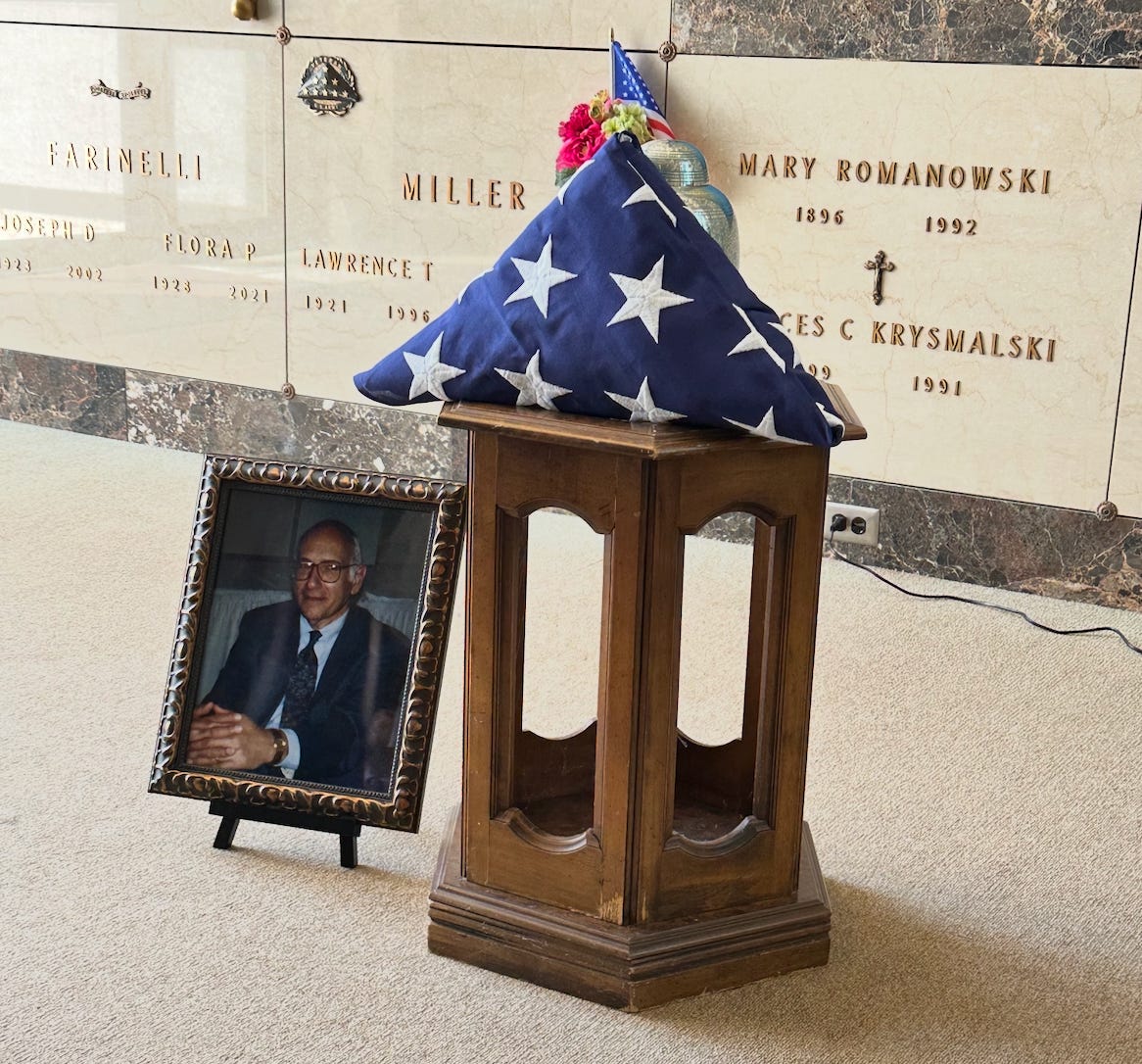
Then we came home, repacked our suitcases, and three days later drove six hours to Pittsburgh for my father-in-law’s funeral, with some of our kids getting right back on airplanes to be there.
Within just a few weeks, we’d experienced some of the highest highs and some of the deepest lows.
The joy of having all our kids together and watching humpback whales breach over and over again.
The exhaustion of constant travel and jet lag.
The grief of saying goodbye to someone we loved deeply.
By the morning of the visitation, I felt emotionally discombobulated. My nervous system was waving a little white flag, even if I hadn’t admitted it to myself yet.
Everyone had come in for the funeral except our youngest.
She lives in California, and after we’d just spent all that time together, another cross-country trip simply wasn’t realistic. Work, finances, and even the lingering cold she had caught on our trip made it impossible. We all understood that.
And still...
I missed her.
I found myself looking around the room and imagining where she would have been sitting. I wished she could have hugged her dad. I wished she could have heard the stories everyone was telling about Grandpa. I wished distance didn’t mean missing so many of the moments that quietly weave a family together over time.
Those feelings can all be true without meaning someone has done something wrong.
I’m finding that’s one of the hardest truths about parenting big kids.
So you know what I did?
I sent her a text that seemed perfectly reasonable in my mind.
I think it would be good for you to send Dad a note today. He seems a bit sadder that you’re not able to be here.
If you had asked me ten seconds after I hit send what my motivation was, I would have told you it came from love.
Love for my husband.
Love for my daughter.
A desire to make sure they both felt connected on a hard day.
But love doesn’t always land the way we intend it to.
Later that evening, she texted me back.
She told me she had already planned to message her dad that morning. In fact, she’d been looking forward to doing it. But waking up to my text changed something. Instead of reaching out because she wanted to, it suddenly felt like she was reaching out because she was supposed to.
UGH. I stared at my phone for a long time.
Not because I thought she was wrong.
Because she wasn’t.
Immediately, the defense attorney in me started preparing her opening statement.
I wanted to explain.
I wanted her to understand everything I had been carrying. The grief. The exhaustion. The fact that her dad really was sad. The ache of knowing that when your kids live far away, they inevitably miss things that matter.
I wanted her to know my text hadn’t come from manipulation.
At least not consciously. I really believed it had come from love.
But as I sat there, another realization began to surface.
Love may have been present...but so was something else.
There was a part of me that had quietly reached for one of the oldest parenting tools in the box.
A “should.”
You should text your dad.
It sounds so harmless. Loving, even.
But underneath that little “should” was something else: I was trying to regulate myself.
If she texted him, maybe he’d feel a little less sad. And if he felt a little less sad... maybe I would too.

And then something else broke through all the noise.
My daughter was trusting me enough to tell me how my words had landed.
She could have swallowed those feelings. She could have decided it wasn’t worth bringing up. Instead, she believed our relationship was strong enough to hold an honest conversation.
I didn’t want to waste that gift by making the conversation about me.
So I apologized. Said those very important words with no sneaky caveats: “I’m sorry.”
I told her it was not good on my part.
I admitted that I’d spoken for her dad when I shouldn’t have.
And then I wrote something that surprised me even as I typed it.
I spoke to try to control things and regulate myself and not from a good, healed place in my heart. Thanks for your patience with your mom as always.
The more I sat with those words, the more I realized they were true.
And you know how that child of mine responded?
She simply texted back:
Thank you 💕💕
Love you SO much.
I cried.
Not because I’d gotten everything right. Quite the opposite. I cried because she trusted me enough to tell me the truth. She didn’t stuff it down or quietly carry something that belonged between us. She trusted that our relationship was sturdy enough to hold an uncomfortable conversation, and I don’t take that for granted.
It’s a relationship that’s been built over thousands of ordinary moments. Moments where we’ve misunderstood each other. Moments where we’ve hurt each other. Moments where one of us has said, “I’m sorry,” and the other has said, “I forgive you.” Not perfectly, but faithfully.
And then, after all the tears had dried, another question quietly took its place.
Because if I’m really honest, there were still so many things I wanted to say to her. I wanted to tell her how much I hated that she wasn’t there. I wanted to tell her how much I wish she lived closer. I wanted to tell her that every funeral, every birthday, every random Sunday dinner reminds me that someone is missing.

Every one of those things is true.
But are they hers to carry?
I’ve been sitting with that question ever since because somewhere in the middle of all of this, another sentence found me.
Our children can be the reason for our grief (or, to be honest, for all our dysregulation) without becoming responsible for relieving it.
I don’t know that I’ve ever had words for that before.
Of course my daughter’s absence is part of my grief. I miss her. I wish she lived closer. I wish distance didn’t ask so much of our family. Those feelings are real. But they’re mine to tend. Mine to grieve. Mine to bring to my husband, to a trusted friend, to a therapist, to God. Not because my daughter isn’t compassionate enough to hold them, but because I don’t want her to ever feel responsible for fixing them.
And that’s where I’ve been left this week. Wondering where that line is. Wondering how to let my children know the truth of my heart without quietly handing them the weight of it.
I’m not sure I know the answer yet.
I just know it feels like one of the most sacred questions motherhood has ever asked me.
From my trying-to-regulate mama heart to yours,
Esther
💬 Mom-to-Mom Reflection:
I’m genuinely curious.
How do you let your big kids know they’re deeply missed... without making them feel responsible for your missing them?
I don’t think I’ve figured that out yet, and I’d love to hear what you’ve learned. Or anything else you want to share, because I love comments!!

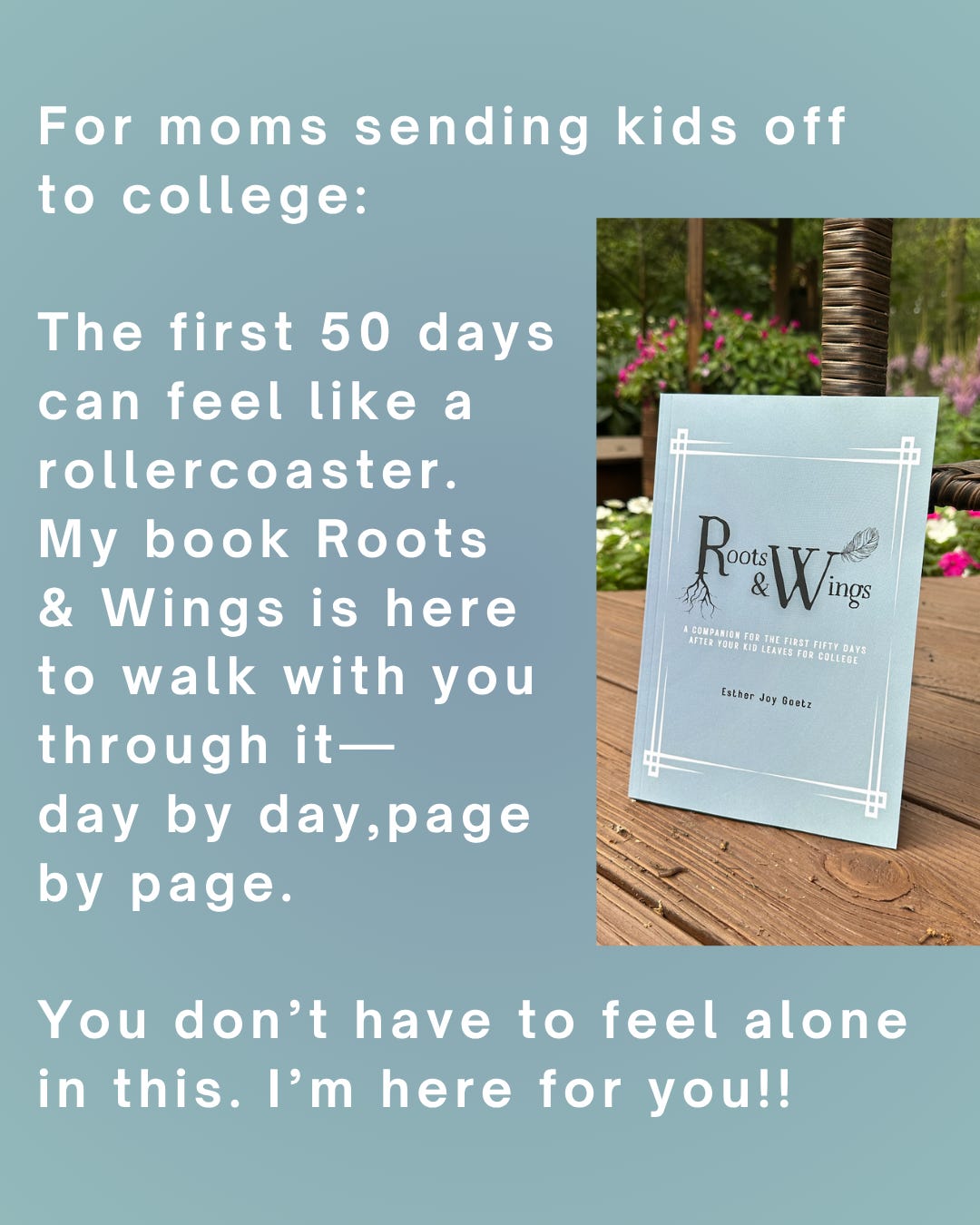
I’m now offering Mom-to-Mom Coaching (and it’s not crazy expensive like so many coaching spaces) — a simple, honest, judgment-free space to talk about big kids, changing roles, boundaries, worry, pride, grief, and everything in between.
If you’ve been thinking, “I wish I had someone to talk this through with,” this is for you.
FIND OUT ALL THE DETAILS HERE!
👉 Book a FREE 15-minute consult to see if it’s a good fit. No pressure, no commitment — just a real conversation.
💌 If this made you feel seen, share it with another mom who might be struggling and she isn’t quite sure what to do about it.
No posts
Comments
Nothing yet. Say the first thing.
Sign in to join the conversation.