
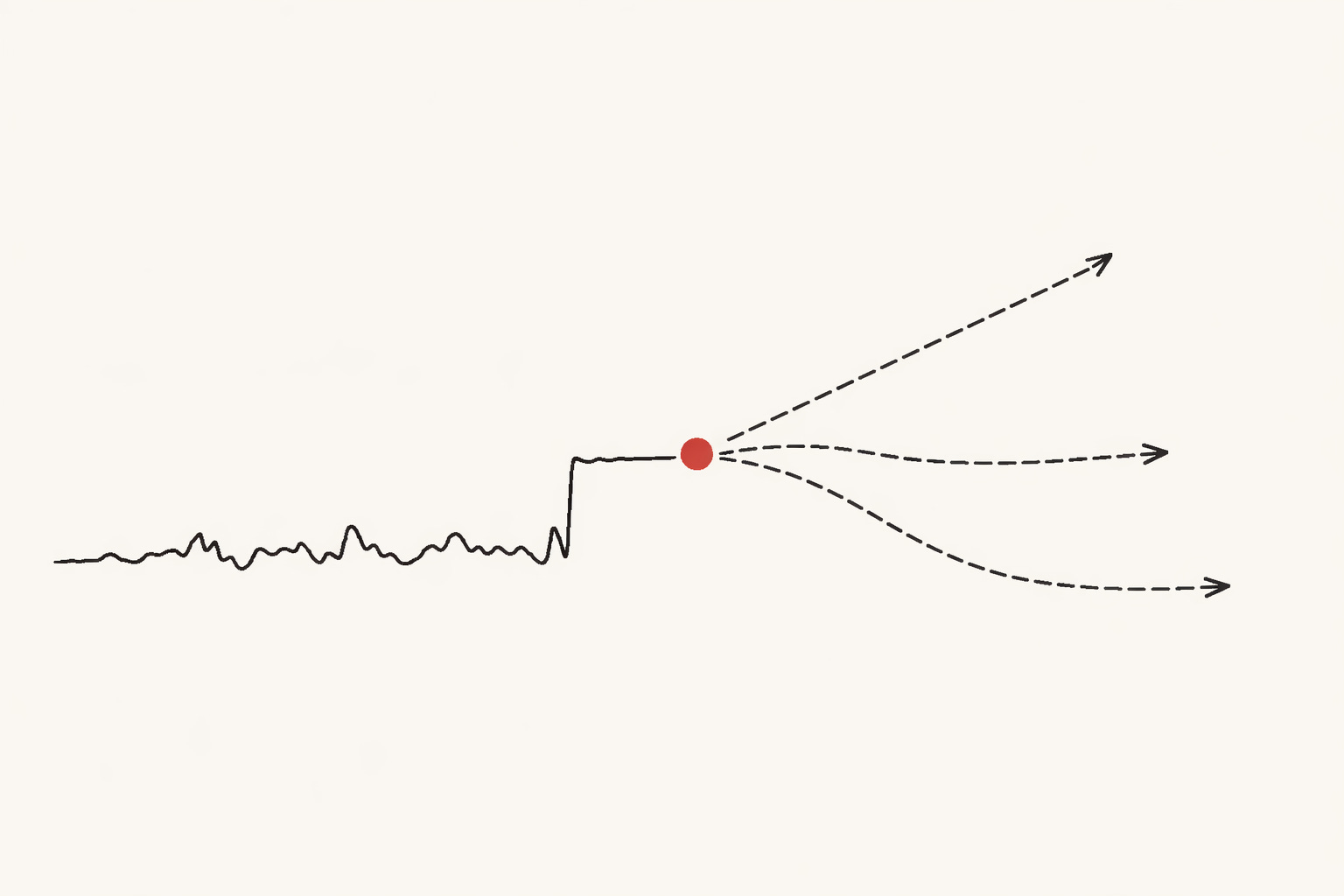
Central banks around the world face decisions this week amid extreme uncertainty about oil prices. Conflict in the Middle East has disrupted supply routes. Prices are rising. And the question everyone is asking — what happens next? — does not have a straightforward answer.
Two thoughtful recent analyses here on Substack capture the difficulty well. Erik Fossing Nielsen argues that the ECB should hold steady: supply-driven inflation is beyond the reach of monetary policy in the short run, and Europe’s energy resilience has improved dramatically since 2022. Stefan Gerlach observes that oil prices could plausibly end the year anywhere between 30 and 120 USD per barrel, making the case for strategic inaction — emphasizing vigilance without committing to a direction.
Both analyses are based on deep experience and market understanding. And both reveal the same fundamental difficulty: we don’t know how large the oil price jump will be. We don’t know how long it will last. We don’t know how much of the increase will pass through to inflation. And we don’t know whether this disruption is temporary — with prices eventually returning to pre-conflict levels — or the beginning of something more lasting.
This is not a failure of analysis. It is an honest description of a situation where the future is genuinely unknown. The question I want to raise is: what kind of forecast does this situation call for?
Both Nielsen and Gerlach draw comparisons to the 2021–22 inflation surge — but emphasize that this time is different. The starting conditions have changed: energy resilience is stronger, policy rates are higher, and central banks are determined not to repeat the “transitory” mistake. These are important differences.
But there is a deeper similarity between then and now that is worth emphasizing. In both episodes, we are entering territory where the past offers limited guidance. In 2021, nobody knew how an unprecedented fiscal-monetary combination would interact with pandemic-disrupted supply chains. Today, nobody knows whether the current disruption will be contained or will cascade into a broader reorganization of energy supply.
In the language of economic theory, the standard framework treats disruptions like these as shocks — large but temporary disturbances hitting an economy whose underlying mechanisms are assumed to remain constant. The oil price jumps, but the transmission from oil prices to inflation, the structure of energy supply, and the policy reaction function are all assumed to work the same way as before. The economy is knocked off course but transitions back toward its previous path.
That framing is not neutral. And the language matters more than we might think.
When commentators ask “how should central banks react to the oil price shock?”, many of them mean something broader than the narrow theoretical concept — they are thinking about a complex, evolving situation with uncertain implications. But the word “shock” quietly imports the constant-mechanism assumption. It frames the question as being about the size of the disruption and the appropriate calibration of the response, not about whether the mechanisms themselves might be changing. We need a broader framing, because the appropriate reaction depends on whether this is just a large shock within a familiar regime or a structural change — a shift in the regime itself.
Consider a concrete illustration. The ECB’s December 2025 projections included option-implied oil price paths in which even the 75th percentile remained below 75 USD per barrel through 2026. Current prices are far above that range. We have moved outside what the market considered plausible just three months ago — not because of an unusually large draw from a known distribution, but because the conflict has changed the dynamics of oil supply itself.
At the same time, as Nielsen points out, Europe’s energy landscape has undergone its own structural shift since 2022. The EU has replaced 100 billion cubic metres of Russian gas annually, energy intensity has fallen, and the energy mix has diversified. This may mean that the pass-through from oil prices to European inflation is smaller than it was during the 2022 shock — another structural change, this time working in the favorable direction.
These shifts illustrate precisely why the situation is so difficult to forecast. The uncertainty is not just about the magnitude of a known type of disruption. It is about whether the underlying dynamics — geopolitical alignments, supply structures, the energy transition — have themselves shifted, and in which directions. In theoretical terms, this is the distinction between a shock within a stable regime and a structural change to a new regime.
My research with Roman Frydman formalizes this distinction. When the economy undergoes nonrepetitive structural change, the future may differ from the past in ways that no fixed probability distribution can capture. That is Knightian uncertainty — not just large probabilistic risk, but genuine uncertainty about the structure of the economy.
The distinction between probabilistic risk and Knightian uncertainty has practical implications for forecasting and the corresponding communication of forecast uncertainty.
What Nielsen and Gerlach are doing — reasoning carefully through different possibilities, looking to the past for guidance while acknowledging that this time might be different — is exactly the right kind of analysis for a situation like this. They are offering narratives: if the disruption is temporary, here is what follows; if it is not, the implications are different.
But the conventional forecast format does not fully match this kind of reasoning. The standard approach at most central banks is to publish a baseline projection — the most likely path for growth, inflation, and other key variables — accompanied by a fan chart that shows the range of uncertainty around that central case. Some central banks supplement this with sensitivity analyses: what happens to the forecast if oil prices are 20% higher, or if the exchange rate moves? And occasionally, as in the ECB’s June 2025 projections on tariff policy, full alternative scenarios are included alongside the baseline.
These are useful tools. But notice what remains focal: the baseline. The fan chart communicates uncertainty about magnitude within a scenario — things may turn out higher or lower than the central case, but the underlying story is the same. Sensitivity analyses ask “what if one input is different?” while keeping the rest of the framework fixed. Even when alternative scenarios are included, they tend to be presented as risk illustrations around a baseline that retains its privileged status as “the forecast.”
What this format struggles to express is uncertainty between scenarios — the possibility that the story itself might be different, that the mechanisms might have changed. The ECB’s December 2025 oil price sensitivity analysis is a case in point: even its most pessimistic path fell well below where prices are today. The current situation did not just exceed the baseline — it fell entirely outside the range of reported sensitivities. That is not a failure of calibration. It is a signal that we have moved into a different kind of uncertainty.
When the honest answer is “we are not sure which world we are in,” a wider fan chart is the wrong response. It communicates “I know the story but not the numbers” when the truthful message is “I am not sure which story we are in.”
If the uncertainty is genuinely about which story we are in, the forecast format should reflect that. Instead of a single central projection, the honest alternative is a small set of scenarios — each with:
A narrative explaining what kind of world it describes and why the forecast path looks the way it does
A conditional forecast showing what follows if this story is right
An uncertainty band within each scenario (because even within a story, the numbers are uncertain)
Signposts: what incoming data would make you update toward or away from each scenario
For the current oil price situation, this might mean two scenarios: one where the disruption is contained within months, oil returns toward pre-conflict levels, and inflation impact is limited; and one where supply structures shift more permanently, the oil price settles at a higher level, and second-round effects on wages and expectations require a different policy response. Each scenario would specify not just a forecast path, but what evidence — tanker traffic, supply agreements, wage negotiations, inflation expectations data — would make you update toward or away from it.
This is not scenario planning as decoration. It is forecast communication that matches the actual structure of the uncertainty.
It also gives concrete meaning to the “data-dependent” approach that central banks increasingly emphasize. With a single central projection, data-dependence is vague — it means “we will adjust if things change,” without specifying what would trigger a change or in which direction. With explicit scenarios, it becomes precise: if incoming data are more consistent with one scenario than another, the central bank shifts its assessment — and the public understands why, because the scenarios were laid out in advance. The promise is not “we will always be right” but “we will tell you what we are watching, and if the data point toward a different story, we will react accordingly.”
Practitioners are already moving in this direction. Thomas Harr, reflecting on lessons from the post-2021 inflation surge in Chapter 9 of his excellent book with Callum Henderson, The Great Inflation Resurgence, writes that the pandemic was “an example of what Mervyn King and John Kay call ‘radical uncertainty’” (p. 143) — a situation where people can form views about what might happen, but cannot ground those views in reliable probabilities.
His practical conclusion: “particularly when large, unprecedented shocks occur, it is crucial to analyze inflation from all angles” (p. 148) and to rely on broad economic reasoning rather than model output alone. He also notes that “when large shocks occur, it may also be useful for central banks to publish scenario analyses in addition to the base case” (p. 152).
The Riksbank has pioneered this approach, publishing alternative scenarios with separate policy rate paths alongside its main projection — explicitly because, as they put it, “the only thing we can be sure of is that the future will not unfold as we expect.” The Bank of Canada went further during the pandemic, replacing its usual projection with a range of scenarios when a single baseline could not be credibly maintained. The Bank of England, catalyzed by the Bernanke Review, is moving toward multi-framework approaches that do not assume expectations are always well-anchored.
The ECB itself has moved in this direction, though episodically. Its June 2025 projections included two alternative scenarios on US tariff policy alongside the baseline — each with distinct assumptions and separate forecast paths. The current oil price situation would seem to call for the same treatment. It will be worth watching whether the ECB’s March 2026 projections include explicit scenarios for different oil price trajectories — and if so, whether they are presented as genuine alternatives or merely as sensitivity analyses around a baseline that remains focal.
What these developments share is an implicit recognition that during episodes of structural change, the most important uncertainty is between stories, not within one.
Consider again the current oil price situation. If the disruption is temporary — contained to current supply routes, with prices returning to pre-conflict levels once the situation stabilizes — one set of policy responses follows. If the energy landscape is shifting more fundamentally — new geopolitical alignments, changed supply elasticities, accelerated or disrupted energy transition — a different set of responses is appropriate.
A forecast that holds open both stories, specifies what each implies, and tells you what evidence to watch for is not a failure of forecasting. It is forecasting that is honest about what we do not know.
The reasoning that Nielsen and Gerlach offer — careful, experienced, weighing multiple possibilities — deserves a forecast format that can express it. Scenarios provide that format. Not because the “temporary disruption” story is necessarily wrong, but because we cannot know in advance whether it will turn out to be right.
No posts
Comments
Nothing yet. Say the first thing.
Sign in to join the conversation.