
In my previous post, I argued that when the world might be undergoing structural change, a single forecast with a fan chart is the wrong format. The honest alternative is a small set of scenarios — each with a narrative, a conditional forecast, and signposts for what evidence would shift your assessment.
This week has underscored the point. Central banks around the world have responded to the Middle East conflict and the associated energy price surge — and several have done exactly what that post argued for: the ECB published three alternative scenarios for oil prices and their pass-through to inflation. The Riksbank presented two scenarios without attaching probabilities, in addition to their baseline forecast. Jerome Powell acknowledged in his press conference that the uncertainty surrounding the Fed’s outlook has increased substantially.
In this post, I will explain the underlying reason why structural change requires a fundamentally different approach to forecasting. This requires acknowledging the distinction between probabilistic risk and Knightian uncertainty.
Frank Knight drew this distinction in his classic book Risk, Uncertainty, and Profit, published in 1921.
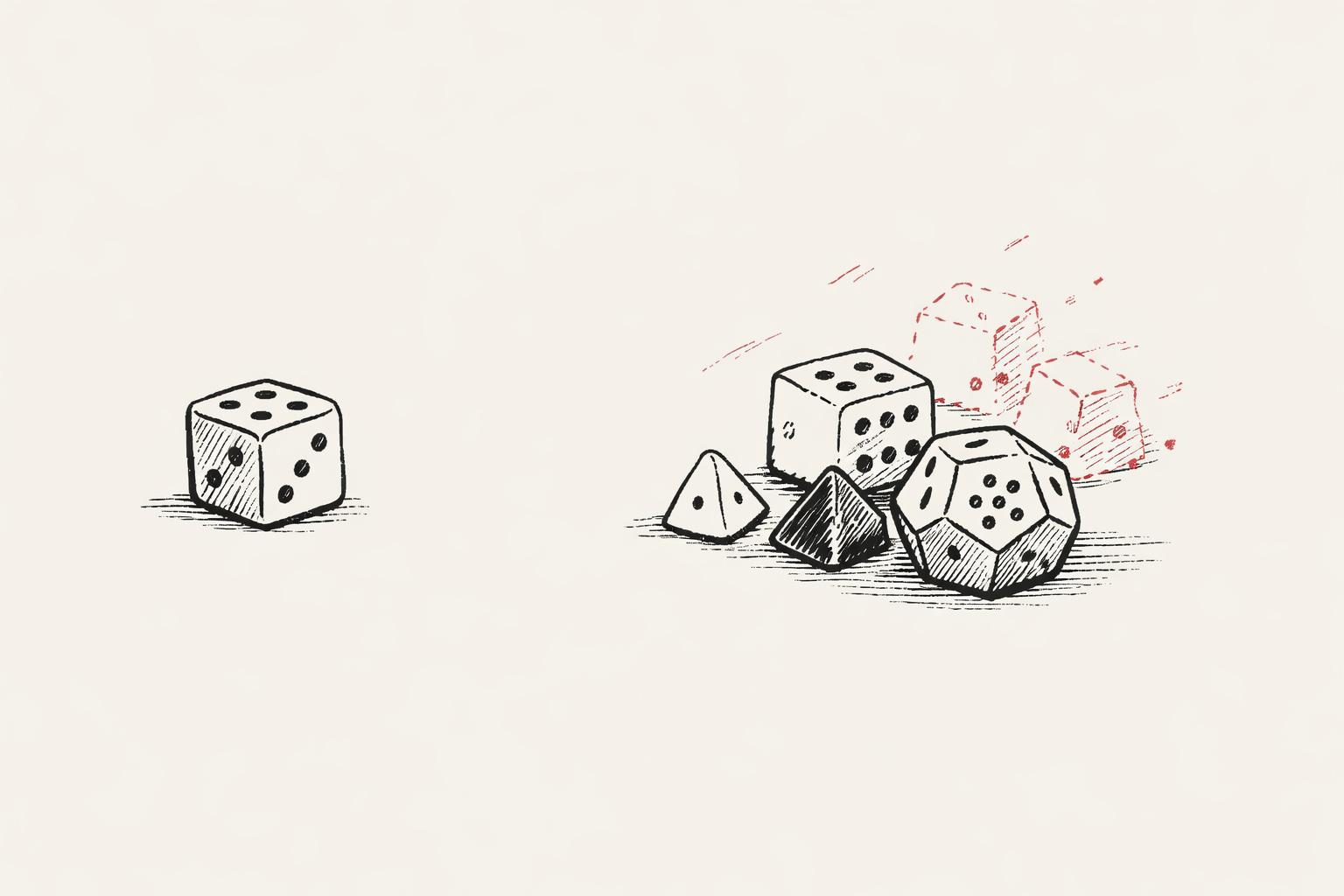
Risk, he argued, is uncertainty that can be characterized in probabilistic terms: you don’t know the outcome, but you can describe the possible outcomes with a probability distribution. Rolling dice involves risk — you don’t know whether the next throw will be a six, but you can assign probabilities to all six possible outcomes. In some risky situations, you might not initially know the probability distribution, but you can learn it from past data: roll the die enough times and the frequencies converge.
True uncertainty — what is now called Knightian uncertainty — is different. You cannot reduce the uncertainty to a single probability distribution. What has been largely overlooked in the subsequent literature is Knight’s key argument for why this is the case: the economy undergoes changes that cannot themselves be characterized in probabilistic terms. You cannot reduce the uncertainty to risk, because the situation itself might change in ways you cannot foresee.
Knight’s insight was that Knightian uncertainty is not simply a more extreme version of risk. It is qualitatively different, and it arises for a specific reason: the economy undergoes changes that have not occurred before. It is the novelty of the change that makes the uncertainty unquantifiable. If the same type of disruption had occurred many times under similar conditions, we could estimate its consequences probabilistically. But when the change is genuinely new — a new geopolitical configuration, a new energy landscape, a new structure of inflation expectations — there is no frequency to fall back on and no stable distribution to estimate.
Consider the current moment. A conflict has disrupted a fifth of the world’s oil supply. We don’t know whether it will last weeks or years, whether it will cascade into broader trade disruption, or whether the energy transition will accelerate or be set back. As Fed Chair Jerome Powell emphasized in his press conference on Wednesday: “We just don’t know.” This is not a situation where historical oil price distributions can tell us the probabilities. The underlying dynamics may be shifting in ways that make the past a poor guide to the future.
To see why this distinction matters, consider how the dominant theoretical framework in macroeconomics and finance formalizes uncertainty.
In the standard approach — rational expectations models, DSGE models, and their cousins — the economy is assumed to have a fixed structure. The equations that describe how output, inflation, interest rates, and expectations interact are assumed to be stable over time, governed by constant parameters. The economy is subject to shocks — random disturbances that push variables away from their expected paths — but the mechanisms through which those shocks propagate are assumed to remain unchanged. An oil price shock hits the economy; it transmits through well-understood channels (energy costs, consumer spending, inflation expectations, monetary policy response); and the economy eventually returns toward its previous path.
In this framework, nothing ever happens that could not, in principle, have been foreseen and characterized in probabilistic terms. The shocks are draws from known distributions. The parameters are constants to be estimated from past data. The future is, in a precise sense, a probabilistic replica of the past: the same mechanisms, the same distributions, the same structure — just a different realization of the random variables, similar to a sequence of rolls of a die.
This is a powerful simplification. It makes the knowledge problem tractable: if the structure is constant, then learning about the economy reduces to estimating the model’s parameters, which can be done with sufficient data. It also implies that, in principle, perfect probabilistic foresight is attainable — agents who know the model’s structure can form expectations that are, on average, correct. All uncertainty is probabilistic risk: the future is unknown, but the distribution it is drawn from is not.
Consider what this meant for the ECB’s December 2025 projections. The oil price sensitivity analysis showed option-implied paths in which even the 75th percentile remained below $75 per barrel through 2026. Current prices are far above that range. The current situation didn’t just exceed the baseline — it fell entirely outside the space of possibilities that the analysis considered. That is not a failure of calibration. It is the consequence of basing the projections on the assumption that oil price movements in 2026 would resemble the recent past.
But there are periods where the recent past is a poor guide — and for the oil price, we are in such a period right now. This is because the economy does undergo structural change — shifts in the relationships between variables, in the behavior of economic agents, in the institutions and policies that shape outcomes. The energy landscape of March 2026 is not the energy landscape of December 2025. The structure of inflation expectations after five years of above-target inflation is not the same as before.
The key feature of these changes is that they are nonrepetitive. History often rhymes, as Mark Twain is supposed to have said, but it doesn’t repeat itself exactly. Each structural change has its own character — a unique combination of causes, channels, and consequences. The 2022 energy shock shared some features with the 1970s oil crises but differed in crucial ways. The current Middle East disruption shares some features with 2022 but differs in others. The similarities are real, and they provide some guidance. But the differences are also real, and they are precisely the part that cannot be read off from historical data.
Because these changes are nonrepetitive, future structural changes are unforeseeable. We cannot know in advance exactly how and when the economy’s structure will change. We may know that change is possible — even likely — but we cannot characterize the precise nature of the next change, because it hasn’t happened before. This is the deep reason for Knightian uncertainty: because the structural changes that drive the most consequential economic outcomes are unforeseeable, we cannot reduce the uncertainty about those outcomes to a single probability distribution.
This also renders perfect probabilistic foresight inherently impossible. No matter how sophisticated the model or how extensive the data, we cannot attain complete probabilistic knowledge of the future, because the future may differ from the past in ways we have not foreseen. As Karl Popper put it in A World of Propensities: “Quite apart from the fact that we do not know the future, the future is objectively not fixed. The future is open: objectively open.”
This is the core of the research program that Roman Frydman and I are developing at the INET Center on Knightian Uncertainty. In our recent working papers, we formalize this argument: when the economy undergoes unforeseeable structural change, rational forecasters face Knightian uncertainty, and their forecast errors have a specific, testable structure — one that differs fundamentally from what standard constant-parameter models predict.
This might sound like a theoretical or philosophical discussion. It is not. The distinction between shocks and structural changes — and between risk and Knightian uncertainty — has direct practical consequences, and the language we use helps shape how we deal with uncertainty.
Most economists and commentators talk about the recent oil price surge as a “large shock.” They do not necessarily mean “shock” in the narrow sense of a constant-parameter model — they often mean something broader, something closer to “a big, disruptive event.” But the language matters, because the word “shock” quietly imports the constant-mechanism assumption. It frames the question as one of calibration — how large is the shock? How much will inflation rise? — rather than one of identification: are the mechanisms themselves changing? Is this the same game with a larger disturbance, or a different game?
When we call the current oil price disruption a “shock,” we are implicitly asking: how much will inflation rise given the existing structure of the economy? When we call it a “structural change,” we ask a different question entirely: has the energy supply landscape shifted? Have the transmission mechanisms from oil prices to inflation changed? Are inflation expectations behaving differently than they did in previous episodes? These questions have different answers and different policy implications.
The distinction also matters for how we communicate uncertainty. A fan chart says: I know the story but not the numbers — the model is right, and the only question is the magnitude. A set of scenarios says: I am not sure which story we are in. These are different cognitive states, and conflating them leads to the wrong tools being applied in the wrong situations.
The most important implication of taking this distinction seriously is this: we cannot quantify the true uncertainty about the future. Not because our models are too simple or our data too limited — but because the economy undergoes unforeseeable structural change, and there is therefore no single probability distribution that correctly characterizes the uncertainty we face.
But this does not mean that we cannot quantify uncertainty or make forecasts at all. We can — and we must. What it means is that all quantifications of uncertainty and all forecasts are contingent: they depend on a specific assumption or assessment about whether and how the economy’s structure might change.
Contingent on a specific scenario — say, that the conflict is short-lived and oil prices return to pre-conflict levels — we can quantify the uncertainty and produce a well-defined forecast. The forecast is rigorous. The uncertainty quantification may be based on advanced models estimated on decades of data. But it is contingent on the scenario being correct.
During stable times, when the economy’s structure has been relatively constant, we might reasonably assess that the near future will be structurally similar to the recent past. In that case, the uncertainty can be well approximated as probabilistic risk: a single model, a single probability distribution, estimated from past data. This is the domain where standard tools — confidence intervals, fan charts, VAR forecasts — work well, because the assumptions they rest on are approximately satisfied.
But during times of major change — when the economy’s structure may be shifting in ways we cannot fully anticipate — a single scenario is not enough. We need multiple scenarios, each with its own conditional forecast and its own uncertainty band. And we have to acknowledge that there is no objective basis for attaching probabilities to those scenarios, because the structural changes they describe are unforeseeable.
We might choose to attach probabilities — say, assigning one-third to each of three scenarios. That is a legitimate choice, and it reduces the set of scenarios to a single (compound) probability distribution. But those probabilities are themselves contingent assessments. There is no frequency data and no structural model that can tell us the “true” probability of an unforeseeable change occurring. Two equally competent, equally well-informed forecasters can attach different probabilities to the same scenarios — not because one of them is wrong, but because they are making different assessments about the likelihood of structural change, and there is no way to distinguish between those assessments in advance.
This is the fundamental challenge of forecasting in an economy that undergoes unforeseeable change: we can produce rigorous, model-based forecasts contingent on specific scenarios, but we cannot know in advance which scenario will turn out to be correct. This is not a limitation we can overcome with better models, more data, or more sophisticated estimation techniques. It is inherent in the nature of the problem. The uncertainty is irreducible — not because we are ignorant, but because the future is genuinely open.
Consider again the current situation. The Middle East conflict is a vivid example of an unforeseeable change. Of course we knew that a conflict in the region was possible. Geopolitical risk in the Middle East is a perennial concern. But there is no way to assess in advance exactly what a specific conflict — with its particular combination of actors, targets, and escalation dynamics — will mean for oil prices, energy supply routes, inflation, and the broader economy. The specific consequences are unforeseeable, even if the general category of uncertainty was recognized and multiple scenarios considered.
This is precisely why several major central banks have, in the past few days, moved toward the kind of uncertainty communication that the theoretical argument calls for. The ECB published three alternative scenarios for oil price developments and their pass-through to inflation — and explicitly stated that its standard fan charts, based on historical forecast errors, “would not, in the present circumstances, provide a reliable indication of the high uncertainty.” The Riksbank published two alternative scenarios without attaching probabilities. Even at the Fed, which maintained its standard dot plot and fan chart apparatus in its Summary of Economic Projections (SEP), Jerome Powell admitted in the press conference that “if we ever were to skip a SEP, this would be a good one — because we just don’t know.”
These responses are not ad hoc — even if they are not always framed in the language of Knightian uncertainty. They reflect a recognition, implicit or explicit, that the current situation is not well described by a single probability distribution. That multiple stories are plausible. And that the honest response is to present the analysis contingent on different scenarios, rather than pretending that a wider fan chart captures what we don’t know.
In my next post, I’ll tell the story of how this is playing out across central banks — a quiet revolution in how monetary policymakers communicate forecast uncertainty. It is a revolution that has been building since the 2021–22 inflation failure, catalyzed by the Bernanke Review, and now accelerated by the events of this week.
No posts
Comments
Nothing yet. Say the first thing.
Sign in to join the conversation.