
All the way back to Gibson’s very first forays into electric amplification in the latter half of the 1930s, the manufacturer has sought new and effective ways to make the strings wiggle and warble. Pioneers of electric guitar on the Gibson roster - names like William H “Herman” Doeppe (the Glenn Miller Orchestra) and or Les Paul himself - were eager to see what sorts of new sonic possibilities the burgeoning technology could offer, and Gibson was happy to provide.
From this primordial ooze of electric guitar design, Gibson’s forays into vibrato hardware finally sprouted legs and crawled out of the muck in the 1950s, with the introduction of Paul Bigsby’s eponymous design, which quickly became a mainstay on Gibson guitars. But it wasn’t all Bigsby all the time: Gibson’s in-house Maestro brand took center stage in the 1960s with a string of unique vibrato designs, and the hardware evolved right alongside the instruments themselves. By happy chance, we’ve got every iteration of Maestro vibrato in the shop right now, providing us a perfect opportunity to talk about this fascinating era of pivotal Gibson history.
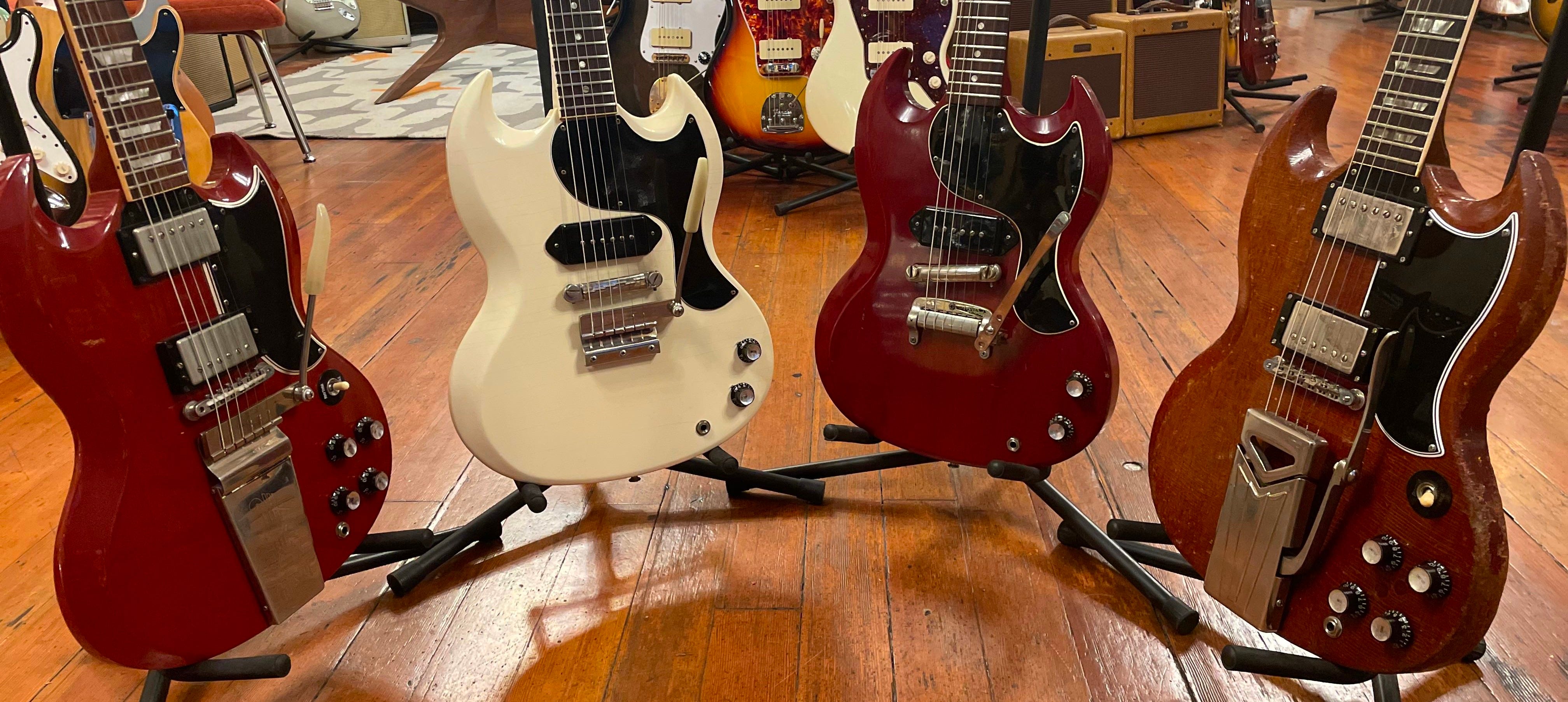
In the 1950s, Gibson not only had licensed Bigsby’s vibratos, they even had a hand in the unit’s overall development. Legendary Gibson president Ted McCarty had a long-standing relationship with Paul Bigsby, and helped redesign the original fixed arm to the movable version Bigsbys have featured ever since. However, with the release of the redesigned Les Paul in 1961 (the instrument we now know as the SG), Gibson wanted to kit it out with their latest tech.
The result was this beauty (in form if not in function):
THE “SIDEWAYS” VIBROLA (1961)

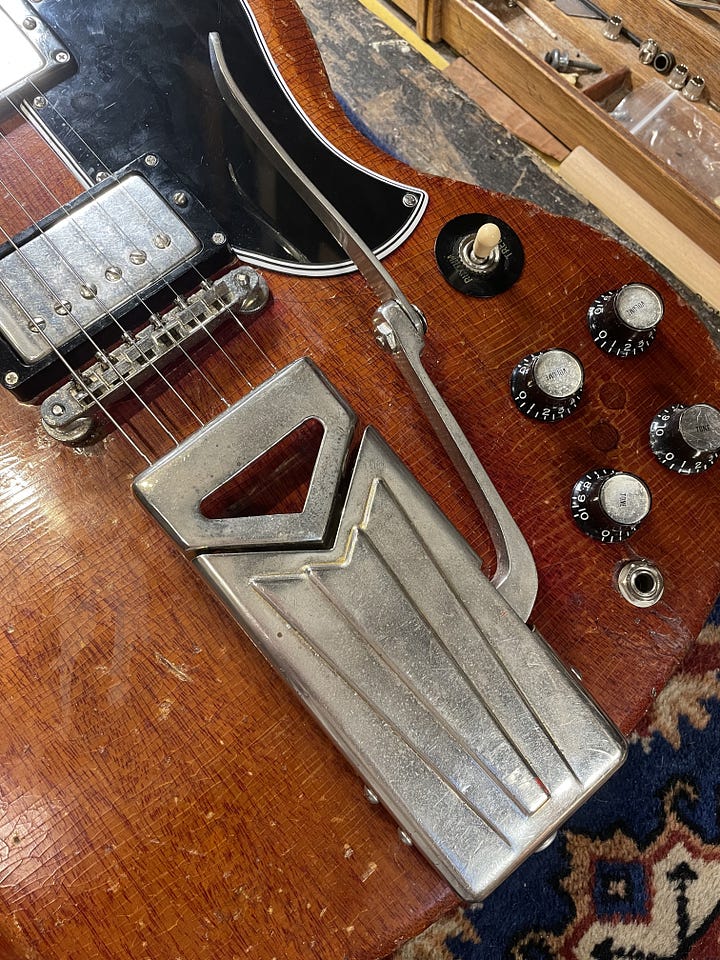
Now commonly referred to as the sideways or side-pull vibrola, this unit was simply advertised in the 1961 catalog as the New Gibson Vibrato, with the sales pitch that it “operates in [the] direction of pick stroke; swings out of the way for rhythm playing.” Available as early as 1959 on Gibson’s ES models, it’s a common misconception that the sideways vibrola was introduced in ‘61 alongside the new Les Paul (SG).
The sideways vibrola is an undeniably cool-looking piece of kit: it’s got Art Deco-influenced stylings on the cover plate, a two-piece folding arm, and a commanding visual presence on the guitar. Functionality is achieved via a fascinatingly complex array of machined aluminum components which transfer the movement of the arm to a pair of springs. The internals on these are absolutely gorgeous, and wonderfully over-engineered, particularly when compared to other, simpler designs.
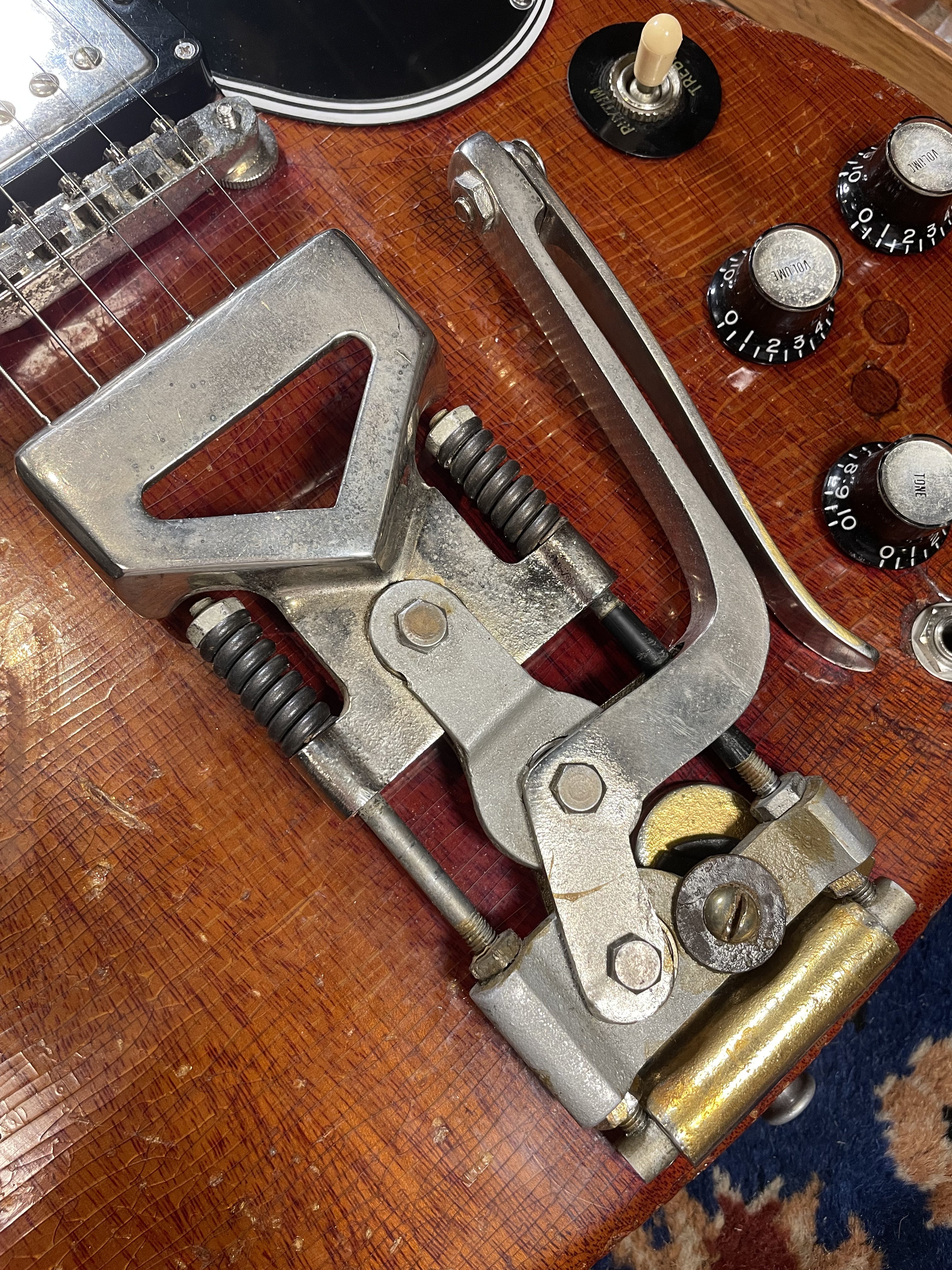
However, if you’ve ever used one of these vibratos (the original or the various recreations Gibson has made for ‘61 reissues), you know that they are far from the most functional. If you’re looking for Floyd Rose levels of stability, look elsewhere: while the side-pull action does enable some unique intra-picking interactions, these units are infamous for falling in and out of pitch on less than a whim, to the point where many users would simply block the vibrato, sacrificing all functionality for the sake of overall stability (MojoAxe even sell a kit designed specifically for this purpose).
The central “why” of this overbuilt design and its implementation on a Les Paul (SG) can be traced directly back to the original vibrato unit: the “Vib-Rola,” invented by Clayton “Doc” Kauffman. Kauffman was a lifelong friend and early collaborator of Leo Fender’s: Fender and Kauffman’s company K&F was the direct progenitor to the Fender Electric Instruments Company, which Leo started after Doc left the company.
Prior to K&F, Kauffman was a designer at Rickenbacker, who jumpstarted the electric guitar industry in 1931 with the introduction of their “Frying Pan” lap steel. In 1932, Kauffman patented a design for an “Apparatus for Producing Tremolo Effects,” which Rickenbacker then utilized on the Ken Roberts Electro-Spanish model. Just like the unit that Gibson would later implement, the Kauffman Vib-Rola was actuated via a side-pull mechanism, albeit with only one spring compared to Gibson’s two.

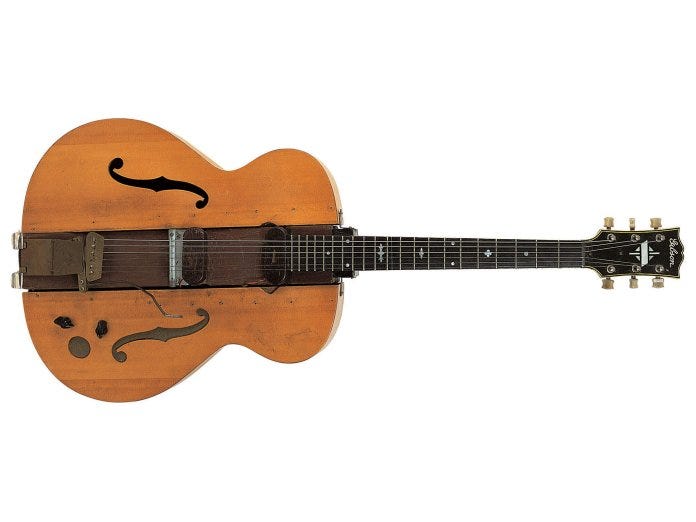
The Kauffman Vib-Rola was an exceptionally forward-thinking bit of kit, and forward-thinking musicians were drawn to it, despite its stability issues and limitations. Kauffman was friends with Les Paul, and it was a Kauffman Vib-Rola that Paul put on his “The Log” prototype electric guitar in the ‘40s and, in turn, on his original 1952 Les Paul, removing the factory tailpiece to do so. Gibson was, at least to some degree, familiar with seeing a side-pull vibrato on their instruments and had factory-installed the Kauffman as early as 1934.
In that context, the side-pull vibrola makes sense as a more robustly-built, vertically actuating evolution of the Kauffman design, but it does little to diminish the inherent flaws. Relative freshness of bushings and springs make a big difference, of course, as well as the use of a heavier string gauge being more in-line with the norms of the early ‘60s, and some units return to original pitch better than others. Overall, though, these vibratos weren’t destined to stick around for long - they couldn’t compete with the more stable units already on the market like Leo Fender’s Synchronized Tremolo or Paul Bigsby’s various offerings.
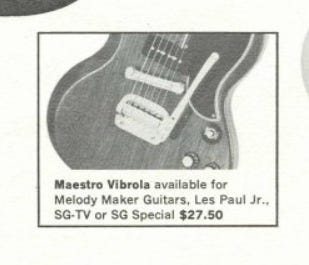
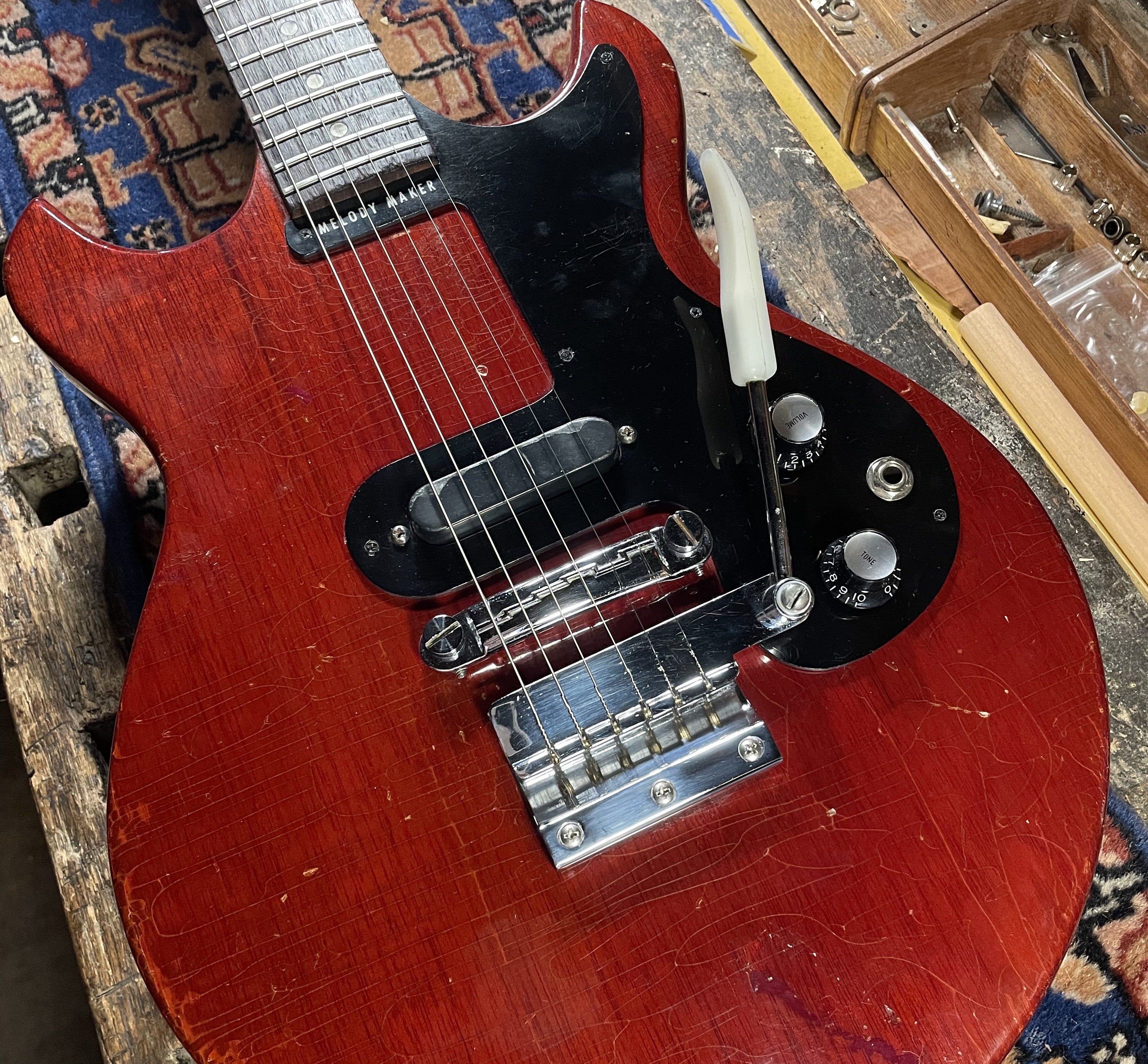
But the sideways vibrato wasn’t the only such unit Gibson was pioneering in the early ‘60s - on less ornate instruments like Melody Makers, Les Paul Juniors, SG-TVs and SG Specials, they offered a smaller, more straightforward unit called the Maestro Vibrola.
THE MAESTRO VIBROLA/VMB-1-2 (1961)
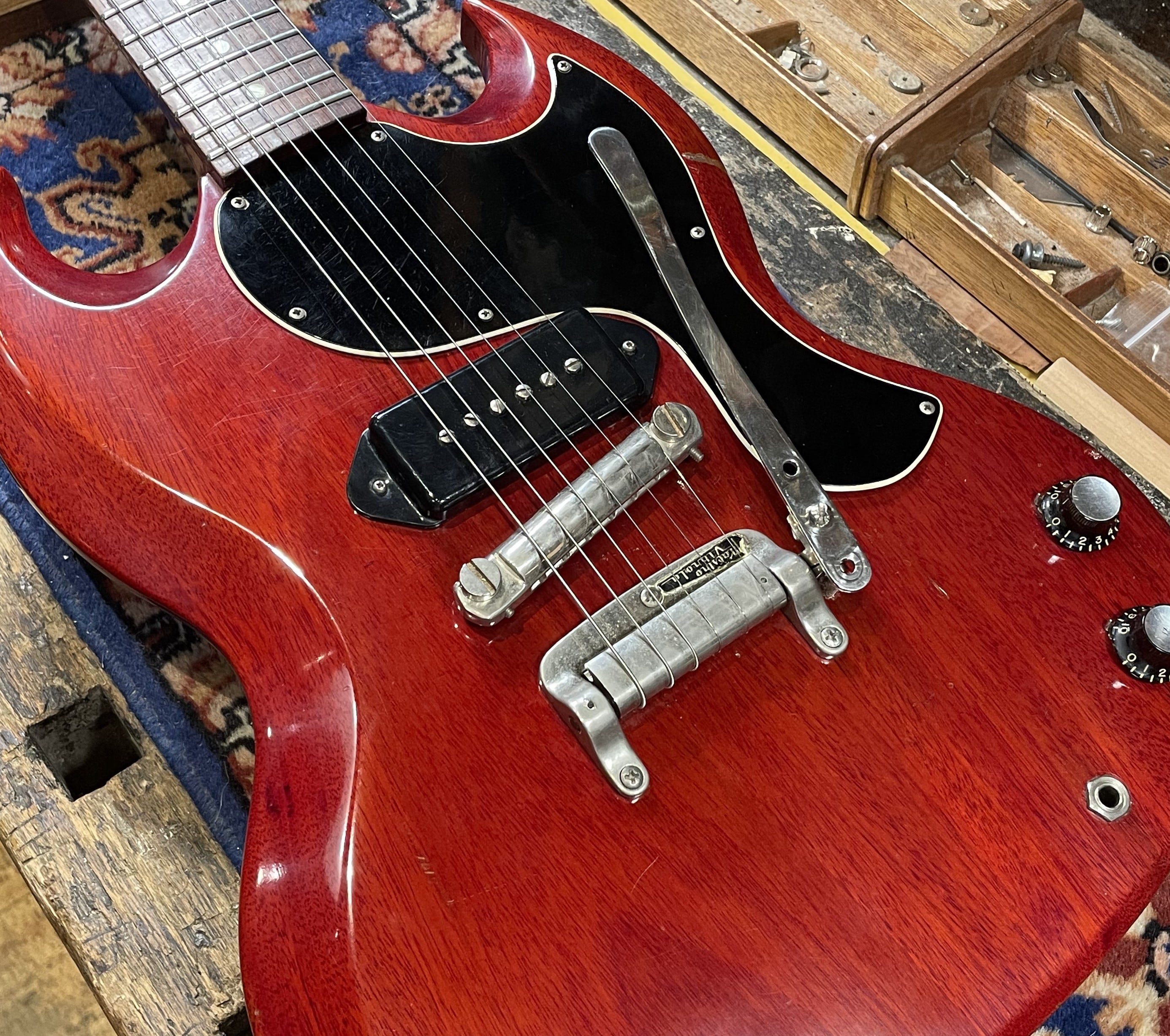
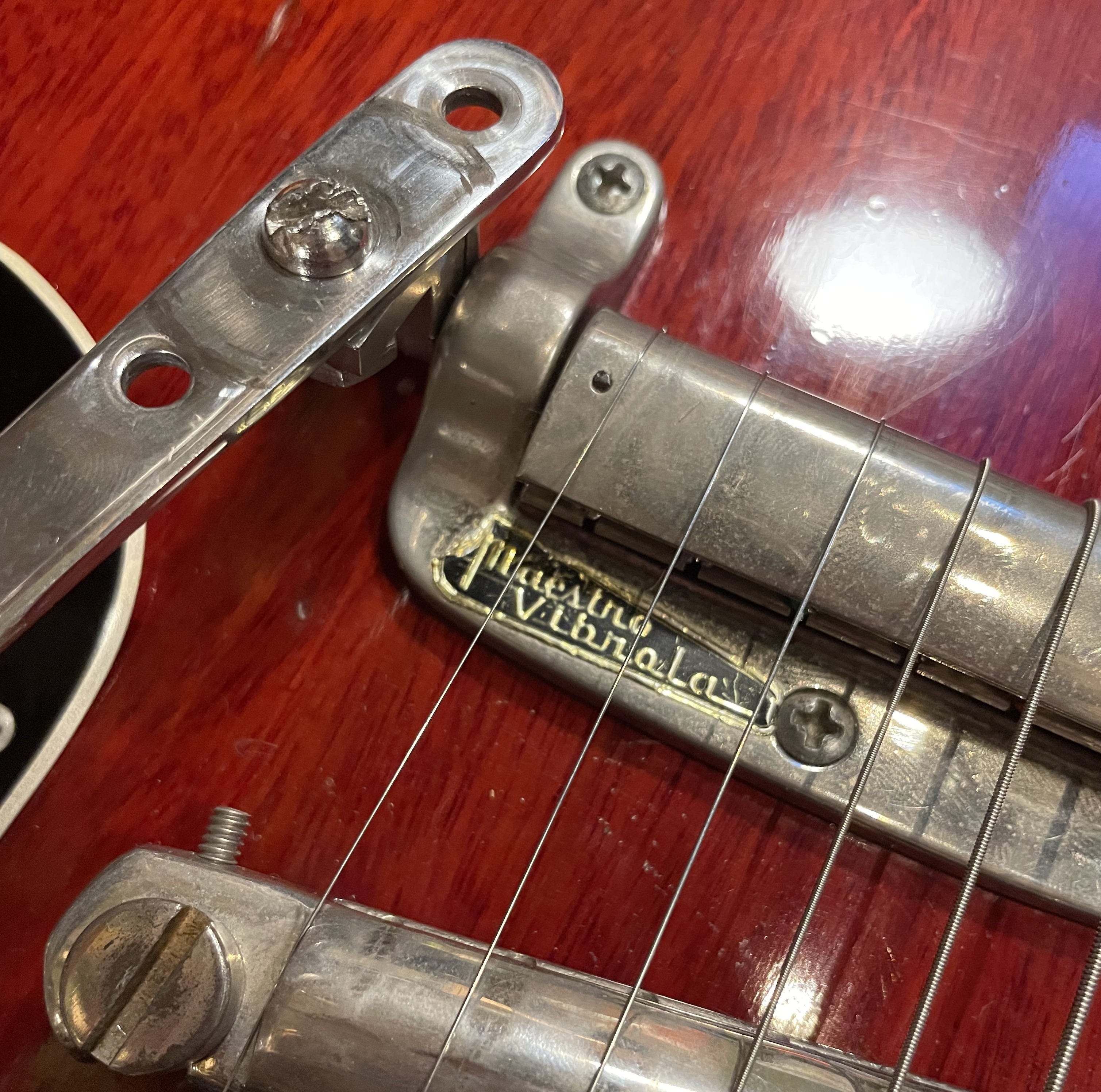
Also known by its model designation VMB-1-2, this relatively simple vibrato is the original iteration of Maestro, branding that Gibson would reappropriate for a handful of other units that would follow it (see below).
Compared to the ornate complexity of the sideways vibrola, this Maestro looks downright pedestrian. It’s a hybrid wraparound design that stays at tension regardless of whether or not it is strung up, which is achieved via an internal bar. The bar is pinned on one side of the external housing (the side opposite the arm); when you push down on the bar, the actual metal of the internal bar itself torques, and the vibrato effect is achieved. Release the bar, and the natural tendency of the metal to return to its starting position restores the original pitch (or a pitch roughly thereabouts).
Interestingly, when fully depressed, the pitch change between the high E and low E is within one semi-tone, a fascinating feature seen on sparingly few vibratos throughout history - for more info on this, tune back in for our upcoming addendum. This early Maestro design was equipped with the so-called “teaspoon” arm, the length of which was adjustable via three independent mounting points.
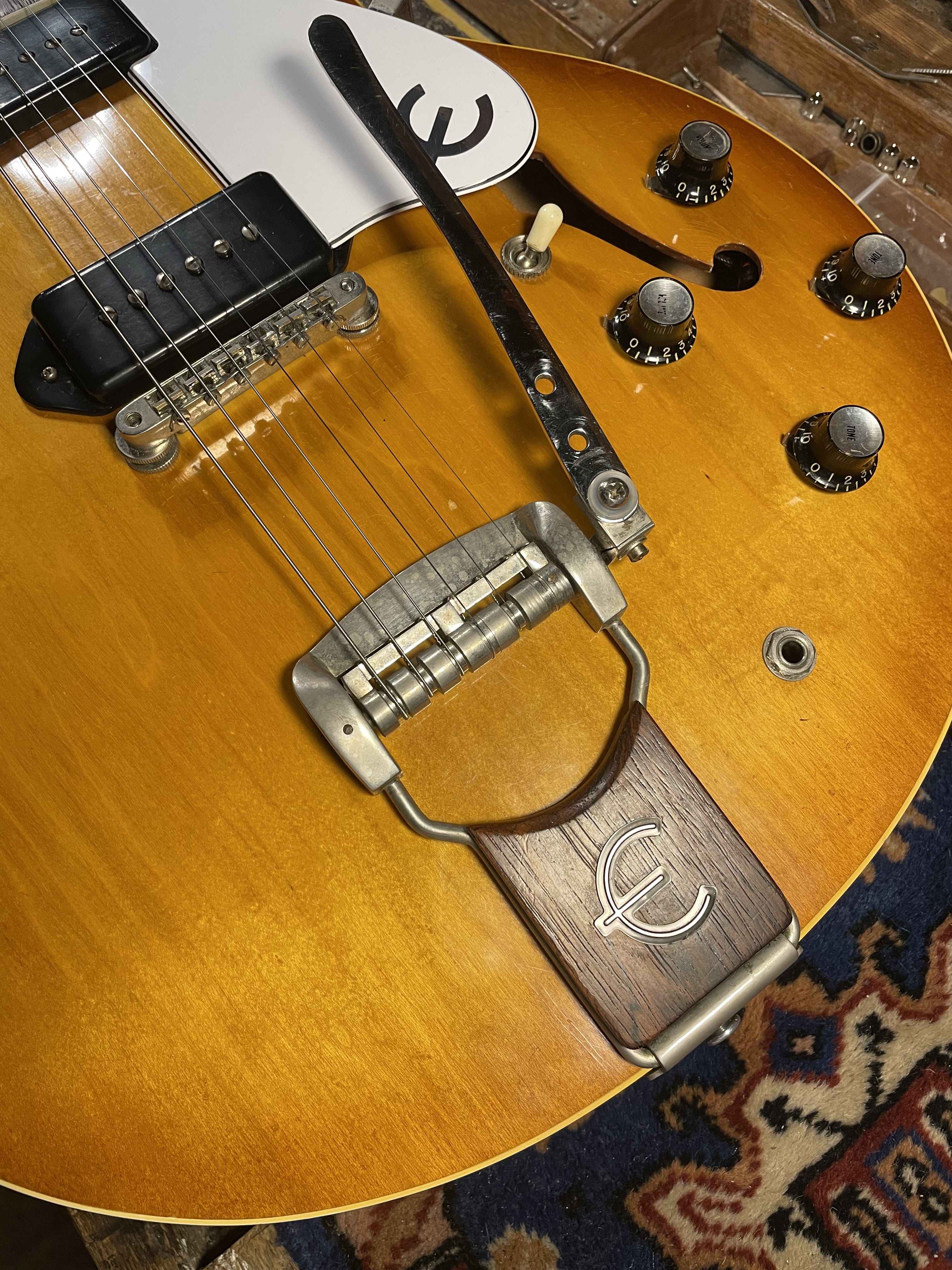
The original Maestro was short-lived, only in production on Gibson models for roughly a year before being phased out in favor of its immediate successor, which shared its name. Yet the same mechanism would stay in production at Gibson’s Kalamazoo, Michigan factory in both its original form factor and under a new name, the Epiphone Trem-o-Tone. A “long frame” version of the Maestro VMB-1-2, the Trem-o-Tone was functionally identical to the Maestro, used across a range of Epiphone-branded models including the Casino and Crestwood. Epiphone’s Wilshire model would continue to use the VMB-1-2 in its original form well into the ‘60s.
When it came to Gibson, though, the original Maestro was short-lived, only in production for roughly a year before being phased out in favor of its immediate successor, which shared its name.
MAESTRO VIBROLA V2/SHORT-FRAME MAESTRO (1962)
The next version of the Maestro forewent the hybrid wraparound/internal spring design of its predecessor, opting instead for a compact leaf spring design.
There’s real beauty to the simplicity of the design: just like in a car, the flexibility of the curved metal that makes up the leaf spring transfers the user’s input energy (the bending of the bar), slightly loosening the strings before snapping right back.
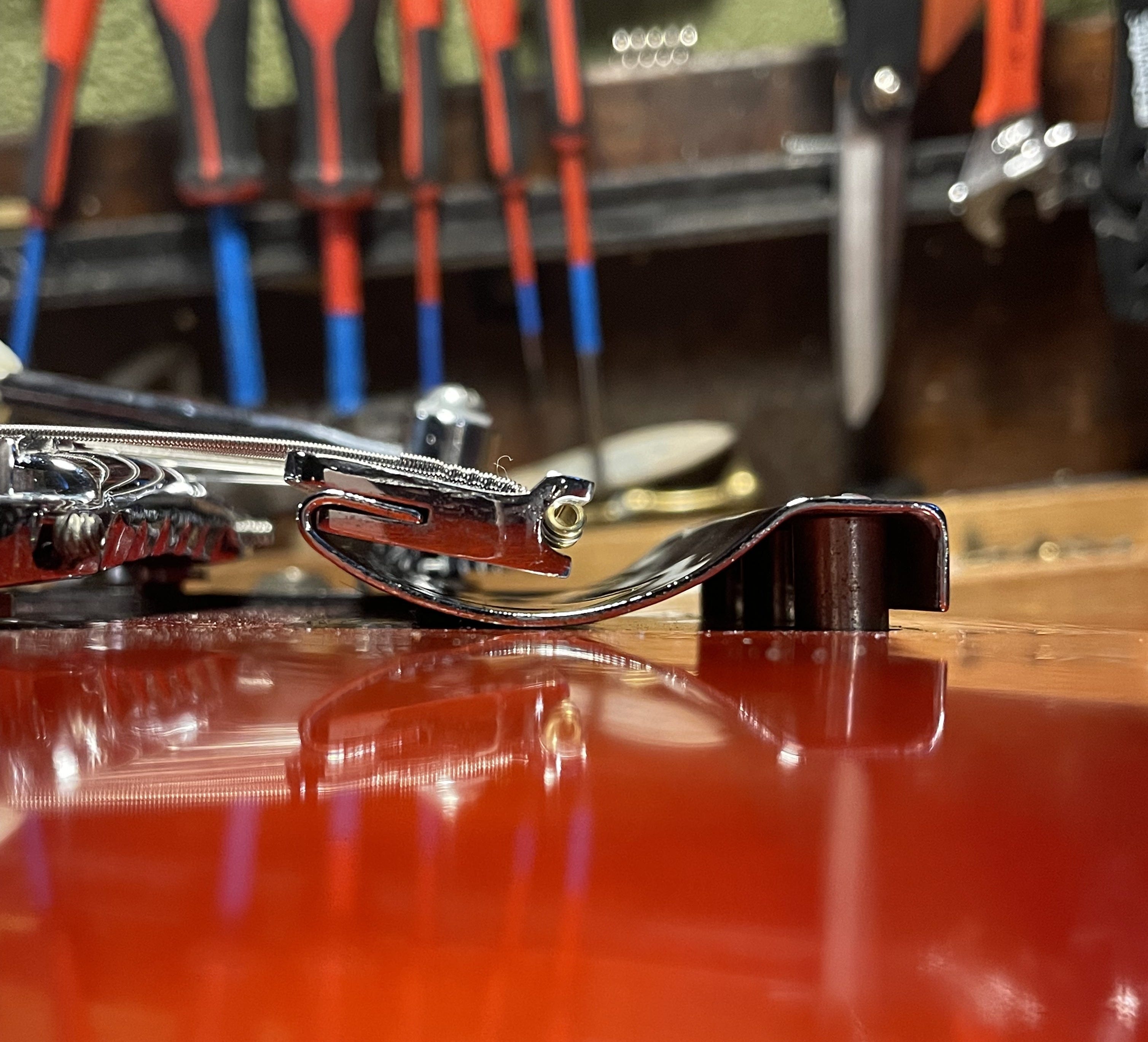
The design of these units produces quite a bit of tension, which admittedly limits the range of movement (and resultant pitch change) somewhat. However, that same tension also makes these vibratos snap back to pitch extremely quickly, particularly in comparison to the VMB-1-2, ideal for more subtle shimmers and warbles.
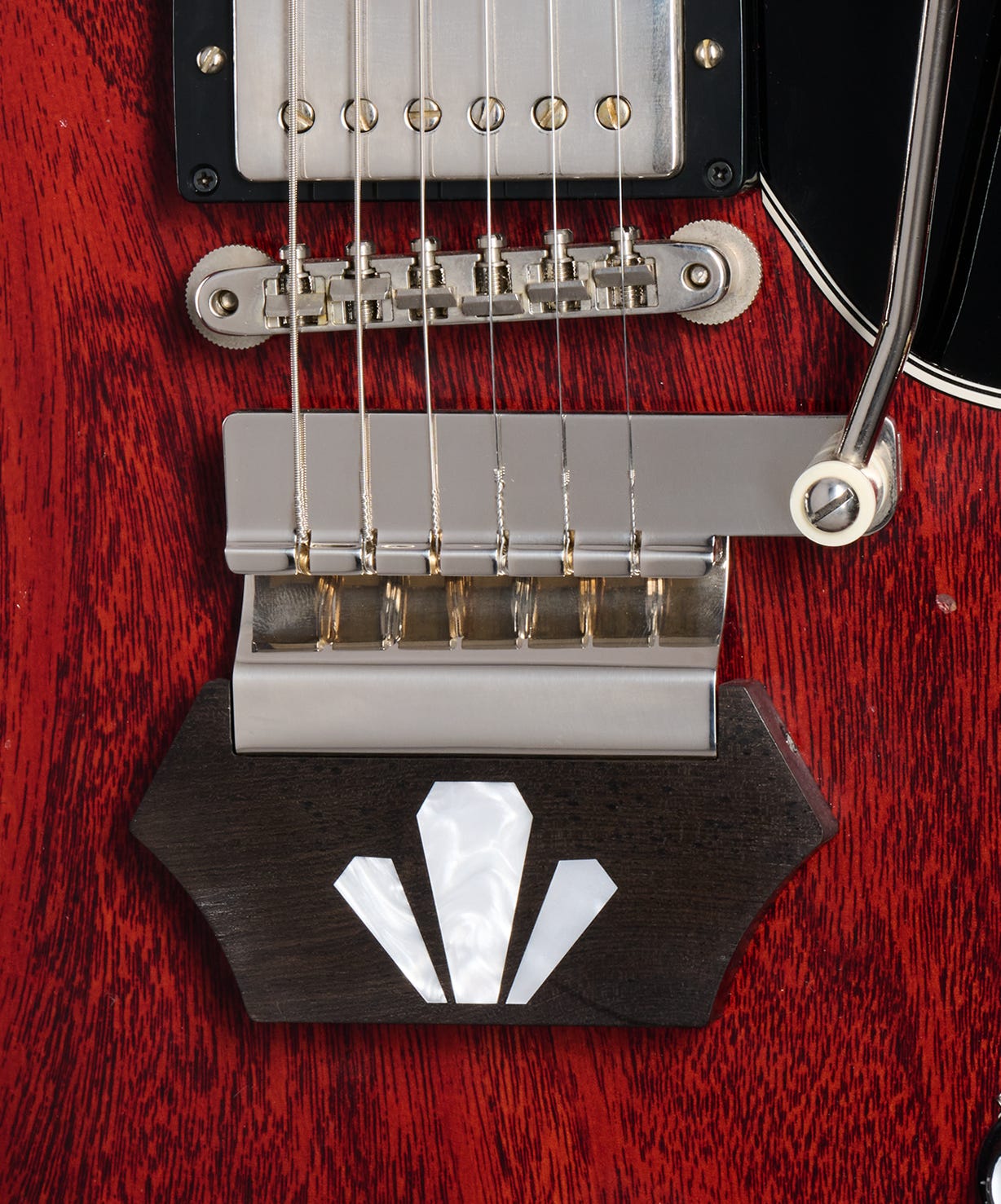
In 1962, there was a brief moment where some of the more premium SG models were equipped with short-frame Maestros and also outfitted with a central ebony tailblock with pearl inlays. The ebony block doesn’t affect the functionality of the vibrato at all, it’s just there to gussy up the look of the unit and to fill space on the body of the guitar. These instruments are notably rare - if you find one buried in a relative’s closet, you’re gonna want to hold on to it (or reach out to your pals at the Guitar Bar).
In ‘63, the sideways vibrola was officially out, and the ebony block had proven unreasonably costly at scale for the short-frame Maestro. Gibson needed to fill the extra space south of the vibrato with something eye-catching - just ornate enough for the premium models, but not too cost prohibitive for production.
They came up with this:
LONG-FRAME MAESTRO VIBROLA (1963)
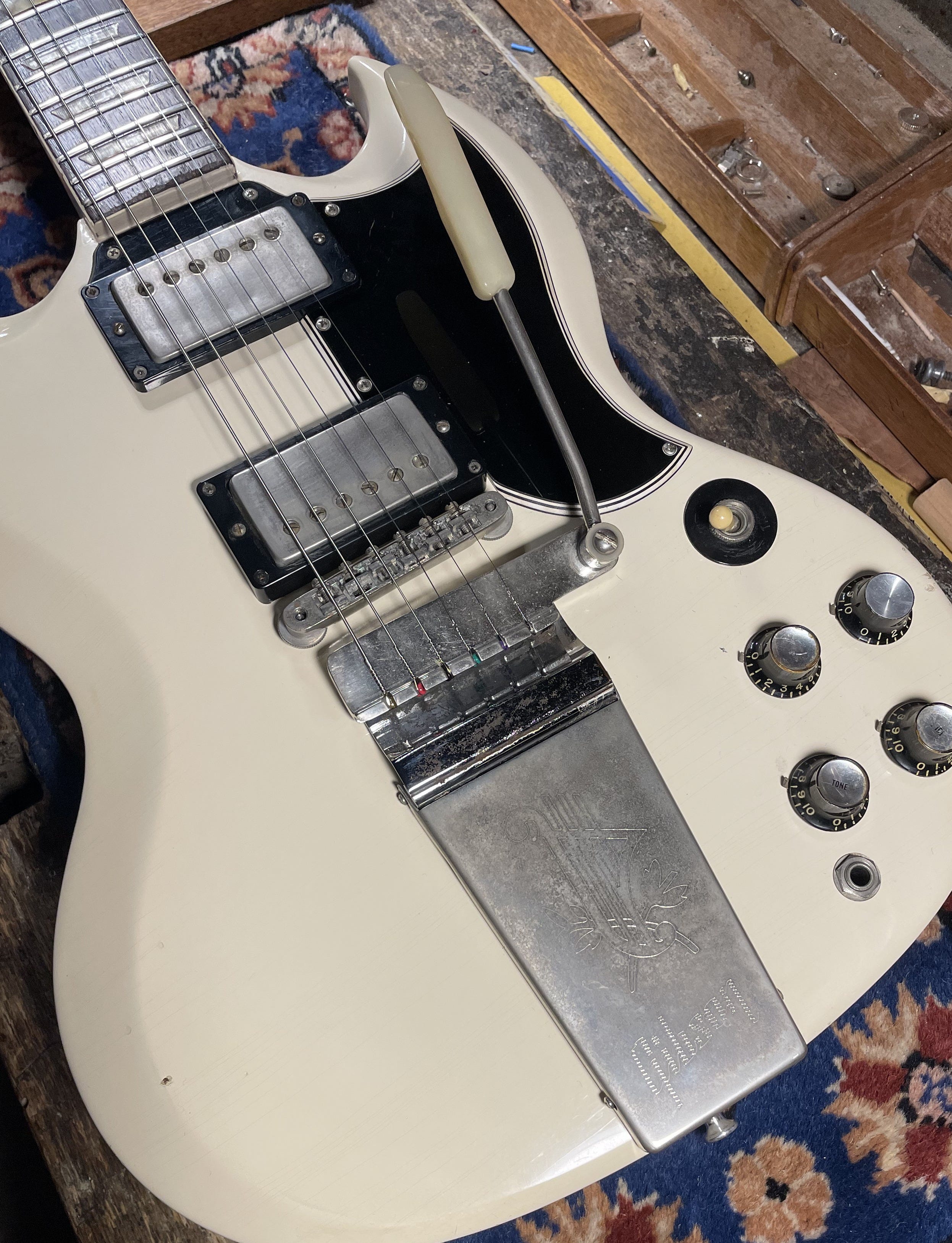
Functionality of the long-frame vibrola is identical to the short-frame despite differences in ornamentation and aesthetics, thanks to the large cover plate, engraved with the Gibson’s lyre graphic.
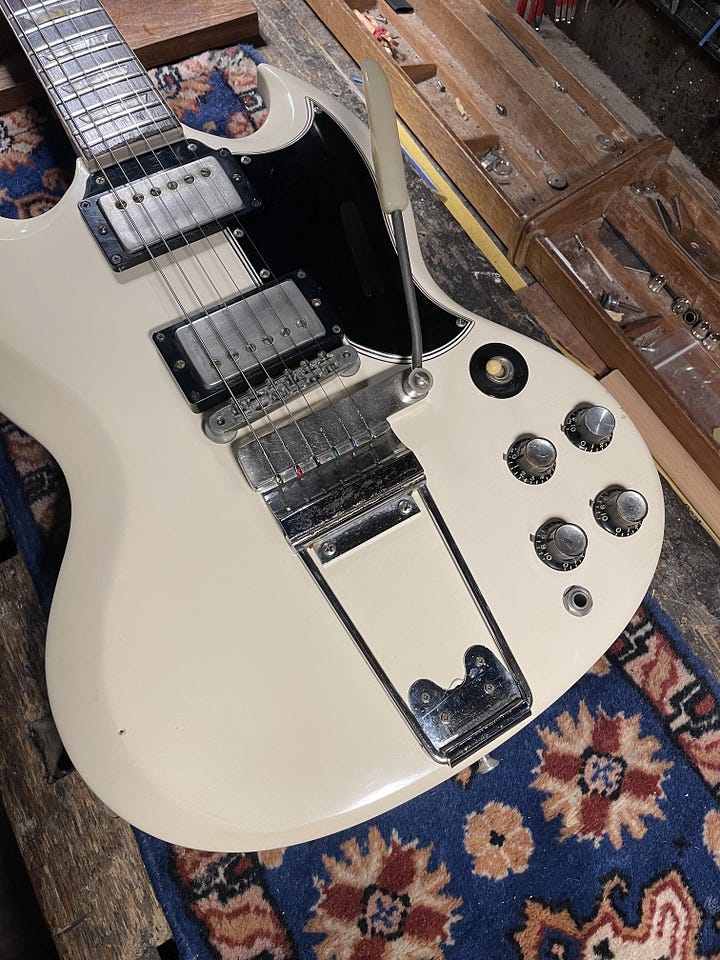

Also in ‘63, the “teaspoon” arms that had been paired with all vibratos were replaced with non-adjustable plastic-tipped arms (colloquially referred to as the “walrus tooth” arm); this change had no significant impact on playability aside from the mild change to adjustability, but it did further class up the overall look of the units.
The long-frame Maestros were the de facto premium vibrato for Gibson’s SGs throughout the rest of the decade, still favored by countless players for their quality, simplicity, and reliability. And there’s certainly something to be said for the viability and reliability of the original leaf springs from ‘60s Maestros. For players seeking comparable performance from modern Gibson reissues, the new models certainly function in the spirit of their forebears, yet lack a spring that has the same nuance and snappy response.
With Norlin’s acquisition of the Gibson brand in a corporate merger in 1969, the Maestro designs were relatively quickly phased out in favor of Bigsby vibratos. It was a logical move: the Bigsby company itself had been owned by Gibson since ‘66, when Paul Bigsby decided to retire. By the early ‘70s, a Bigsby variant was the only vibrato option available for all SG models, and remained the sole choice for many years thereafter.
From Kauffmans to Bigsbys, side-pulls to Maestros, each variant has its advocates, and all have a home here at Guitar Bar, where we’re ready to geek on the best vibrato to fit your needs or tweak your current vibrato-equipped git for optimal performance.
-S. J. Feehan
No posts
Comments
Nothing yet. Say the first thing.
Sign in to join the conversation.