
Bear with me: this is a nerdy one.
I was researching and mucking around with a Maestro VMB-1-2 for our recent post regarding the timeline of Gibson’s various vibratos in the ‘60s (be sure to check it out if you haven’t already), when I made a rather surprising discovery.
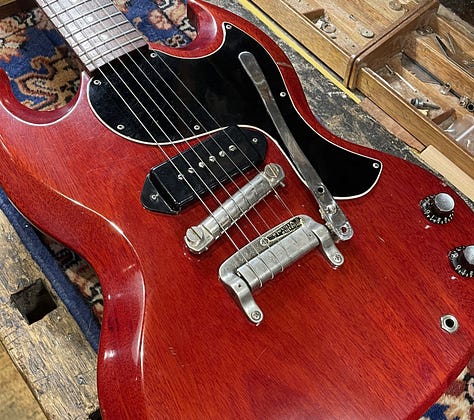
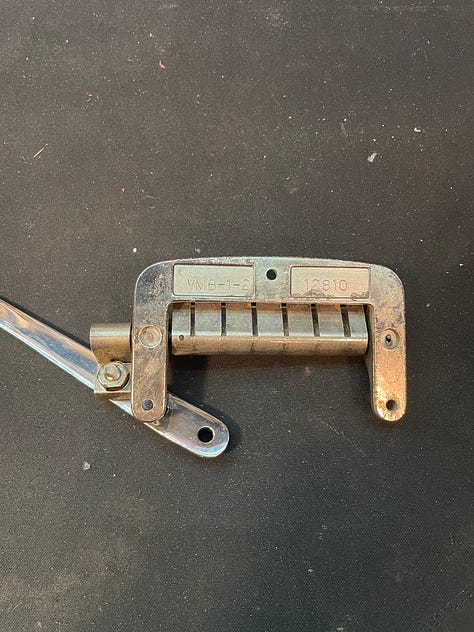
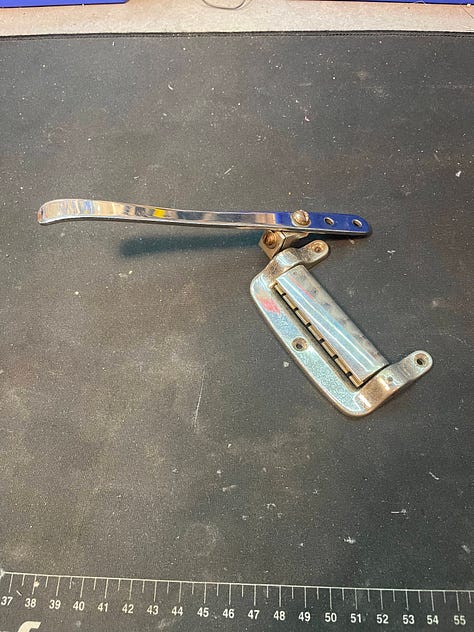
As a quick refresher: the VMB-1-2 was the first Maestro model ever made, predating the short-frame or long-frame units that share its name. And while it would only remain in use on Gibson-branded models for roughly two years, it enjoyed continued use across Gibson’s Epiphone-branded instruments throughout the ‘60s.
The VMB-1-2 features an internal bar, pinned on one end, with the arm placed on the other side. Push the arm down, and the bar torques itself around, all the way up to the pin. Obviously, the pinned part of the bar cannot rotate, and it’s this resistance that creates the vibrato’s tension. Release the arm, and the bar itself acts as a spring, utilizing the natural elasticity of the metal to bring itself back to the resting position and bring the strings back to pitch (or something thereabouts).
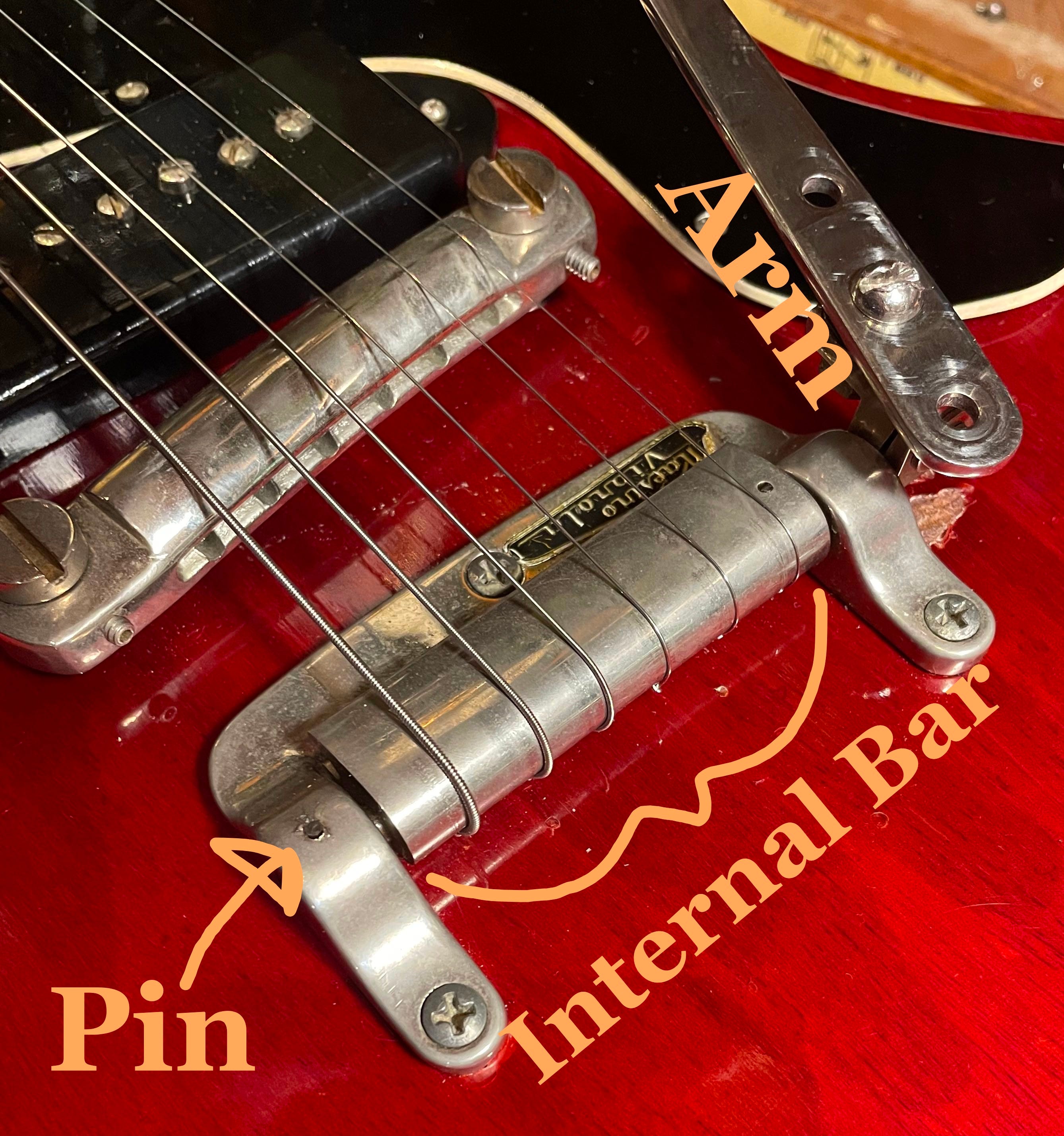
Reflecting on that somewhat antiquated technology got me thinking: if the pinned side isn’t moving much, and the low E string is sitting directly next to the pin, presumably the string won’t be moving very much either.
Even though the strings wrap around the external housing, there must be a minute difference in how much slack the unit provides. So I broke out my most precise tuner, and got to measuring.
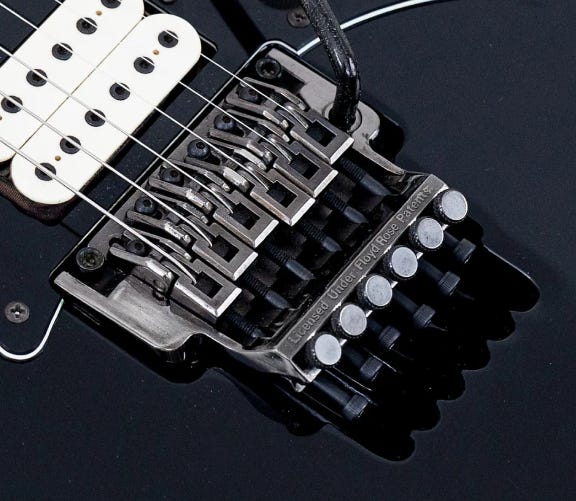
What I (foolishly) forgot to consider was the fact that strings do not tune and detune at the same rate. Think about how many turns it takes to drop your low E to a D, as opposed to lowering your high E. Or, if you’re a Floyd Rose user, try hitting your deepest divebomb; really tap into the spirit of EVH (or break out a Strat and go full Jimi). You’ll notice that the wound strings will go completely slack long before the highest string has lost all of its tension. With knife edge tremolos, the entire unit should be moving the same distance, so what gives? Why are the thicker strings detuning so much faster?
The logical first thought might be string tension, but the differences in overall tension (measured in pounds) are actually very negligible between the various strings. If there is any difference, the thicker string gauges are actually under slightly more tension than the plain strings. Plus, they sell balanced tension strings: if you don’t believe me that tension isn’t the culprit, throw a set of those on your guitar and give ‘em some healthy whammy action. The wound strings will still drop further in pitch, and still do it much faster than the high E.
In fact, it’s that very difference - wound vs plain/unwound - that’s the real culprit. Not the external, wound portion of the string itself, which bears none of the tension and is merely there to add thickness to the string. In fact, it’s the core of the wound string that does all of the heavy lifting. The cores of wound strings vary slightly in terms of gauge depending on overall string gauge (generally in the 14-16 gauge range, in standard guitar nomenclature), but they are virtually guaranteed to be thicker than the thinnest plain string on the instrument, whether you’re rocking with 9s, 10s, or 11s. The greater the tension-bearing cross section of a string (the core for wound strings, and the entire string for plains), the less the string has to strain to reach tension, and the less taut the string will feel under the finger. It’s a subtle difference numerically, but makes a significant impact on both feel and functionality. That’s a big part of the reason you can bend that low E down across just about the entire fretboard, but the high E makes you work for each quarter-tone. For the purposes of our investigation, the biggest impact is the speed with which the string moves away from its tensioned pitch when tightened or slackened.
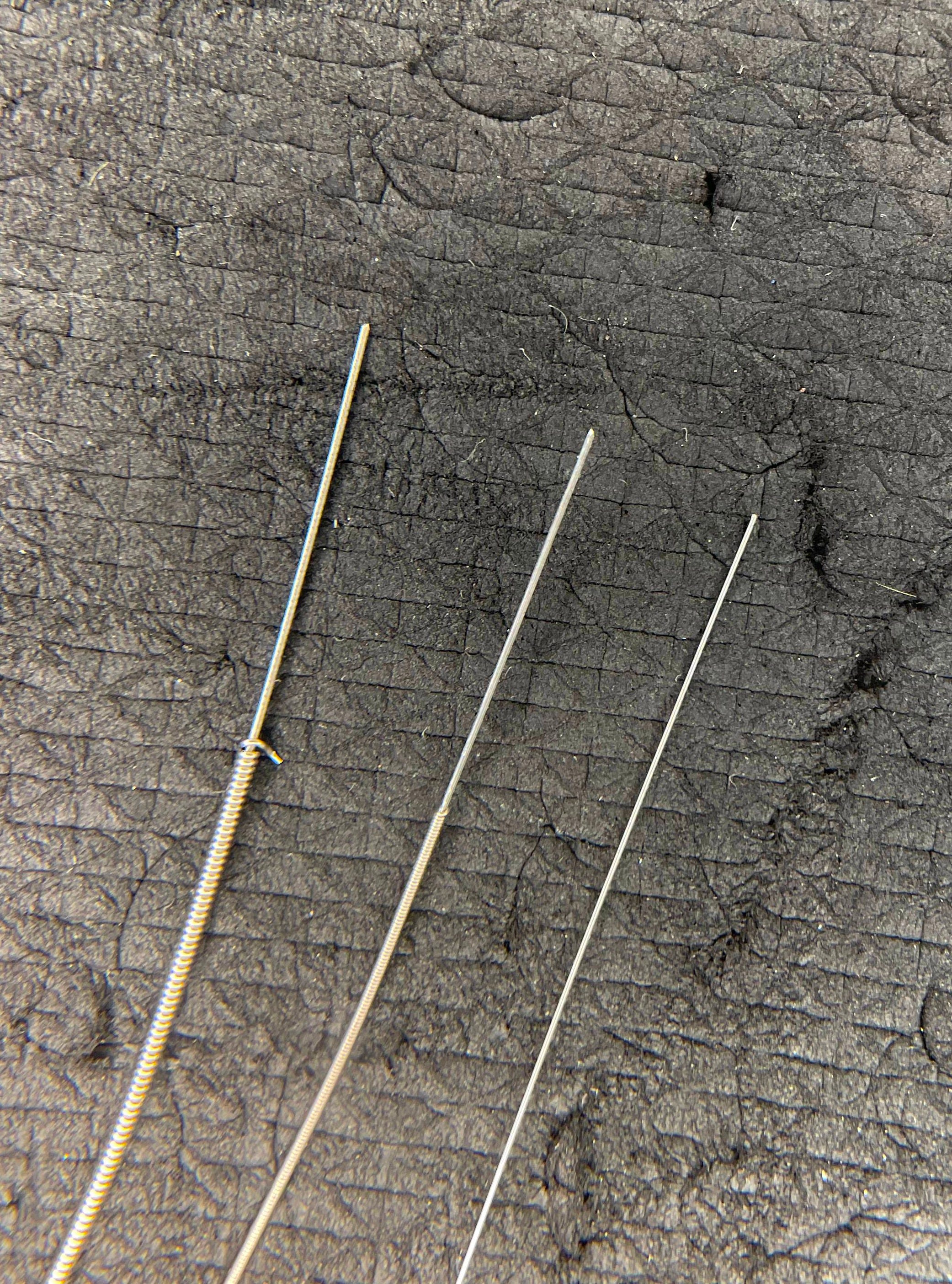
The pitch-change-speed difference isn’t exactly massive (except with those extreme vibrato movements), but it’s enough to make it so that chords can’t really be transposed via movements of the trem arm. You can test this, too: fret a chord and try to move the entire chord down, say, just a single semi-tone. Even if you can be precise and consistent with your usage of the trem arm, you can hear the notes move slightly away from each other and the overall intonation of the chord deteriorate. This is why most vibratos are far more effective for flutters or warbles than specific, held transposition.
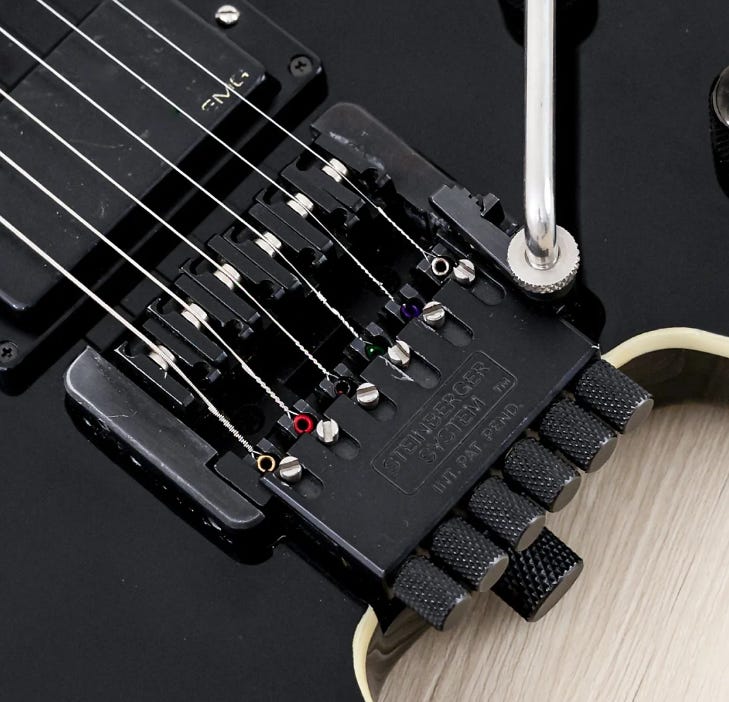
Of course, I’m not the first person to explore this particular rabbit hole: there are a select few vibratos that have been designed to address the issue of string-to-string intonation while in use. The most notable of these is the Steinberger TransTrem, which utilizes six independent pivot points (one for each string, naturally) to keep things equivalent, enabling full-chord transposition. The TransTrem is a real feat of engineering, and one that requires a great deal of effort just to set up - we had one of these in the shop recently, and it’s hard to overstate how unique they are in terms of both construction and function.
But that’s enough background. You’re probably wondering what any of this has to do with an early, simple Gibson vibrato - and rightfully so. It’s pretty unlikely that Ted McCarty & Co. were seriously considering string-to-string intonation while developing the VMB-1-2. But here at the Guitar Bar in 2025, I was. And what I found was truly surprising.
So, back to me and my tuner.
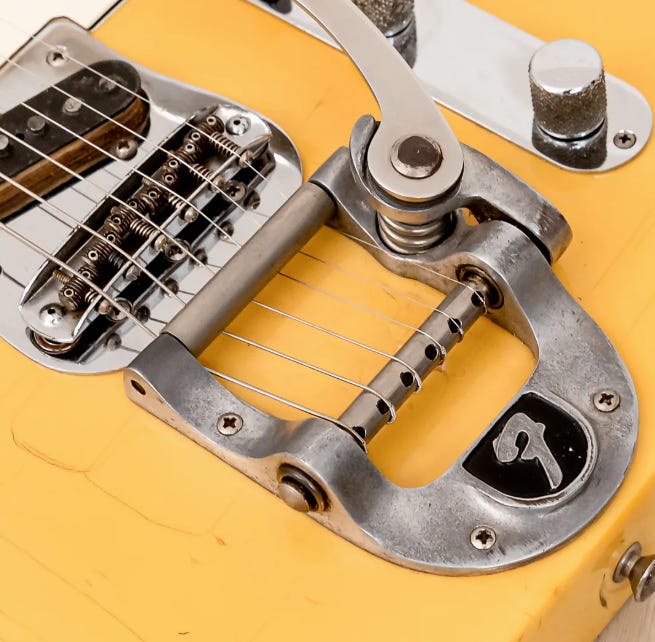
As it turns out, my initial hypothesis was partially correct: the pinned bar design does necessarily limit the movement of the vibrato the further you are from the arm itself. Let’s compare with a quintessential, standard vibrato - the original: the Bigsby. If a Bigsby B7 is depressed to the lowest pitch it can achieve without the string going fully slack, the low E can go all the way to about a B. High E can drop down just slightly, to a D#/D.
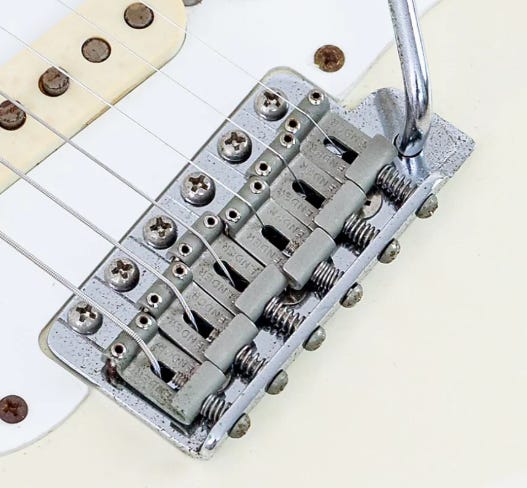
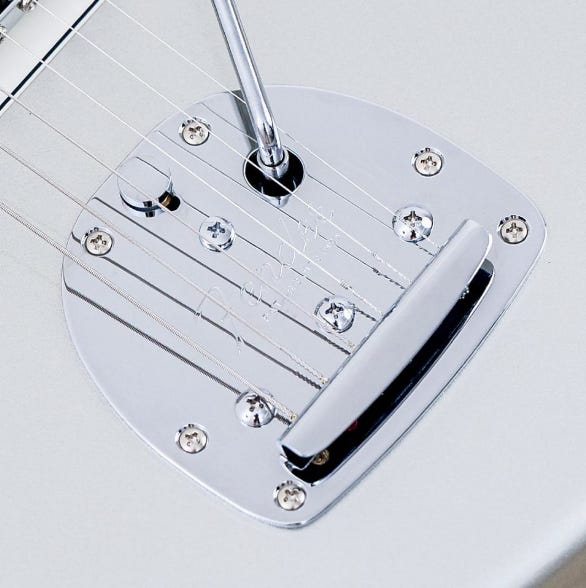
And now the moment of truth: the VMB-1-2. Fully depressed, low E only drops down to a C#. Significantly less of a drop than on any other vibrato I tested, confirming than that the low E is moving less with a pinned-bar design than any spring-loaded or blade options. And for the high E string: down to the flatter side of D. Remarkably, it’s extremely close to a one-to-one transposition. I tested all the common units: Synchronized Tremolo, Offset, Bigsby, Floyd… none were even close to an equivalent shift.
Now, can the VMB-1-2 actually be used to transpose chords effectively? I wouldn’t go that far - it’s still not quite perfect enough across all six strings for meaningful usage on that front. Maybe if the internal bar was made of some kind of fantasy metal with a perfect blend of elasticity and rigidity (vibranium, maybe), it’d be the greatest simple vibrato of all time. We’ll never know.
But, in one very particular way, it (accidentally) comes exceptionally close to an elusive type of vibrato functionality that wouldn’t exist again until the hyper-engineered work of Ned Steinberger more than two decades later. And in that way, the VMB-1-2 is kind of brilliant.
-S. J. Feehan
No posts
Comments
Nothing yet. Say the first thing.
Sign in to join the conversation.