
Say, it’s Monday. You have Claude (or ChatGPT) open, and you are typing a version of the same paragraph you might have typed last Monday.
You feed it some Search Console data (or ask it pull it). Compare the last 28 days to the 28 from the same time last year. Skip the posts I already updated. Tell me what is worth updating and why I should do that this week.
Or it’s something simpler. Here are my 400 posts, what email should I send this week? Can you write a first draft for me and sound like me and not like AI wrote it?
You might have a version saved somewhere in a note. You might just paste it. Change a word. Run it. And next Monday, you will probably do a version of the whole thing again. How do you stop yourself from doing this next week?
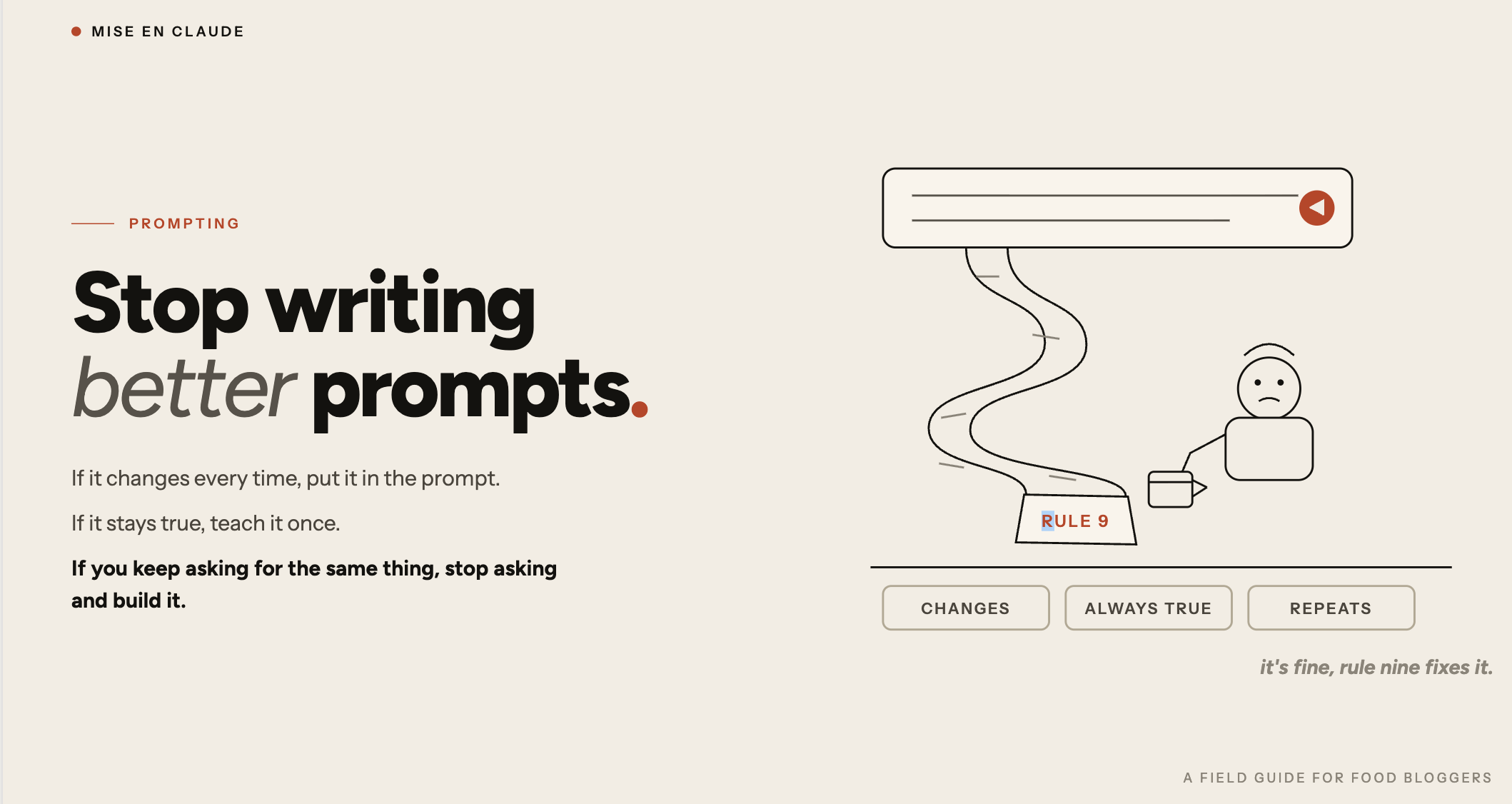
If it changes every time, put it in the prompt.
If it stays true, teach it once.
If you keep asking for the same thing, stop asking and build it.
Your prompting might not feel finished because you keep trying to fix it with better wording, when most of what you type does not belong in a prompt at all.
If you have got four more minutes, let me show you how I got there.
I was blown away by it’s capabilities. Then I had text-expanders do the same thing. Then I built a skill in Claude to do the same thing.
My SEO prompt had nine numbered rules in it. I was proud of it. But today, no workflow of mine has a prompt with 9 rules in it.
A lot of prompt advice assumes you are asking AI something new every time. Give it a role. Paste in examples. Tell it to think step by step. Spell out the rules.
That makes sense if you are exploring: a fresh question, a blank problem, one good answer, then you move on.
But that is not how most food bloggers use AI.
Imagine this instead - it is 8:30pm. You just put the kids down. You probably spent the whole day batch-filming reels. And you are probably running the same four jobs you ran last week:
Turn this tested recipe into a newsletter
Check to make sure your draft doesn’t sound like a robot wrote it
Write the Pinterest descriptions the way you always write them
Find the post bleeding traffic and decide whether it is worth updating (maybe).
Same tasks. Same rules. Same you.
This is not exploring. This is OPERATING. So then the question changes from “How do I write this prompt better?” to “Why am I writing this prompt at all?”
There is REAL research now poking holes in some of the old prompt tricks.
Large studies are finding that “think step by step” does not actually beat just asking the question clearly. It’s also pointing out that piling on more instructions can make a model WORSE at following all of them.
I read the dense, 400 page papers in my free time (or maybe all the time) and I find it absolutely fascinating.
But I am not building my business around the prompting technique of the month. The models will change again.
So the more useful question rattling about in my brain is one layer deeper:
Once I started looking at my workflows that way, I was able to see three buckets of things.
What changes every time belongs in the prompt
Your actual traffic numbers from last week. The specific recipe in front of me that I want to run through to make sure I didn’t list an ingredient I didn’t use. Maybe a decision I am trying to make on whether I should promote X opt-in vs. Y opt-in.
THAT is what a prompt is good for. And it can stay short, because it only has to carry what is new today.
What stays true should be taught once
Who I write for (i.e., my Priyas and Jessicas).
How I sound (like this newsletter, really, if you know me in real life).
The words I will not use (reliably is making the cut these days)
That vegetarian food is not a “substitute.”
That my recipes are fast and filling, not a “culinary journey.”
This is not fresh news. This is permanent context about your business and it should sit UNDERNEATH the conversation, so you do not have to declare your identity every time you open a new chat.
What repeats should also stop being a prompt
Call it a Monday Search Console pull. A newsletter conversion every week. The recipe QA check.
The same task, the same rules, roughly the same output every week.
That is not a prompt anymore. It is a workflow wearing a prompt’s clothes.
And you do not need a better version of it because you only need to build it once.
If it changes every time, put it in the prompt.
If it stays true, teach it once.
If you keep asking for the same thing, stop asking and build it.
Now, you might be thinking - wow, Shruth, you spend half your emails telling us to give Claude context, and now you are telling us to type less into it. What gives?
Truly, both. Because they are different layers.
Context matters enormously. But the context about your business was never supposed to live inside every prompt. It should sit underneath it. That is what lets the prompt get shorter without making the answer more generic.
In the next post, I will share a bit about the first layer I teach in my paid challenge. What I call “a brand brain” aka, what Claude should know about your business stone cold. What belongs there and what absolutely doesn’t.
If you haven’t already read my post on why dumping every document and piece of information you own into a Project is not the same as giving Claude good context, do read it. It might be entertaining.
Do not improve a single prompt.
Instead, find one you have typed more than three times and really look at it.
What is the prompt asking for? Probably not to be sharpened. It probably wants to be built into a repeatable workflow. With the same inputs and the same outputs on the same days of the week or month.
Then just split it into the three piles.
Take a recipe-to-newsletter prompt: turn this new recipe into this week’s email, keep the hook tight, don’t oversell it, and end with a usual CTA.
What changes: the recipe, the angle you want to emphasize, and anything timely about this week’s email. That belongs in the prompt.
What’s always true: how your newsletter sounds, who it is for, what “too salesy” means to you, how you structure the CTA. Claude should already know that.
What repeats: every new recipe goes through roughly the same recipe → newsletter process. Once that pattern is stable, stop rebuilding the request and turn it into a workflow.
Those should not live in a saved prompt you keep pasting. Claude should already know them. And if every new recipe goes through the same recipe → newsletter process, that is not really a prompt anymore. It is a workflow you build once and reuse.
You do not have to FIX any of that today btw. But once you see a prompt split into what changes, what is always true, and what repeats, you literally cannot unsee it.
Leave a comment or send me an email. I’ll help you brainstorm how to take that task off your plate.
But also, if building the second and third piles sounds like more than you want to take on alone, that is the reason I am running the next Mise en Claude AI Operating System Challenge.
Four weeks, a small group, building that 'foundational’ layer together (aka, the context Claude should probably already know, the workspace your business lives in, and a few real workflows), so Claude needs less from you than it does today. If you are a newsletter subscriber, you can use code “MISE” for $60 off.
The goal is simple.
By the end, Claude should need less instruction from you than it does today. Hand it a few tasks like you would a competent employee, and turn your attention to other parts of your business.
Cohort 2 starts the week of September 14. I hope to see some of you there. Toodles!
No posts
Comments
Nothing yet. Say the first thing.
Sign in to join the conversation.