
If you haven’t already seen the news, two days ago, Anthropic announced that Claude embeds “invisible watermarks” in all the text it generates. Every model released after August 2nd.
And if you’re a food blogger who uses Claude to help with your writing, your first reaction was probably something like: oh no. Mine too, for about ten minutes.
But it was not clear to me how this would all pan out - would it work if I copy pasted first into a different document? How does one even watermark TEXT? It was a deep rabbit hole, my friends, but I figured I’d share what I learned here so you can benefit from it too.
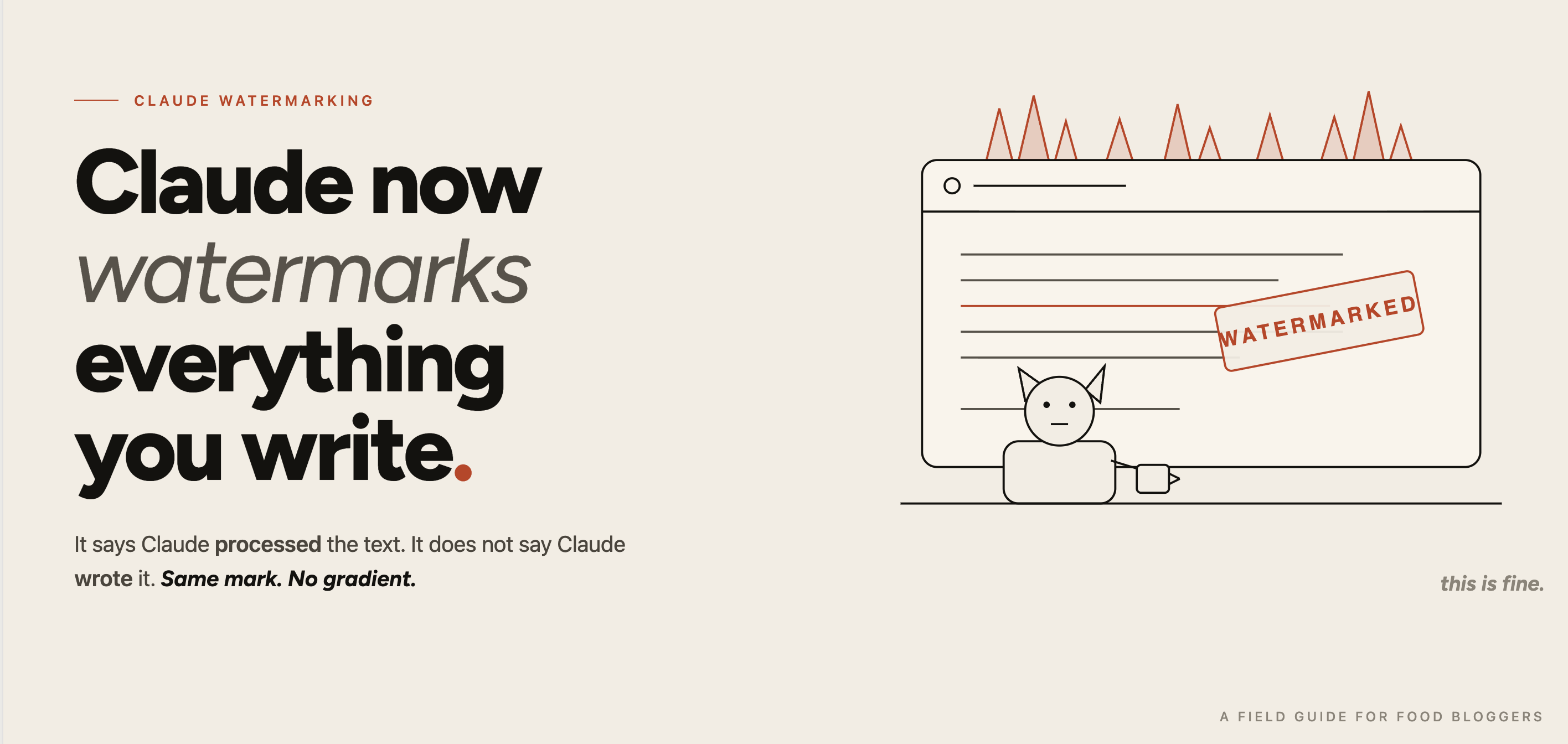
The watermark tells you that Claude PROCESSED the text. It does not tell you that Claude WROTE the text. Anthropic admitted this.
Read that again.
So, if you write your own blog post introduction, of course in your own voice, from your own experience making that dish forty billion times, and then you paste it into Claude and say “tighten this up so I don’t ramble as much,” the output carries the exact same watermark as a post Claude wrote from scratch. Wild.
No gradients, which is truly insane.
When you ask Claude to help you sharpen an argument (which I’ll admit, I do like 10 times a day if not more) - you are not outsourcing your thinking.
You’re doing exactly what people with bigger budgets have always done: you’re getting a second set of eyes on the work.
You give it inputs. It helps you craft or refine a statement.
You look at the output and go “no, that’s not quite right” and you push it in a different direction.
The ideas are yours. The judgment call about whether that paragraph earns its place in the post is yours. (Hopefully).
That used to cost a copywriter.
A really good one, at rates most solo food bloggers (or even small business owners) can’t justify against their revenue. Now it costs $20/month, and the tool is available to everyone. I see how AI is hurting people, I really do, but it’s also opening up access, and I find myself quite torn on the two fronts.
Watermarking that interaction the same way you’d watermark a fully generated post flattens a distinction that matters. Not to the model, no. But to the person using it.
I’m going to put this in super simple terms, but you can read the Nature paper which is the basis for this approach if you wish.
It works by “nudging” which words Claude picks during generation. When there are two equally good word choices, the model leans toward one based on a key only Anthropic holds. Over a long enough stretch of text, that creates a statistical pattern a detector can find. Like flipping a coin that lands on heads 51% of the time. One flip tells you nothing. A thousand flips and the bias is obvious.
Does it hurt the quality of the writing? The research behind this approach (published in Nature, tested on nearly 20 million responses) found a 0.01% difference in user approval ratings between watermarked and unwatermarked text. So, no, not really, or barely.
But there’s a real question about whether the nudging affects Claude’s ability to match a specific writing style, especially in non-English languages or technical contexts.
For recipe intros and blog posts, we are probably fine.
For code or legal writing? Oof, I guess the jury’s still out.
only Anthropic can verify its own watermark.
The detection tool hasn’t shipped yet. When it does, Claude is both the marker and the judge. That’s worth watching.
The watermark survives copy-paste but degrades with heavy editing, translation, or paraphrasing. Short text (under roughly 100 words) can’t be reliably detected at all. So one option is to potentially generate shorter pieces of text in each iteration.
And this isn’t just Anthropic.
Google embeds the same kind of watermark in Gemini output through a system called SynthID.
And the whole industry is moving this direction, largely driven by the EU AI Act (because of course, the EU always force action eons before anyone else does), which went into effect August 2nd. That act requires AI companies to mark generated content so other systems can identify it.
Some platforms are already adding their own AI detection tools. Substack recently did and caused an outrage.
My fanfiction reading portal of choice, Archive of Our Own, started showing a red skin for Claude-generated text and cause a literal furore amongst readers pointing easy fingers at authors for “AI generated” content.
Yes, readers can scan a post and get an estimate of how much was human-written versus AI-assisted, ok? Publishers can add a transparency statement about how they make their work. And this is going to become normal.
For food bloggers who use Claude as part of their workflow, it means understanding what triggers a detection result.
Because “I asked Claude to fix a run-on sentence” and “Claude wrote my entire post” look the same to these tools right now.
Nobody knows where to draw the line between AI-assisted and AI-authored until they’re forced to.
That’s not an AI problem. That’s a human problem.
We’ve never had to define what “I wrote this” means when the tool you used to write it can also write independently.
Did you write the email if your assistant drafted it and you edited?
Did you write the recipe if your recipe tester developed the method and you approved it?
We’ve always had these gray areas. The difference now is that the gray area has a watermark on it and everyone can see it.
Google, for what it’s worth, has not changed its position. Quality matters, method doesn’t. No AI penalty. That hasn’t moved. The SEO fear is a red herring.
The real question isn’t whether you used AI. It’s whether the work is YOURS. Whether the judgment and the decisions about what stays and what goes came from you.
If they did, the watermark is metadata. It’s not a verdict.
Know what the watermark is and what it isn’t. It’s a processing signal. It is not an authorship claim.
If your platform offers a transparency statement about how you create your work, fill it out. “I use Claude as an editing and brainstorming tool. The ideas, recipes, and voice are mine.”
That’s honest, and it puts the framing in your hands before someone else frames it for you.
Don’t stop using the tools that make your work better. Just understand what they leave behind.
This is exactly the kind of systems-level question we’re digging into with the first cohort of my AI OS challenge right now. Not panic, just pattern recognition!
Onward.
No posts
Comments
Nothing yet. Say the first thing.
Sign in to join the conversation.