
Hi there!
Last time we split your Monday prompt into three piles.
What changes every time. What stays true. What repeats.
A lot of you wrote back about pile two.
Fair. “Teach it once” is a lovely sentence. Teach it WHAT, exactly. And where does the teaching go.
So today, I want to share a bit of the ‘behind the scenes’ on what I actually build, and a single file that carries most of the weight of my business.
I recently told my AI Operating Systems Challenge cohort that …
Opening a blank chat every time, no project, no memory of you, is like hiring a brilliant stranger.
You brief them on your whole business. They get one thing done well. Then you fire them. Tomorrow, another stranger. Same brief, from scratch, forever.
A project is the opposite. It is one specialist you onboard once and keep. Your SEO person. Your email person. Your social person. Each one remembers their corner of your business, because you never fired them.
And the handbook every specialist reads on day one, so they all sound like your brand and not like temps, is what I call your “Brand Brain”.
The more you think about your Claude operating system as a team, that gets sharper over time as they absorb and remember more context, the better your system gets.
My Claude “Operating System” has five layers, and they stack.
The bottom (aka foundational) layer is YOU. Your taste, your judgment, the decade of knowing a recipe is off before you can say why. You don’t need to build this one, because you already have it. This lives in your account instructions.
On top of that sits the Brand Brain, which is today’s focus.
Above that is what I call the “Workspace”, aka the project and folder structure that holds your context so any tool can read it.
Then, you have your “team” which are skills (aka automated SOPs) that you train and brief.
And finally, at the top, the things that only become possible once the bottom four hold, like catching a decaying post before it tanks. A scheduled automation.
Skip straight to the top and you get an agent with nothing to read.
Today we build the layer that makes everything above it worth building.
Five steps. I run this as a live interview with Claude in my AI OS challenge, but here is the shape of it.
Step one, your audience and the job they hire you for. And no, you cannot stop at “busy home cooks” because that literally describes half the internet! Who specifically, and what are they actually hiring your recipe to do for them? If you have done archetype analysis, this will come in handy, but just remember that your blog readership is not your Instagram viewership is not your newsletter readership. You want to think about who you WANT TO write for. And stick to it.
Step two, your positioning and what you believe. The thing you would argue with another food blogger about, if it came up. I don’t develop recipes with fake meat. That’s a hard line stance. Maybe you love Cool Whip. Whatever this might be. These are the nuggets that really get to the heart of who you are.
Step three, your voice, with real examples. This one trips people a lot. Share two great examples, not ten mediocre ones. More context is not always better voice. I could yell that from the rooftops: MORE CONTEXT IS NOT ALWAYS BETTER. Give it two and tell it WHY they work. A negative example does way more work than a positive one usually, so if you have a draft that sounds nothing like you, hand that over too and say WHY. Again, the “WHY” is important. Think of Claude as your hyper competent VA, yeah? If you don’t tell them why you want them to do something a certain way, or not do something a certain way, you tell them WHY. Otherwise, it doesn’t stick!
Step four, your hard lines and banned phrases. Name the tells explicitly or the guardrail does nothing. Mine include nestled, symphony of flavors, culinary journey, delve, bursting with flavor, elevate, game-changer, perfect for, look no further, a testament to. If a draft could run on anyone’s blog, it is wrong. I also don’t use the words healthy, nutritious, or any variant of that anywhere. I don’t write health food, and that’s okay. And one guardrail that is coded into every setup.
Claude may read a recipe to write the things around it, the intro, the description, the SEO, the email, the social captions. Claude may never change an ingredient, an amount, a step, a substitution, a time, a temperature, or a yield, and never rewrite the recipe itself.
If a request seems to need changing the recipe, stop and ask first. The recipe is yours. The job is everything around it.
Step five, your tie breakers. When two of your own rules conflict, which one wins. This is the section everyone skips and the one that saves you the most arguing later.
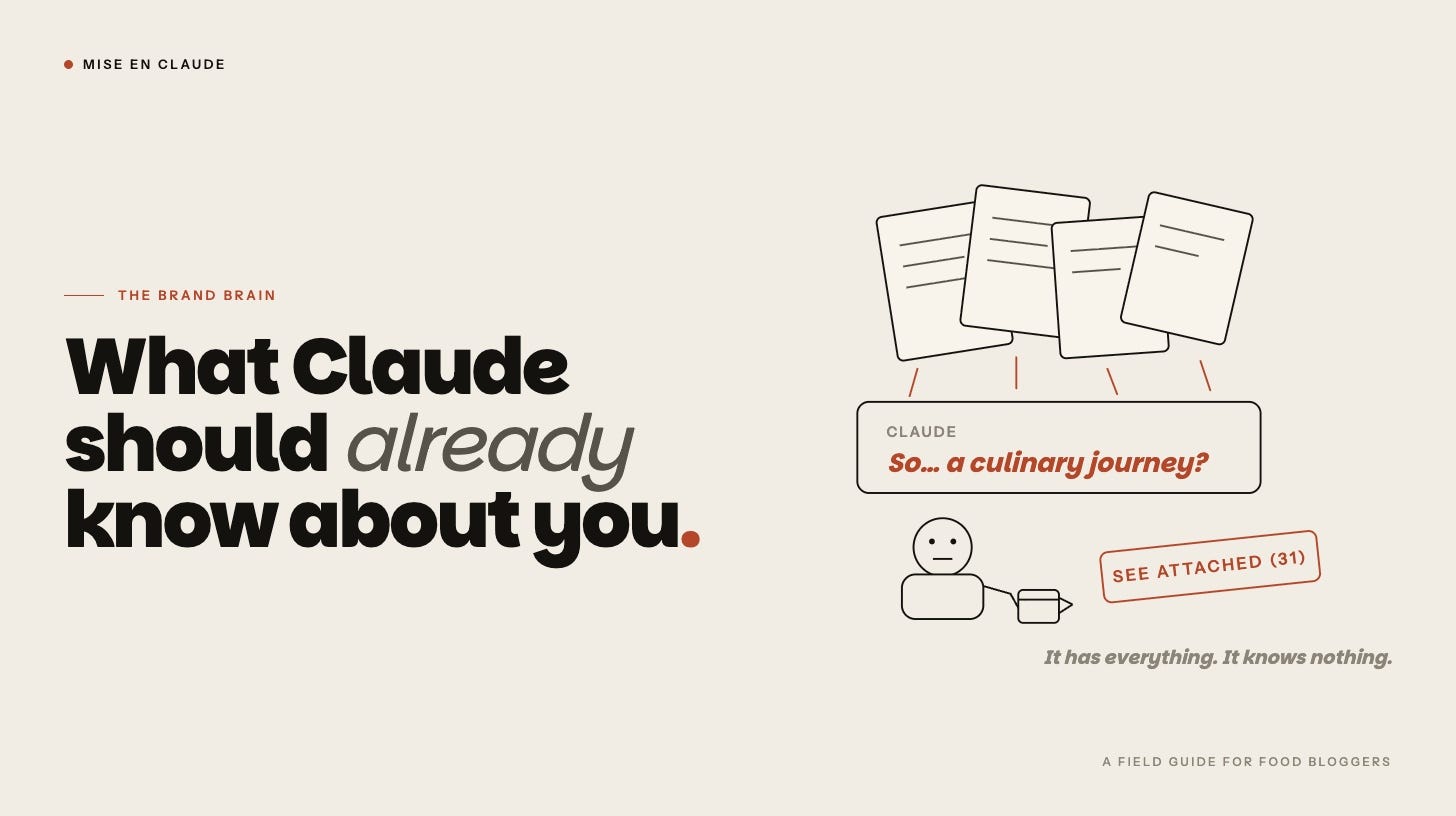
So, now you get excited. You drag in the media kit, the 2023 strategy deck, thirty of your best posts, two half-finished docs. Yes, Claude now has vastly more information about you but also noticeably worse judgment about you!
Every extra document is one more thing Claude has to guess the relevance of, like, how is it relevant to the next sentence it is about to write, with no reliable way to guess correctly.
Your old documents disagree with your new ones, and Claude cannot tell which one won.
And a lot of times, the stuff that matters the most is simply not written down anywhere. I never call vegetarian food a substitute. That was not written down anywhere until I built my Brand Brain - I would just correct it, over and over, and it was annoying, until I finally write it down ONCE. In the right spot.
So the test for anything going in.
Can this change a sentence Claude writes?
If yes, it is context, it goes in the Brand Brain! If no, it is storage, it belongs in a folder, not the brain.
Looks right is not the same as is right. Spot check the facts that actually matter. Did it keep your real numbers.
Changed a rule. Check it. Open a fresh chat and ask Claude to repeat the rule back to you before you trust it in the wild.
Worse output. Add less. If a draft gets worse after you added five more examples, the fix is almost never a longer document. Cut back to your two best examples and one clear instruction.
There are nuances that do not survive a Substack post, because they only make sense watching them happen.
For instance, what order should you run the five steps in when your business has three audiences instead of one? How can you tell your positioning step was too safe, from the specific way Claude’s first draft comes back generic instead of wrong? Or maybe it’s the exact wording that gets Claude to tell you it simply does not understand your voice (yet - the operative word is always, yet) instead of calmly faking a confident answer.
Oh gosh and the failure modes!
I have watched a room full of super smart people build this exact thing, and many parts of the operating system setup can break in ways no one expects, and no post warns you about.
Read about it and you get the shape. Build it next to someone who has already hit every wrong turn and you get the shape plus the hour you would have lost finding it yourself.
So keep your eyes peeled for a free webinar I’ll be running in October when my next cohort of the AI Operating System wraps up where we’ll build a Brand Brain live, on screen, from a blank chat, with a real business. (And hit me up if you want to volunteer). So hopefully, you can bring your laptop and build yours alongside me, or watch and ask questions as they come up!
Toodles.
No posts
Comments
Nothing yet. Say the first thing.
Sign in to join the conversation.