
I did something this week I had never done before.
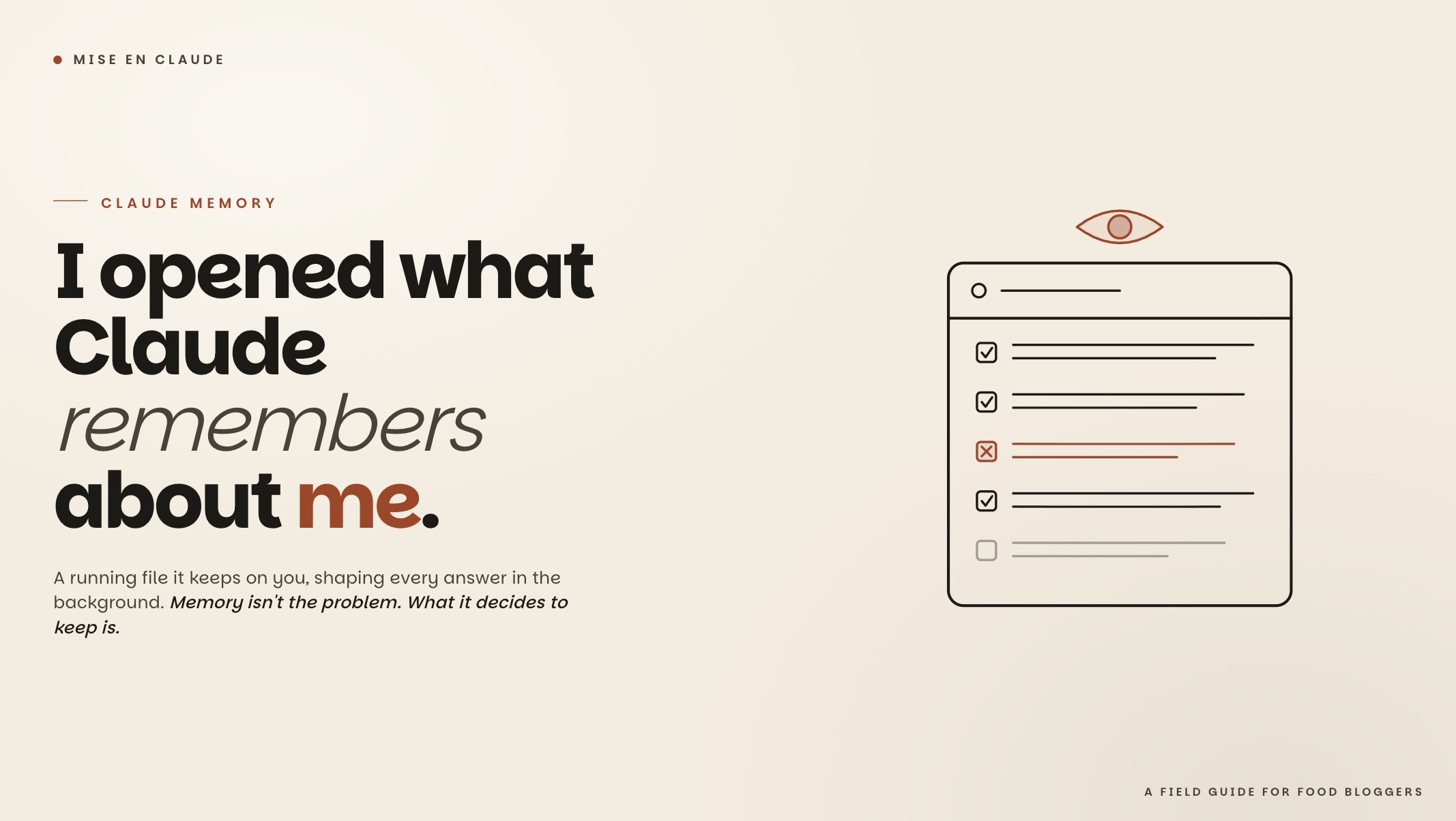
I opened up what Claude remembers about me.
Not the chat history. The memory. The actual running file it keeps on you now, the one that shapes every answer it gives, quietly, in the background, whether you ever look at it or not.
As of this month, Claude’s memory is a set of entries you can open, read, edit, and delete one at a time. Go to Settings, then search for “Memory” and it should show up under Capabilities
I went in expecting a tidy little summary. A name, a job, maybe my time zone.
That is not what I found. Woot. The crazy amount of time I spent setting up Claude worked, for the most part.
The first thing that stopped me was how RIGHT some of it was.
It had my writing voice down. Short paragraphs. The caps I use for punch. The way I close warm. None of which I ever sat down and explained to it.
Then I found this.
Somewhere in there, Claude had written itself a little rule: that I use the word “actually” casually in my own writing, even though one of my own hard style rules bans it, and that it should let that one through because it is how I really talk.
Read that again.
It watched me break my own rule. It decided I meant to. And it quietly gave itself permission to keep my voice instead of my instructions.
That is not a search bar remembering what I typed. That is a model forming an opinion about who I am from how I behave. Eerie.
Also, honestly, a little flattering. It knows me better than my own style guide does.
And then I kept scrolling.
Here is the line I actually laughed at.
In my permanent memory, the one that is supposed to hold the durable stuff, who I am and how I work, there was a note about a chimichurri script that was “pending vinegar clarification.”
Vinegar. Clarification.
A note about which vinegar to use in one video, filed in the same place it stores the fact that I left a twelve-year career and run a business.
That is the AI problem in one entry.
My AI’s long-term memory was holding a to-do about salad dressing as if it were part of my identity.
I scrolled up and the entire top section was like that.
A snapshot of one busy week.
Eight scripts in progress.
A production sprint.
All of it true last week.
All of it false by August.
Memory is supposed to know who you are. Mine was mostly keeping track of what I was doing that afternoon.
One entry listed a business I supposedly run.
I went looking for the folder. I keep a folder for everything. There was no folder. There was no file. There was nothing.
I still do not know if I forgot to build the thing, or Claude did.
Either way, my most-used tool had been quietly reasoning as if a whole venture existed, and it had never once occurred to me to check.
I was going to grab a screenshot of my memory to show you. Proof, receipts, the whole thing.
Then I read it.
It had my job search in it. A role I am quietly exploring. Names. Things I have told almost no one.
So here is a real warning, not a cute one.
Your AI’s memory holds things you would never put on a slide. Before you ever share your screen with that open, or hand a screenshot to someone, read every line first. I nearly did not.
None of this means the feature is bad. It is genuinely good that I can finally see and fix this.
But it changed how I think about the whole thing.
A system that remembers last Tuesday as if it were who you are will drift. Slowly. Confidently. It will keep getting more and more sure about a version of you that is three weeks stale, and you will feel it as “why does Claude keep getting my brand wrong” without ever knowing where the wrongness lives.
The fix is not more memory. It is the right memory. Identity, not to-do list.
Open Settings, then Memory. Give it ten real minutes. Two passes.
First, cut the sprint. Anything that is this-week noise, delete it. Your AI does not need to carry your task list as part of who you are. You can tell it right there in the box: “delete the entries about my current production sprint, that is short-term task state, not durable context.”
Second, fix the wrong kind. The entries that are eerily right, leave them alone. The one number, name, or fact that is off, correct it in a single line.
You will close that panel knowing exactly what your most-used tool believes about you.
Then set a reminder to do this every month.
Almost nobody does this. It is sitting one click away, and it is running your outputs whether you look or not. Now, go look.
No posts
Comments
Nothing yet. Say the first thing.
Sign in to join the conversation.