
Ruth Pitter (1897-1992)1 began publishing poetry at the age of twelve. Her parents, both teachers, encouraged Pitter to read and memorize poetry from a young age, and she was inspired by the natural world, especially her family’s trips to Hainault Forest.
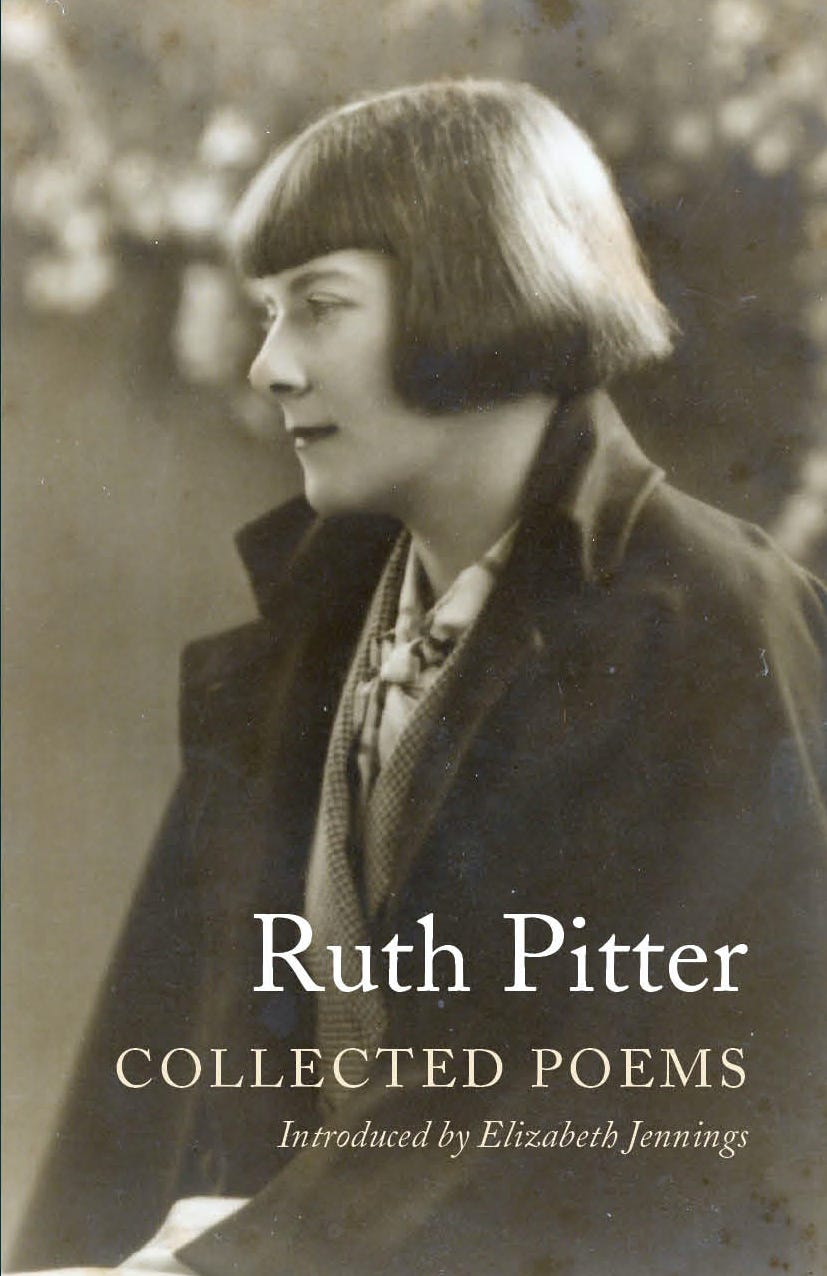
Pitter began her poetry career in earnest as a young adult, sponsored by Hilaire Belloc, coming out with several collections in the 1920s. She worked in the War Office during the Great War, and later found a vocation as a furniture decorator. Her trays and other pieces grew in demand, and she struck out on her own with her business partner Kathleen O’Hara.
Pitter’s poetry career grew in the 1930s, as she explored her voice as a traditional poet, against the growing stream of modernism. While Pitter admired T. S. Eliot, she did not write poetry to be clever or obscure, but to make plain the beauty she saw in the world around her. She converted to Christianity during WWII, through listening to C. S. Lewis’s broadcasts during the air raids. His intellectual arguments for the faith gave her strength in a time of despair, and she took them to heart. She continued writing poetry in much the same vein, though she continued to work full-time until she could afford to retire.
She spent the final decades of her life happily in the Hawthorns, Long Crendon, Buckinghamshire. One of her great creative efforts late in life (in addition to a few volumes of poetry) was adapting the York Cycle of mystery plays for her parish, St Mary the Virgin in Long Crendon. Her work was admired by Lewis, who became a dear friend; Lord David Cecil, who asked Pitter to be the godmother of his daughter Laura; Philip Larkin; John Betjeman; John Masefield; and many others. Her awards included the Heinemann Award, the Queen’s Gold Medal for Poetry, becoming a Companion of Literature, and being named a Commander of the British Empire.
“Stormcock in Elder,” one of Pitter’s better-known poems, is from her 1936 collection A Trophy of Arms, published by Cresset Press. This book won Pitter the Hawthornden Prize in 1937. (The next year, the prize went to David Jones for In Parenthesis, which Sarah Coogan has written about here.)
When I first read “Stormcock in Elder,” I figured a stormcock must be an imposing bird, perhaps a raptor. As I read further, I realized Pitter was talking about a smaller, unassuming bird, yet one who was still in command of creation. “Stormcock” is a Shropshire term for several birds: the green woodpecker, the mistle (or missel) thrush, and the fieldfare. The mistle thrush and fieldfare have similarities, but the fieldfare has Pitter’s “spots of chestnut” and “white merged into russet.”

With this image of a fieldfare, or stormcock, in your mind, listen to the fieldfare call, and meet this proud bird in Pitter’s poem.
Text within this block will maintain its original spacing when published
In my dark hermitage, aloof
From the world's sight and the world's sound,
By the small door where the old roof
Hangs but five feet above the ground,
I groped along the shelf for bread
But found celestial food instead:
For suddenly close at my ear,
Loud, loud and wild, with wintry glee,
The old unfailing chorister
Burst out in pride of poetry;
And through the broken roof I spied
Him by his singing glorified.
Scarcely an arm's-length from the eye,
Myself unseen, I saw him there;
The throbbing throat that made me cry,
The breast dewed from the misty air,
The polished bill that opened wide
And showed the pointed tongue inside:
The large eye, ringed with many a ray
Of minion feathers, finely laid,
The feet that grasped the elder-spray:
How strongly used, how subtly made
The scale, the sinew, and the claw,
Plain through the broken roof I saw;
The flight-feathers in tail and wing,
The shorter coverts, and the white
Merged into russet, marrying
The bright breast to the pinions bright,
Gold sequins, spots of chestnut, shower
Of silver, like a brindled flower.
Soldier of fortune, northwest Jack,
Old hard-time's braggart, there you blow!
But tell me ere your bagpipes crack
How you can make so brave a show,
Full-fed in February, and dressed
Like a rich merchant at a feast.
One-half the world, or so they say,
Knows not how half the world may live;
So sing your song and go your way,
And still in February contrive
As bright as Gabriel to smile
On elder-spray by broken tile.
In this poem, Pitter takes a mundane moment—getting bread from the pantry—and elevates it into a holy experience of close attention. She begins the poem “aloof / from the world’s sight and the world’s sound,” but by the end of the poem is transfixed by sight and sound, in deep connection with the natural world.
Years ago, I lived in an apartment that I thought of as a treehouse. Our three windows looked out into dense trees, and in summer we could hardly see the ground. Inspired by the wildlife we could see through the sliding glass door to the balcony, my husband put up a bird feeder, and we had constant entertainment watching cardinals, blue jays, rose-breasted grosbeaks, and squirrels vie for provender. When we noticed particularly bright birds, we would freeze, remaining still to admire the sights while not disturbing the wildlife.
I think of Pitter frozen in attention, her hand still extended for bread in the darkness of the pantry, yet her eyes fixed above as the stormcock’s song filled her ears. She was close enough to notice the detailed color and “minion feathers,” still enough to see the “large eye ringed with many a ray.”

Pitter’s poem invites us to like attention, to wake from our late winter slumber to see the world coming to life again. This year, late February brought Christians into Lent, a time of fasting. In the medieval era, the Lenten fast was not just for spiritual reasons, but a frank acknowledgement of emptying stores as spring planting began and winter stores dwindled. “Full-fed in February” Pitter notices the stormcock, “dressed / Like a rich merchant at a feast.”
Collected Poems by Ruth Pitter. This collection, published two years before her death, begins with poems from A Mad Lady’s Garland.
Sudden Heaven: The Collected Poems of Ruth Pitter, a Critical Edition, ed. Don W. King. This critical edition from 2017 includes poems from her early collections and previously unpublished material, including Pitter’s transposition of portions of C. S. Lewis’s Perelandra into irregular Spenserian stanzas, and some of her radio speeches about poetic theory and practice.
Hunting the Unicorn: A Critical Biography of Ruth Pitter, by Don W. King
The Letters of Ruth Pitter: Silent Music, by Don W. King
Biographical information drawn from the Oxford Dictionary of National Biography (https://doi-org.ezproxy.st-andrews.ac.uk/10.1093/ref:odnb/41102) and Don W. King’s biography of Pitter, Hunting the Unicorn: A Critical Biography of Ruth Pitter (The Kent State University Press, 2008).
No posts
Comments
Nothing yet. Say the first thing.
Sign in to join the conversation.