
Yet this is not the end! I feel, Babette, that this is not the end.1
My personal Holy Saturday tradition is reading “Babette’s Feast” by Isak Dinesen (Karen Blixen, 1885-1962), quoted above. In 2025, I considered the cross in literature as part of my Lent and Holy Week meditation. This year, on Maundy Thursday in anticipation of Easter Sunday, I wish to consider the Eucharist in three works of literature: “Babette’s Feast” (1958), The Feast (1949), and Prince Caspian (1951).
You might be itching to comment that “Babette’s Feast” is an Advent story, and you would be perfectly correct. The titular feast occurs on December 15, squarely in the Advent season, though the “pious ecclesiastic…sect” surely abandoned the trappings of the liturgical year.2 It’s also a film,3 but I’ll be considering the short story by Isak Dinesen (Karen Blixen)4 here.
Babette, a Frenchwoman, escapes the political violence of her native country by emigrating to Norway. She lands on the doorstep of Martine and Philippa, elderly sisters named “after Martin Luther and his friend Philip Melanchthon.”5 The sisters are carrying on their father’s legacy in his pietist sect, that despite its simple expression of faith was riddled with complex wounds and hurts to one another.
“Babette can cook,” writes her sponsor Achille Papin.6 After years of faithfully making split cod and ale-and-bread-soup for the sisters and the people they serve, Babette wins the French national lottery. She asks the sisters for permission to make a feast for the hundredth anniversary of their father’s birth, and reluctantly they assent.
The members agree to not comment upon the food (they fear batrachian fare) but their senses, deprived by their simple ways of living, are overwhelmed with the wine, quail, and confections cooked by Babette. As they gather and feast, Dinesen writes,
…the rooms had been filled with a heavenly light, as if a number of small halos had blended into one glorious radiance. Taciturn old people received the gift of tongues; ears that for years had been almost deaf were opened to it. Time itself had merged into eternity. Long after midnight the windows of the house shone like gold, and golden song flowed out into the winter air.7
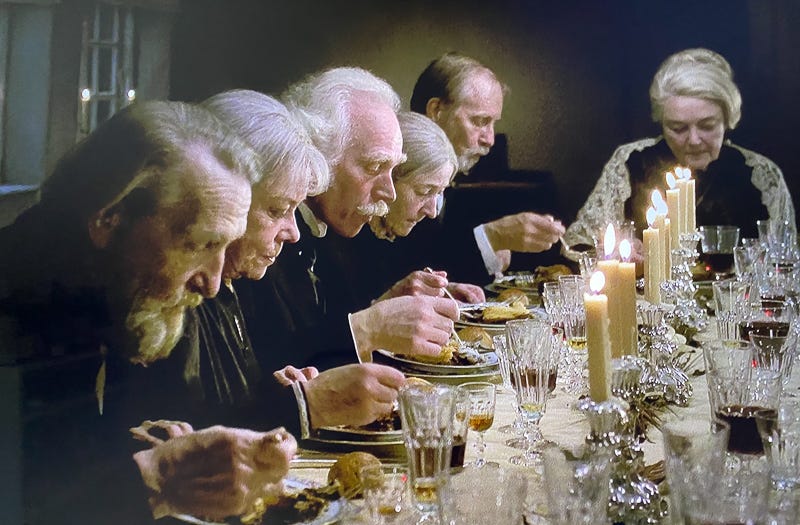
It is not only Babette’s food (and wine) that exalts the guests. It is the sense of grace (and perhaps a little inebriation) from an overwhelming feast to people who have eaten little other than cod, bread, and vegetables in endless forms for their whole lives. Babette does not partake, and her act of spending all she had on feeding undiscerning palates could be seen as one of supreme generosity. “For your sake? …No. For my own,” Babette says. “…I am a great artist. A great artist, Mesdames, is never poor. We have something, Mesdames, of which other people know nothing.”8
In this way, “Babette’s Feast” shows us that the Eucharist is for all of us: discerning and undiscerning. While we do not want to partake unworthily, we all know that we are here undeserving, equal in God’s eyes, receiving his body with empty hands, grace upon grace. Jesus, who instituted the Eucharist by laying down his own body and lifeblood, was also a great artist. He had the unknown mystery of Triune love, the promise of the resurrection, “of which other people know nothing.” Like Babette “enchanting the angels,”9 the feast to which Jesus invites us is given wholly of himself: he is the server, and he is the food and drink. The Eucharist is a work of profound artistry whose imaginative depths we will never plumb, no matter how many times the feast is laid before us, no matter how many times we partake.
The Feast by Margaret Kennedy is what C. S. Lewis called “most remarkable: a wholly successful allegory of the Seven Deadly Sins” in a letter to the poet Ruth Pitter.10 He wrote this on January 1, during the twelve days of Christmas, which is also the feast of the Circumcision (also called the Holy Name). Once again, I co-opt story for the season of Easter, though it is about a summertime holiday spot. Spoilers beware: skip to the next section if you want to read the novel without spoilers!
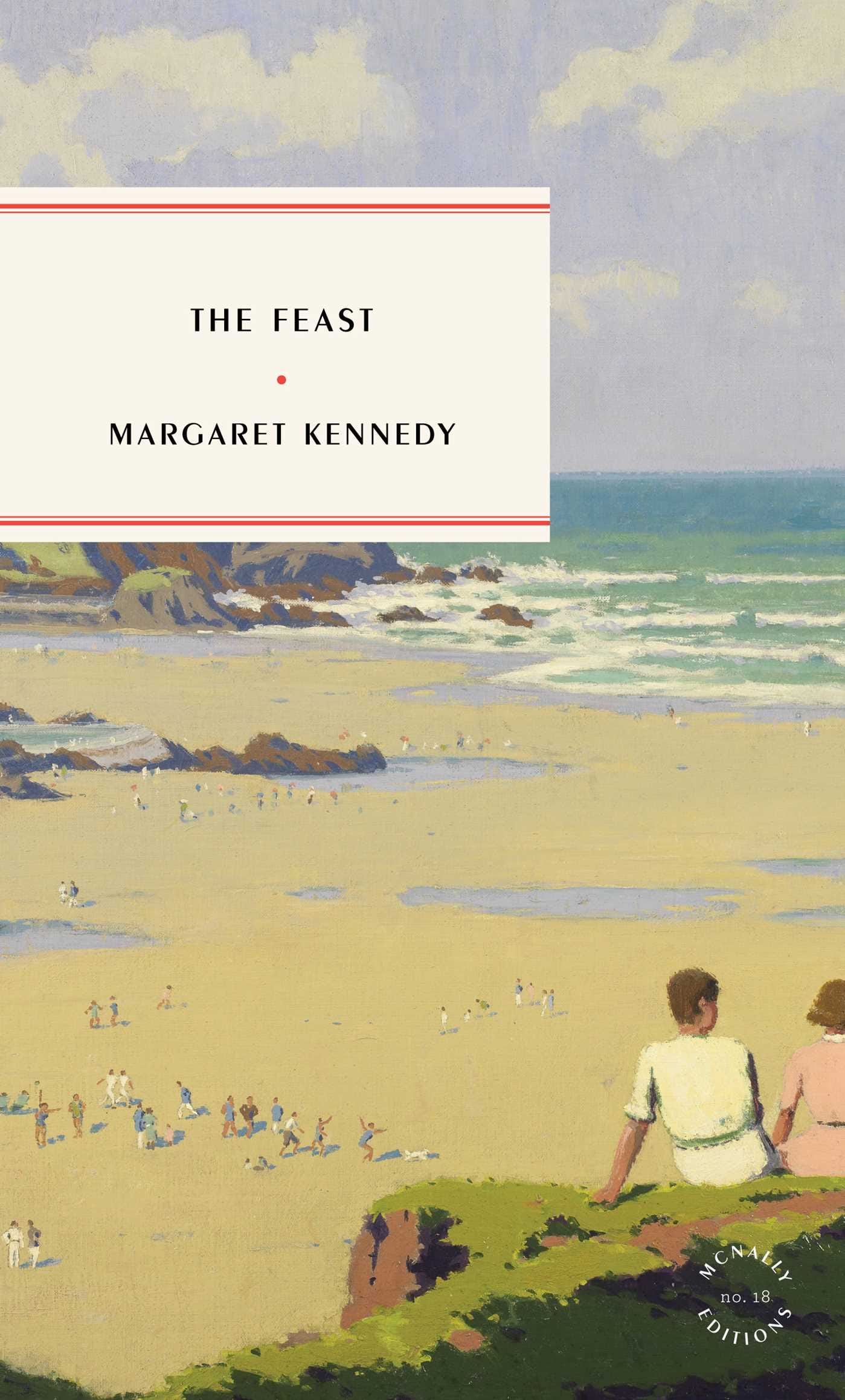
The Feast is set on the coast of Cornwall in 1947. A cliff, with a hotel on it, has fallen into the sea, as we learn in the opening pages. Kennedy begins with the end and traces her story back to the arrival of the hotel’s guests and the circumstances leading up to the catastrophe.
While The Feast has many significant characters, seven of them represent the deadly sins of pride, greed, wrath, envy, lust, gluttony, and sloth. (I recommend reading Dominika’s post to learn more.) These seven characters are not simply abhorrent figures of comic evil. They mirror the worst, hidden sides of ourselves. Who hasn’t wanted something someone else has? Who hasn’t wanted to feel better than others around us, or eat one more slice of cake? Kennedy’s genius is not only in those seven characters, but in the sixteen normal characters around them, who take up the struggle against their lower appetites. She avoids making a stark contrast with characters representing the seven heavenly virtues (prudence, justice, temperance, fortitude, faith, hope, and charity). Instead, she spreads out the journey to virtue among many characters, adults and youths and children.
When we finally reach the climactic day when the hotel will crash into the sea, we join the characters at a feast gleefully put on and promoted by the children in the story. Everyone is invited. The feast is initiated by the Cove girls, the children who lack the most, whose covetous mother takes from others just for the twisted pleasure of it. The Cove children dream not of “having it all,” but sharing it all. When they finally achieve the dream of their feast,
The Coves were too happy to sing, too happy to eat. Gravely they circled round the ring offering food and drink to their guests. Without seeming to do so they ruled the Feast and saw to it that everything should be done in a suitable manner.
…‘A lovely speech!’
‘A lovely Feast!’
‘For…’
‘FOR THEY ARE JOLLY GOOD FELLOWS,
FOR THEY ARE JOLLY GOOD FELLOWS…’11
Without being heavy-handed, The Feast demonstrates the Gospel truth that following the little children to the feast saves us from sin and death: “Truly I tell you, whoever does not receive the kingdom of God as a little child will never enter it.”12 When I read of the Cove girls “ruling” the Feast, I see “a little child leading them.”13 The Feast reminds us that at the Eucharist we are all Jolly Good Fellows in the kingdom of God, upside-down as it is: where the last are first, the first are last; where the holy mountain will never hold hurt or destruction; where children are seen, heard, and blessed.
Prince Caspian was the second book published in the Chronicles of Narnia, a war novel about the Narnians against the imperial powers. After the battle against the Telmarines and the return of their king, the Narnians run wild as Aslan frees people from the shackles of un-abundant life.
The Triduum, or the three days (Maundy Thursday, Good Friday, and Holy Saturday) leading up to Easter, are solemn and sorrowful as we commemorate Jesus’ passion and death. When Jesus died, he descended to the place of the dead and harrowed hell, conquering sin and death. No Eucharist is consecrated after Maundy Thursday until the Easter Vigil. During the Easter Vigil, we recount all of salvation history from Genesis to Jesus until we get to the resurrection, when the Eucharist occurs once more in celebration of his victory. It’s after the agony, the crucifixion, the death, and the descent to the dead that we feast. While we imaginatively share in Jesus’s passion—and some of us, perhaps, “bear on our bodies the marks of Jesus”—Jesus fought for us, on our behalf.
Lewis’s feast in Prince Caspian also occurs after the battle, after freedom has been one. It emerges straight from the joy of Aslan’s victory:
Then Bacchus and Silenus and the Maenads began a dance, far wilder than the dance of the trees; not merely a dance for fun and beauty (though it was that too) but a magic dance of plenty, and where their hands touched, and where their feet fell, the feast came into existence—sides of roasted meat that filled the grove with a delicious smell, and wheaten cakes and oaten cakes, honey and many-colored sugars and cream as thick as porridge and as smooth as still water, peaches, nectarines, pomegranates, pears, grapes, strawberries, raspberries—pyramids and cataracts of fruit.14
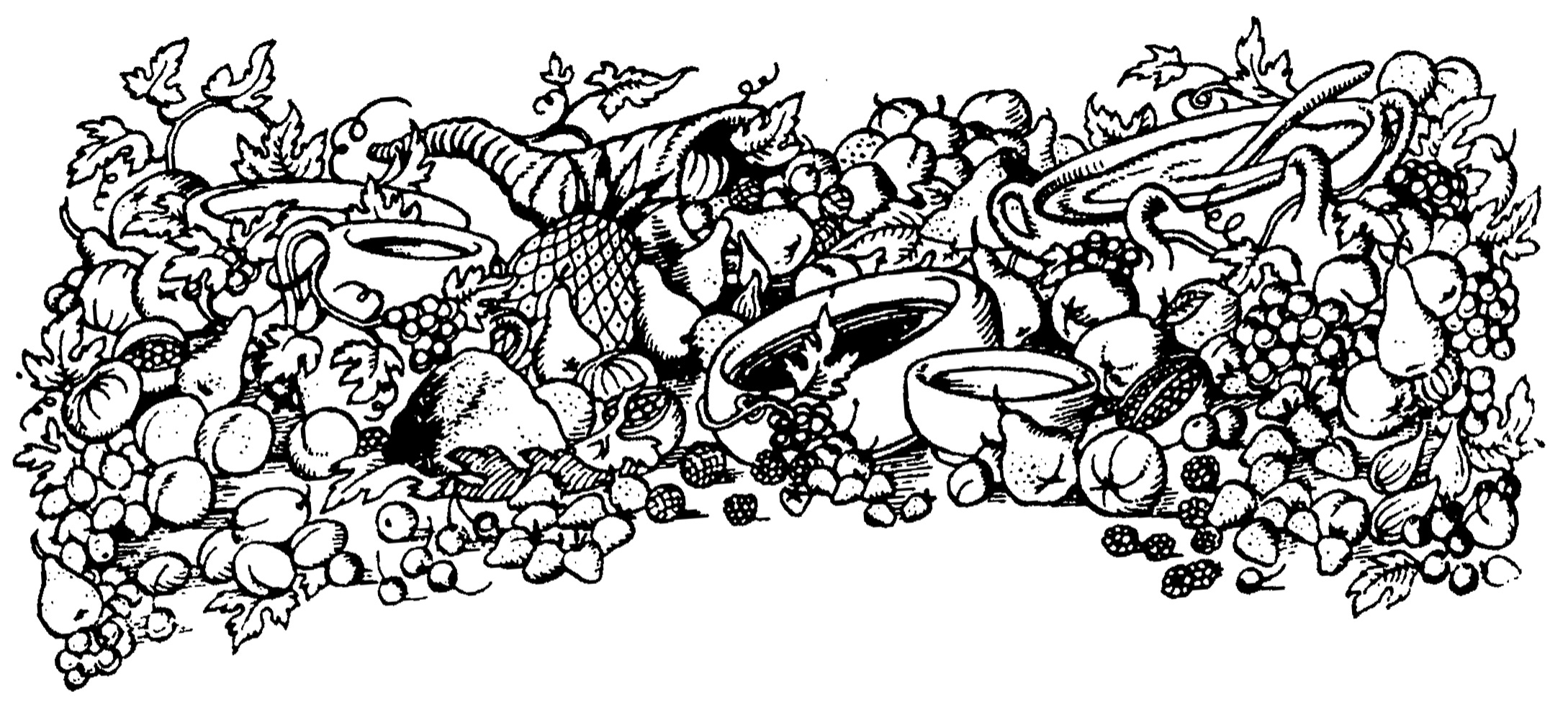
In this way, Lewis captures the image of the Paschal feast:15 after battle, dancing and feast! Lewis’s imagery makes me consider Jesus “trampling Hell and Satan under his feet” as a dance. The feast goes on “till long after the sunset had died away,” and “there was no breaking up or going away, but as the talk grew quieter and slower, one after another would begin to nod and finally drop off to sleep with feet toward the fire and good friends on either side.”16 Aslan and the moon, instead of sleeping, “gazed upon each other with joyful and unblinking eyes.”17 Not unlike the Great Commission, given at the Ascension, the novel continues with a sending-forth of the Telmarines and the Pevensies back to Earth, only two of whom will return to Narnia as children. Lewis reminds us that the feast, though marvelous and hard-won, is not the end in itself. It is a step on the journey to eternity.
It’s no accident that Isak Dinesen and Margaret Kennedy included the word “feast” in their titles, nor that Lewis detailed the joys of the feast in Prince Caspian. Despite when (and where) these three stories take place, I find in all of them an Easter resonance. Each year we re-institute the Lord’s supper on Maundy Thursday and celebrate it with fullest joy on Easter Sunday. Stories like “Babette’s Feast,” The Feast, and Prince Caspian can call our attention to the wonder of the feast that is spread before us.
In This Is Happiness (2019), Niall Williams writes,
Books, music, painting are not life, can never be as full, rich, complex, surprising or beautiful, but the best of them can catch an echo of that, can turn you back to look out the window, go out the door aware that you’ve been enriched, that you have been in the company of something alive that has caused you to realise once again how astonishing life is, and you leave the book, gallery, or concert hall with that illumination.18
In a lifetime of worship, the Eucharist can sometimes feel commonplace, an everyday occurrence, as it is in parishes around teh world. Stories like these smack me with astonishment, make me aware I’ve been enriched, “turn [me] back to look out the window.” With Dinesen I am overwhelmed with my unworthiness and gobsmacked by artistry. With Kennedy I am humbled to be invited and follow the little children. With Lewis I marvel at the dance that yields a feast, and am illumined.
Christ has died, Christ is risen, Christ will come again. Therefore, let us keep the feast!
“Babette’s Feast” in Anecdotes of Destiny and Ehrengard by Isak Dinesen (Vintage International, 1993), 59. All quotations from this story will be from this edition.
The 1987 film is absolutely wonderful and wholly successful. Its grave error, for me, is the film’s transposition of the story to the author’s native Denmark. The village becomes unnecessarily bleak (the houses in the story are “gray, yellow, pink, and many other colors” [21]) and the majesty of the Nordic fjords are lost. This does not stop me from rewatching the film every year alongside my annual re-read!
I’ll be using Blixen’s penname Isak Dinesen here, because she chose Isak since it means “laughter,” which is a perfectly acceptable response to good news that we should really stop mocking of Sarah for, and instead join in.
“Babette’s Feast,” 57-58.
“In Paradise you will be the great artist that God meant you to be! …Ah, how you will enchant the angels.” Philippa speaking in “Babette’s Feast,” 59.
C. S. Lewis to Ruth Pitter, 31 January 1956, C. S. Lewis Collected Letters vol. 3, 700.
The Feast by Margaret Kennedy (McNally Editions, 2023), 320 and 322.
“The wolf shall live with the lamb; the leopard shall lie down with the kid; the calf and the lion will feed together, and a little child shall lead them.” (Isaiah 11:6 NRSVUE)
I would be remiss to omit the trees’ feast of earths (211-212) which has long lingered in my memory.
Prince Caspian, 212-213.
No posts
Comments
Nothing yet. Say the first thing.
Sign in to join the conversation.