

Over the past month, Mint Money has been examining the issues plaguing health insurance portability. It began with our reporting on health insurance retention rates, where one of the major drivers of churn was policyholders porting their policies.
Portability was introduced by the insurance regulator to ensure customers were not trapped in health insurance policies that didn’t serve them well. The idea was simple: allow policyholders to switch insurers without losing continuity benefits such as the no-claim bonus, waiting periods already served and the time completed towards the 60-month moratorium.
While a strong consumer reform on paper, it appears to be falling apart on the ground. We examined the guardrails meant to protect consumers: the ban on commissions for ported policies to prevent unnecessary churn and the requirement that every portability request be routed through the Insurance Information Bureau of India (IIB) to enable seamless exchange of underwriting and claims information between insurers.
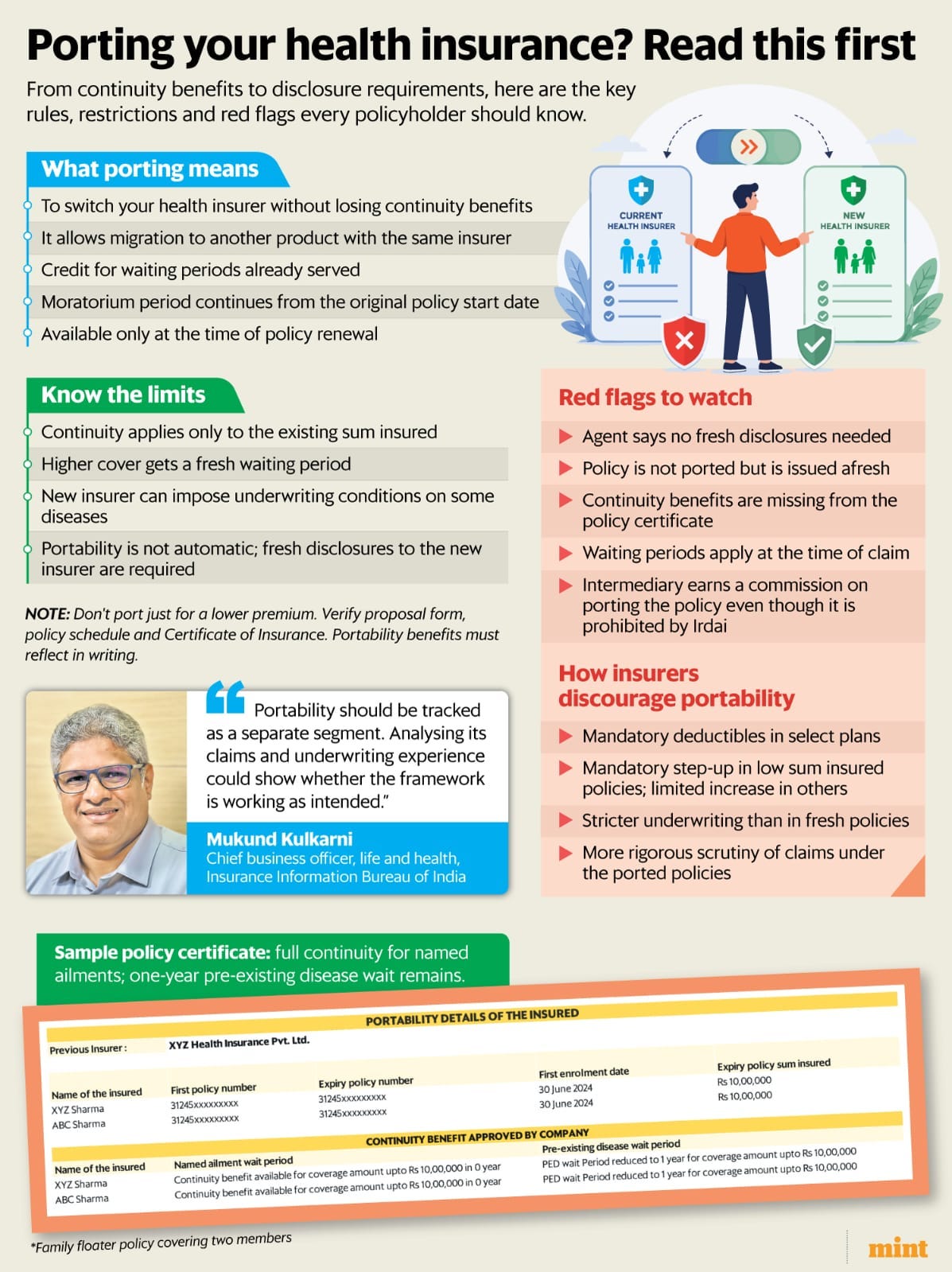
Our reporting found gaps on both fronts. First, commissions are indeed being paid on ported policies and quite brazenly. Intermediaries admitted to us that they receive direct commissions on ported policies, while in some cases policyholders are even being sold fresh policies in the name of portability. Second, our conversations with the IIB revealed there is currently no mechanism to ensure that all portability requests are actually routed through the IIB.
The data gap is equally worrying. There is no meaningful data to assess whether portability is working as intended. How many policies are ported every year? What is the claims experience of ported policies? How many claims are rejected, and do such rejections trigger any compliance review? If underwriting and claims information is expected to flow seamlessly through the IIB, then disputes arising from past disclosures should themselves become a regulatory red flag.
Aprajita Sharma and I examine how a reform meant to protect policyholders is instead exposing them to new risks. In my accompanying column, I argue that these gaps point to a broader regulatory failure.
In the investment space, we have two important stories from Jash Kriplani. The first looks at the rise and fall of South Korea’s stock market and the lessons it leaves in its wake. South Korea’s benchmark KOSPI index hit an all-time high in June before plunging nearly 40% over the next six weeks. Both the rally and the crash were driven by the AI narrative and the index’s heavy dependence on it. More than half the index is concentrated in just two semiconductor giants, Samsung and SK Hynix, making it highly vulnerable to concentration risk.
The decline was then exacerbated by leverage, which can magnify gains during a rally but amplify losses just as quickly when markets reverse. In South Korea’s case, leveraged exchange-traded funds (ETFs) tracking Samsung and SK Hynix alone added fuel to the fire. That is the fundamental risk with leverage — borrowed money can supercharge returns in a rising market but unravel portfolios with equal speed when sentiment turns.

The story is an important reminder of why diversification matters and why leverage should be used with caution. But perhaps the most powerful lesson comes from a Korean investor who succumbed to FOMO and invested the money he had set aside to buy an apartment because he didn’t want to miss out on the market rally. Today, he is struggling to pay even the apartment instalment. This is an important reminder that narrative driven investing can derail even the most carefully laid financial plans.
The second story looks at how passive investing is evolving beyond the broad market Nifty 50 and Sensex indices.
As index funds and exchange-traded funds (ETFs) have become mainstream, fund houses are launching sectoral and thematic passive funds tracking everything from banks and metals to defence, energy and capital markets. The recent outperformance of several sectors has only added to their appeal. But these are tactical bets, not core holdings. Experts suggest limiting such funds to 15-20% of your portfolio. It’s also advisable to resist spreading small amounts across too many themes that can also dilute the impact.

But before you decide it’s also important to understand that sectoral passive funds are not for everyone. They require a higher risk appetite and an understanding of sector cycles, including when to enter and exit.
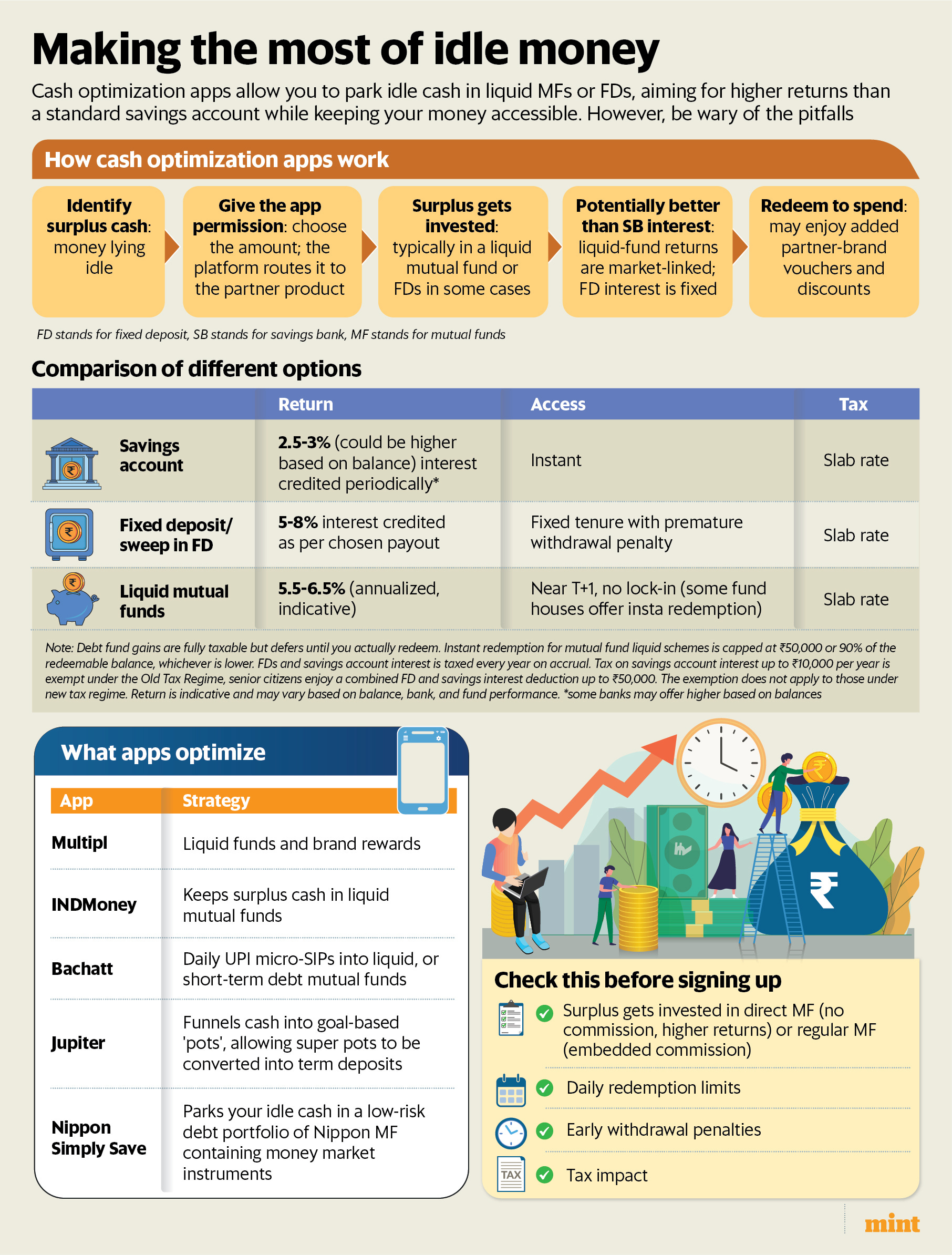
In the spending space, Ananya Grover tracks the rise of cash optimisation apps that promise to earn more on the money lying idle in your savings account by parking it in liquid mutual funds or fixed deposits.
Layered with merchant discounts and cashback, these apps appear attractive at first glance. But as the story explains, higher returns also come with trade-offs including costs, exit loads, liquidity constraints that users should weigh carefully.
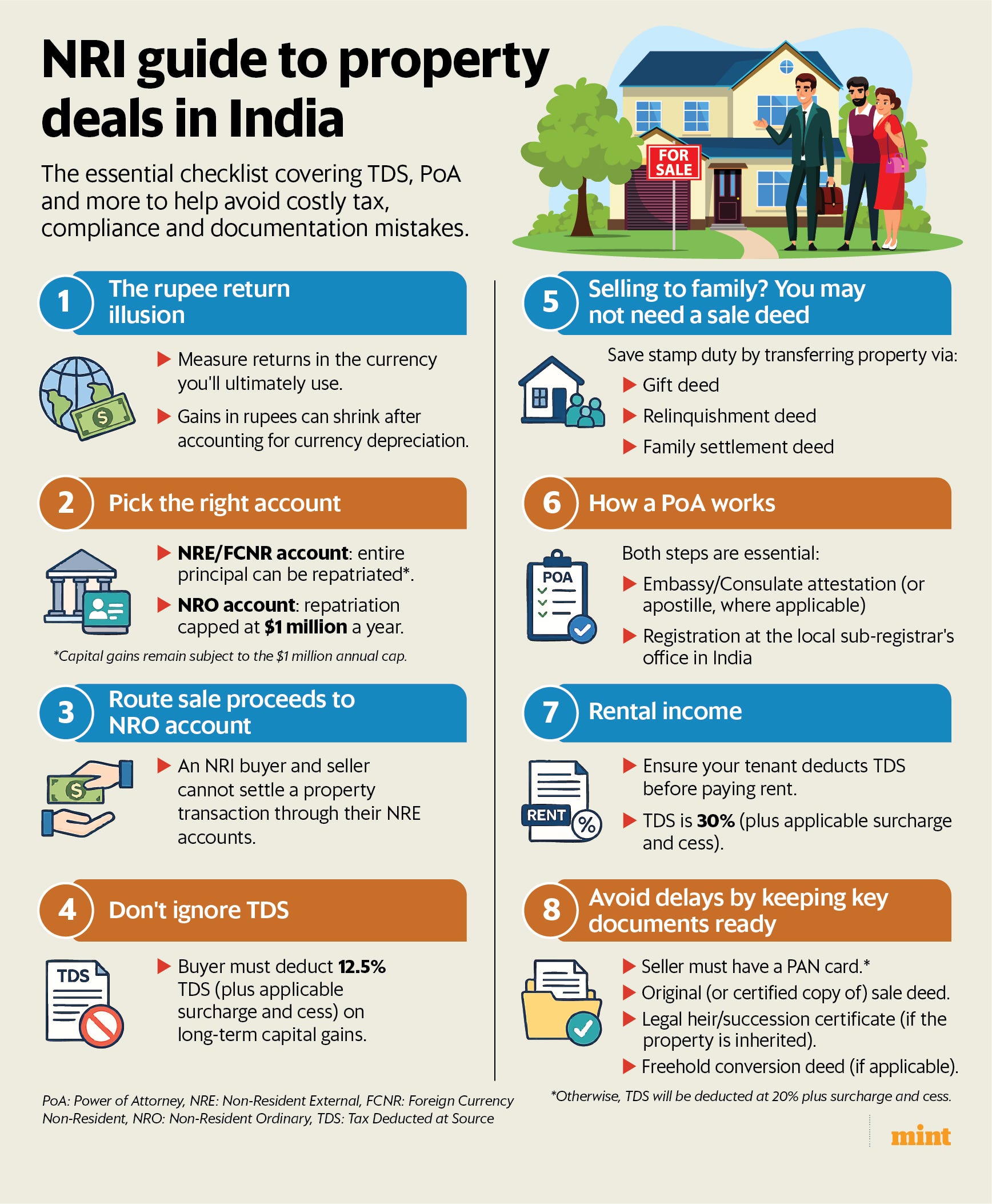
The final story is for NRIs looking to buy or sell real estate in India. The transaction is not just about finding the right buyer or seller. It also involves navigating a maze of capital gains tax, TDS, FEMA regulations, repatriation rules, documentation requirements and even the right bank account for receiving and remitting the proceeds.
Aprajita Sharma walks readers through the key rules, common pitfalls and practical steps, making this an essential playbook for NRIs navigating property transactions in India.
In this week’s Money Guru, Aprajita Sharma spoke to Narendra Bharindwal, president of the Insurance Brokers Association of India (IBAI), about the Insurance Intermediaries (Amendment) Regulations, 2026. The conversation unpacks what the new rules mean for intermediaries.
Some of the notable changes include mandatory tagging of every policy to the individual salesperson who sold it, perpetual registration in place of periodic licence renewals and stronger governance and disclosure norms aimed at improving accountability across the insurance distribution ecosystem.
That’s all from the Mint Money team this week. Until next time!
Deepti Bhaskaran is editor, Mint Money, with two decades of experience as a personal finance journalist. Her work reflects a strong focus on financial literacy, consumer protection and practical money management. She can found at deepti.bhaskaran@livemint.com.
No posts
Comments
Nothing yet. Say the first thing.
Sign in to join the conversation.