

For many NRIs, ageing parents become the strongest reason to return home.
Years ago, a techie friend who had planned to settle in the US made the difficult choice to move back to his Tier II hometown to care for his parents. It wasn’t an impulsive decision. After exhausting help from relatives for hospital visits and increasingly depending on friends, he realised his parents’ growing medical needs could no longer be managed across time zones.
But coming home also meant a financial reset. His income fell sharply, while expenses—from medical care to home loan EMIs—became harder to manage.
His story isn’t unique. Many non-resident Indians who return to care for ageing parents discover that the move demands as much financial planning as emotional readiness.

Ann Jacob examines the financial realities of this reverse migration, from adjusting to lower incomes and managing overseas assets to navigating a new tax regime. The transition should ideally begin months before the flight home: setting up a Power of Attorney for overseas assets, reviewing foreign property and retirement accounts, notifying banks of your change in residential status, completing exit compliance formalities, and making the most of the RNOR window to reorganise foreign assets before they become taxable in India. Experts also advise postponing major investment decisions until both income and life in India have stabilised.
Back home, taxpayers are always looking for legitimate ways to reduce their tax outgo, and any structure that promises a separate taxable entity can sound tempting.
The Hindu Undivided Family (HUF) is one such option. An HUF is a separate legal and tax entity comprising members of a Hindu family who share a common ancestor and family assets. But that doesn’t mean you can simply shift your income into an HUF and lower your tax bill.

For salaried individuals, transferring salary, investments or other personal assets to an HUF rarely delivers any tax benefit. Instead, clubbing provisions often negate the advantage altogether. An HUF works best when it has genuine family wealth of its own—such as ancestral property, inherited assets or a family business. It can also receive certain gifts or be funded through properly documented loans.
There’s another important caveat: once assets are transferred to an HUF, they no longer belong to you individually. Other coparceners acquire rights over them, making any future sale or partition more complicated.
Shipra Singh explains why an HUF can be an effective vehicle for managing family wealth, but is unlikely to be the tax-saving shortcut many salaried taxpayers imagine.
The first looks at SEBI’s proposal for a new category of portfolio management services that would sit between mutual funds and traditional PMS offerings. The proposed mutual fund-only portfolio management services (MF-PMS) will invest exclusively in direct plans of mutual funds, exchange-traded funds (ETFs) and specialised investment funds (SIFs).
While such offerings already exist, the new framework would formally recognise the category and introduce its own regulatory structure, along with lower investment thresholds to widen access.
Jash Kriplani spoke to experts to examine whether MF-PMS offers enough value over building a portfolio of mutual funds yourself.

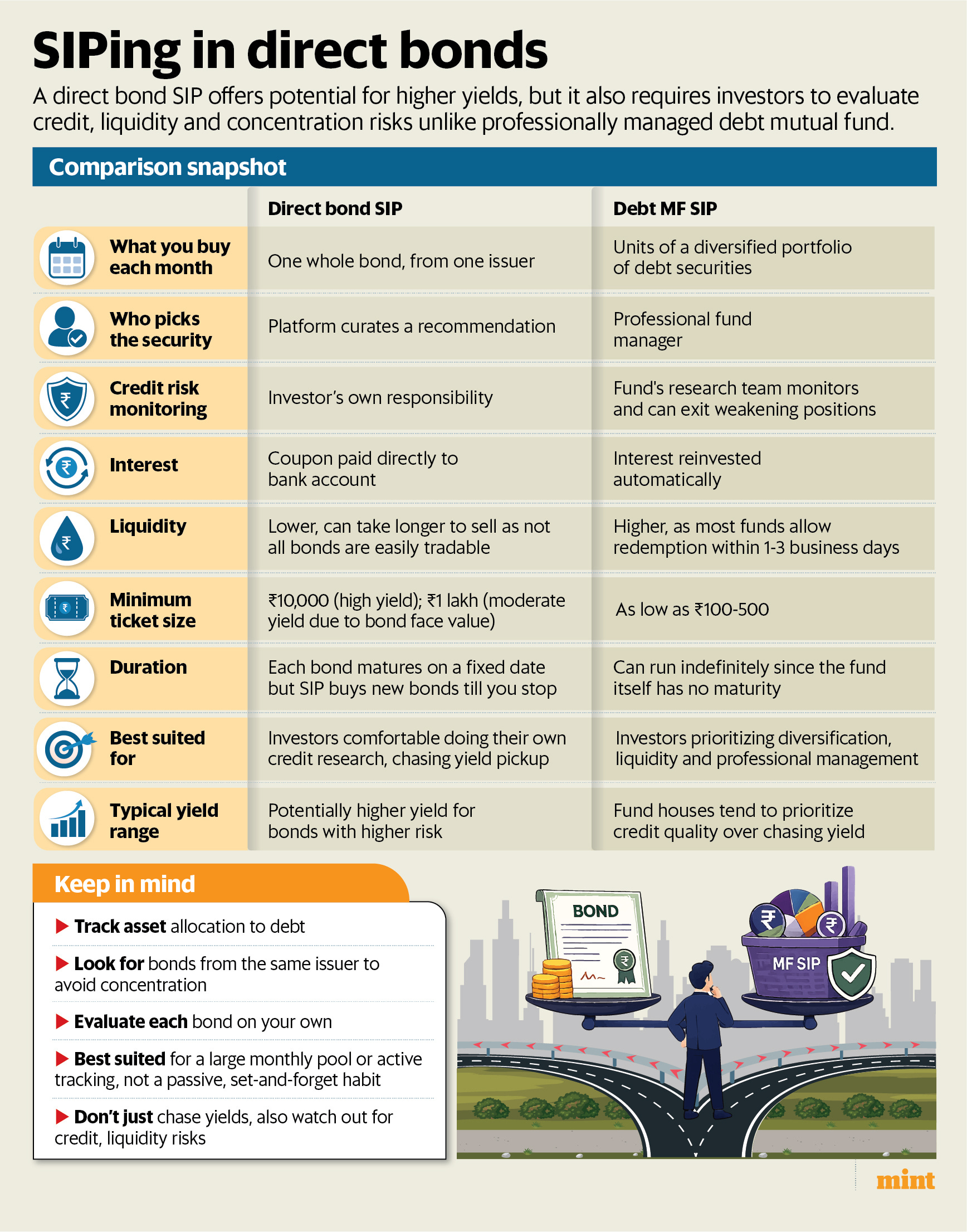
The second story looks at how systematic investment plans, or SIPs, have become part of everyday financial vocabulary—and are now being used to market bonds through monthly auto-debit mandates. Fintech platforms are increasingly offering ‘bond SIPs’, allowing investors to buy a different bond every month. The pitch is straightforward: invest regularly, diversify across issuers and potentially earn higher yields.
But a bond SIP is fundamentally different from a mutual fund SIP. In a mutual fund, even your first instalment gives you exposure to a diversified portfolio. A bond SIP builds diversification gradually, one bond at a time, meaning a default in the early months can have a disproportionately large impact. That’s why understanding the underlying credit risk is critical.
Ananya Grover explains how bond SIPs work and why investors need to look beyond the convenience of the SIP wrapper and carefully assess the bonds they’re actually buying.
Our third story explores active momentum funds, a relatively new category that has attracted investor interest after outperforming the broader market during the recent bout of volatility. Momentum investing involves buying stocks that are performing well and exiting those that begin to lose momentum, using indicators such as price and earnings trends. The active momentum funds have an advantage over passive strategies because fund managers can rebalance more frequently and use tools such as cash allocations or hedging when momentum reverses.
Jash Kriplani explains how these funds work—and why investors should remain cautious, given that the strategy is yet to be tested across multiple market cycles.

In this week’s Money Guru series, Jash Kriplani speaks to Kenneth Andrade, founder and chief investment officer of Old Bridge Mutual Fund, about the sectors he’s bullish on and why he’s avoiding IT despite attractive valuations. Andrade also shares why he remains constructive on Indian equities and the biggest risks he believes markets face.
That’s all from the Mint Money team this week. Until next time!
Deepti Bhaskaran is editor, Mint Money, with two decades of experience as a personal finance journalist. Her work reflects a strong focus on financial literacy, consumer protection and practical money management. She can found at deepti.bhaskaran@livemint.com.
No posts
Comments
Nothing yet. Say the first thing.
Sign in to join the conversation.