
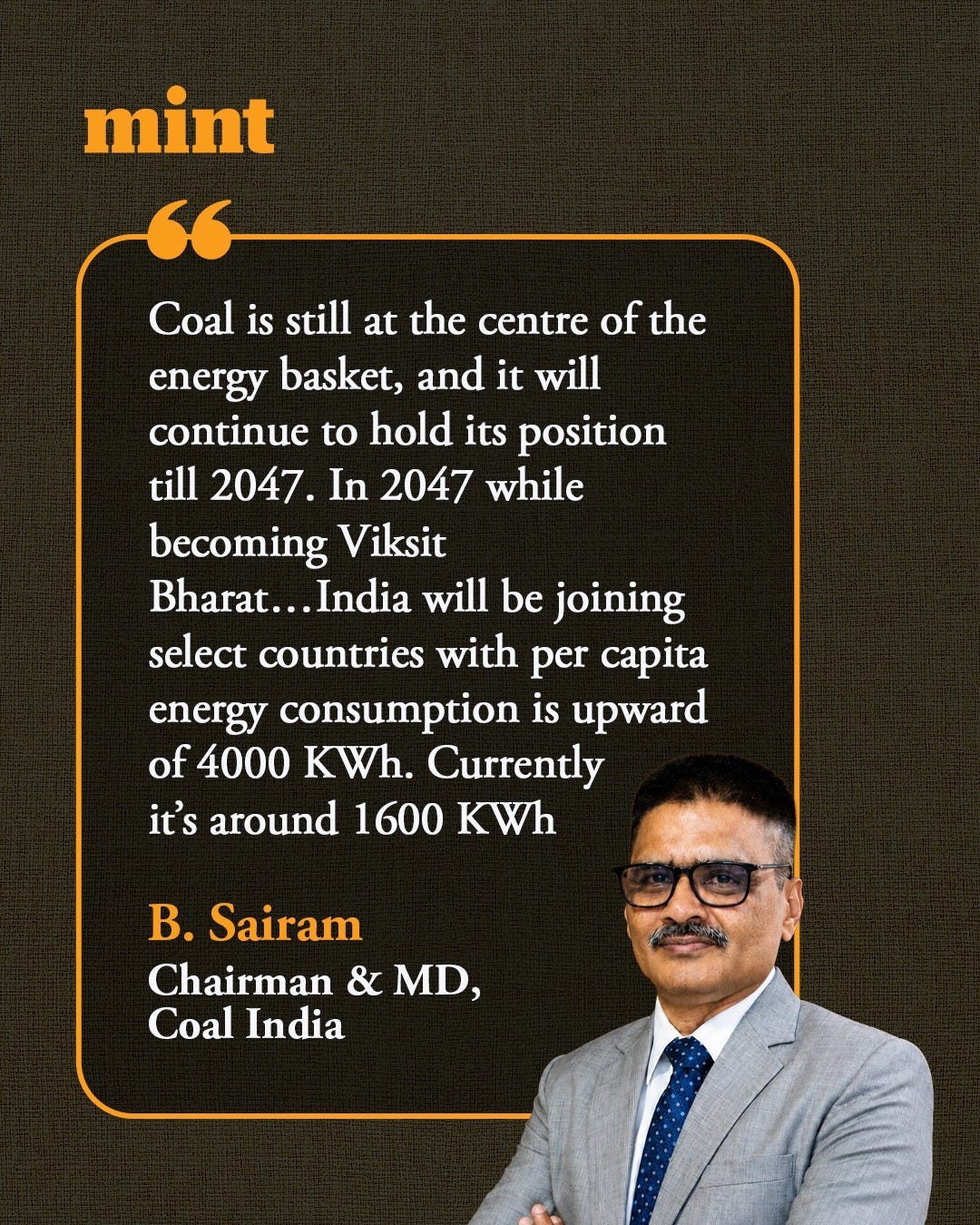
Coal India Ltd. may be a key player in India’s energy transition, but it is also betting heavily on coal’s staying power. Chairman B. Sairam told Mint that coal will remain central to India’s energy mix until 2047, as industrialisation, urbanisation and rising power demand drive consumption.
The world’s largest coal miner plans to spend nearly ₹48,000 crore on rail links and mechanised evacuation to help lift annual production to 1 billion tonnes by FY30. It is also committing ₹50,000 crore with partners to three coal-gasification projects and exploring more. At the same time, Coal India is diversifying into critical minerals, with five domestic assets and potential lithium investments across Chile, Argentina and Australia.
The expansion comes with a cost headache. Industrial diesel prices has surged to ₹155 a litre amid the Iran war, while ammonium nitrate is up 60-70%. Coal India has absorbed the price hikes, and Sairam says that there is no proposal to raise coal prices, just yet.
Coal India is therefore lining up a trillion-rupee-plus capex plan across coal evacuation, gasification and diversification. The spending is designed not just to expand its traditional coal business, but also to position the company for the next phase of India’s energy demand.
That means building out logistics to support higher coal production, investing in gasification and developing a critical-minerals portfolio, including overseas lithium and rare-earth opportunities. Coal India is also expanding renewables to 9.5 GW by FY30 and plans to integrate battery storage into new solar projects.
The message from the spending is clear: as India’s energy mix changes, Coal India is betting it can straddle both the old and new energy economies.
India’s stock market reversed losses as crude oil fell to a one-week low, while volatility persisted ahead of the first monthly F&O expiry under the new so-called closing-auction system.
The benchmark Nifty 50 rose 0.48% to 24,334.55 and the BSE Sensex added 0.37% to 77,656.09. They were up 0.2% each ahead of the closing auction. Twelve of the 16 major sectors logged gains.
The broader small-caps fell 0.1%, while mid-caps gained 0.5%. Financials and IT rose 0.3% and 0.6%, reversing losses in the final hour of trade.
🔗 Key factors that drove India’s stock market today
Why has India barred certain cold medicines for children under 4?
FPIs are back in India. Their bets show they’re still not sold
Navin Fluorine’s new refrigerant capacity is building momentum
Metals: Ambani sets up potential Adani showdown with aluminium entry
Explainer: What SC’s ‘industry’ ruling means for workers, employers
Retail: Vishal Mega Mart gets a five-year vote of confidence
Aviation: Govt weighs annual random drug tests for airline pilots
SEBI’s latest study on retail F&O traders goes beyond losses to reveal the behavioural traps keeping them in the game.
The data points to overconfidence, lottery-like option buying and loss-chasing—91% of traders active for one year lost money, rising to 96.5% among those active for four years. Only 0.5% traders active across five years were profitable every year. Options buyers, who made up 93% of the sample, suffered particularly steep losses.
Yet big winners and big losers were equally likely to keep trading. The lesson: regulation may need to target behaviour, not just risk. Read more.
Comments
Nothing yet. Say the first thing.
Sign in to join the conversation.