
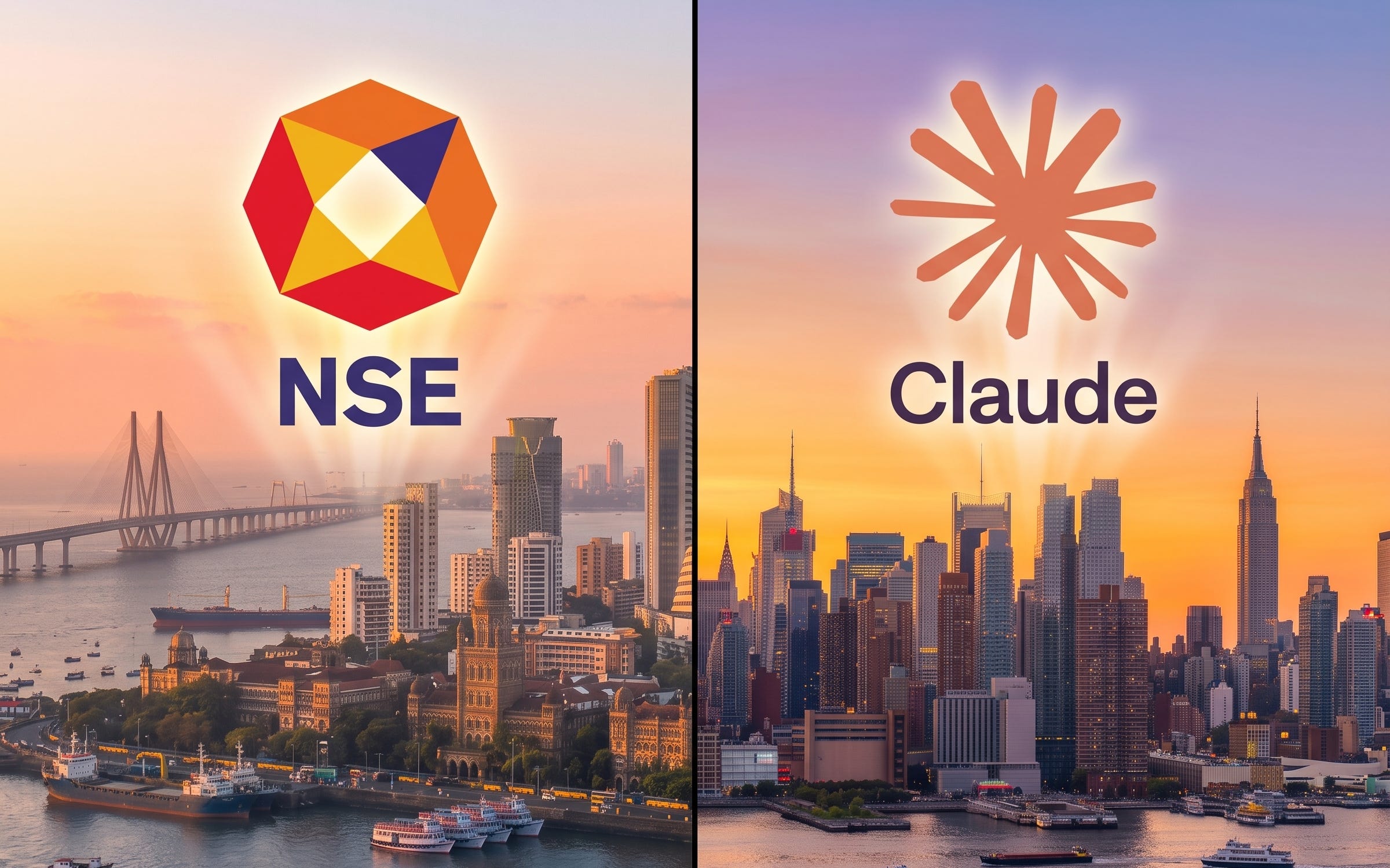
Two of the biggest IPOs this year, at opposite ends of the world and equally dissimilar in nature, point to the contrast between the corporate ecosystems of India and the US.
The National Stock Exchange is expected to hit the market in September in what could be India’s largest-ever IPO, potentially raising around ₹30,000 crore. In the US, Anthropic PBC, the AI company behind Claude, is reportedly considering an IPO that could value it at around $2 trillion, which would make it the largest IPO in US history.
NSE, India’s largest exchange, is a three-decade-old institution whose fortunes have grown with the extraordinary expansion of India’s capital markets. Highly profitable, its IPO is essentially the final step in a successful privately held institution turning into a public company. With the exchange hardly in need of fresh capital, its main objective seems to be to give existing shareholders an opportunity to cash out. A potential NSE investor in its IPO is therefore being offered a highly profitable business whose future is, broadly, an extension of its past.
An Anthropic investor, on the other hand, is being asked to value a company whose ultimate market, and indeed the economic impact of the technology it is developing, is still uncertain. That says something about corporate ambition as much as investor appetite. Capital in America seems to be comfortable financing companies whose great attraction lies in what they might become rather than what they are. Anthropic is just one such. The pipeline also includes SpaceX, already valued at around $2 trillion, CoreWeave and other businesses whose valuations depend heavily on technological possibilities that have yet to be fully realised.
This is possible because America has built an extraordinarily deep ecosystem of venture capital and private equity that takes risky bets. Take SpaceX, which, besides being a very efficient rocket manufacturer, is a company built around the ambition of enabling human life beyond Earth. At its fundamental level, it is one man’s audacious ride and investors are being invited to join.
India’s IPO market tells a rather different story.
Mostly, it has been dominated by businesses like financial services, manufacturing, healthcare, consumer goods, logistics and energy, which serve existing markets. Thus, Tata Capital, LG Electronics India and Dhoot Transmission are established businesses that were brought to public investors after reaching a certain scale.
NSE is not asking investors to finance the creation of a new market but to buy into the dominant institution of an existing one. Even the potential Jio IPO, which could be among India’s largest, would essentially be of a business that is already mature.
This is evidence of a corporate sector becoming broader and more institutionalised, but it also reveals something about India’s much-lauded startup ecosystem.
For all its success, much of Indian startup capitalism is still about making existing services cheaper, faster or more convenient. Food delivery, quick commerce, digital payments, online retail, mobility, lending and logistics are substantial businesses and some of the entrants have deployed technology at impressive scale. But they are largely businesses of the present. The important distinction is between using technology to improve an existing market and building a company around a technology that could create an entirely new one.
That’s because the Indian ecosystem has become very good at scaling solutions to today’s problems. It is less successful at persuading capital to finance a bet on what tomorrow’s problems, or opportunities, might be. A Bernstein research report of October 2025 on India’s IPO wave noted:
“While many assume tech startups are dominating, the facts show otherwise: most IPOs, by company count rather than deal size, are in traditional sectors with industrials leading the numbers. Though a few names from fintech, consumer tech, and D2C brands have tapped the markets, these new-age businesses are still a minority (~16%) in the IPO universe.”
Countries that repeatedly produce companies operating on the frontiers of new technologies build intellectual property, foster talent, research capabilities and supply chains that ultimately reinforce their position in the next generation of industries. This is one reason the US continues to dominate so many technology sectors.
The current IPO boom represents an important stage in the evolution of Indian capitalism: successful businesses are becoming durable institutions with dispersed ownership. But in the next stage, it needs to go much further. When a company that aspires to take humans to Mars and beyond goes public, its dream becomes a shared one, raising society’s aspirations for itself. That is what the next big Indian IPO should be about.
Comments
Nothing yet. Say the first thing.
Sign in to join the conversation.