
M&M written content is human-created, independently researched, and filled with resources to deepen your learning. Click here to see all the ways you can support this work. Not medical advice.
Summary of main points:
Heart disease is one of the leading causes of death. There are different points of view on the major dietary and metabolic drivers. Conventional, mainstream thinking holds that saturated fats of all kinds make atherosclerosis more likely, and polyunsaturated fats of all kinds make it less likely—the former “clogs your arteries,” while all polyunsaturated fatty acids (PUFAs) protect you.
That simplistic viewpoint does not discriminate between the many different saturated and unsaturated fatty acids, none of which have identical metabolic effects. The length of fatty acids, as well as the number and placement of double-bonds they contain, play a major role in the effect they have on the body. Biology doesn’t neatly conform to the convenient conceptual boxes people like to draw, as such “saturated fats = all bad” or “unsaturated fats = all good.”

Different saturated fatty acids, such as those with even or odd numbers of carbons, have distinct associations with cardiovascular health. Likewise, polyunsaturated fats come in multiple flavors; two major classes are the Ω-6 and Ω-3 polyunsaturated fatty acids (PUFAs). They’re not merely different, but often have opposing effects. They also compete for metabolic processing by the same enzymes, which is why the relative balance of Ω-6 and Ω-3 PUFAs is important.
If you’re like me, then you recognize that the non-enzymatic oxidation of PUFAs is a critical step in the pathophysiology of atherosclerosis. Peroxidation of PUFAs produces harmful reactive substances which the immune system naturally and automatically recognized as toxic waste it needs to dispose of. Evidence is mounting that the fundamental, rejuvenating purpose of sleep is to protect mitochondrial metabolism in the brain by removing oxidized PUFAs (i.e. rancid fat) from the nervous system.
And that’s just dietary fatty acids we’re talking about. What about the long, long list of other nutrients and bioactive substances that might promote, prevent, or reduce atherosclerotic plaque buildup? Like it or not, biology is complex. This post is meant as a relatively simple resource—a short primer on non-prescription substances, such as simple dietary nutrients, that show evidence of preventing or even reversing atherosclerosis.
No matter what anyone happens to believe about the causes, atherosclerosis is bad and you want as little plaque in your blood vessels as possible. The more plaque that builds up, the more likely it is you are to experience heart disease.
A common question I’ve gotten from private clients: how do I prevent or reduce arterial plaque buildup without using prescription drugs?
I will briefly describe the evidence behind each of the listed substances listed below, together with dosing information, whole food sources, and supplements. If you think there are major examples missing, please leave a comment linking to evidence. (I will periodically update this page).
We will start with Ω-3 polyunsaturated fats, where the evidence is fairly clear. This will help highlight the importance of oxidative stress, inflammation, and lipid peroxidation in driving disease generally. As you’ll see, many of the substances below work, at least in part, by protecting against the toxic effects of lipid peroxidation. Understanding the fundamental biology here is crucial for understanding metabolic health and disease generally, not just atherosclerosis.
You will have to decide for yourself what you consume and why. If you want my perspective on your personal situation, you can book time with me here.
The balance and specific fatty acid profile of our cells has health consequences ranging from oxidative stress and toxin production to the regulation of inflammation. Humans display genetic diversity in metabolism, with large differences in PUFA (polyunsaturated fatty acid) metabolism— diversity with major consequences for cardiometabolic health. For example, some people produce very little long-chain Ω-3 PUFAs like EPA from dietary plant Ω-3 fats; for those people especially, dietary intake of EPA is crucial.
Most people alive today consume way more Ω-6 PUFA than Ω-3 PUFA. Intake of dietary Ω-6 PUFAs, such as linoleic acid (“seed oil fat”), increases the ratio of long-chain Ω-6 PUFAs to Ω-3s. Here’s the part that many people miss: this does not happen because linoleic acid substantially increases levels of the long-chain Ω-6 arachidonic acid; instead, it lowers levels of the long-chain Ω-3 polyunsaturated fat EPA (“seafood fat”; more detail here).
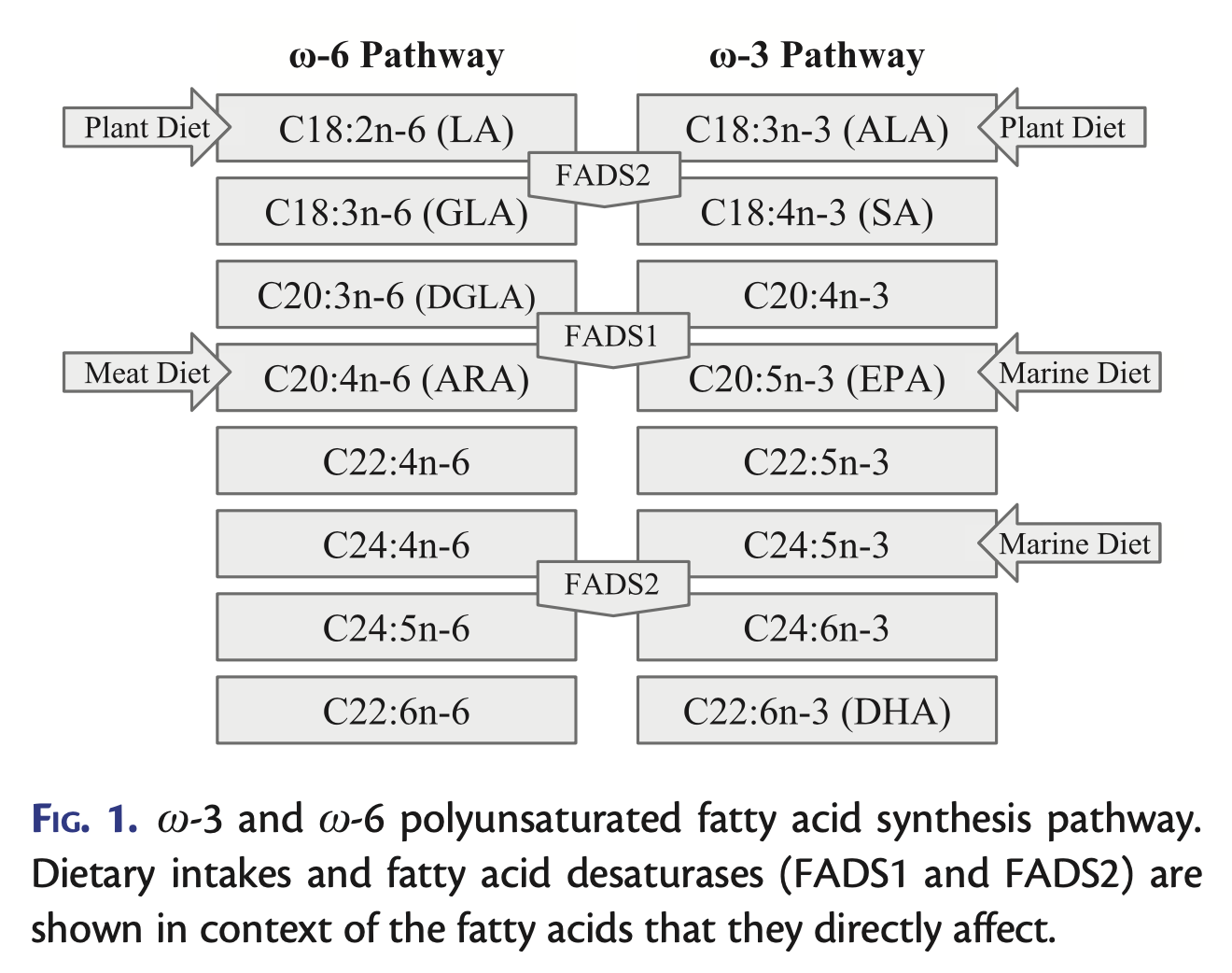
The greater one’s intake of Ω-6 PUFAs like linoleic acid, the greater one’s need for direct consumption of the Ω-3 EPA, especially for those with certain genetics. There are many reasons why you don’t want to be deficient in long-chain Ω-3s like EPA and DHA; cardiovascular disease is one of them. EPA in particular (as opposed to EPA/DHA together) has been associated with reduced atherosclerotic plaque burden in human imaging studies.
From this review:
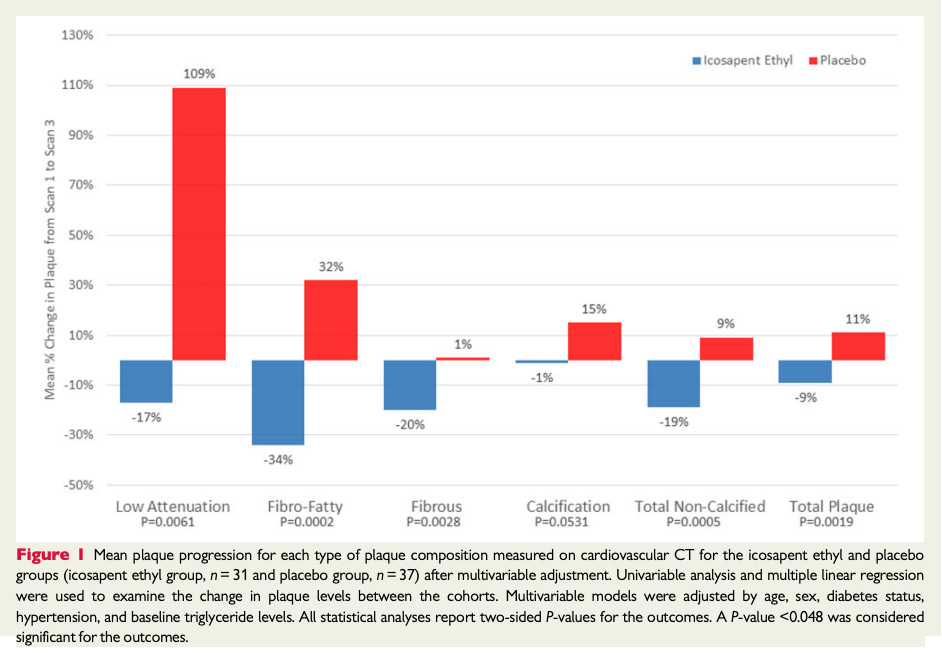
“EPA monotherapy has been associated with plaque regression and features of stabilization across imaging modalities. IVUS trials show greater regression with EPA plus statin than statin alone, OCT studies demonstrate fibrous cap thickening, and the EVAPORATE trial reported reduced low-attenuation plaque with IPE compared with placebo. Exploratory analyses further suggest reductions in lipid-rich necrotic core and other vulnerability features. In contrast, EPA/DHA combination therapies have not demonstrated consistent plaque benefit…”
In this trial, a highly purified form of EPA was given to 80 patients with existing coronary atherosclerosis. These people were already on statins and in poor metabolic health. They were given 4 grams/day of purified EPA for 18 months, which resulted in significant regression of arterial plaque.
The overall effect of EPA supplementation from that trial:
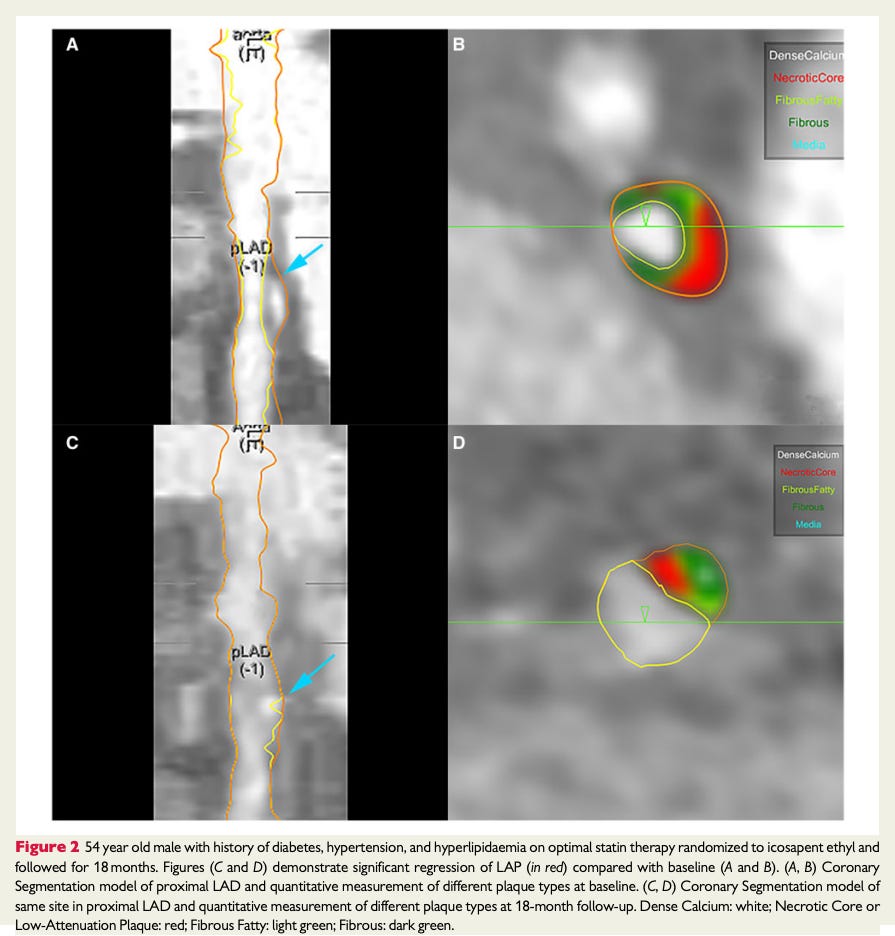
An example of one patient’s arterial plaque reduction:
My suspicion is that such patients have poor cardiometabolic health to begin with, at least in part, due to consuming a highly skewed Ω-6:Ω-3 diet (in favor of Ω-6s), as most people do. Based on other data, 2-4 grams of EPA per day is often what is recommended for cardiovascular health.
My view is that amount you need is likely proportional to the Ω-6:Ω-3 profile of your diet: the more Ω-6 linoleic acid you consume, the more Ω-3 EPA you will require to offset this. It’s much better to reduce Ω-6 intake substantially, while ensuring adequate and balanced intake of EPA, than it is to consume high levels of both Ω-6 and Ω-3 PUFAs.
In other words, people without arterial plaque and in good overall metabolic health likely don’t need 4 grams/day of EPA, as in the trial above with unhealthy people. My personal view is that you need sufficient intake of polyunsaturated fat for your body’s needs, but no more than this, with an approximately equal proportion of Ω-6s and Ω-3s. Achieving this is difficult in the modern food environment due to the density of Ω-6 PUFAs in processed foods.
One of the biggest problems with nutrition labels today is that they only tell you the total amount of polyunsaturated fat that processed foods contain, without breaking out the Ω-6 and Ω-3 content. This means that, as the consumer, you are forced to do more work in order to understand the actual contents of processed foods.
Putting all of the above together, there are two ways to increase EPA levels and reduce the Ω-6:Ω-3 ratio in your cells:
Reduce intake of dietary Ω-6 PUFAs like linoleic acid, which reduce EPA levels;
Ensure adequate intake of the Ω-3 EPA itself.
EPA intake can occur through two routes: consumption of EPA-rich whole foods; supplementation with EPA directly. As a rule, I prefer whole food sources of nutrients to supplements. Fish oil supplements are big business, and you want to be sure fish oil supplements do not contain rancid oils. For this reason, I prefer liquid cod liver oil stored in the refrigerator to fish oil capsules, as far as supplements go.
2-4 grams per day of EPA would be considered a higher dose of EPA. If you’re eating fresh, fatty seafood two or more days per week, the need for supplementation is less. The total amount of EPA and Ω-3s you need is proportional to how much Ω-6 PUFA you consume. Most people are eating 10s or grams of Ω-6 fat per day. For those people, reducing Ω-6 intake will improve the Ω-6:Ω-3 and EPA profile of their cells on its own, due to the suppressive effect Ω-6s have on EPA—a direct, costless way to improve your omega fat profile.
Whole foods with EPA: Fatty fish & certain seafoods
EPA occurs almost exclusively in marine animal foods, with fatty fish like herring, anchovies, mackerel, salmon, and sardines with the most. Other seafoods with good EPA content often include: Pacific oysters, black cod, some trout, and bluefin tuna. Smaller amounts of EPA can be found in crab, mussels, and shrimp. Overall, seafood is king when it comes to whole food sources of EPA.
How Nick handles his EPA and Ω-3 levels
If you’ve already moved to a lower Ω-6 diet (like me), then 2-4 grams of EPA per day may be more than enough. I don’t supplement at all on days I know I’m eating fatty seafood (twice per week minimum), and take only a small teaspoon of cod liver oil otherwise. I’m also a “strong metabolizer” of dietary PUFAs based on my genetics—my body is more efficient than most at converting dietary Ω-3 PUFAs into longer-chain PUFAs like EPA, which means my risk of deficiency is lower.
If I was in poor metabolic health and had arterial plaque buildup, I’d focus on lowering Ω-6 intake while also getting ~4 grams per day of fresh, unoxidized EPA—especially with a fatty liver, and doubly so if I was a weak PUFA metabolizer. Because I’m in good metabolic health and have different PUFA genetics, I have less need for specific supplementation, especially since I have a balanced intake of Ω-6 and Ω-3 PUFAs from food, consuming no more than several grams of PUFAs total each day.
Learn more about specific dietary fats & human variation in PUFA metabolism:
Podcast | Ancestry & Genetic Diversity in Human Fat Metabolism: Seed Oils & Omega Fats | Floyd Chilton
Comments
Nothing yet. Say the first thing.
Sign in to join the conversation.