
M&M written content is human-created, independently researched, and filled with resources to deepen your learning. Click here to see all the ways you can support this work. Not medical advice.
Summary of main points:
MOTS-c is a mitochondrial microprotein (peptide) released under metabolic stress that reprograms cells toward energy conservation and expanded ATP-production capacity.
Rodent work shows clear benefits with short daily or intermittent protocols: protection from diet-induced obesity and insulin resistance, restoration of youthful muscle sensitivity, increased running capacity, and extended healthspan in aged animals (human-equivalent doses in the low-to-mid tens of milligrams).
Natural, endogenous MOTS-c release is pulsed, not chronic: prolonged elevation risks sustained stress effects (including elevated homocysteine and impaired methylation); too much, too often is expected to turn benefit into risk.
No human trials exist for exogenous, injected MOTS-c. Acute exercise raises endogenous MOTS-c and levels naturally decline with age.
Community use typically involves 5–10 mg subcutaneous injections 2–3 times per week in 4–6 week cycles with washouts, often paired with exercise.
Mechanistic animal data suggests a cautious human approach: at most one injection per day, 2–3 days per week, for no more than a few weeks; prefer starting in the 1–5 mg range rather than 10+ mg; continuous daily dosing for extended periods will likely become counterproductive.
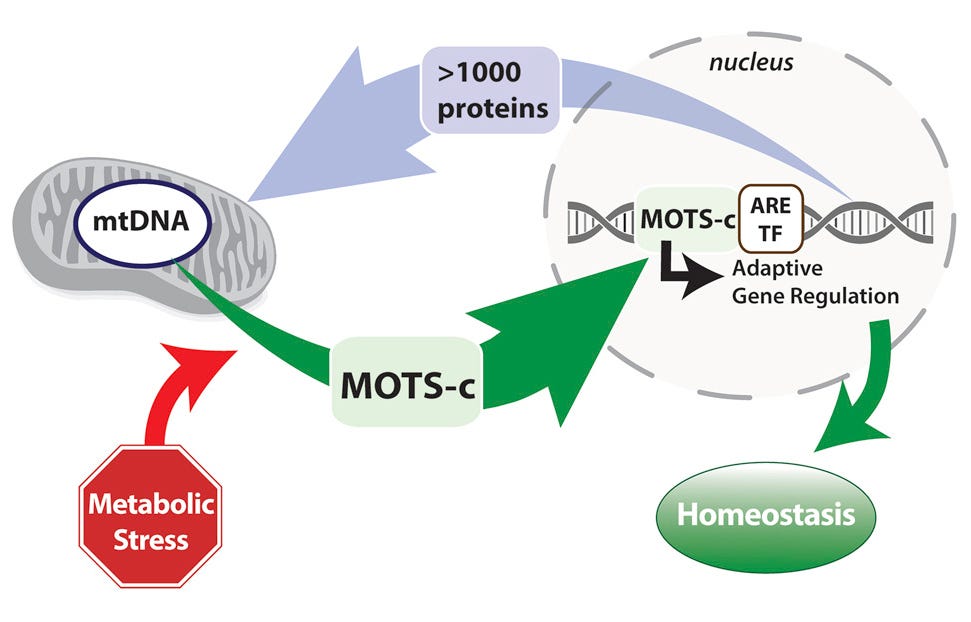
MOTS-c is a 16-amino-acid peptide (“microprotein) encoded in the mitochondrial genome. Mitochondria produce and release MOTS-c in response to metabolic stressors, such as exercise or nutrient deprivation; it then acts both locally and systemically, entering the nucleus of cells to alter broad patterns of gene expression.
The effects of MOTS-c are context-dependent: under baseline conditions, when cells are “happy” and unstressed, it does little; under conditions of energy deficit, such as vigorous exercise, MOTS-c is produced by mitochondria and reprograms metabolism. In general, this peptide lowers protein synthesis to conserve the currency of cellular energy (ATP), while boosting ATP-production capacity through mitochondrial biogenesis.
Protocol thinking is popular in the health space, but biology is history- and state-dependent. The same molecule can drive adaptive change or risk depending on conditions and peptide dosing schedule. The preclinical literature supplies the clearest data here. Although standardized, evidence-based dosing protocols for humans have yet to be formally developed, there is good reason to think exogenous MOTS-c carries real risk when taken too much, too often.
Let’s first review what’s been clearly shown in animal models, using those results to help us think about exogenous MOTS-c use in humans.
Listen to the podcast that inspired this article, with the scientist who discovered the MOTS-c peptide:
Podcast | MOTS-c & Mitochondrial Peptides in Health & Aging | David Lee
The foundational paper on MOTS-c is described in this article. In short, mice injected with MOTS-c daily for 8 weeks were protected against diet-induced obesity, fatty liver, and hyperinsulinemia despite the same caloric intake as controls.
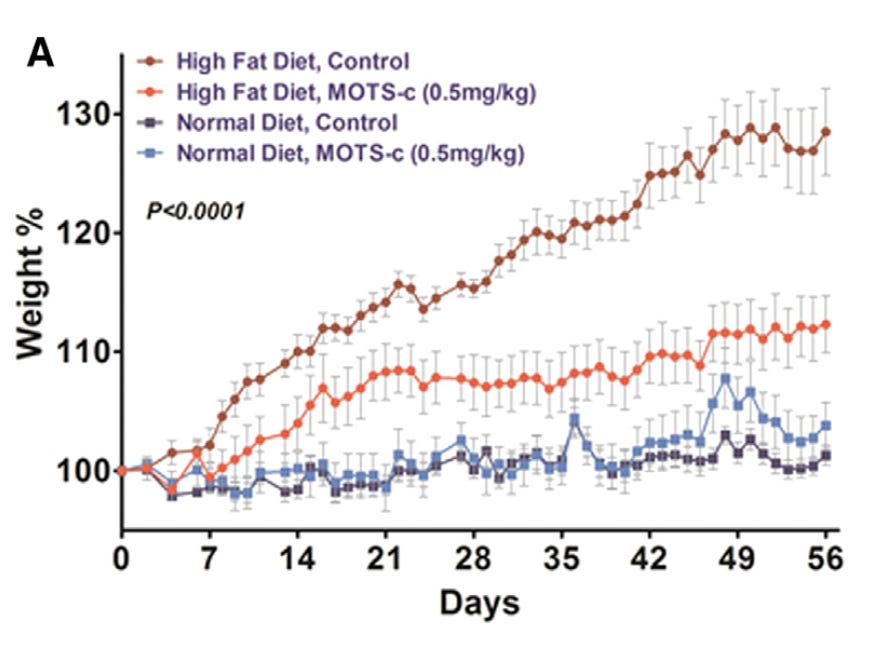
Peptides like MOTS-c have a short half-life, especially in species with a very fast metabolism like mice. In these experiments, mice were injected once per day, starting at 0.5 mg/kg of body weight. Based on how metabolic rate scales across species, that roughly equates to something in the range of 2.3 to 4.6 mg/day for an adult human.
In the same study, shorter courses with higher dose (5 mg/kg daily for 7 days) improved glucose tolerance and other aspects of metabolism in skeletal muscle, restoring middle-aged muscle insulin sensitivity toward youthful levels. That dose would roughly correspond to ~23 to 45.5 mg/day in a human.
A 2021 study extended this to physical capacity and aging. Young mice given 5 mg/kg daily for 2 weeks ran farther and longer. Middle-aged (12 months) and old (22 months) mice received 15 mg/kg daily for 2 weeks. Old animals roughly doubled treadmill running time and distance, outperforming their middle-aged counterparts. When treatment began even later (~24 months) and switched to an intermittent schedule of 15 mg/kg three times per week, aged mice maintained grip strength, gait, and the ability to complete a walking test that most untreated, age-matched animals failed. Fat mass was lower and lean mass better preserved, with modestly extended healthspan.
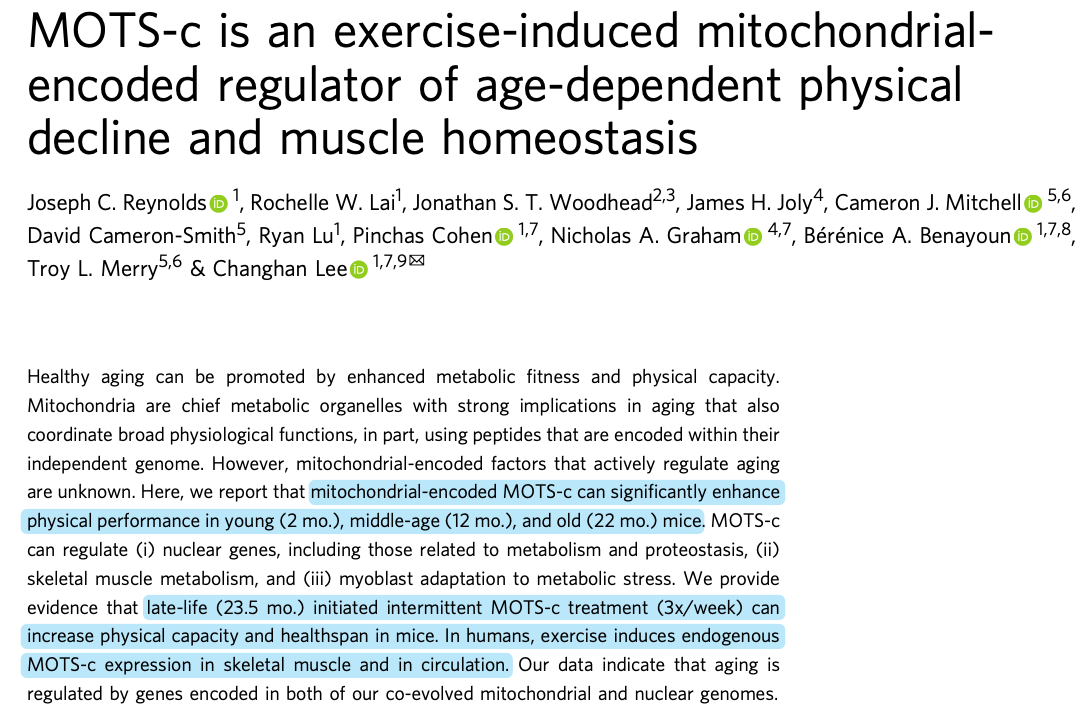
So, between those two studies, we’re talking about several days of once-daily MOTS-c injections, or else three injections per week, using human equivalent doses in the range of 1s to 10s of milligrams per day. Those protocols drove beneficial metabolic and physical performance changes in both young and old mice, without obvious problems. When MOTS-c was given to very old mice, they basically performed like much younger mice. Healthspan was extended, which is what everyone is really after—nobody wants to live longer it means more years of decrepitude.
Despite the lack of clear negative effects in animal studies, the underlying biology MOTS-c taps into clearly suggests, in my view, that you would never want to chronically take exogenous MOTS-c for extended periods. You may even want to avoid very high single doses, multiple doses per day, or multiple days in a row.
Let’s take a look at why.
Learn more about how MOTS-c works at the cellular level:
Article | MOTS-c & Cellular Energy Homeostasis
See this article for a more detailed explanation. MOTS-c is doing a couple of major things at the molecular level:
Raising AMPK and suppressing mTOR, shifting cells from anabolic “build” toward catabolic “burn” programs.
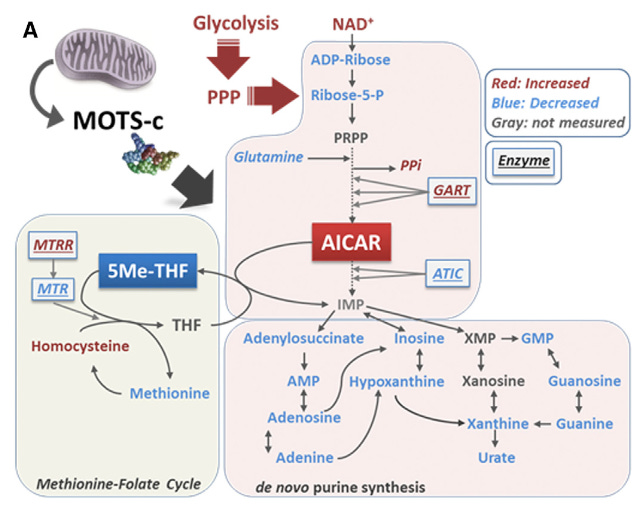
Inhibiting key steps of the methionine-folate cycle. This helps drive AMPK activation and changes the cells’ capacity to methylate DNA, important for the gene expression changes driven by MOTS-c.
By stimulating AMPK and driving down mTOR activity, MOTS-c helps preserve ATP by decreasing translation (protein synthesis), which is energetically expensive. At the same time, mitochondrial biogenesis is stimulated. The basic idea is that, in a state of metabolic stress or energy deficit, the cell doesn’t want to “spend” ATP to build up new structures requiring protein synthesis; instead, it wants to preserve ATP and specifically build up production capacity by generating more mitochondria.
That’s all great, but it’s meant to be a temporary metabolic response to stress, not a persistent change. When MOTS-c levels stay elevated for too long, the methionine-folate cycle is impacted for longer than it “should.” If the cell is in a state of metabolic stress like this for too long, homocysteine starts to rise. Homocysteine is usually kept at low levels, as it’s quickly re-methylated back to methionine. As a biomarker, you basically want homocysteine to be as low as possible. If homocysteine accumulates and does not revert to methionine, your cells will be impaired in their ability to methylate other things, such as DNA. Compromised methylation capacity leads to all sorts of problems.
Elevated homocysteine is a risk factor for:
Cardiovascular disease (e.g. atherosclerosis)
Cerebrovascular events (e.g. stroke).
Broader effects such as increased oxidative stress and inflammation.
Think of it this way: some stress is good, but too much stress is bad. Exercise is a form of metabolic stress. Obviously, exercising is generally good for you, but only up to a point. If you train too hard, too often, it can cause problems. At the macroscopic level, this might mean injury, slower recovery, etc. Under the hood, it means excess inflammation, oxidative stress, and so forth. Elevated homocysteine is a major reason why.
You don’t want MOTS-c to be arbitrarily elevated, and definitely not persistently. Too much is expected to cause problems, especially over time, even though the rodent studies above seemed to find mostly metabolic benefits from once-per-day injections. Keep in mind that rodents have a much higher metabolic rate than humans, so they will metabolize peptides like MOTS-c even faster than you or I would. Once-per-day injections might be fine for a rodent, but not for a human. You always have to be very cautious about applying animal results to the human case. Dosing and timing protocols will never translate 1-to-1 across species, even if the overall effects are directionally similar.
Again, the human equivalent doses we’re taking about here would be roughly 1s to 10s of milligrams per injection, given once in a single day. With that in mind, let’s review what people today are reporting when they self-administer MOTS-c.
I’m not aware of any published randomized trials of MOTS-c in humans. Observational data show that acute exercise raises endogenous MOTS-c in skeletal muscle and circulation in young men. Endogenous MOTS-c levels decline naturally with age.
A small human study indicates that endurance and resistance exercise may stimulate endogenous MOTS-c to different degrees. That work found that endurance exercise stimulated higher increases in plasma MOTS-c compared to resistance exercise. (A similar pattern was seen for the humanin, another mitochondrial peptide).
What about exogenous MOTS-c? How much are people injecting, and how often?
Community and clinic reports commonly describe 5–10 mg subcutaneous injections two or three times per week, often in 4–6 week cycles with washouts. Common reports seem to be faster recovery and favorable shifts in body composition (fat loss with muscle preservation) when the peptide is paired with training. These patterns roughly approximate the intermittent rodent schedules rather than daily injections for multiple weeks.
Given the preclinical data and the mechanism by which MOTS-c acts, there is very likely risk from taking too much exogenous MOTS-c, too often. Without well-controlled human data it’s hard to make specific claims here, but it seems prudent to me to avoid injecting MOTS-c more than once per day and perhaps 2-3 times per week. You certainly wouldn’t want to be taking large doses, every single day, for extended periods.
What is a “large dose” of MOTS-c for a human?
Comments
Nothing yet. Say the first thing.
Sign in to join the conversation.