
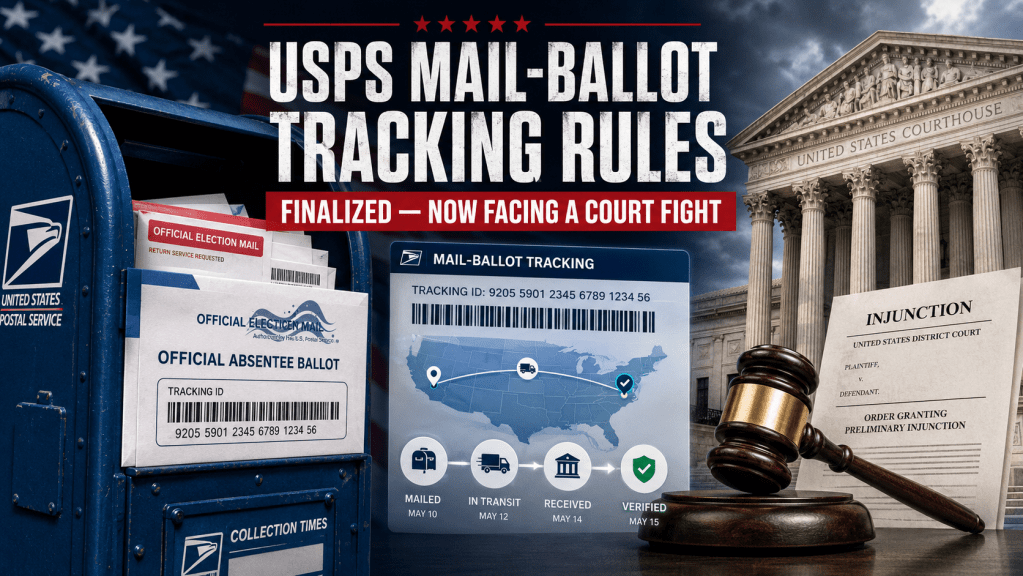
The U.S. Postal Service has finalized a major new rule for mail-in and absentee ballots used in federal general, special, and runoff elections, setting up an increasingly urgent legal showdown before the November midterms.
The rule does not apply to primaries or state-only elections. It also exempts military and overseas ballots covered by UOCAVA.
And despite some of the rhetoric surrounding it, the basic concept is fairly straightforward: if a state wants USPS to handle covered federal ballot mail, the Postal Service wants those ballots prepared in a standardized way, connected to unique tracking information and matched to voter participation data supplied by the state.
That is not the same thing as abolishing mail voting. It is a chain-of-custody system.
Under the final rule, authorized state election officials would submit information about voters receiving covered mail ballots through a USPS portal. That information would include the voter’s name and address, along with unique Intelligent Mail barcodes tied to the outgoing and return envelopes.
USPS would use that information to verify covered outbound ballot mail before accepting it from election officials. That last part matters.
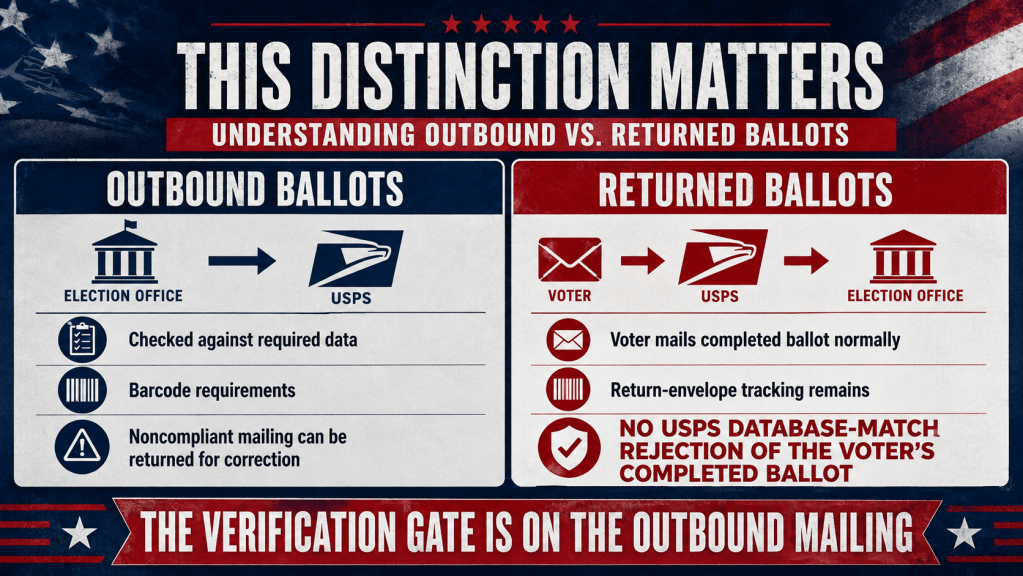
The verification-and-rejection process applies to outbound ballot mail sent by election authorities. If a jurisdiction presents noncompliant outgoing ballot mail, USPS could refuse to accept it and return it for correction. It does not mean USPS would start rejecting completed ballots mailed back by individual voters because of a database mismatch. That distinction has been blurred in some of the online coverage.
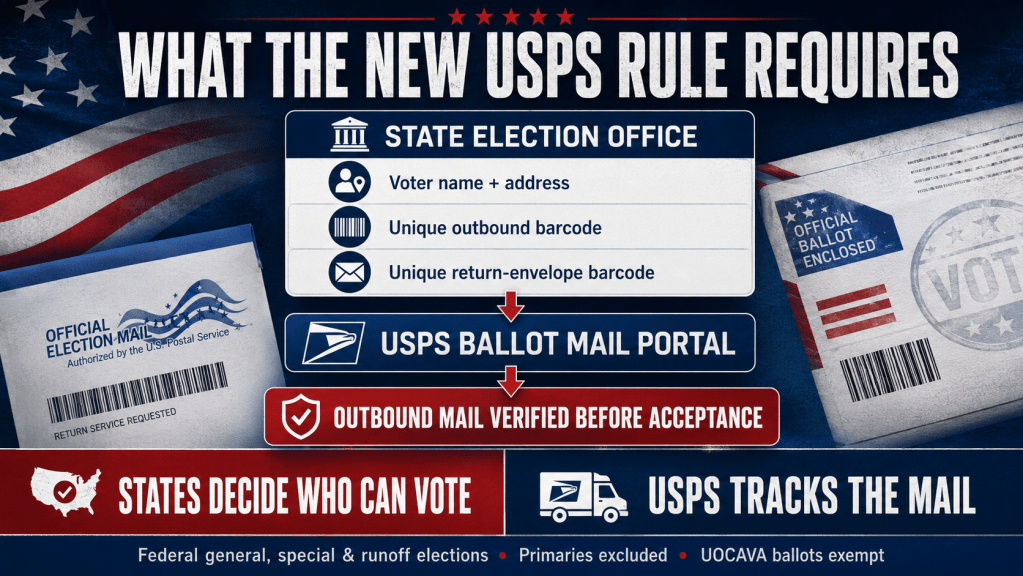
The new system would require covered federal ballot envelopes to meet standardized design and tracking requirements. Outbound and return envelopes would carry unique Intelligent Mail barcodes. State election officials would provide USPS with data identifying the intended recipients of those ballots. USPS would compile that information into a state-specific Mail-In and Absentee Participation List and use it in the administration and tracking of covered ballot mail.
But states would still decide who is eligible to vote.
USPS says the rule does not give the Postal Service authority to determine voter eligibility, remove people from voter rolls or administer state elections. That remains the states’ job.
So the policy is better described this way:
States decide who may receive a ballot. USPS establishes requirements for identifying, preparing, and tracking the ballot mail it is being asked to carry.
That is an important distinction.
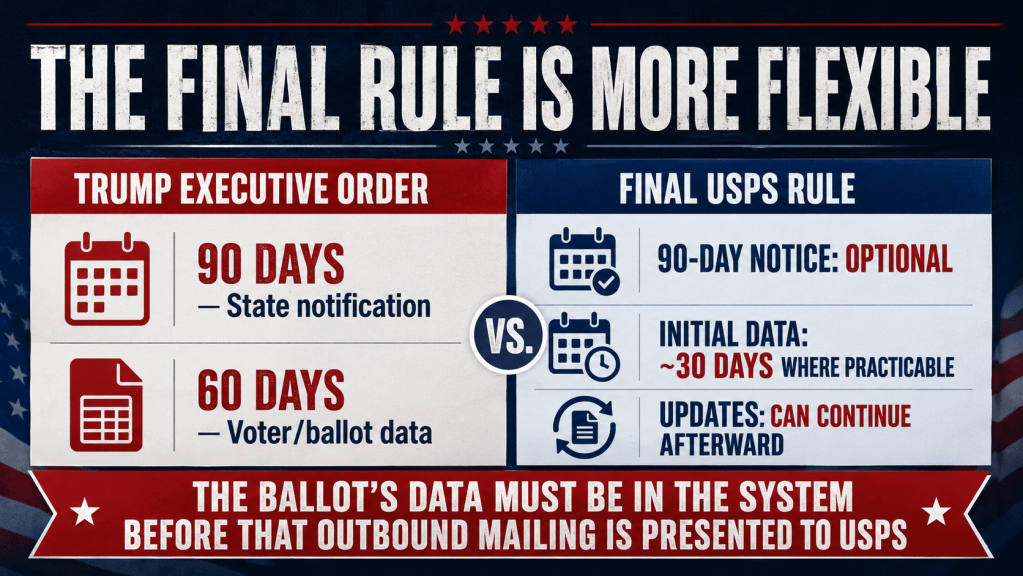
The final USPS rule is more flexible than President Donald Trump’s original March 31 executive order contemplated. The executive order envisioned states notifying USPS 90 days before an election and providing ballot-recipient information 60 days beforehand.
But USPS changed those deadlines in the final regulation. The 90-day notice is now optional.
And instead of a rigid 60-day data deadline, the final rule says initial ballot-mail information should generally be entered into the Postal Service portal at least 30 days before the election, where practicable, or by the date state law allows ballots to begin being mailed.
States can continue adding or correcting entries afterward, potentially through Election Day.
The harder operational requirement is that the information associated with a particular outbound ballot mailing must already be in the USPS system before election officials present that mailing for acceptance.
That flexibility answers at least part of the concern that states could be forced to produce a complete ballot-recipient list months before voting even begins. But the calendar still matters.
USPS says it wants the system ready for the Nov. 3 election if the courts permit implementation.
Opponents argue the administration is trying to intrude into an area traditionally controlled by the states and Congress. That legal fight is real.
USPS argues that its postal statutes give it authority to establish preparation, tracking, entry, and data requirements for ballot mail entrusted to the postal system.
Opponents argue those requirements cross the line from mail administration into election regulation. That is the core legal dispute.
But USPS is not claiming authority to decide who votes. Its position is narrower: states decide eligibility, while USPS sets conditions for how covered federal ballot mail enters and moves through the postal system.
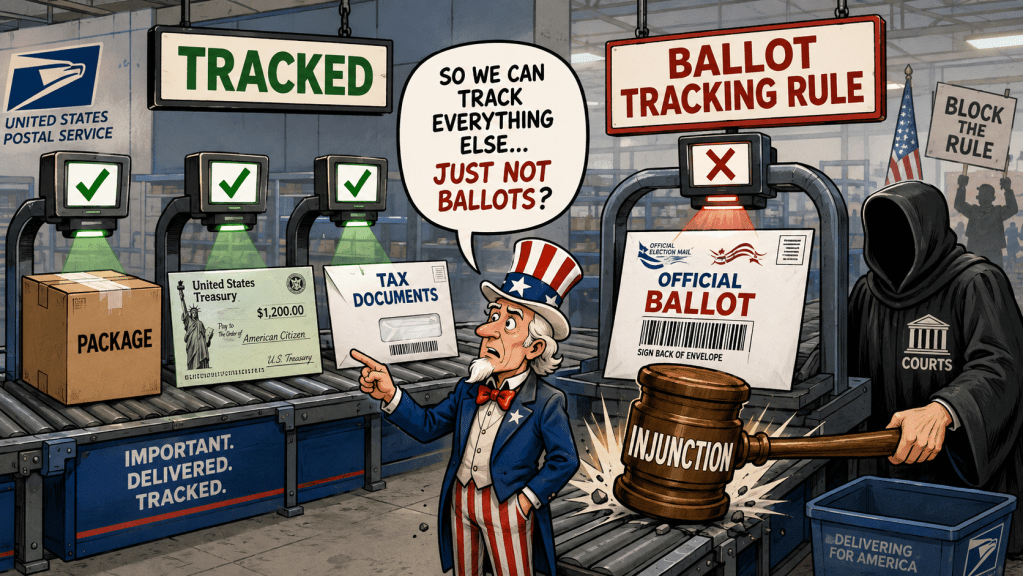
From a practical standpoint, supporters argue that it is not especially radical. Americans already routinely expect valuable or sensitive items moving through large delivery networks to generate tracking data. Supporters argue ballot mail deserves comparable visibility, even though election mail presents different legal and operational requirements.
This is where the story has become more complicated.
USPS finalized the 95-page rule despite an existing federal injunction that blocks implementation of key portions of Trump’s election executive order for the Nov. 3 election and earlier federal elections.
On Aug. 11, U.S. District Judge Indira Talwani granted voting-rights groups a preliminary injunction barring USPS officials from implementing, enforcing, or giving effect to Section 3 of the executive order for those elections.
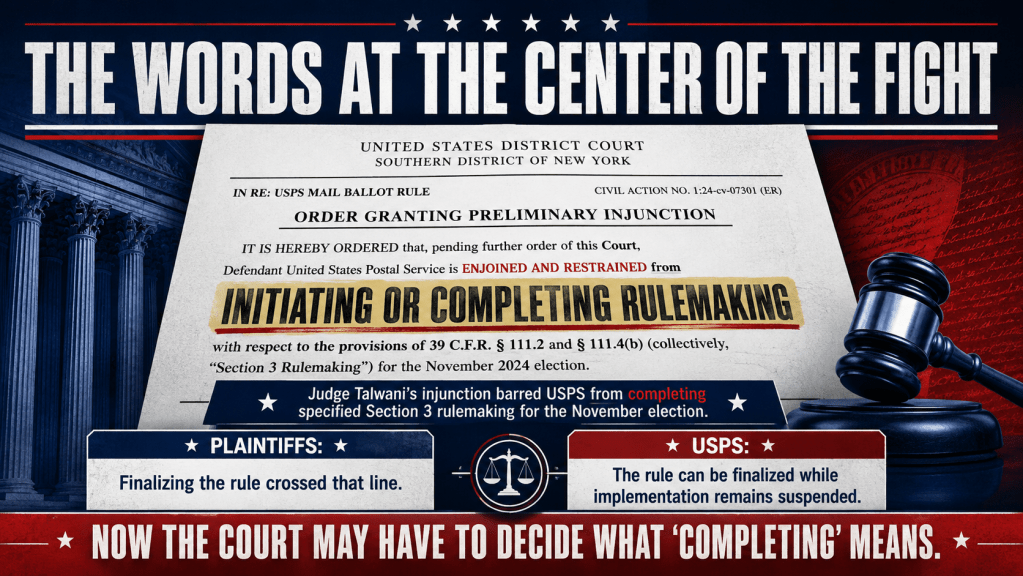
Her order went further. It also prohibited USPS from initiating or completing rulemaking to promulgate specified regulations required by Section 3 for the November election. USPS nevertheless finalized the rule on Aug. 21.
The regulation itself carries an immediate effective date, but USPS says it will not take steps to implement the blocked provisions for the 2026 election unless the government obtains relief from the injunctions.
That distinction matters:
The rule is final on paper, but USPS says its operative requirements will remain dormant unless the courts clear the way.
Formal publication in the Federal Register is scheduled for Aug. 26.
The finalization of the rule triggered another round of litigation almost immediately. On Aug. 22, the League of Women Voters of Massachusetts and other plaintiffs filed an emergency motion to enforce the preliminary injunction and for expedited briefing in Talwani’s court.
They are arguing, in substance, that USPS’s decision to finalize the regulations conflicts with an injunction that expressly barred completion of the relevant rulemaking for the November election.
That does not mean Talwani has issued a new ruling against USPS. She has not, at least not yet. It means the plaintiffs are asking her to enforce the order she already entered. That procedural distinction is important.
So the current posture is unusual:
USPS says the rule is finalized but will not be implemented while the injunction remains in force. The plaintiffs say finalizing it may itself violate the injunction.
Now Talwani may have to decide whether merely completing and publishing the regulation crossed the line her Aug. 11 order drew.
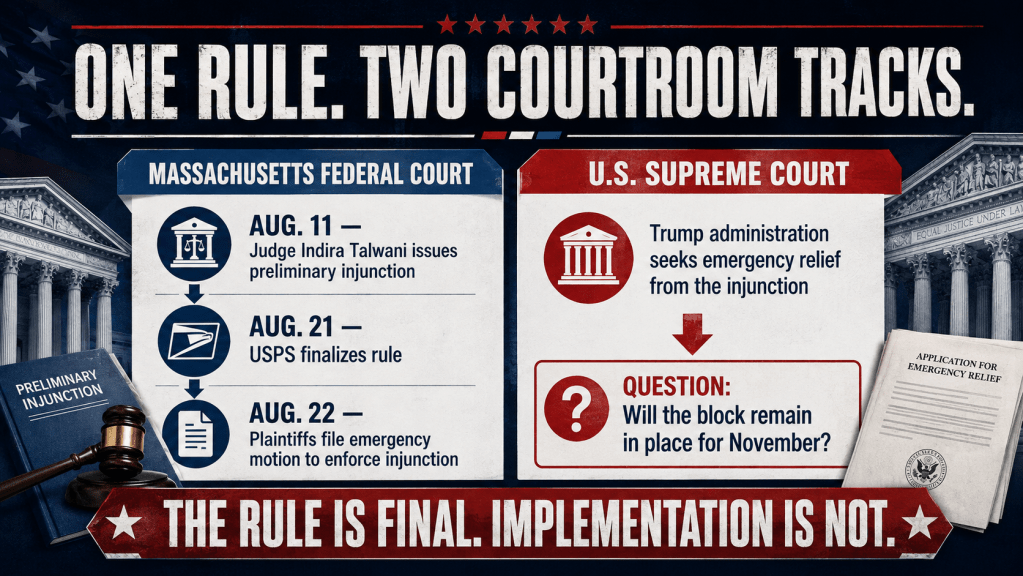
At the same time, the Trump administration has asked the Supreme Court for emergency relief from the lower-court restrictions. The administration filed a stay application seeking to suspend the Massachusetts injunction and allow the relevant portions of the executive order to operate while the litigation continues.
That means two tracks are moving at once.
In Massachusetts, the plaintiffs are asking Talwani to enforce her injunction against USPS.
At the Supreme Court, the administration is seeking relief that could remove the barrier to implementation.
So this is now a race between the courts and the election calendar. If the injunction remains intact, USPS says it will not implement the new requirements for November. If higher courts lift it soon enough, USPS has positioned itself to move quickly.
The strongest argument for this policy does not require pretending widespread fraud has already been proven. It does not require relitigating 2020. And it does not require treating every mail ballot as suspicious.
The stronger argument is straightforward:
Election systems should be designed to make legitimate ballots easier to verify and irregularities easier to investigate.
Mail voting necessarily moves ballots outside the traditional polling-place environment. Those ballots can pass through election offices, printers, postal facilities, homes, and processing centers before they are counted. Adding unique tracking to that chain makes sense. Banks track money. Retailers track packages.
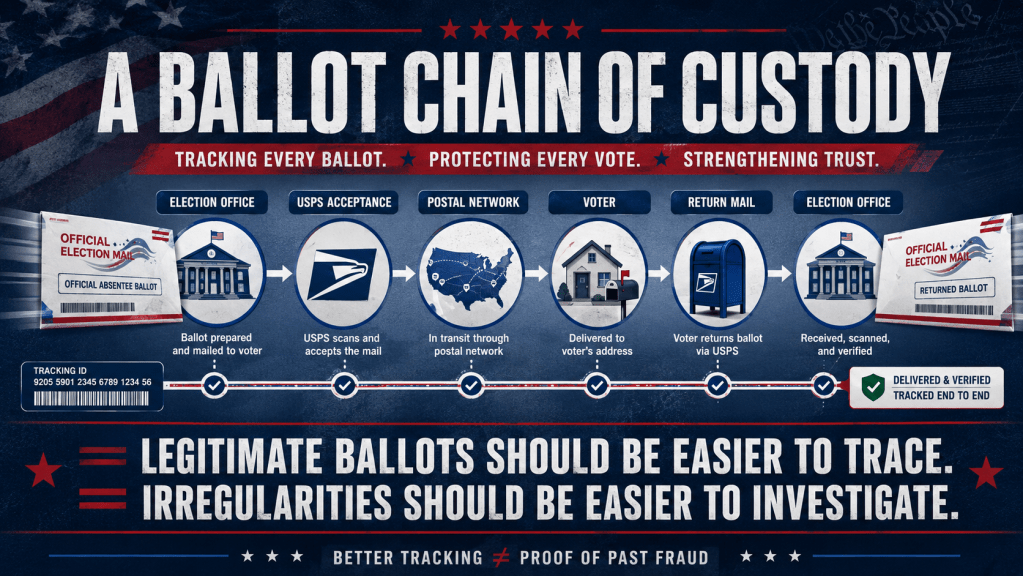
Government agencies already rely on serialized documents, audit trails and chain-of-custody procedures when the integrity of a process matters. Expecting better visibility for federal ballot mail is hardly an outrageous standard.
There is also a fact check conservatives should be willing to make. The creation of tighter safeguards is not proof that previous elections were stolen. A government does not need to prove a catastrophe already happened before improving safeguards.
You do not wait for a bridge to collapse before inspecting it. You do not wait for a bank robbery before installing cameras. And you do not need proof of millions of fraudulent ballots before deciding that stronger tracking and auditable procedures are worth having.
Election-security measures should be judged on whether they improve the system, not on whether they validate every allegation ever made about a previous election. That is the stronger case.
The final rule also acknowledges concerns raised by election officials and critics. Those include implementation costs, technical burdens, voter-data privacy, and the possibility that administrative mistakes could cause outgoing ballot mail to be rejected or delayed. Those are legitimate operational questions. A badly implemented security system can create its own problems.
USPS argues that the benefits — better tracking, greater visibility and more useful information for investigations — outweigh those burdens. That tradeoff deserves scrutiny. But the existence of implementation challenges does not make the underlying goal illegitimate.
The courts were already being asked whether the executive branch and USPS have the authority to impose these requirements. Now there is an additional question:
Did USPS violate a federal injunction simply by finishing the rulemaking process while promising not to enforce the resulting rule?
Talwani’s order expressly barred the agency from “initiating or completing rulemaking” for specified Section 3 regulations covering the November election. USPS, meanwhile, says it finalized the rule so it can be ready immediately if the injunction disappears.
That is no longer an abstract policy dispute. It is a direct disagreement over the meaning and reach of a federal court order. And the Supreme Court could ultimately determine whether the entire fight matters for November.
Strip away the litigation for a moment, and the underlying policy question remains:
Why shouldn’t every covered federal mail ballot have a verifiable chain of custody?
If states remain responsible for deciding voter eligibility, and USPS is requiring better identification and tracking of the mail it carries, the proposal looks far less like a federal takeover of elections and far more like an attempt to impose modern logistics on one of the most consequential pieces of mail in America.
Election confidence is not improved by telling skeptical voters to stop asking questions. It is improved by building systems that produce better answers.
If unique barcodes and standardized ballot-mail records make legitimate ballots easier to trace and irregularities easier to investigate, that is not inherently voter suppression. That is a policy worth debating on the merits.
And now the courts may have only weeks to decide whether Americans will see it in action this November.
Sources for this article include the U.S. Postal Service’s final rule on federal ballot-mail preparation, tracking and participation-list requirements; President Donald Trump’s March 31, 2026 executive order on election integrity; Judge Indira Talwani’s Aug. 11 preliminary injunction in League of Women Voters of Massachusetts v. Trump; the plaintiffs’ Aug. 22 emergency motion to enforce that injunction; the Trump administration’s emergency stay application pending before the U.S. Supreme Court; and contemporaneous reporting from Reuters and the New York Post on USPS finalizing the rule despite the ongoing court fight.
Comments
Nothing yet. Say the first thing.
Sign in to join the conversation.