
By Michael Phillips | MDBayNews
A federal judge has struck down one of the Trump administration’s broadest immigration restrictions of 2026. But there is a Maryland angle that deserves more attention.
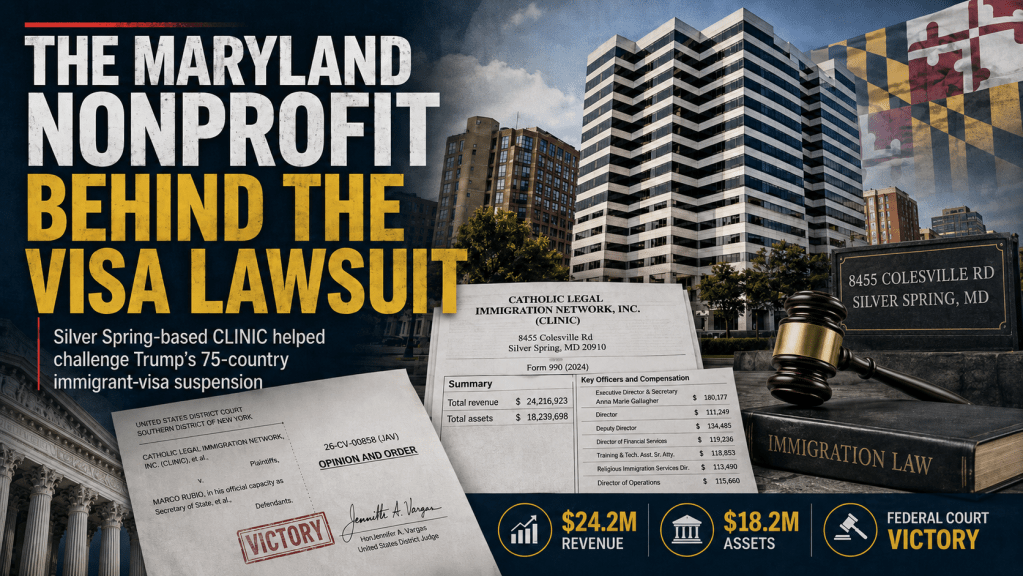
One of the plaintiffs was the Catholic Legal Immigration Network, Inc. — CLINIC — a tax-exempt immigration legal organization based in Silver Spring, Maryland. And this is not a small local legal-aid shop.
CLINIC’s own 2024 federal tax filing reports $24.2 million in annual revenue, nearly $25 million in expenses, and $18.2 million in total assets. Its executive director, Anna Marie Gallagher, received $180,177 in reportable compensation, with total compensation of $206,063 once retirement/deferred compensation and nontaxable benefits were included.
That does not make the organization corrupt. But it does make CLINIC a useful example of something conservatives should understand much better: immigration policy in America is contested not only at the ballot box and at the border, but by a large, sophisticated nonprofit legal infrastructure capable of challenging presidential policy in federal court.

In January, Secretary of State Marco Rubio announced a policy suspending the issuance of immigrant visas to applicants from 75 countries. That distinction matters: this was not a suspension of every type of U.S. visa. The State Department said the affected nationalities presented heightened concerns that immigrants could become dependent on public assistance. But the policy went beyond telling consular officers to apply stricter scrutiny.
According to the court record, officers were instructed to refuse immigrant visas to applicants from the 75 designated countries even when an individualized assessment indicated the person was otherwise eligible and unlikely to become a public charge.
On Friday, U.S. District Judge Jeannette Vargas, a Biden appointee in Manhattan, vacated the policy. Her ruling was not that the federal government is powerless to enforce the public-charge provisions of immigration law. Rather, Vargas concluded that the State Department had gone beyond the authority Congress gave the secretary by effectively imposing a nationality-wide rule over immigrant-visa decisions that federal law assigns to consular officers. Reuters reports that she called the policy “patently unlawful.”
CLINIC was one of the plaintiffs, along with African Communities Together, affected visa applicants and U.S. citizens sponsoring relatives.
CLINIC’s 2024 Form 990 lists its address as:
8455 Colesville Road, Suite 960
Silver Spring, Maryland 20910
The filing identifies the organization as a 501(c)(3) and lists Gallagher as executive director.

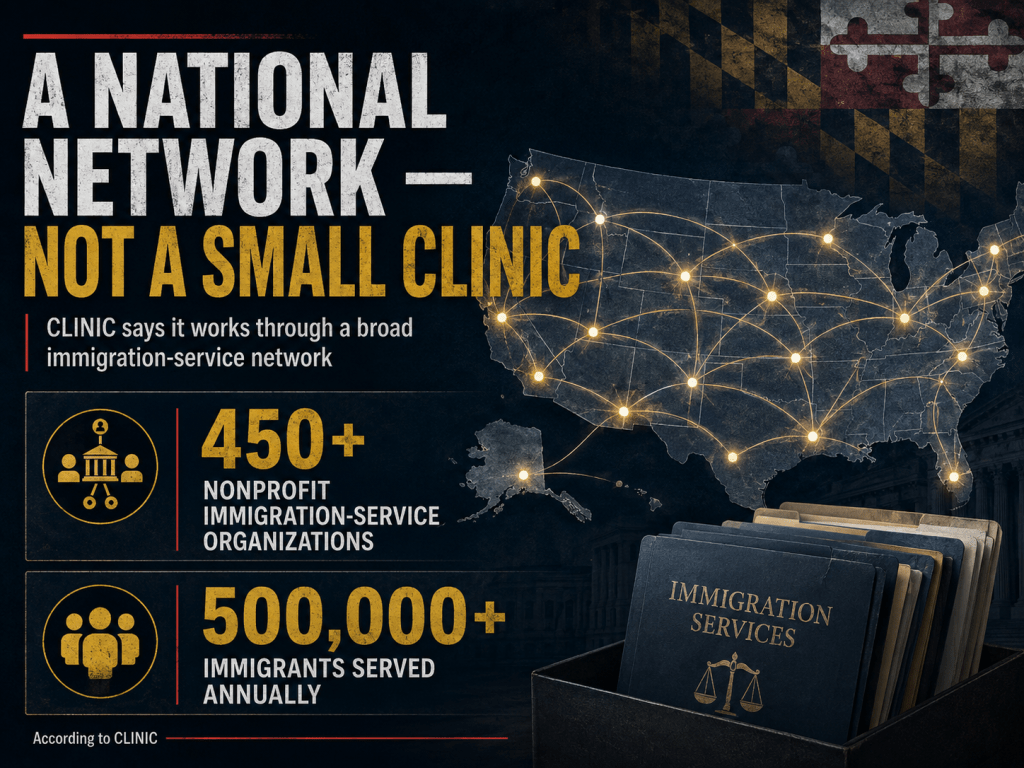
What matters more than the street address is the organization’s scale. CLINIC describes itself as the country’s largest nonprofit immigration-law organization. Its network includes more than 450 nonprofit immigration-service organizations and collectively serves more than 500,000 immigrants each year.
CLINIC says its work includes training immigration legal representatives, providing direct representation to asylum seekers, assisting families, supporting immigrants in detention and removal proceedings, educating the public about immigration law, and advocating for immigration policies it considers fair and just.
In other words, this is not simply a charity helping people complete government forms. It is also an advocacy and legal-policy organization.
CLINIC says so itself.

The numbers deserve attention, but they should be presented accurately. CLINIC’s 2024 Form 990 reports:
$24,216,923 in total revenue
$24,972,699 in total expenses
$18,239,698 in total assets
$13,275,088 in net assets
$19,330,024 in contributions and grants
Those figures show a substantial national nonprofit operation. They do not, by themselves, prove that CLINIC “profits from immigration” or that its litigation is financially improper. In fact, the organization spent more than it took in during 2024, reporting a roughly $756,000 operating deficit.
That distinction is important.
A conservative critique should not depend on claims the records do not support. The stronger point is that America now has well-funded nonprofit organizations with professional legal staffs, national networks, and policy operations dedicated to shaping immigration law and challenging government restrictions.
CLINIC is plainly one of them.
CLINIC’s Form 990 lists Executive Director Anna Marie Gallagher at $180,177 in base/reportable compensation.
Schedule J separately reports $3,000 in retirement and other deferred compensation and $22,886 in nontaxable benefits, bringing her total compensation to $206,063.

Again, that salary is not evidence of wrongdoing. But it helps put the scale of the organization in perspective. This is a professionally staffed national advocacy institution, not an informal volunteer group.
There is also no need to speculate about CLINIC’s political or legal role.
Its own 2026 advocacy priorities say the organization works at the local, state and federal levels to influence law, policy and systems affecting immigrants. The organization says those priorities are informed by its network of more than 450 nonprofit immigration-service providers.
Its website says CLINIC will “fight for the rights of immigrants” and identifies advocacy for immigration-policy changes as one of its core activities.
That is entirely legal. It is also politically relevant.
When voters hear that a president has announced an immigration policy, they may imagine the argument is simply between the White House and Congress.
In reality, there is another center of power: litigation.

This case illustrates the institutional imbalance conservatives regularly run into after winning elections. A Republican administration can announce a policy on Monday. By Friday, national advocacy groups may already be assembling plaintiffs, lawyers, and legal theories to challenge it.
That is their constitutional right.
But conservatives should stop pretending this infrastructure does not exist. CLINIC alone says its network serves more than half a million immigrants annually. It reported more than $24 million in revenue in 2024. It has a nationwide affiliate network. And in this case, it was part of a lawsuit that successfully persuaded a federal judge to invalidate a major immigration restriction imposed by an elected administration.
That does not mean the judge was necessarily wrong. The administration still has to operate within the Immigration and Nationality Act, and the court concluded Rubio exceeded the authority Congress actually gave him. But the policy outcome is unmistakable:
Trump’s 75-country immigrant-visa suspension is gone, at least unless the ruling is stayed or reversed on appeal.
And one of the organizations responsible for bringing the challenge is a multimillion-dollar nonprofit headquartered in Maryland. That is the story worth following.
Not because nonprofit advocacy is illegal.
Not because lawyers should be prevented from suing the government.
And not because immigration organizations should be smeared merely for doing their jobs.
But because voters deserve to understand how immigration policy is actually made — and unmade.
It happens in Congress.
It happens at the White House.
It happens at the border.
And increasingly, it happens through well-financed nonprofit litigation networks capable of turning presidential immigration policy into a federal court fight almost immediately.
That is a power structure worth scrutinizing.

Sources: Reuters reporting on the Aug. 22, 2026 federal ruling striking down the State Department’s 75-country immigrant-visa suspension; the Catholic Legal Immigration Network’s 2024 Form 990 for revenue, expenses, assets, net assets, and executive compensation; CLINIC’s own website and 2026 advocacy materials for its mission, nationwide network size, and number of immigrants served; and the federal court’s opinion and order in Catholic Legal Immigration Network, Inc. v. Rubio for the legal basis of the ruling and the scope of the visa policy.
Comments
Nothing yet. Say the first thing.
Sign in to join the conversation.