

On Wednesday night, Kelly Swoope didn’t show up for the 7 p.m. broadcast. That’s not a scandal. Swoope, an anchor at Baltimore’s WMAR-2 since 2003, is fine. She just wasn’t on air, because WMAR isn’t running live anchors for that slot anymore. In their place: a weather hit, a roll of prerecorded packages, and centralized filler piped in from a regional hub. Viewers got graphics where a person used to be, and a few seconds of dead air before the ads.
WMAR is Maryland’s oldest television station, broadcasting since 1947. It’s also the test case for a company-wide pivot at its owner, E.W. Scripps, toward what the company calls a 24/7, AI-driven streaming model — a shift Scripps is rolling out across roughly a dozen smaller markets before deciding whether to push it company-wide. The rollout followed layoffs at WMAR, inside a broader restructuring in which Scripps has been cutting broadcast staff while redirecting budget toward automation and streaming infrastructure.
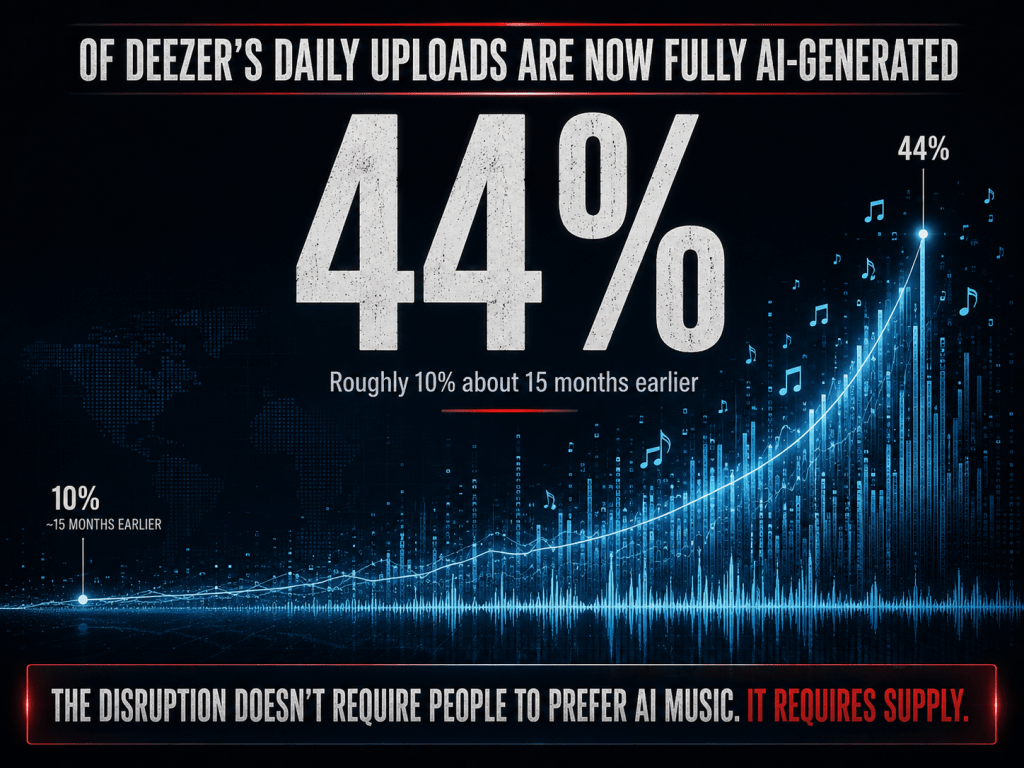
Cover that as a local story, and you miss what it actually is. The same week WMAR went anchorless, Deezer disclosed that 44% of the tracks uploaded to its platform daily are now fully AI-generated — up from roughly 10% about fifteen months earlier. And Challenger, Gray & Christmas, the firm that has tracked U.S. layoffs since the 1980s, reported that AI has become the single most-cited reason employers give for job cuts, responsible for roughly 40% of announced reductions in a single month this year — the first time in the report’s history that any stated cause has outranked “economic conditions.”
“This is a national labor story wearing a local-news costume.”
Three industries. Same month. Same underlying arithmetic. This is a national labor story wearing a local-news costume, and it’s worth tracing where the money actually goes.
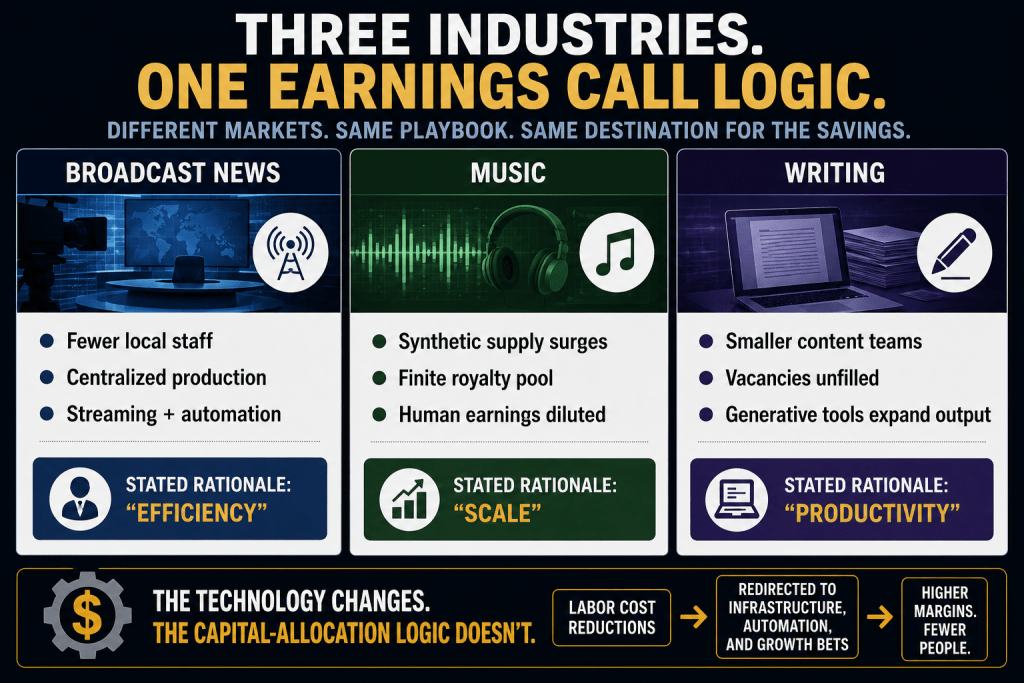
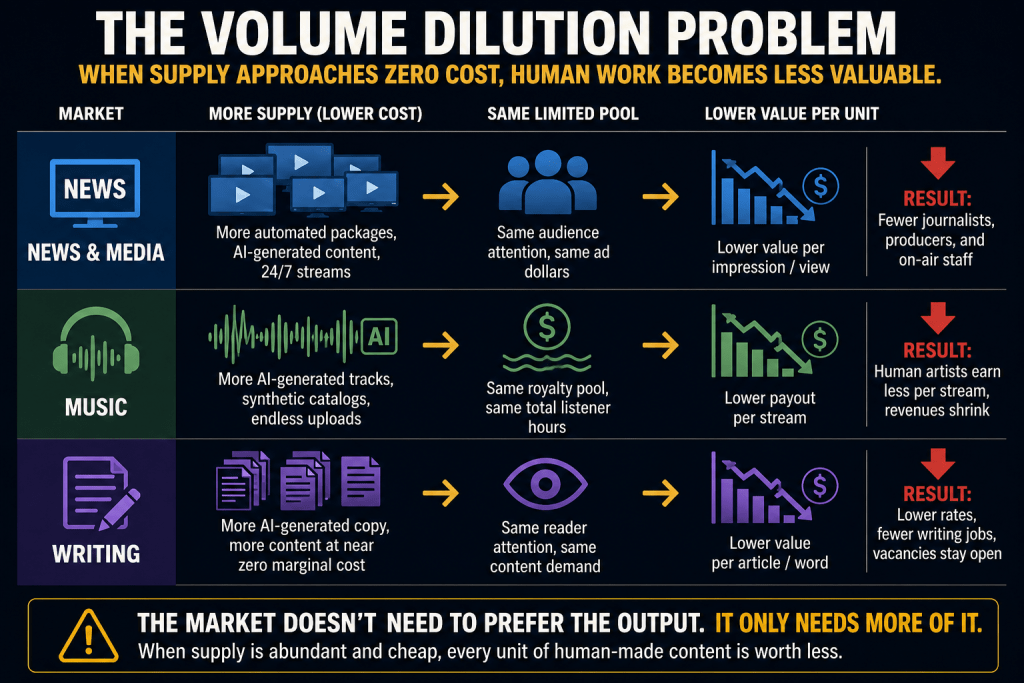
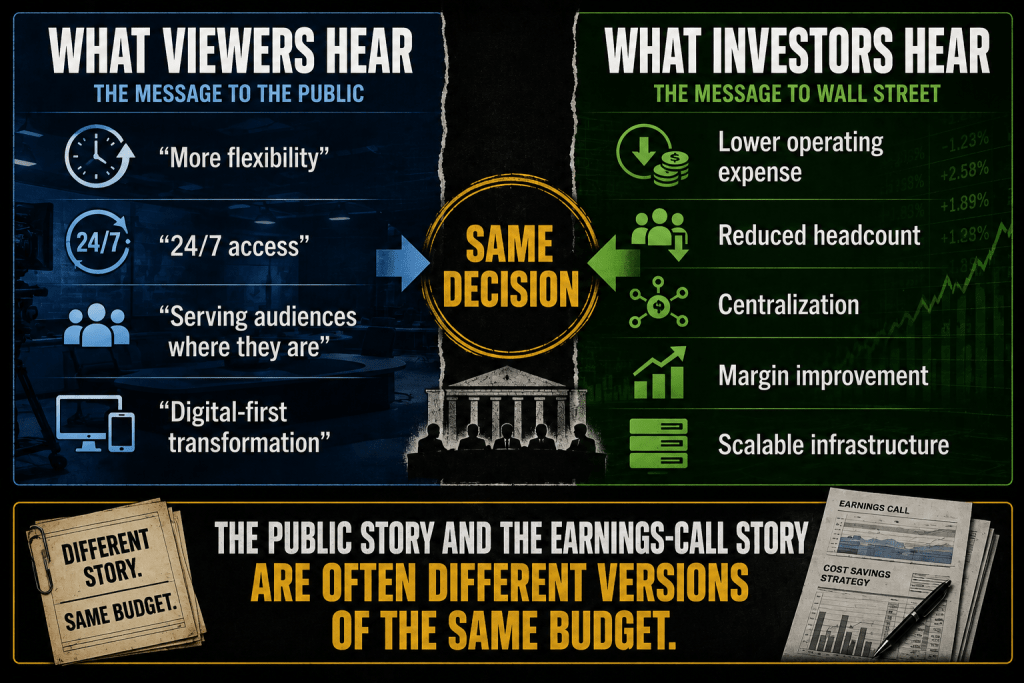
Broadcast news. Local television is the most visible casualty because the disruption is the most legible — a viewer can watch an anchor disappear in real time. Press Gazette’s rolling tracker documents more than 2,300 confirmed U.S. and U.K. newsroom job losses in the first half of this year alone, already on pace to exceed all of 2025. The Washington Post, Politico, Vox Media, the BBC, and the Associated Press have each cut staff in 2026, citing a mix of AI-driven cost pressure and the collapse of search-referral traffic — Google’s AI-generated search summaries now measurably keep readers from clicking through to the original reporting at all. Scripps frames its streaming pivot as a way to serve audiences on their own schedule. What the framing omits is that the same pivot lets the company run a station with a fraction of the people previously required to staff one.
“A viewer can watch an anchor disappear in real time.”
Music. The mechanism is different, but the money moves the same way. Streaming royalties are paid out of a shared, finite pool: every play — human-made or synthetic — draws from that same pot, which mechanically dilutes the per-stream payout owed to everyone else. Generative platforms like Suno and Udio can now produce broadcast-quality, multi-stem tracks from a text prompt, and Deezer’s 44% figure shows an industry being flooded from the supply side, even as listener sentiment moves in the opposite direction. Luminate’s 2026 research found consumer comfort with AI music has been declining, not growing — net sentiment dropped from -13% to -20% in under a year. Listeners don’t have to want the AI content. The industry group CISAC projects human artists stand to lose close to a quarter of their streaming revenue — an estimated $4.64 billion annually — by 2028, on volume dilution alone. The preference of the audience is not what’s setting the payout.
“Listeners don’t have to want the AI content.”
Writing. This is the vertical without a single dramatic on-air moment, which is precisely why it’s under-covered. AI is now the leading cited cause of layoffs across the U.S. economy broadly, not confined to media, and freelance and staff writing roles have been quietly folded into “content operations” budgets without the kind of standalone announcement that draws a headline. The visible cases — CNET and the Sports Illustrated publisher both caught running AI-generated copy under fabricated bylines — got treated as one-off scandals. The less visible and more consequential pattern is companies simply declining to backfill writing roles as they open, because a much smaller staff paired with generative tools can now match the old output volume.
Meta’s 2026 workforce reductions track closely against the company’s own capital expenditure guidance — $115 to $145 billion earmarked substantially for AI infrastructure. That’s the pattern worth sitting with: in most of these cases, the AI tool itself is not what’s doing a laid-off employee’s job feature for feature. What’s changed is what the company is now willing to fund. The salary line becomes a funding source for the buildout, and the AI narrative becomes the explanation offered to employees, shareholders, and reporters for a decision that was, underneath the framing, about capital allocation.
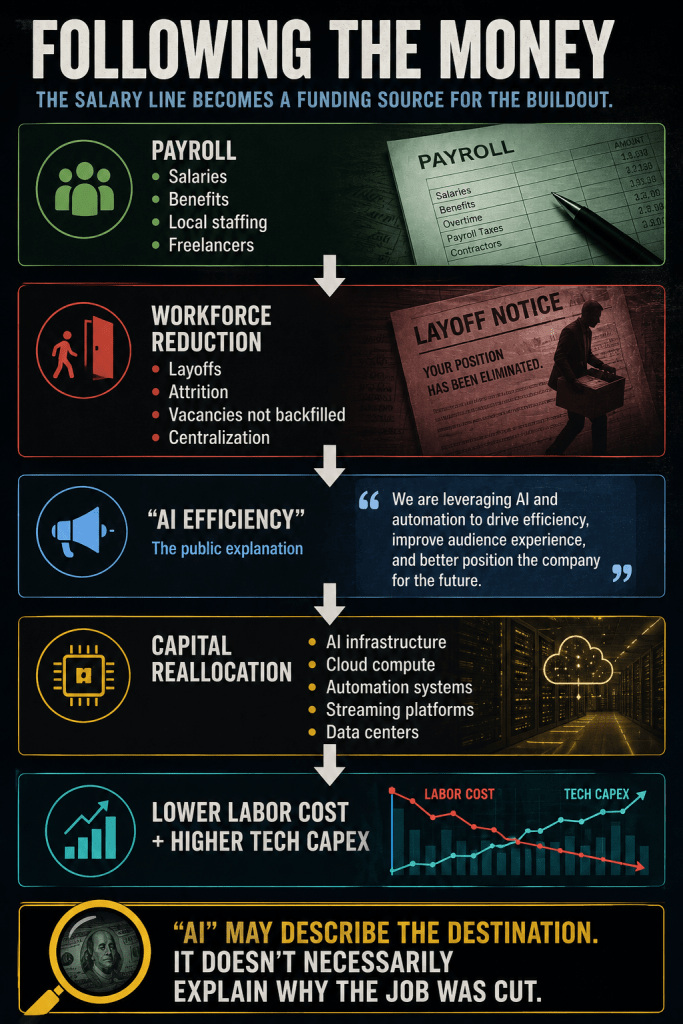
That distinction matters for accountability reporting. When a company attributes a layoff to “AI,” it’s citing a cause that sounds inevitable — a force of nature, not a choice. Challenger’s own analysts caution against taking those attributions at face value; a company can say AI is why it’s cutting jobs without that being independently verifiable as the actual driver. Some of what gets filed under “AI-related workforce reduction” is efficiency. Some of it is a company redirecting the same money toward a different bet and reaching for the more palatable public explanation.
“When a company attributes a layoff to ‘AI,’ it’s citing a cause that sounds inevitable — a force of nature, not a choice.”
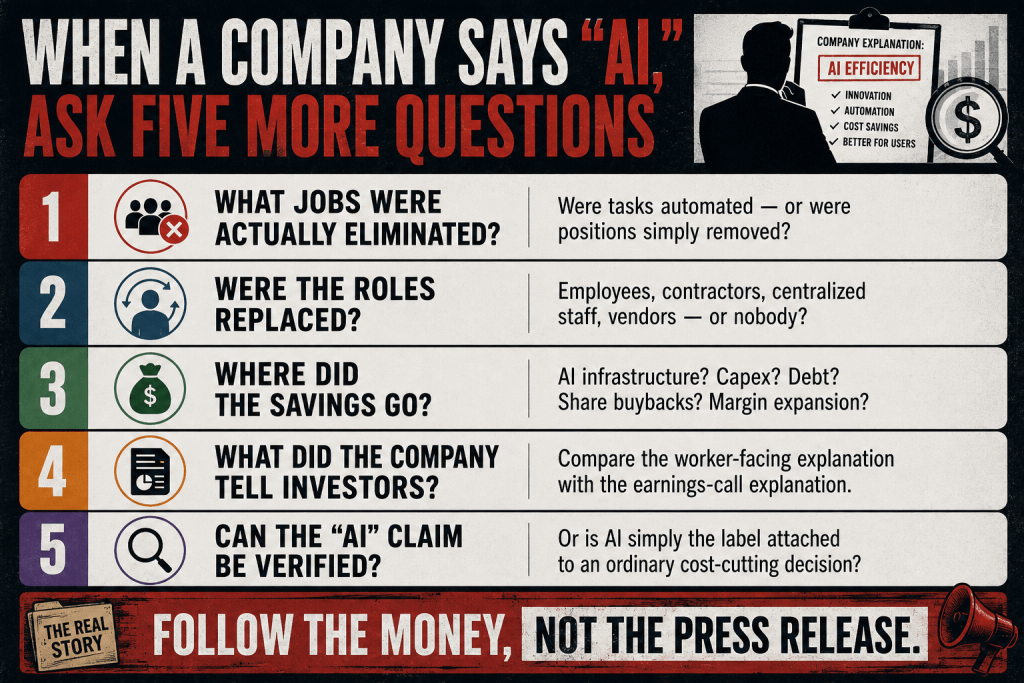
WMAR’s viewers were told the shift serves them better. Scripps’ shareholders were told it controls cost. Both things can be true. What’s missing from either version is an accounting of where the eliminated payroll actually went — and whether “AI” is doing the explanatory work of a decision that was really made in a budget meeting, not a boardroom about journalism.
“Follow the money: not whether AI is capable of the work, but who decided the savings were worth more than the jobs.”
That’s the story still to be reported, market by market: not whether AI is capable of the work, but who decided the savings were worth more than the jobs, and whether anyone outside the C-suite got a vote.
Reporting on WMAR's anchorless format draws from The Baltimore Banner, NewscastStudio, and DCRTV coverage of the Scripps rollout and staff departures. Music-industry figures come from Deezer's own upload-tracking disclosures (via NPR's May 2026 coverage of the Luminate consumer-sentiment report) and industry royalty-dilution projections attributed to CISAC. Layoff and labor-market data is drawn from Challenger, Gray & Christmas's monthly job-cut reports (March through July 2026 releases), which track AI as a stated cause of U.S. layoffs. Newsroom-specific job-loss figures come from Press Gazette's rolling 2026 journalism layoffs tracker. Meta's capital-expenditure-versus-headcount pattern is sourced to the company's own 2026 guidance as reported by CNBC and aggregated in Founder Reports' AI-layoffs tracker. The CNET and Sports Illustrated AI-bylines incidents are drawn from widely reported 2023 coverage of those publishers.
Comments
Nothing yet. Say the first thing.
Sign in to join the conversation.