
There is something very cool about working as an independent analyst, able to say whatever you want in a newsletter without oversight.
And there is something very humbling about the fact that with all that independence comes almost zero power or real influence.
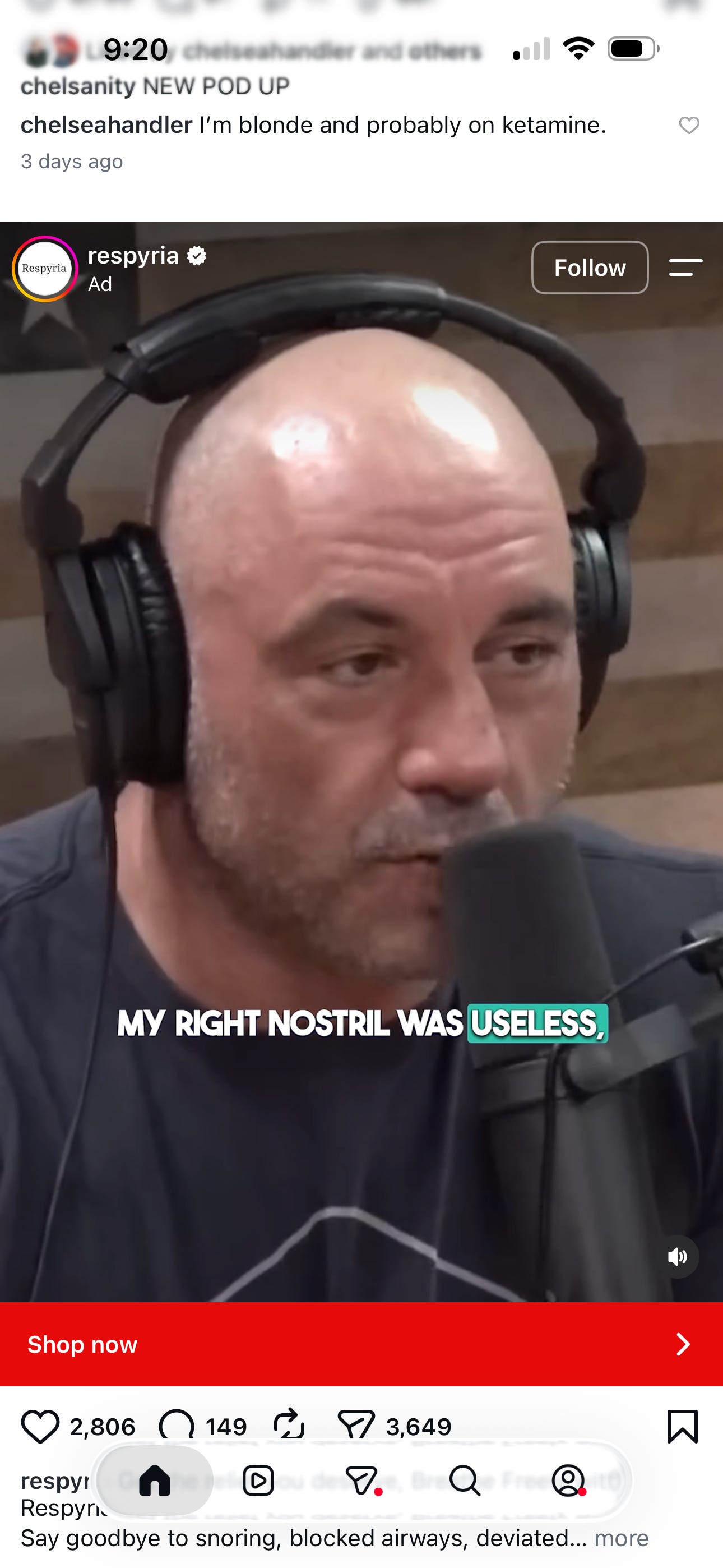
A few months ago I wrote about the anti-snoring brand Respyria was posting a bunch of ads on Instagram making it look as though celebrities like Joe Rogan and Jack Black were endorsing the product in podcast interviews.
Not exactly Watergate, I realize (as Yelena would say, small potatoes). Still, I was surprised when last week, I started to receive a flurry of similar ads on Reels featuring Rogan and Theo Von seemingly glowingly endorsing Respyria in interviews. These podcast clips were clearly augmented by generative AI - which was ironic given that Meta had just announced a continued investment in AI, denting the company’s profitability and irking investors.

Again, one random nasal-insert brand’s bogus ad campaign isn’t likely to shake up the social media ad economy. Nor is the company getting called out on this behavior going to cause deepfake artists’ knees to buckle. Still, you’d think they’d maybe pull the campaign, or shift gears a bit, instead of tripling down.
And you’d think that maybe Meta would, I don’t know, stop them? Yet the ads are right there in Meta’s ad tracker.
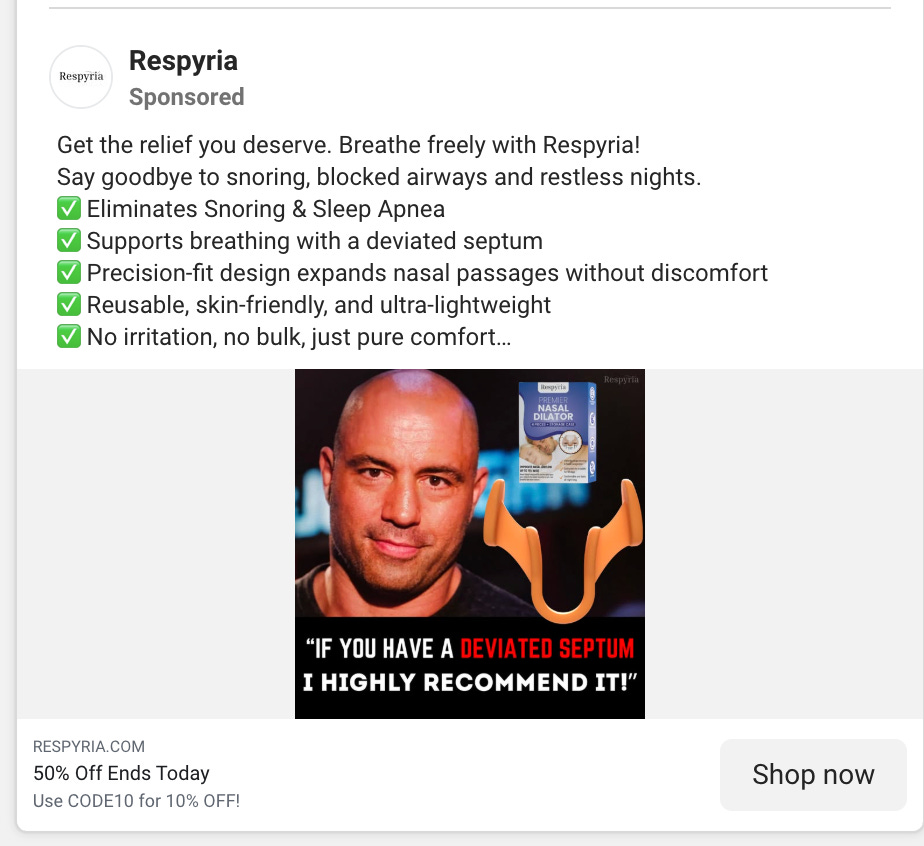
Alas, there is nothing like wielding the power of an independent creator!
Unless, of course, I was wrong, and Rogan, Black and others all do have deals to endorse Respyria. Yet funny enough, nobody has been screaming at me for corrections to my post. I double checked the videos featured in the ads I saw last week, and Rogan and Von do not mention Respyria - though they do extol nose-breathing.
Which makes me wonder, what’s Meta’s role here? On the one hand, generative AI is so easy to use, that stopping deepfakes on a platform that is so wide open seems near impossible. And to Meta, money is money.
“This is not necessarily new, but a continuation of a moderation challenge the platforms have had for a while,” said Will Heins, managing partner, data and media, Jellyfish, pointing to disinformation surrounding the 2016 election. With advancements in AI, “It’s harder now.”
“On one side, you don’t want fake news and bot farms. And you also don’t want to curtail creators. So it’s an incredibly challenging balance for the platforms to strike.”

Still, as mentioned, Meta is staking a claim that it’s rather good at AI. If you listen to CEO Mark Zuckerberg (once again coming to a theater near you), Super Intelligence is the company’s future. Yet let’s review:
Meta bet big on Llama. Like most LLMs, it ain’t cheap to build.
Per Reuters: Meta “now expects 2026 capital expenditure to be between $130 billion and $145 billion, compared with its prior forecast of $125 billion to $145 billion.
When you are out in the world, you surely hear about people using ChatGPT, or Google Gemini. Nerds use Claude (“you should Vibe Code Mike!). Maybe once in a while Perplexity. Do you Llama much? Have you benefited from Super Intelligence yet?
What am I missing here? Meta doesn’t have a consumer-facing AI chat product. And it doesn’t have a product like Codex that companies use to build stuff. Yet it wants to compete with OpenAI and Anthropic, right? Is that Meta Assistant? Again, do you use that much?
Why does it matter that Meta’s AI is ‘open-sourced’ if people aren’t using it? Do developers care?
Where is all this cash going? To invest in curing diseases? (Meta spent over $30 billion last quarter) Or to sublet your servers to someone else? So Meta is now the Mr. Roper of AI? Here’s how you know that things are going bad for Zuck of late - he did actual interviews with real media companies like The Wall Street Journal and The New York Times.
To be sure, I am not saying that Meta isn’t an AI company. It’s just that it’s an AI Advertising Company. In fact, it’s the Shohei Ohtani of AI advertising. Let’s not forget that Apple’s ID changes from a few years ago were supposed to severely hinder Meta’s ability to target ads and track their impact (its superpower). Instead, it invested heavily in AI specifically to rebuild its ad tech. Based on Meta’s continued growth and performance, its targeting and attribution is better than ever. It pulled in $60 billion in Q2!
For some reason, Zuckerberg doesn’t want to own this achievement. Instead, he wants to be thought of in the same sentences as Sam Altman and Elon Musk. Unfortunately, when you have the personality and emotional IQ of a smart fridge, these are your role models.
I realize I digress heavily here. Still, it’s worth asking - for a company that excels at delivering ads for products that you never knew you needed, why can’t it do a better job of keeping bogus ones off of its apps? Because presumably, deepfake ads are only going to get better, and become a bigger problem.
Who’s getting hurt you might say? Why should millions of Meta advertisers of all kinds care about what a few shady ones are doing?
Well, at a certain point, you have to wonder what the preponderance of fake AI ads does to the credibility of Instagram ads - and advertising at large.
According to a recent report from Omnicom Media Intelligence: a majority (81%) of consumers believe that at least a quarter of the ads they encounter today are already AI-generated.
And nearly two thirds (64%) of consumers say AI usage in advertising should only happen alongside human involvement
While 81% of consumers say they now value human-made advertising more
Thus, marketers are already risking a reputation as professional BS artists. Are we headed to a place where all advertising becomes suspect in the minds of consumers?
“When an overwhelming majority of [a platform’s] revenue is ad based, people need to believe and trust the ad content they see,” said Heins. “It’s essential for the whole ecosystem.”
“If your ecosystem is being viewed as, ‘everything is fake,’ that’s an existential problem. I don’t know if we’re there yet.”
Zuck, if you can fix that, you’ll be an ad tech hero! You’d get comped at Programmatic IO!
In the meantime, here are some more examples of Respyria’s questionable tactics:
Right here, Joe Rogan tells comedian Shane Gillis that he uses a “mouthpiece” to guard against sleep apnea
Yet in this ad, Rogan is telling Shane about Respyria, which goes in your nose. Rogan ‘says’ “You should get the Respyria nose dilator. The result is awesome…I’m telling you it changed my life.”
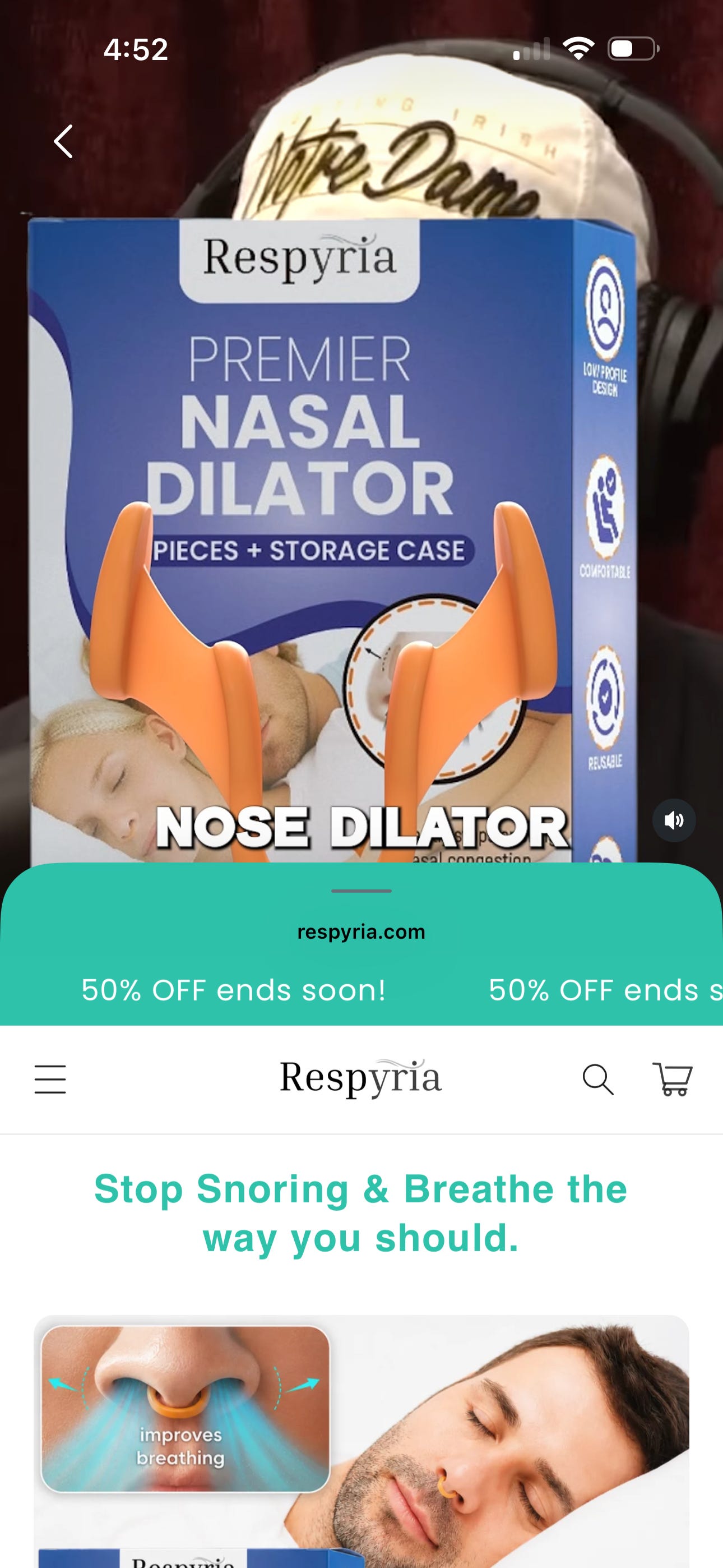
In one ad, Respyria implies that Rogan and surfer Laird Hamilton were discussing using devices to open your nostrils at night. They were not.
In one ad, Rogan’s mouth is covered by an image, during which it sounds like he says he uses Respyria. But in the below interview with

Similarly, this clip from Theo Von’s interview with James Nestor is being used to imply that Vaughn endorses Respyria. While they do endorse nasal breathing, he does not mention Respyria.
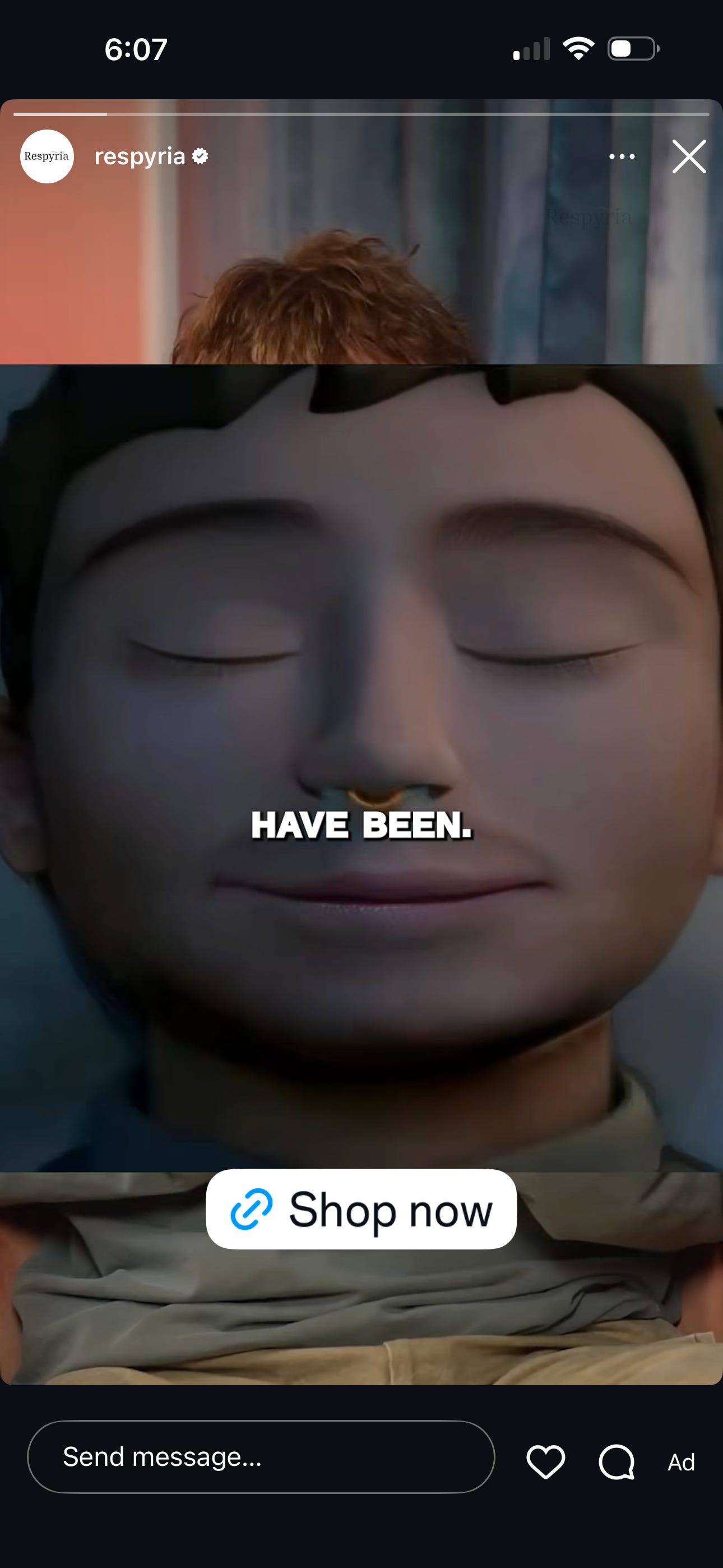
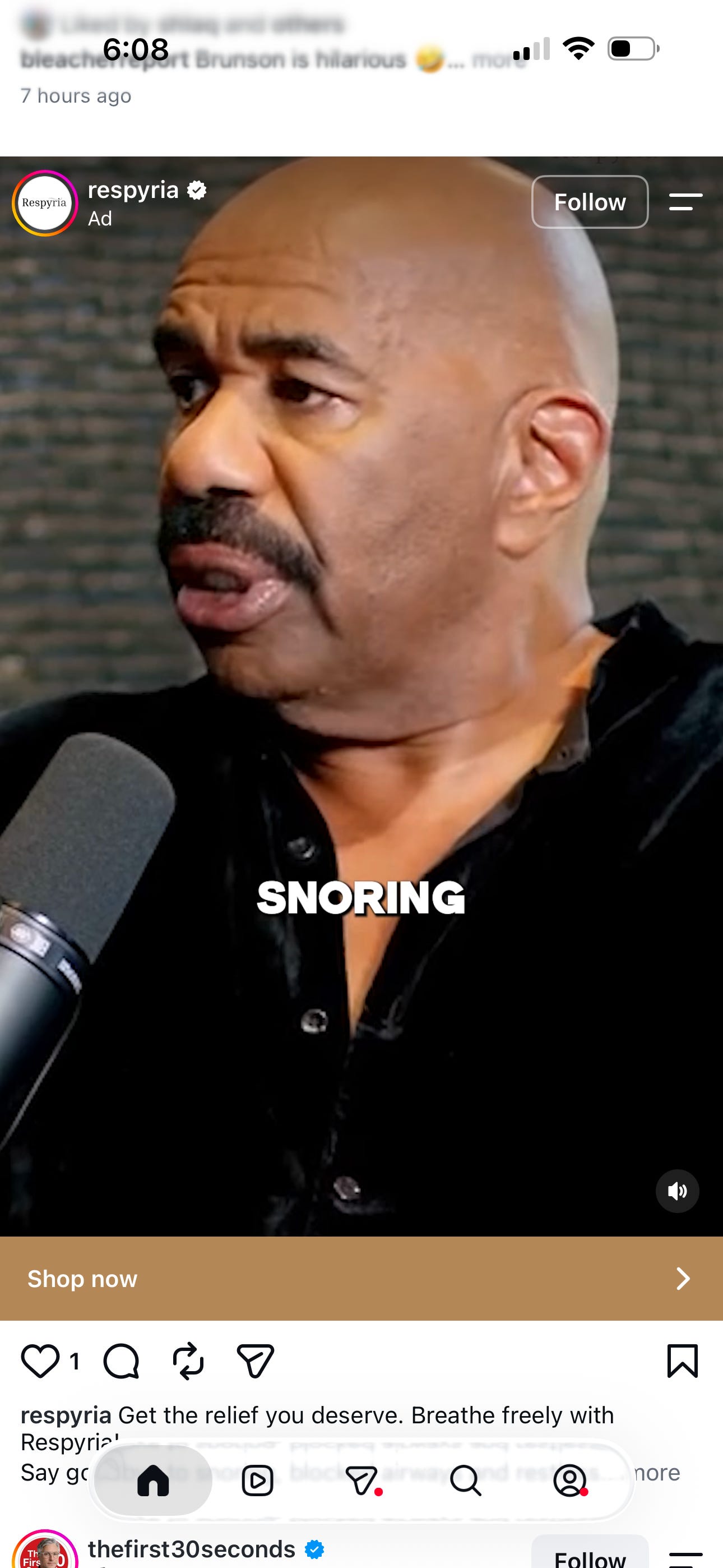
Does Steve Harvey really endorse Respyria? You tell me.
No posts
Comments
Nothing yet. Say the first thing.
Sign in to join the conversation.