
Over the past several years, the talk in retail media circles has been the need to “go off platform” - and “definitely full-funnel.”
Which has essentially been code for “we’re running out of room and ad dollars on our shopping website and app” and “we want access to bigger brand budgets.”
At a media offsite last week, I talked to an industry exec about just how hard this can be for most retail networks, outside of the Amazon/Walmart realm. Right now, bringing a retailers data out to every DSP and the open web and TV may not lead to a clear payoff.
"Most RMNs are still being funded by shopper marketing budgets,"said Melissa Gallo, VP of Solutions & Delivery, Vantage, a retail media tech firm. However, Gallo noted that budget flows are becoming multi-dimensional. “If you build only for the hardcore media buyer, you miss a large swath of investment; if you build only for the shopper marketer, you miss the incremental dollars. That tension is really the heart of [this debate.]”
Some argue that this debate misses the point. They might even ask, are too many RMNs hoping to become full-fledged media brands? “I think retail media needs to re-embrace retail,” said Molly Hjelm, corporate Vice President and General Manager of RedVest Media at Ace Hardware on this week’s episode of Next in Media. “For a long time we’ve been attempting to be media companies, or really trying to position ourselves as media companies.”
In a business where every RMN wants to announce a shoppable ad deal or a CTV extension, and most watch with envy as Amazon streams the NBA or Walmart buys Vizio and Vibe, Hjelm’s point of view serves as a pretty hot take. "Pushing your data unfettered into other environments really divorces your audiences of the meaningful context of how you can grow a business within that retailer."
"It's not a never for us, but we're thinking intentionally about how and where... we're thinking about audience extension."

Of course, that may make sense for a hardware seller like Ace, since people who’ve recently shopped for high ticket items like lawnmowers or bone saws may not be as receptive to being retargeted all over the place. Or it may be an admission that there’s a ceiling to this business.
Which would potentially scream for more alliances. For many retail media networks, “the smarter strategy is to make their shopper data portable into premium CTV environments through strong partners,” said Goodway Group CEO Paul Frampton-Calero in a recent conversation. A retailer like Ace or Lowe’s, “ These are not generic audiences; they are valuable, category-specific audiences with real commercial intent.”
“At that scale and in those categories, these retailers do not need to become Walmart. They need to make their data actionable, measurable, and easy to activate where consumers spend time.”
Hjelm tends to agree. “I think we can’t tolerate hundreds more retail media networks,” she said. “The ones that will kind of make it in this environment are the ones that have the scale... the e-commerce scale and reach... the best data on their customers.”
Check out the full episode here:
Are we underestimating Pinterest?
When you look at earnings this week, which by coincidence featured both Paramount and Pinterest, it struck me that while the former pulled in nearly $7 billion, Pinterest snagged just $1.18 billion in revenue. While that represents a healthy jump of 18% year-over-year, this is a platform that now claims 640 million monthly active users.
While Pinterest clearly can’t pull in TV money or even YouTube money just yet, that’s a fairly impressive trajectory for a social/search/shopping app that is often an afterthought among the walled gardens.
At a moment when search habits are being completely upended, and search advertising may be up for grabs (while publishers struggle with capturing intent), Pinterest claims that its users conduct 80 billion searches each month, and more than half of those are commercial (keep in mind, these numbers are global).
The company also says that paid clicks to advertisers are up over 5x in the past three years. Yet investors didn’t like the guidance given out earlier this week.
To be sure, Pinterest is facing challenges with AI slop. Still, with this combination of intent and performance would seem to be under-leveraged. The company has made an aggressive move into connected TV with its deal to acquire tvScientific (which should start bearing more fruit soon). Here’s what I’m wondering:
When does Pinterest start to emulate the Amazon playbook - as in striking deals to bring its data/audiences to the likes of Disney, Netflix, Spotify, etc.?
Does the Pinterest ID become a new contender for digital ad dollars?
“I do think there’s a real opportunity there, but it’s category-dependent,” said Gallo. The value comes from strong audience overlap, so it works best in categories where intent naturally lives on the platform: greeting cards, party planning, DIY, home improvement. Pinterest is also having a genuine moment right now, particularly with younger users, so the audience case is stronger than it was a few years ago.”
“If the industry keeps building pure play businesses, we’ll miss the customer where they actually are—and that’s where a platform like Pinterest could play a bigger role, whether through RMN partnerships or by leaning harder into its own data.”
Something seems off at Paramount
The company announced Q2 earnings yesterday, and numbers were decent, all things considered as it waits for an answer in the ongoing Warner Bros. Discovery pursuit. Yet one number stood out to me: the direct response division, which houses Paramount+ and Pluto, grew 9% year over year.
In an ad market that is growing at around 8%, a rate of 9% sure isn’t terrible Yet CTV advertising was supposed to be a rocket ship overall, and a savior to companies dealing with linear TV declines.
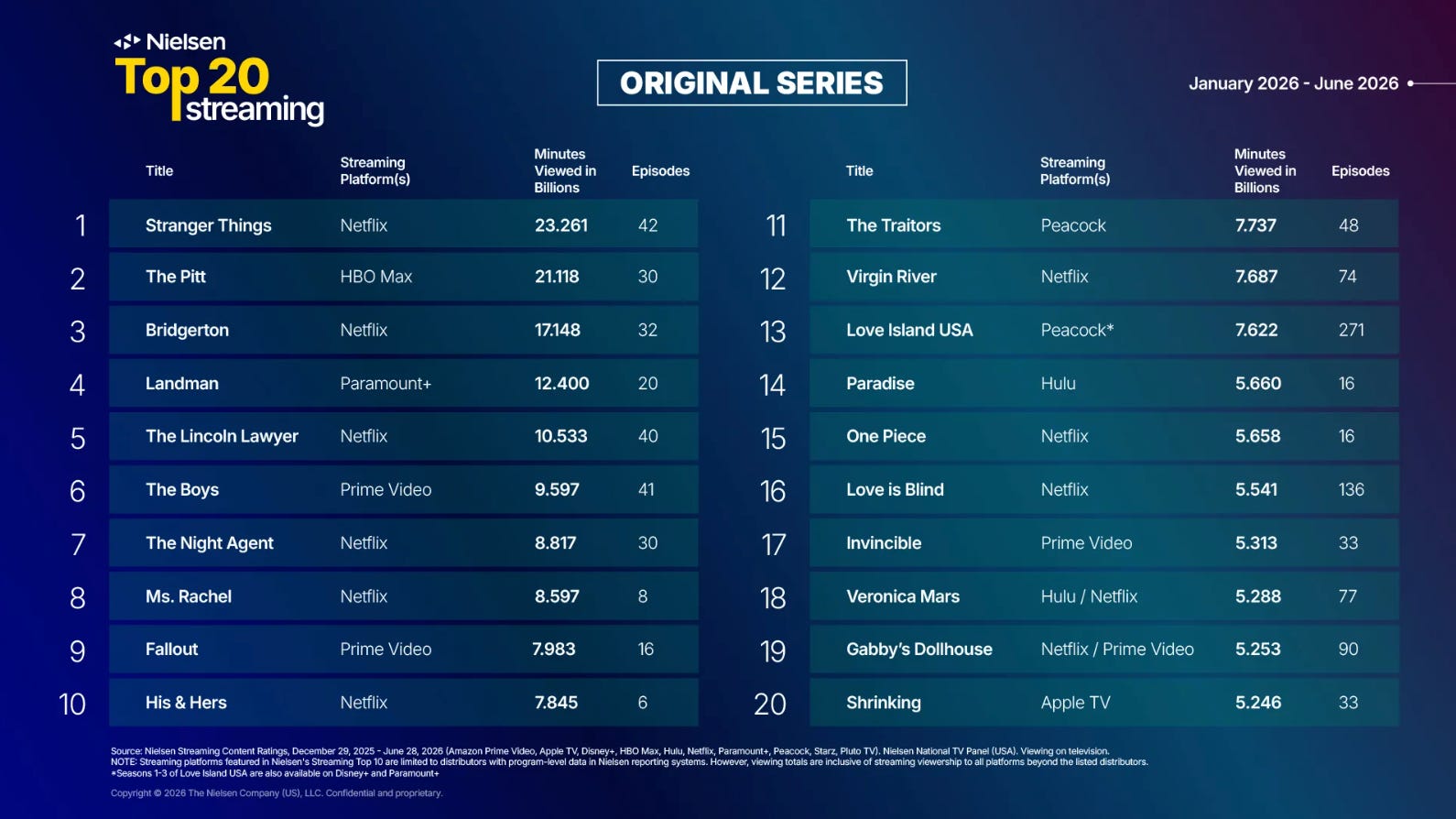
Consider that Paramount+ has a string of hits from uber-creator Taylor Sheridan, including a new Yellowstone spinoff, as well as “Landman” - the fourth biggest original streaming show in the first half of this year, per Nielsen.
Plus, in a much hyped deal, Paramount+ snagged the rights to the UFC earlier this year. According to CNBC, “the second quarter was its “best quarter for retention in Paramount+’s history” and the service snagged 2 million new subs. ion subscribers during the quarter, bringing its total to 81.6 million global customers. Which has me wondering when this is all going to translate into increased watch time and ad revenue.
A big part of Paramount’s problem is that people tend to watch a Sheridan show, and duck out. Plus, in my opinion, the faulty Paramount+ app discourages frequent viewership (I love those shows, yet dread launching them).
In addition, Paramount’s once smart-looking Pluto bet appears to be flailing - the free platform lacks a brand compared to Tubi, and now there is too much CTV inventory out there to make it an important media buy.
Yet, as Business Insider reported, Paramount is exploring a new, free ad-tier for Paramount+. I’m not sure how this will drive more revenue (unless viewership really surges) while protecting the value proposition of the paid service. As Variety reported, Disney is exploring FAST (and everyone thinks Netflix is), in part because “unlike a lot of our AVOD competitors, we’re fairly well sold, meaning more inventory would actually help us accelerate our ad revenue growth,” said CEO Josh D’Amaro
Unlike a Netflix or a Hulu, Paramount+ only has so many shows. If you make “Landman” free, what does that do to P+?
No posts
Comments
Nothing yet. Say the first thing.
Sign in to join the conversation.