
THINGS IN THE FIRST PHASE of the Pink Floyd story played out remarkably quickly – for better and worse. The better part came out of a confluence of the band’s ambitions and the fast-rising movement in London’s arts scene and youth culture. The Beatles and the Rolling Stones, among numerous other artists, were transforming the aesthetics and purposes of mid and late 1960s British pop – how it sounded, what it could say, how it emboldened or unsettled listeners – and this impact carried past radio to how people made and viewed art, how they dressed and how they gathered and interacted in public situations. As a result, experimentation and a daring new sense of social play increasingly became a part of not just popular culture but of daily life. In London, from 1965 to 1968 this all became enmeshed in a movement sometimes known as the London Underground, or the Spontaneous Underground. Whether they intended to or not, Pink Floyd, more than anybody – more than the Beatles, for example – became the sound, the central house band, of this movement. That’s because Pink Floyd, billed sometimes as “London’s farthest-out group,” developed themselves and their music in the midst of it all live, night after night, with a population that was far more than a mere audience. Behind all that, there was a diligent attempt by various parties, such as producer Joe Boyd, ESP record label owner Steve Stollman, Indica bookstore and gallery operator Barry Miles and organizer John “Hoppy” Hopkins, to arrange events that brought music, poetry, performance art and kinetic art together with a participatory audience, with some partakers experimenting with marijuana, hashish and psychedelics – primarily LSD. It all became intertwined enough that for some – both advocates and detractors – the music seemed inseparable from the drug experience. (Roughly similar gatherings had taken place the year before at the Acid Tests in Los Angeles and the Bay Area, with Ken Kesey’s Merry Pranksters and the Grateful Dead, though the London scene was much more fashion- and art-conscious.) These events – sometimes called happenings or raves – were frequently unadvertised, promoted by word-of-mouth and invitation.
Pink Floyd worked their way into the heart of this scene in a series of key live appearances, starting in early 1966 at London’s Marquee and spreading by the end of that year to the All Saints Church, the Roundhouse and the short-lived all-night UFO Club, playing for crowds that included Paul McCartney, John Lennon, Mick Jagger, Christine Keeler, Pete Townshend, Donovan, Marianne Faithfull and Yoko Ono (the latter whose performance art appeared at the 14-Hour Technicolor Dream rave at Alexander Palace in early 1967). There were other acts popular in this circuit, including Soft Machine, Arthur Brown, Procol Harum, Tomorrow, the Pretty Things, the Third Ear Band and the jazz group AMM, but Pink Floyd set themselves apart with two features: an increasingly complex and resourceful cycle of light projections that appeared to envelop and react to the band as it played, and their abstract style of improvisation that could appear formless and unruly one moment then precise, pounding and exhilarating the next. Artist Duggie Fields, who was a close friend of Barrett’s, said: “A group of their friends was their audience first, then suddenly they got an enormous following in a very short space of time, shorter than it took for the Rolling Stones to happen.” Other artists, of course, had been playing extended improvisations in clubs as well, such as the Yardbirds and blues and jazz bands, but largely those acts extemporized within well-formed metric structures.
By the end of 1966, Pink Floyd had signed a rather lucrative deal with EMI, which allowed them unlimited time to record their first album at the label’s Abbey Road studios. (They would in fact end up recording during the same early 1967 stretch that the Beatles were making Sgt. Pepper’s Lonely Hearts Club Band. Paul McCartney had been a fan of Pink Floyd’s Spontaneous Underground shows and told Barry Miles he thought the band represented a “new synthesis of electronic music and rock & roll.”) Joe Boyd had hoped to produce the band but EMI wouldn’t let a non-staffer head a recording, and instead assigned the group to Norman Smith, who had been the Beatles’ sound engineer up through Rubber Soul. (Boyd, though, did produce the group’s path-clearing first single, “Arnold Layne,” and also recorded their sessions for Peter Whitehead’s film Tonite Let’s All Make Love in London, which is how intent and unified Pink Floyd was in improvisations.) Smith appeared a strange fit for the band – reportedly he wasn’t initially fond of the band’s instrumental experiments, “Astronomy Domine” and “Interstellar Overdrive” – and in later years he disparaged the group in unnecessarily unkind terms. “I could barely call it music,” he said. Smith also found working with Syd Barrett exhausting, seeing him as hard to communicate with and not receptive to suggestions.
Still, what resulted from those sessions was something wonderful and enduring. With Pink Floyd’s debut The Piper at the Gates of Dawn (Barrett had named the album after a passage from Kenneth Grahame’s The Wind in the Willows), the band loomed as a potentially matchless force in British rock & roll, though Syd Barrett was clearly the group’s imaginative center. He had been paying close attention to the other transformative music of that time – the Beatles’ Revolver, the Byrds’ Fifth Dimension, the Mothers of Invention’s Freak Out, the Kinks’ Face to Face, John Coltrane’s A Love Supreme and Om, the debut works by the Fugs and Love – and though it all had its influence, he nonetheless emerged rapidly as an original. He wrote Lewis Carroll- and Hilaire Belloc-indebted wordplay, and he wrote songs about fantasy and childhood and horror and the I-Ching, all paired with remarkably inveigling and intuitive melodies. He was the primary reason Pink Floyd was now the most notable new band in British rock & roll, and he loved being a part of the cultural adventure that surrounded them.
Then, just as 1967’s Summer of Love was underway, the Spontaneous Underground came under fatal fire as the British press mounted attacks against the morality of the movement, and as the London police began making more frequent arrests for drug possession. As a result, EMI quickly tried to distance the band from the movement that had launched them, stating in a press release: “The Pink Floyd does not know what people mean by psychedelic pop and are not trying to create hallucinatory effects on their audiences.” Jenny Fabian, who did some of the best writing about the London scene, remembered it rather differently. She told writer John Cavanagh in The Piper at the Gates that Pink Floyd “were the first authentic sound of acid consciousness…. They’d be up on stage like supernatural gargoyles playing their spaced-out music, and the same color that was exploding over them was exploding over us. It was like being taken over, mind, body and soul.”
THIS QUESTION ABOUT THE BAND’S PSYCHEDELIC sources was about to take on a painful resonance. At the peak of Pink Floyd’s early creative powers, with a remarkable album – that would define the London Underground season in a vivid and undying way – now finished and set for summer 1967 release, Syd Barrett began to fall apart. The onset was sudden. As the group’s “See Emily Play” soared into the Top Ten, Pink Floyd was set for three consecutive July appearances on the British weekly program Top of the Pops; Barrett looked increasingly haggard and wary as the weeks progressed, until finally he walked off the third show, frantic and angry.
That was just the start. At the International Love-In at the Alexandra Palace that same month, Barrett had to be hauled onstage by Waters but he never played his guitar. In the first week of August, just as The Piper at the Gates of Dawn was being released, Pink Floyd’s managers, Peter Jenner and Andrew King (Jenner had also been a key participant in some of the Spontaneous Underground activities) canceled the band’s English tour due to Barrett’s “nervous exhaustion,” and sent the singer on vacation with a doctor to a Spanish island. While on the island, Barrett screamed in horror when there was a storm and slept in a graveyard. In November, Pink Floyd embarked on its first American tour. Onstage at San Francisco’s Winterland, Barrett stood with his arms hanging limp and occasionally blew into a whistle. On TV appearances, he refused to mime the words to the band’s songs. At a Los Angeles show, Barrett detuned his guitar and stared at some space past the audience. Waters wanted him fired that night. When Waters found Barrett asleep in the band’s L.A. motel, a cigarette burning into his fingers (an instance later depicted in the film The Wall), the band insisted that it was time to leave America. Back in England, on tour with the Jimi Hendrix Experience, Barrett sometimes disappeared for his band’s set. Years later, Nick Mason told Barry Miles: “You’re trying to be in this band…and things aren’t really working out and you don’t really understand why. You can’t believe that someone’s deliberately trying to screw it up and yet the other half of you is saying ‘This man’s crazy – he’s trying to destroy me!’
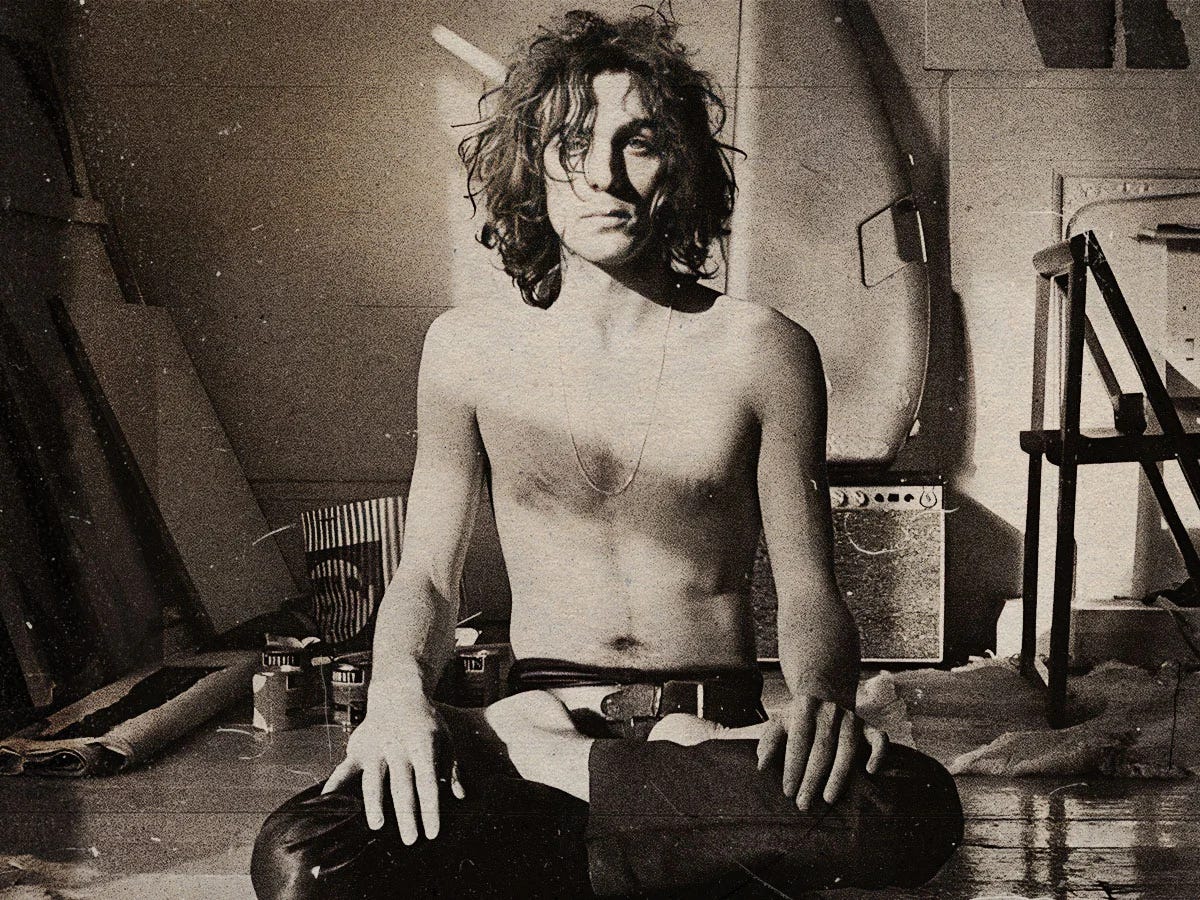
”
No posts
Comments
Nothing yet. Say the first thing.
Sign in to join the conversation.