
Some of the writing that has meant the most to me at Rolling Stone is the writing that ended up surprising me. Though I valued the chances I had to write about Bob Dylan, the Rolling Stones, the Beatles, Sinead O’Connor, the Clash, Leonard Cohen and Aretha Franklin among others, none of those subjects surprised me. I already knew what they meant to me. For that matter, what they’d mean to me for years.
But there were other stories that offered me a challenge. When I accepted assignments on Led Zeppelin, Pink Floyd and some others, I was taking on subjects I had serious misgivings about. I didn’t know if I could do them justice—or for that matter, whether I might do them too much justice.
This week’s series about Pink Floyd is such an example. I entered the subject feeling one way and left it feeling a different way. I was glad my preconceptions ended up shifted. I saw values in the band and its music that I hadn’t expected. It’s nice to prove yourself wrong sometimes.
I suspect that some who read this—if they do—might have doubts similar to my own. I understand that. Just wait until we get to next week’s subject. It might well test you as much as it did me.
THERE WAS NO REASON these men should ever stand together again. Roger Waters, David Gilmour, Nick Mason and Rick Wright – the four musicians who had carried Pink Floyd forward after Syd Barrett had fallen from reason in 1968 – had not appeared on a stage together since June 1981, and it hardly seemed possible they ever would again. Waters and Gilmour had rather famously shown contempt for one another for a quarter-century – each felt the other had tried to dishonor his life’s work and hinder his future. After Waters started his own solo career in 1984, he went on to disparage the men he’d worked with for so long. Guitarist and singer David Gilmour, Waters claimed, “doesn’t have any ideas,” and drummer Nick Mason “can’t play” (Waters had long before thrown keyboardist Rick Wright out of the band). Gilmour gave back as good as he got. When he first took his own version of the band on tour, he appropriated Waters’ most famous prop, a gigantic pig balloon, and attached testicles to it, which some read as a commentary on how he viewed the band’s former bassist. (“So they put balls on my pig,” Waters said. “Fuck them.)
The long squabble resulted in the deepest, ugliest split in rock & roll’s history, and almost certainly the most irreparable. On that warm London night in early July 2005, when the four men finally gathered again as Pink Floyd in London’s Hyde Park at the historic Live 8 concert, it’s unlikely that all the past anger and hurt was easily forgotten or healed, but that’s partly what made the moment so moving. They played and sang despite their bitterness, in part because the evening’s cause – to try to persuade the world’s richest countries to forgive the debts of the poorest countries – was in keeping with belief systems they genuinely shared.
But there was another reason for assembling that night, that ran deeper in their history. They had a debt to pay that could never be paid, but it had to be admitted. Syd Barrett, a man who had been mysterious and lonely for decades, had been the heart of Pink Floyd in its earliest days – he wrote their songs, gave them their style, made them a force in the British music scene – but in 1968, Waters, Mason and Wright threw him out of the band after he slipped into mental disintegration. None of them had seen him since a surprise encounter in 1975 that left them stunned and in tears, but over the years he continued to define the band as they evolved the style he had left them, and as they began to think and write about the darkness that had eclipsed him. They owed Barrett something – in a way, everything – and if they failed to honor him that night at Live 8, in front of the world, they could never meaningfully attempt it again.
THE STORY OF PINK FLOYD is the story of the themes that raised and obsessed and tore at the band for over forty years. That is, it’s a story of madness, alienation, absence, hubris and a self-willed grace. There’s really nothing else quite like it in popular music history From the time they helped ignite pop-cultural upheaval in London in the late 1960s to that touching final public moment at Live 8, Pink Floyd always meant something in their moment. Indeed, the album that transfigured their fame in 1975, Dark Side of the Moon, managed to reflect the doubts and fears of a generation that had to cope with the loss of the ideals of the 1960s – so effectively that it immediately established Pink Floyd as one of the biggest, best-loved bands in rock & roll history. Five years later, the epic and bleak The Wall only made them bigger (both The Wall and Dark Side of the Moon still rank high among best-selling albums worldwide). But The Wall – a story about a bitter, fucked-up loner rock star who could not bear the world around him – proved even darker than it first seemed, as its author, Roger Waters, increasingly could not bear the band around him and did his best to kill that band before it could overshadow him. “If one of us was going to be called Pink Floyd,” he told Rolling Stone in 1987, “it’s me,” though the rest of Pink Floyd didn’t agree.
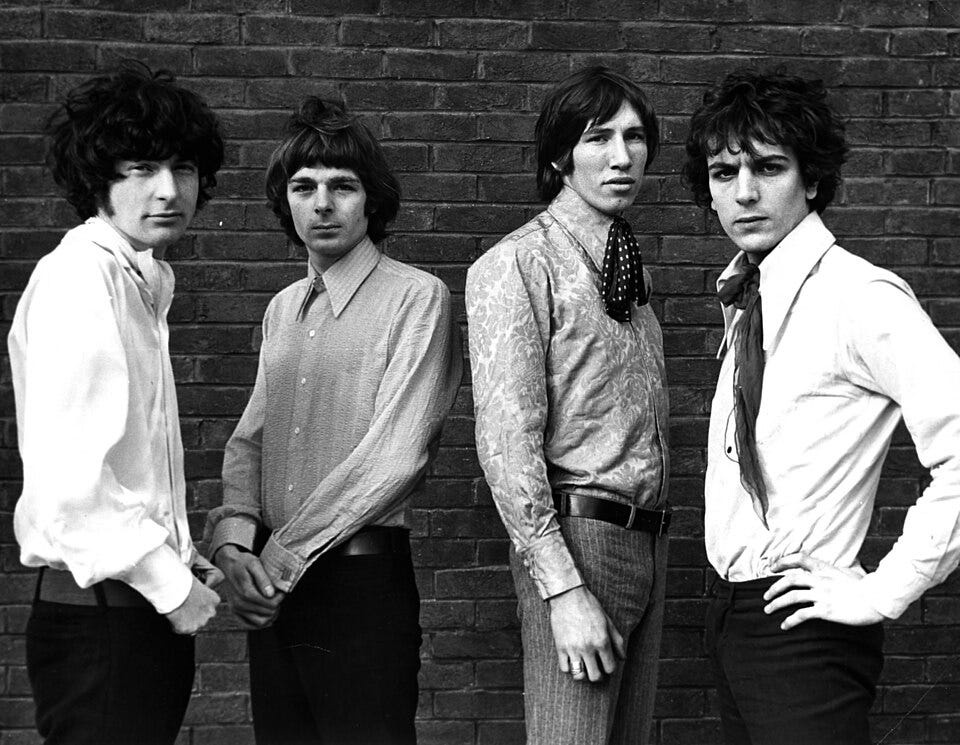
But despite both triumphs and wounds, the band’s members couldn’t escape a certain bond – not just a hatred for one another, but also a realization that without the community they once had, their music could never have mattered. Certainly, the group’s five members shared some strong common formations. All of them were either born in or grew up around Cambridge – a well-off university town that was on one level steeped in the antiquity of its land, history and architecture, but that also prized a progressive streak that was as artistic as it was political – and most of them once appeared headed for careers in the arts. But what would shortly bring the group’s members together was a passion for the promising sounds of rock & roll, blues and R&B, best heard in late night programs emanating from Western Europe’s Radio Luxembourg. Like other key British pop musicians, including John Lennon, Keith Richards, Eric Clapton and Jimmy Page – the members of Pink Floyd—Roger Waters, Syd Barrett, Nick Mason and Rick Wright—would take the knowledge of theory and the spirit of experimentation that they gained from art school and apply it to the raw form of rock & roll, with results that would transform the culture around them.
Waters, Mason and Wright all left Cambridge in 1962 to take architecture courses at Regent Street Polytechnic in London. There, Waters became friendly with Mason, who had grown up around music, art and politics and had been playing drums for years. Waters was already playing guitar – in fact, he sometimes practiced in class when he didn’t want to study. In 1963, he and Mason joined an existing group, Sigma 6, where they met keyboard player Rick Wright, who loved jazz and classical music and had natural music skills. Wright and Mason were still fairly earnest about their possible architectural futures, but not Waters. Throughout school back in Cambridge he had been seen as haughty, rebellious, disrespectful (traits that some felt he derived from the attitudes of his activist mother), and at Polytechnic he was already trying the patience of his lecturers. He fervently did not want to merely move through the university system and be delivered into the professional middle class. “I could have been an architect, but I don’t think I’d have been very happy,” he told journalist Caroline Boucher in 1970. “I hated being under the boot.”
Syd Barrett – another young guitarist who had been regarded back in Cambridge as rebellious – arrived in London in September 1964 to study painting. Waters and Barrett had known each other when the latter was part of the bohemian art school set, learning about French existentialism, the 1950s Beat movement and Eastern religion, and where he was already studying guitar with his friend David Gilmour. Barrett had a passion for the melodic form of the Beatles’ music and for the blues-steeped pop of the Rolling Stones, but he was also given to unusual guitar tunings and an odd slide-guitar technique (which he may have learned from Gilmour). He would become interested in finding a looser form of spontaneity when playing rock & roll. By the time Barrett joined up with Waters in London – the two had vowed in Cambridge to form a band one day – Sigma 6 had become the Abdabs then the Tea Set. There would be personnel changes along the way – including the departure of a bassist, leaving that role to Waters – but by the autumn of 1965 they had settled on a four-man line-up: Waters on bass, Wright on keyboards, Mason on drums and Barrett on lead guitar and vocals. Barrett also gave the group a new identity: The Pink Floyd Sound, derived from the first names of two obscure blues musicians, Pink Anderson and Floyd Council (and from the names of Barrett’s cats). “It was great when Syd joined,” Rick Wright later told author Barry Miles, who would also be a witness to the band’s rise. “Before him we’d play the R&B classics, because that’s what all groups were supposed to be doing then…. With Syd, the direction changed, it became more improvised around the guitar and keyboards. Roger started to play the bass as a lead instrument, and I started to introduce more of my classical feel.”
No posts
Comments
Nothing yet. Say the first thing.
Sign in to join the conversation.