
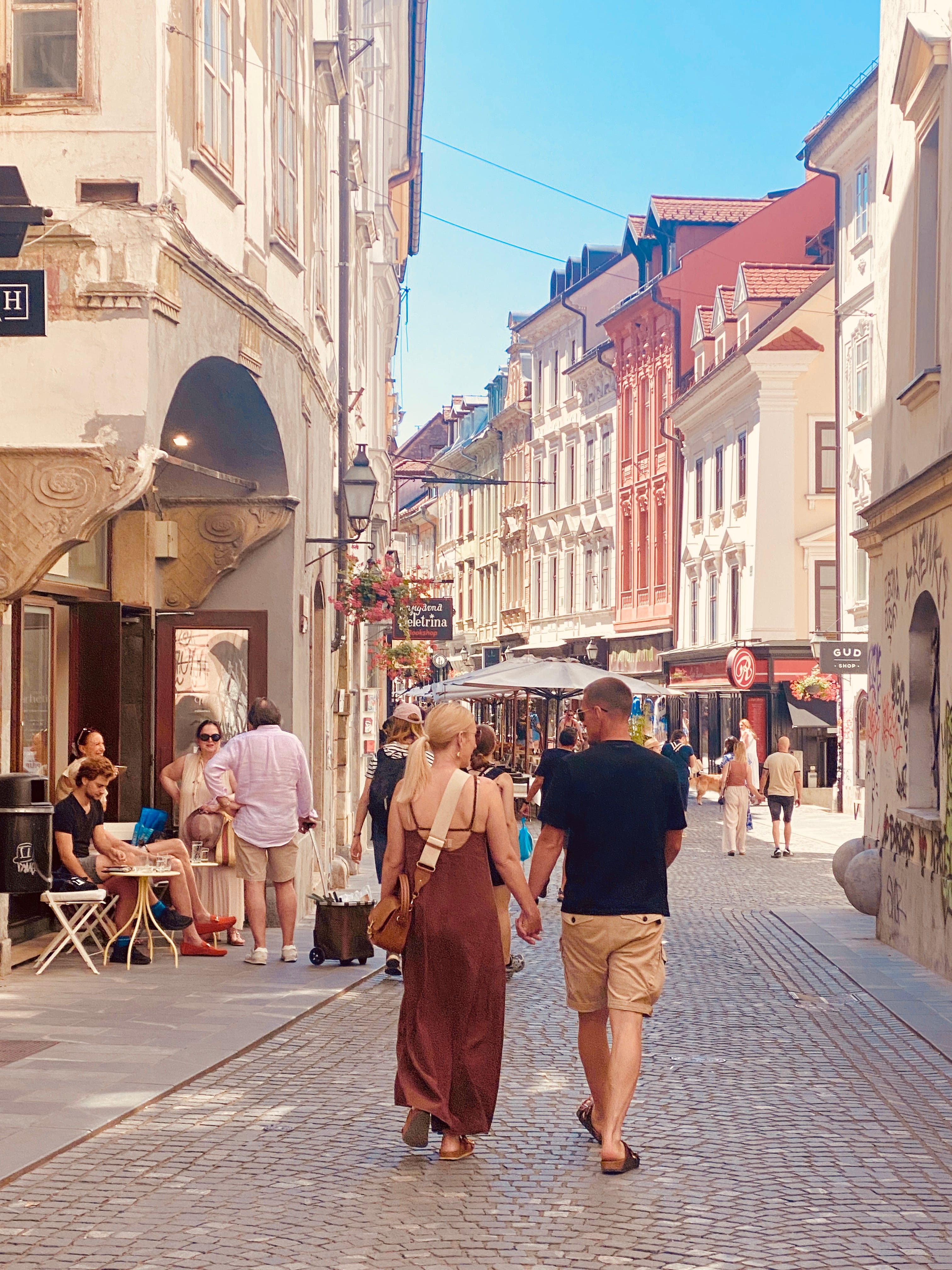
A month before I left for Slovenia, an architect friend told me that what makes Ljubljana unusual is that, more than almost any city in the world, it springs from the imagination of a single architect: Jože Plečnik.
I nodded, unsure how that would translate into my experience of the city and, more pressingly, wondering how on earth one spelled Jože Plečnik.
Within thirty seconds of arriving in Ljubljana, while I was no closer to understanding how carons change the sound of consonants, I had at least begun to understand what my friend meant about having a single architectural theme run through a city.
Plečnik’s fingerprints are all over Ljubljana. Bridges, markets, colonnades, balconies—all threaded together with the same graceful nuance of curves and balustrades. It looked like a fever dream of Vienna or Prague. Which makes sense since though Plečnik was born in Ljubljana, he trained in Prague and Vienna, before returning home and getting busy with whatever the early 1900’s version of CAD was. Walking along the Ljubljanica River, I could feel his hand ushering me from the theater to the market to the iconic triple bridge.
It turns out, though, that Plečnik is only half Ljubljana’s story.
The rest can be summarized by a parking lot.
Except, you see, it isn’t a parking lot anymore.
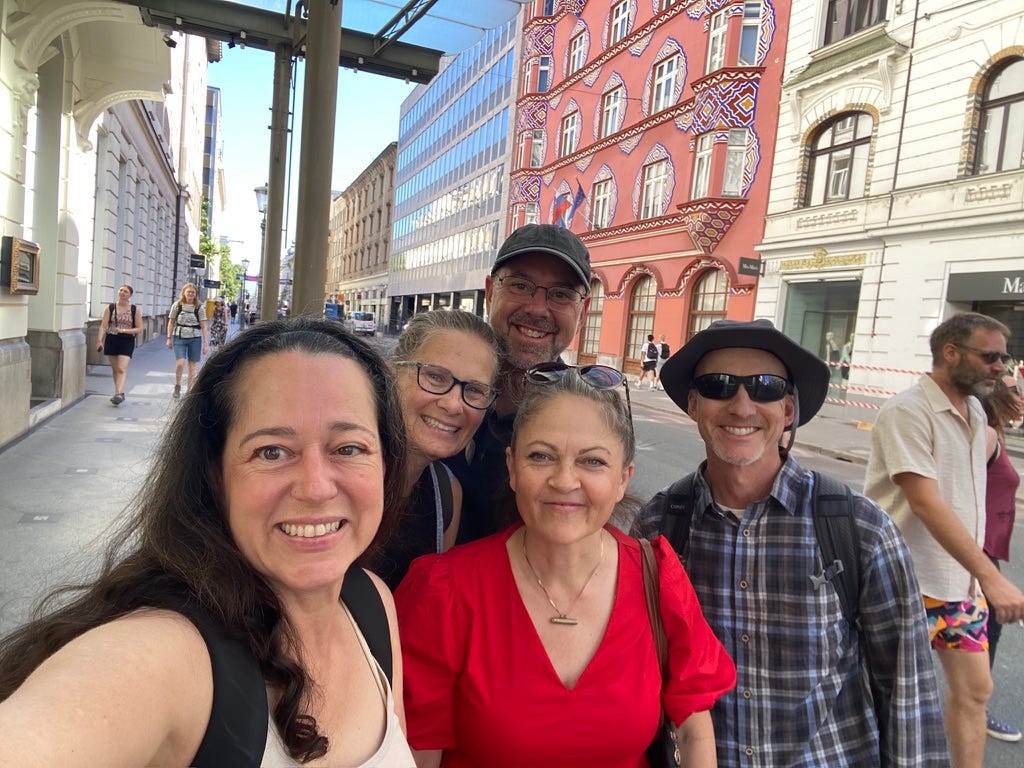
On our first morning in Ljubljana, our unofficial guide—Katarina, a reader who graciously reached out when she learned I was coming to her home city (photo at the bottom)—led us to a tucked-away square where a parking lot once stood.
A guitarist sat in the shade playing Here Comes the Sun while people drifted out of restaurants toward the river, lingering over coffee and conversation.
I stopped walking, drinking it in.
My friends tugged me along—there was so much to see! But I was stuck on that scene in a former parking lot.
Partly because I love a city burble, and partly because Katarina told us that twenty years ago, Ljubljana’s newly elected mayor realized that Plečnik’s elegant squares and thoroughfares were choked with cars and traffic. He decreed that the historic center would become pedestrian-only.
People revolted. Outrage!
How would residents shop? How would businesses survive? How would anyone get around? Madness, they howled.
The mayor’s response was, essentially, “If you don’t like it, don’t re-elect me.”
He’s still mayor.
Both Katarina and our food-tour guide Simona told me the same thing: when residents of Ljubljana’s capital city want to meet friends, they come into the city center. It’s seen as an asset, an area to meet and gather and celebrate and enjoy. PS: the city offers little free shuttles that anyone can take, though they are designed for the elderly residents of the capital city to be able to do their marketing even with limited mobility.
In the course of my two days in Ljubljana, I discovered so much about what makes the city special. But almost all of it really came back to one guy’s decision to turn a parking lot back into a town square.
So simple, but really, so profound isn’t it?
The choices we make have consequences, and visionaries make sure those choices are in line with stated values.
And Ljubljana isn’t finished.
Katarina took us through an exhibit at City Hall showing Ljubljana’s plans for 2045—posters outlining goals for cleaner air, greener spaces, better infrastructure, lower waste. Standing in front of those displays after watching the life along the river, I realized cities aren’t simply places to inherit.
They are pathways to connection.
When we make choices that honor those connections, cafés overflow. Giant stone steps leading to the water become filled with people chatting as the river rustles easily by. Markets become celebrations of the season.
Now when people ask me about Slovenia, I clasp my hands together and trip over my words, wanting to share what I learned about Slovenia’s ten-day war for independence. I want to tell them about Cockta, Yugoslavia’s answer to Coca-Cola. I want to convey the stories I heard about living under communism. I want to gush about how Slovenia’s national anthem is a poem called A Toast, about gathering around a table, and isn’t that a finer thing that bombs exploding in air?
But really, the thing I wish I could fully articulate is how Slovenia seems to understand that our choices reflect what we value. Driving or lingering? Parking or gathering? Traffic or conversation?
I’ve seen glimpses of that elsewhere. Bilbao reclaiming its riverfront. New York giving an abandoned rail line back to walkers as the High Line. Even little things, like Italian towns that close streets for the evening passeggiata so people can reclaim them for a few hours.
Those choices can change a skyline. But the more profound change is how a city feels.
Now, if you’ll forgive a mini departure here: What’s sat with me since these Ljubljana discoveries is something a little more personal. As individuals, as families, it’s the same as cities. Our choices reflect what we value. But how much time do we give to urban planning our lives—identifying what we prioritize in these fixed number of days we get on this spinning marble of a world? Making sure the choices we make support what means something to us, rather meet a societal expectation, or what sitcom families value? Many times since my return, this has come up as I’ve spoken to clients, and there’s this resonant moment in the room when I ask, “So what do you value? What do you choose?”
Deep thoughts.
Anyway, as Keith and I search for a place to someday call home in Italy, I’ve been trying to understand why some towns immediately tug at me while others, despite checking every box on paper, leave me cold.
Ljubljana gave me another clue.
While I like a pretty city as much as the next person, what I really respond to are places that decide to center human connection above all else.
I so want to know…what cities have moved YOU?
PS: If you’ve ever wondered how I seem to stumble on staying travel moments like raking olives for Italian harvests and bonding with restaurant owners over freshly unearthed porcini mushrooms, The Traveler’s Guidebook is my attempt to answer that question. It’s my thank-you gift to paid subscribers, a way to teach a more intentional, vibrant, meaningful way to move through the world.
Comments
Nothing yet. Say the first thing.
Sign in to join the conversation.