
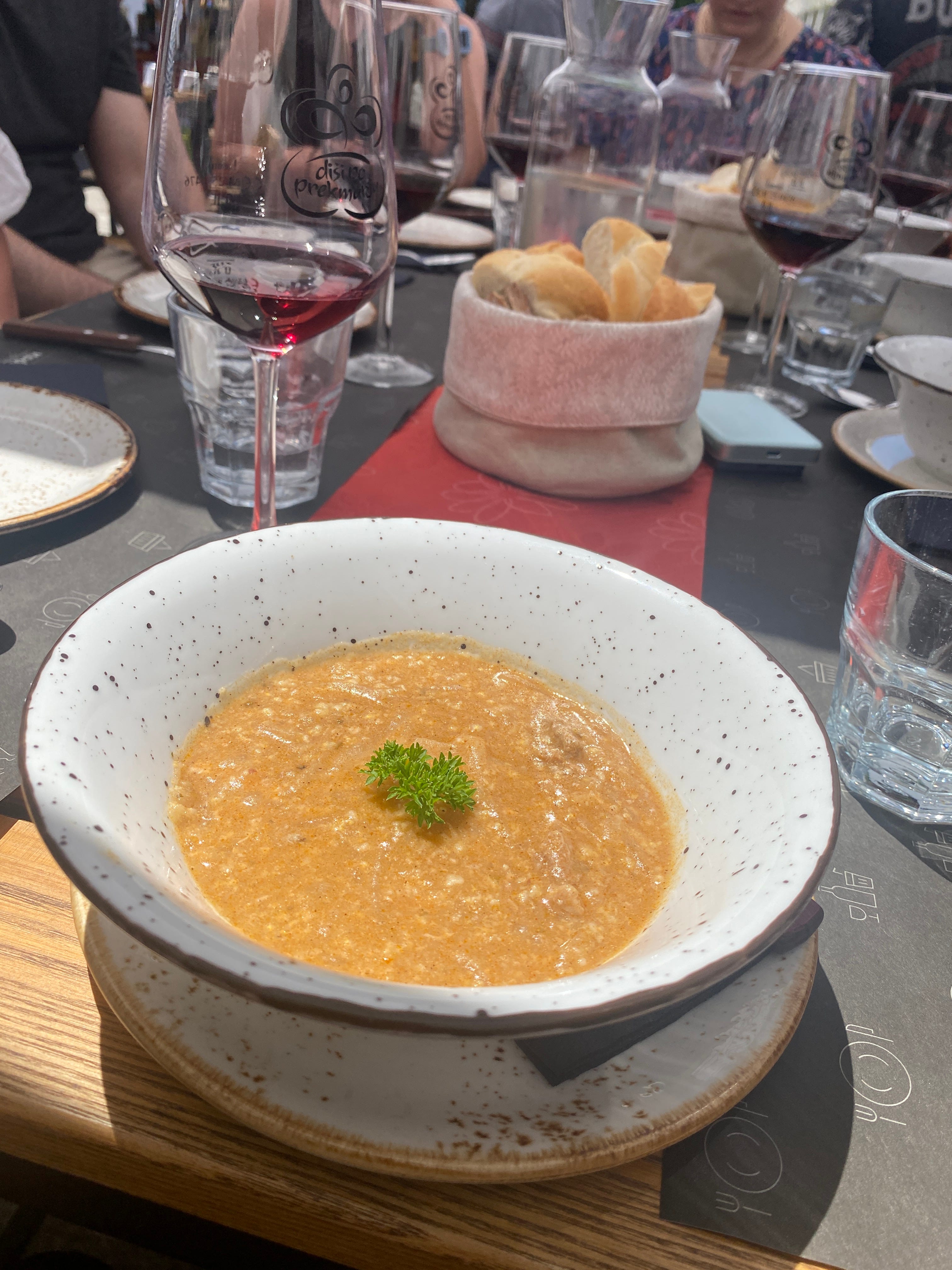
I came home from Slovenia overflowing with memories of wildflowers, Caribbean-blue rivers, and the taste of slaughter turnips.
Yes, you read that right.
Slaughter turnips.
It’s exactly the sort of dish you’d never order on your own, which is one of the many reasons I book a food tour or cooking class every time I visit a new country.
Food tours are my favorite souvenirs because they reveal the scaffolding beneath a place.
Food speaks of agriculture—the relationship between people and land.
Food speaks of community—how they celebrate, mourn, and mark the passing of a year.
Food speaks of daily life—pounding pine nuts and basil together in Liguria, turning an abundant milk supply into washed-rind cheese to last months in Normandy, warming dried peppers on a cast-iron pan in Oaxaca, fermenting vegetables to have vitamins on hand all year round in Slovenia.
Enter slaughter turnips.
Or first, actually, enter our guide, Simona of Food Tours Ljubljana (I’m happy to report I can now spell Ljubljana without leaning heavily on autocorrect). We met in the city’s main square where Simona introduced us to the city through the eyes of Jože Plečnik, the visionary architect whose hand shaped much of the Slovenian capital. She pointed to the statue of the poet France Prešeren, whose poem A Toast became Slovenia’s national anthem.
Which made me wonder why so many national anthems celebrate war when they could just as easily celebrate gathering around a table. Better for morale, in my opinion.
From there we wandered into the market. I’d already discovered it during an early-morning jet-lag-fueled ramble but had managed to buy nothing more than apricots. This time, though, we sampled award-winning Slovenian cheeses and admired Plečnik’s foresight in putting the fish market underground, at river level, where scraps could be whisked away without leaving the market smelling fishy. Instead, the air carried the savor of leeks, lettuces, figs as big as apples, and a tumble of peppers in every shade of green.
Passing a honey stand, Simona explained that Slovenia is one of the world’s great honey-producing countries. In what I was beginning to recognize as characteristic Slovenian conservation wisdom, community gardens are organic, public projects include pollen-producing plants for bees, and wildflower meadows are actively encouraged. This cast-off fact allowed me to notice what I would have otherwise missed the following week—that crossing the border between Slovenia and Italy or Slovenia and Croatia is remarkable for the sudden cessation of fields of wildflowers.
Simona handed us wooden tasting sticks dipped into linden honey, as linden trees are the national trees of Slovenia.
Pretending patience as I waited for my stick, I briefly wondered if we could change our tickets and leave after the linden trees bloomed. Their blossoms always remind me of jasmine laced with citrus. Adore.
Then I tasted the honey.
My eyes rolled back in my head.
Okay, we could leave on time. But I was taking linden honey home.
I’d never tasted anything like it. Just its aroma conjured industrious Slovenian bees. (Yes, Slovenia has its own breed of bees. It also has its own pod of dolphins, who steadfastly refuse to leave Slovenia’s tiny sliver of the Adriatic. National loyalty apparently runs deep.)
Later, I’d spend days surrounded by wildflowers in the Soča valley, watching Slovenian bees indeed kick up a storm of industry as they flit from blossom to blossom. But that afternoon they lingered only in my imagination as we crossed to the butcher shop at the edge of the market.
Under umbrellas shielding us from the summer heat, Simona poured us glasses of Slovenian red wine (did you know Slovenia has a rich wine culture? News to me, and I was delighted to be put through my wine paces) and introduced us to a historic dish called slaughter turnips.
Like so many traditional dishes, it begins with whatever is close at hand.
After a pig slaughter, bones with bits of meat still clinging to them are roasted over sliced onions until the onions practically melt into the collagen, fat, and meat. Then come heaps of fermented turnips—found in nearly every household—and a handful of millet to thicken everything.
Voilà.
Slaughter turnips.
Food tour participants are generally adventurous eaters.
Even so, “slaughter turnips” is a name that gives one pause and I noticed mine was not the only face frozen in an agreeable smile.
Simona assured us that many cultures embrace hot soups and stews during hot weather because they help the body activate its own cooling processes.
I knocked back a mouthful of wine without really tasting it.
Then the bowls arrived.
I leaned over mine and inhaled.
Turnips, I realized, are sweeter than cabbage. The fermented turnips lacked the sharpness of sauerkraut. Softer. Like the curl of an invitation.
I picked up my spoon and took a tentative bite.
The brightness of the fermented turnips balanced the earthy richness of the slow-cooked bones. The millet disappeared entirely, contributing only a gentle creaminess.
Not in a million years could I have guessed what was in that bowl.
Somehow those humble ingredients disappeared into something entirely new. I plucked up a piece of buckwheat bread (where has buckwheat been all my life?) and sopped up every speck. Yes, we had three more stops to make on our Slovenian food tour. And doesn’t millet expand, leaving less room for more bites? No matter, every bit of slaughter turnips must be relished.
At the end of the tour, although we’d sampled plenty of Slovenian dishes that not only sounded much better on paper but were exceptional in flavor and execution, when Simona asked everyone to name their favorite bite of the day, most of us chose the stew.
What a triumph for humble turnips.
I’m home now, and before the first load of post-trip laundry had even finished drying, I’d ordered fermentation lids for mason jars so I can make my own fermented turnips.
Which makes me think.
I’m still trying to master focaccia barese (plan for next iteration: more hydration, less kneading). I’m composing a postcard to a bakery in Venice where I once ate a pastry called a festivo that the internet insists doesn’t exist. (There’s exactly one Reddit thread that suggests I’m not hallucinating.)
Now I’ll be adding fermented turnips and roasted bones to the list to recreate an old-school Slaughter Turnip.
It’s funny. I used to think that eating in a new country was about chasing down the greatest hits—ravioli del plin in Turin, paella in Valencia, pad thai in Bangkok. Now I’m realizing those are the postcard dishes. There’s a culinary backbone to place that I find even more satisfying. Sometimes that’s the same as what the guidebooks tell you are the dishes to seek out. But I’m beginning to suspect the heart of a region is more often found on an unvarnished wooden table during pig slaughter season.
My new travel mission? To collect those dishes that reveal a country’s history and character.
In this way, I can sink back into the soul of a place, even when back on home soil.
What are the dishes you’ve tried recreating once you got home?
PS: If you've ever wondered how I seem to stumble on staying travel moments like raking olives for Italian harvests and bonding with restaurant owners over freshly unearthed porcini mushrooms, The Traveler's Guidebook is my attempt to answer that question. It's my thank-you gift to paid subscribers, a way to teach a more intentional, vibrant, meaningful way to move through the world.
Thanks for reading! This post is public so feel free to share it.
Comments
Nothing yet. Say the first thing.
Sign in to join the conversation.