
You know that saying about travel being the journey rather than the destination? Of course you do. It’s been memorialized on everything from bumper stickers to Instagram memes to book titles.
Even so, when I travel, I spend hours poring over bakeries in my destination and offbeat museums to explore, and limited time thinking about how we’ll get there—or from place to place once we arrive.
Okay, that’s a lie.
I spend zero time on that because I outsource it to my husband, who good-naturedly goes along with our division of travel labor that makes me the dreamer and him the doer.
I actually hate planning that stuff. Mostly because it’s dead boring, but also because, unless I’m wondering what Turkish Airlines might serve for dinner (pro tip: the food from the U.S. to points east is...not their finest work. Istanbul to the US? Fabulous.), there just isn’t much food imagination to be had in getting from Point A to Point B.
Plus—and this probably says something alarming about me—I seem to have a travel-related executive functioning deficit. I’m liable to make a mistake like booking a flight whose connection leaves before I arrive.
By days.
It’s all such a headache, I try to minimize all travel between points. Just get me there and set me loose, that’s my motto.
So imagine my husband’s wide eyes when I told him I had a fixed idea about travel in Slovenia. I was so determined for this journey, I was willing to go out of our way. With no stops for food.
Enter the Slovenian Motorail.
I first heard about the Motorail from friends who visited Slovenia last year. Their stories prompted us not only to put this former Yugoslav country on our bucket list, but to move it to the top.
They told us about Ljubljana’s overflowing cafés, the drama of the Julian Alps, the impossible blue of the Soča River—and this ridiculous thing they’d done called the Motorail.
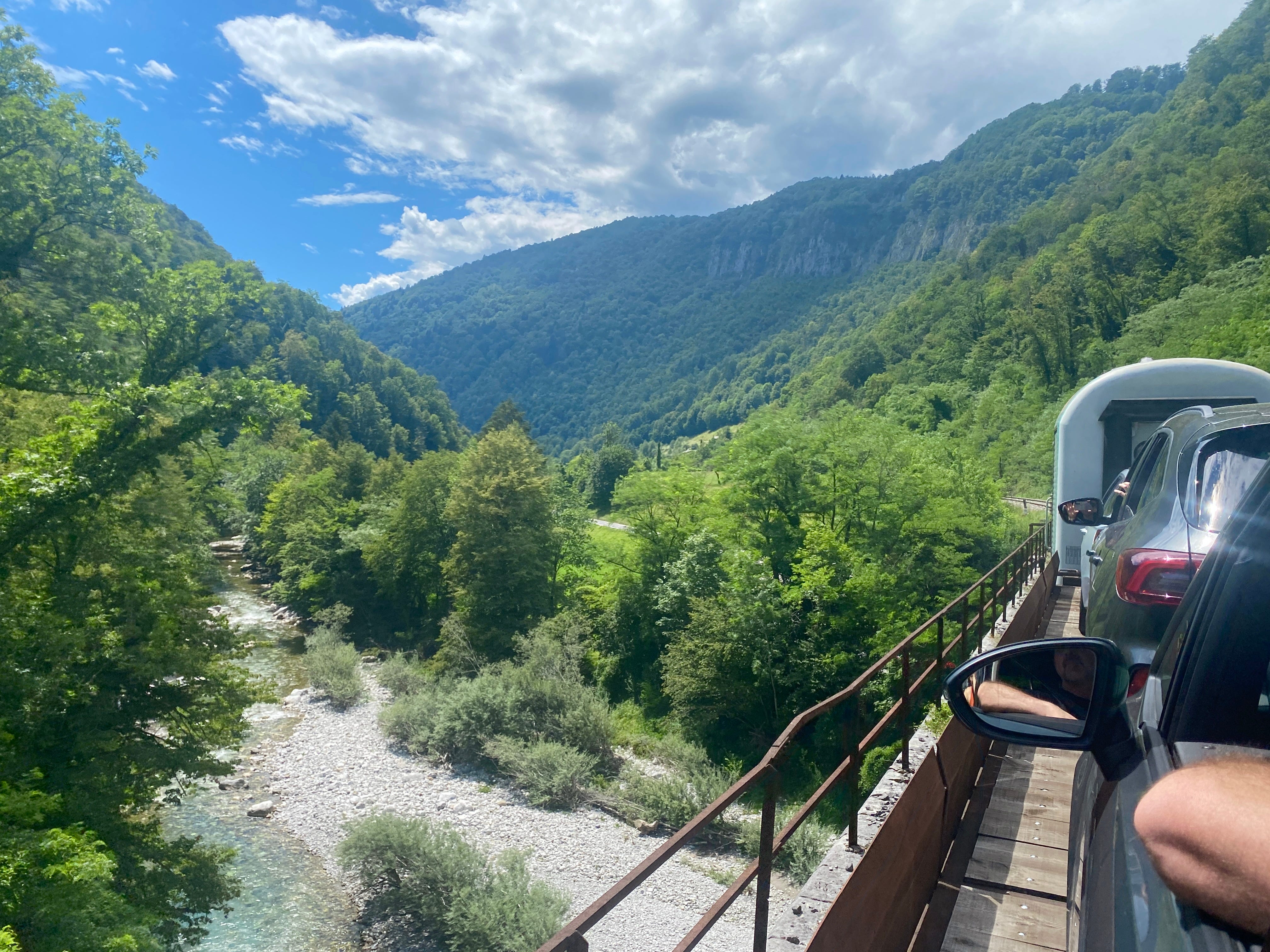
The Motorail, or Avtovlak, is exactly what it sounds like. You drive your car onto a train, put it in park...and stay in the car while the train carries you through the Julian Alps to the other side of the mountains.
I had to do this.
I insisted to my husband it was a practical decision. We could avoid hours of white-knuckling mountain switchbacks and the inevitable carsickness that would surely befall everyone, including the driver.
But really, I knew.
Something about not optimizing the trip from one point to another felt right.
Keith checked my math by studying maps and train schedules. He looked up and said we’d be doing those switchbacks in four days when we traveled from our Airbnb outside Kobarid toward Croatia. And it would add time. And it didn’t really make sense. Why were we doing this?
I waved away his sensibles.
Who needs sensibles when you have the opportunity to drive your car onto a train and get pulled through the Alps?
He wisely decided not to fight me, and luckily our friends are game for just about anything.
So we stocked up on apricots and cherries at the Ljubljana farmers market because, as it turns out, even if a journey doesn’t require snack stops, I still require snacks.
We arrived at the station in Bohinjska Bistrica about forty-five minutes early, thanks to planning for the notorious traffic around Lake Bled. (Which there absolutely was. On the bright side, we got to see Lake Bled.)
We were seventh in line.
This matters because you cannot make reservations. You buy your ticket as you drive onto the train, and loading is first come, first served. During busy periods (like July and August), if you’re too far back in line, there may not be room for your car.
Since we had time to spare, we wandered over to the station restaurant and ordered what may have been the stinkiest hamburger I’ve ever encountered. Excellent beef topped with lard, pungent local cheese, onions, and sauerkraut.
Keith and I split the burger (to our friend’s relief, I’m not sure they could have tolerated two of those at the same table).
The Cockta, however, was mine alone.
I sipped it while thinking about the story our guide had told us—that Yugoslavia, refusing to import Coca-Cola, developed its own herbal soft drink instead.
Communist Yugoslavia is gone. But Cockta remains.
Soon enough, a train worker sold us our tickets, and we clickety-clacked our way onto the flatbed railcar. The last car loaded, the train gave a little heave.
We were off.
I spent the first few minutes trying to decide whether one wears a seatbelt on a train when technically sitting in a car. I tried both approaches before settling on no seatbelt so I could lean out the open window.
The gentle rumble became our soundtrack as we passed through tunnels so long daylight became a forgotten thing, crossed bridges over Caribbean-blue rivers, and rolled past high meadows stitched together with wildflowers and tiny farms, each with its own row of painted beehives.
I never wanted it to end.
Less than an hour later we rolled off (by backing out of about a dozen flatbed railcars; thank goodness my husband is adroit in reverse) in Most na Soči, a town I’m already plotting to revisit. Just outside town sits a lake that, perhaps because we’d just come from Lake Bled, reminded me of its famous cousin—only without the crowds.
That evening, eating Keith’s grilled pork beside lavender edging fields of wildflowers that tipped up into the Julian Alps, we recounted the day’s best, worst, and weirdest moments.
The car train won “weirdest.” Unanimously.
I insisted everyone also vote it “best.”
Now, I can be a bit of a bully, so it’s entirely possible everyone was simply humoring me.
But I’d like to think we all learned that day there are shades to the old expression about the journey being more important than the destination.
Some of those shades involve eating cherries while your car rides a train through Slovenia’s Julian Alps.
What’s your travel experience that was about the journey?
PS: If you’ve ever wondered how I seem to stumble on staying travel moments like raking olives for Italian harvests and bonding with restaurant owners over freshly unearthed porcini mushrooms, The Traveler’s Guidebook is my attempt to answer that question. It’s my thank-you gift to paid subscribers, a way to teach a more intentional, vibrant, meaningful way to move through the world.
Comments
Nothing yet. Say the first thing.
Sign in to join the conversation.