
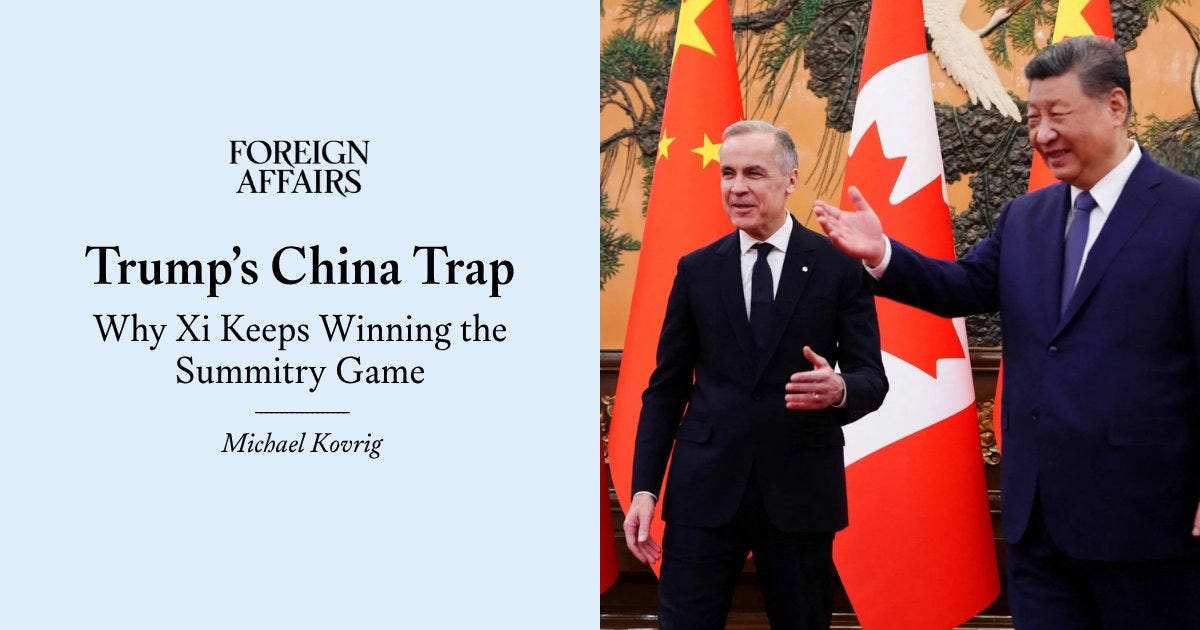
An unprecedented wave of Western leaders has visited China since Donald Trump’s return to the White House. Now this 访华潮 (fǎng huá cháo) of politicians is rising to a foamy crest as the U.S. President rolls into Beijing this week. While each dignitary arrives in Xi Jinping’s court hoping to stabilize relations and influence the General Secretary, instead they usually get co-opted into serving the Communist Party’s agenda and participating in its propaganda. Even with American power behind him, Trump will almost surely get trapped in the same accommodating pattern.
Last week, Foreign Affairs published my essay about this problem (gift link).1 Now, in this first of a series of posts on the wave, we’ll explore some of the more compelling research findings that didn’t make it into Foreign Affairs and extract some pointers the Donald and those who follow him should consider.
The crux of the problem: By accepting the terms the CCP sets for meeting Xi, and by performing in his autocrat’s pageant, they’re fulfilling his yearning to be recognized as the superior statesman—what Francis Fukuyama would call his megalothymia. More dangerously, as global deference to Xi’s power becomes normalized, the risk grows that any dependence on China will be weaponized by a regime that sees displays of acquiescence as evidence of weakness on the part of liberal democracies.
To end this cycle, the essay argues, we need a different measure for success for visits to China: not the dollar value of the deals signed or the warmth of the welcome, but the level of constraint imposed on the Party-state’s coercive impulses. What really matters is not what each leader gets, but in aggregate what the Party learns.
For some perspective, let’s run through all the visits since Trump’s inauguration.2
Now let’s dive deeper into some recent visits to better understand their dynamics.
The 2026 wave’s most consequential visit, Mark Carney’s time in Beijing reveals the pattern in its most paradoxical form. The archetype of what Samuel Huntington called Davos Man, Carney used explicit normalization language (“renewing the relationship,” “strategic partnership”), framed PRC coercion as a trade irritant to be negotiated away, relied heavily on institutional mechanisms and memoranda, seemed optimistic that reciprocal widening in market access could stabilize relations, and minimized the moral signalling. My impression is he’s not naïve, he’s invested in systems: a crisis manager attempting to re-wire exposure through diversification and technocratic bargaining rather than power signalling.
Carney is also the only Western leader who’s articulated a coherent strategic alternative to the binary of either balancing against or bandwagoning with China. His Economist essay and World Economic Forum speech laying out his “variable geometry” concept — middle powers acting through new coalitions of necessity rather than depending on a reliable America — are the most ambitious recent statements on how transcending the binary might actually work in practice. I wrote about them for Foreign Policy in a February commentary, “The Carney Doctrine Can Be More Than a Davos Speech.”3
But Carney’s conduct in Beijing was the opposite of his Davos rhetoric, a contradiction that’s largely been ignored. As I analyzed in the Toronto Star, his delegation appeared overly conciliatory.4 Rather than resist the Party’s status-defining choreography, Carney leaned into it more than most other Western leaders had. The smiles, the “new world order” line caught on video with Premier Li Qiang, the public adoption of CCP propaganda about multilateralism, the rejection of “megaphone diplomacy” — these were the price of entry to the audience with Xi, and Carney paid willingly.
Canada’s PM lowered import barriers to Chinese EVs in exchange for tariff relief on agri-food exports, fracturing North American alignment on Chinese state-subsidized goods. Beijing established that a U.S. ally spurned by Trump could be pressured to break ranks—and that Canada would tolerate hostage-taking, executions of its citizens, and active threats and interference in the hopes of diplomatic stability and economic relief. That set a dangerous precedent for every subsequent visit.
The flurry of commentary Carney’s ideas spurred often overlooked his performance in Beijng. But with the CCP, optics always have enormous significance. Economically, Canada matters relatively little to most Chinese firms. The real prize for the Party wasn’t access to Canada’s market, but rather the spectacle of America’s neighbour and longtime loyal ally seemingly kowtowing. While Xi, Putin, and now Trump may see the comportment of that delegation and others as the toadying they expect all weaker countries to show, it sets an awkward benchmark for others and contributes propaganda-ready evidence that justified outrage at PRC violations of international laws and norms can be dismissed as irrelevant or politically-motivated. As Carney himself said days later at Davos:
“When we only negotiate bilaterally with a hegemon, we negotiate from weakness. We accept what is offered. We compete with each other to be the most accommodating. This is not sovereignty. It is the performance of sovereignty while accepting subordination.”
Variable geometry is a strategy; situational ethics is a failure of principle. Carney has the strategic vision. The question now is whether his further conduct will match it, or whether his doctrine began consuming itself before it even got started.
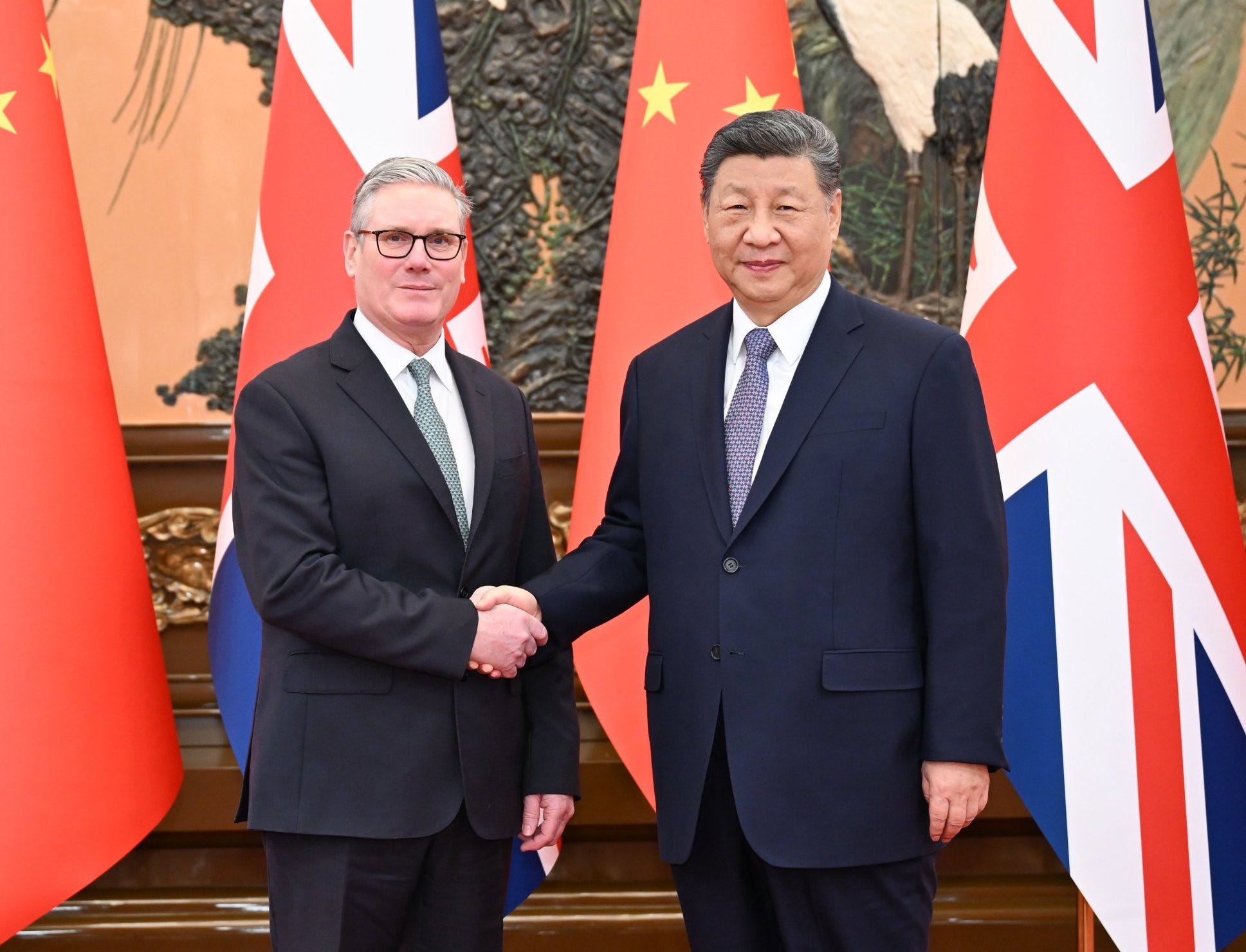
The first UK PM visit to Beijing in eight years was an effort to revive relations after they had gone from a “golden era” under David Cameron to an ice age after China effectively abrogated the Sino-British joint declaration on Hong Kong and various disputes accumulated. Saying he wanted to avoid blowing hot or cold, Sir Keir Starmer set off for Beijing in late January as a managerial pragmatist under severe political constraint due to his domestic unpopularity. Looking for retail wins on what insiders called another “Starm offensive,” he ran a classic business delegation visit heavy on formal cordiality, commercial dealmaking and sectoral agreements.
Ahead of his trip, I offered several recommendations in The Times of London5 and a Substack post. None were more pressing than to put political prisoner Jimmy Lai—a Hong Kong publisher, democracy advocate and British national—and roughly 200 other political prisoners in Hong Kong front and centre. Publicly. Defenders of the visit answer that he did raise Lai’s case. Privately. What of it?
This is where the “cheap talk” literature in international relations is helpful. From Crawford and Sobel onward, the foundational insight is that signals which generate no audience cost convey no information. A leader who discreetly mentions a thorny issue can claim at home to have “raised the matter” while the other government understands no political price will be paid and no consequences imposed. A Western official once told me of a visiting prime minister who remarked to Hu Jintao that he’d noted Hu’s earlier role as Party Secretary in Tibet—thus enabling him to report that Tibet had been discussed. That’s the cynical floor of private representations.
Starmer and Lai showed the ceiling isn’t much higher. Set Lai’s case against two precedents and the choice becomes harder to explain — until you notice what actually predicts the response. In 2013, when British investigator Peter Humphrey was detained in Shanghai for 23 months on fabricated charges, Prime Minister Cameron and Foreign Secretary Osborne were in the midst of their “golden era” sucking up to China. Osborne went to Beijing weeks later to announce the “next big step,” and the case stayed largely consular. In 2019, when a Hong Kong national working at the British consulate in Shenzhen named Simon Cheng was tortured into confessing that Britain was behind the Hong Kong protests, the golden era was already collapsing under those same protests; Foreign Secretary Dominic Raab used the word “torture,” summoned the ambassador, expressed “outrage,” and granted Cheng asylum. It was a staggering contrast to the response to Humphrey’s detention—and to Lai’s.
Days after the visit, a Hong Kong court sentenced Lai to 20 years on manifestly political charges. London responded with statements of disappointment and an immigration tweak for Hongkongers that was already in the policy pipeline. No ambassadorial recall, no Magnitsky-style sanctions on the responsible Hong Kong officials, no restriction of bilateral contacts, no use of the leverage the visit itself had just created. In Starmer’s personal Substack post the weekend after returning—framed around cost-of-living relief and “a shared sense of history”—Lai’s name doesn’t appear. As Britain drifts back toward an engagement posture, the tools to apply pressure haven’t disappeared. The will to use them has.
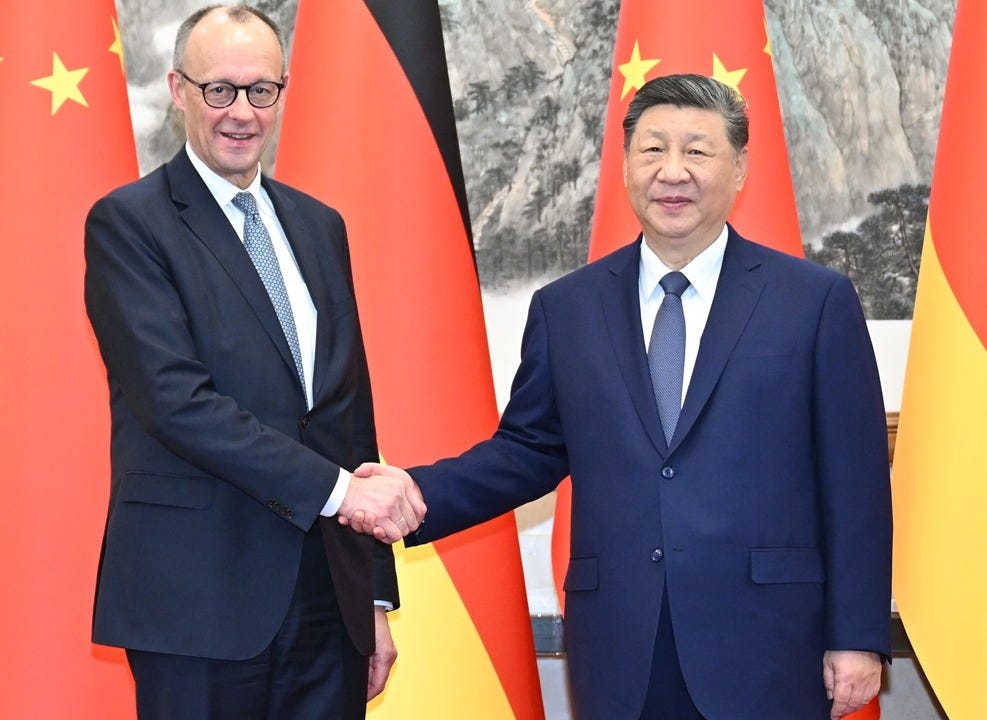
German Chancellor Friedrich Merz’s visit produced a mixed outcome. He talked up Xi’s approval of purchases of Airbus jets—which China Eastern Airlines and China Southern Airlines likely already needed—as the most tangible success of his trip. But Beijing has used political calibration of aircraft orders as diplomatic currency since Richard Nixon’s 1972 visit, and is on track to repeat the trick with Boeings for Trump. To his credit, Merz did raise festering problems in the relationship between Germany and China, including overcapacity, the artificially weak yuan, rare-earth coercion, and support for Russia’s war in Ukraine more directly than other visitors, both publicly and privately. However, he also adopted some of the CCP’s preferred language while softening Germany’s own, and a month later, Merz signaled further accommodation by saying he could “imagine” an EU-China free trade agreement that Chinese officials are pushing. Much more in these posts:
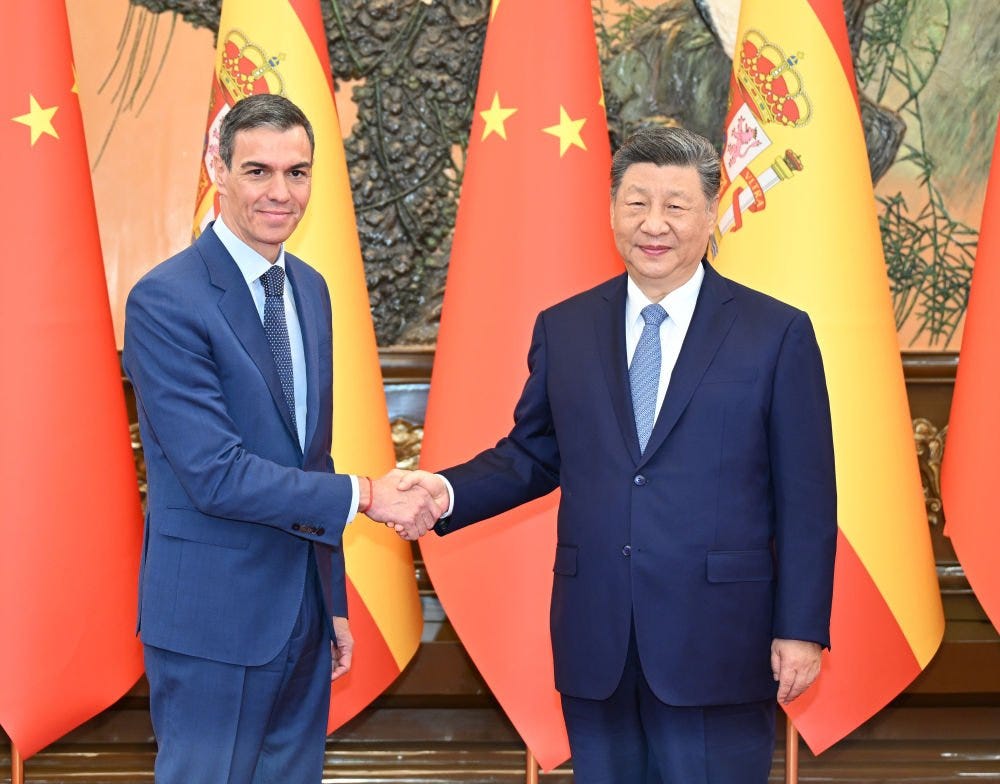
The Foreign Affairs essay necessarily treats Spanish Prime Minister Pedro Sánchez briefly, but his case is worth examining in more detail. Sánchez is a frequent flier: four visits in four years.
In April 2025, arriving just nine days after Trump’s “Liberation Day”, he became the first European head of government to meet Xi in the new tariff era—and used the visit to call publicly on the EU to rethink its China relationship, in open defiance of a U.S. Treasury Secretary warning that Spain was “cutting its own throat.” The visit continued a pattern from prior trips: diluting EU countervailing duties on Chinese EVs from within (Spain had abstained on the October 2024 vote) and modelling how member states could quietly drift from Brussels.
Sánchez then dispatched his foreign and economy ministers, sent the King and Queen on the first state visit in 18 years, with a wreath laid in Tiananmen Square (the EU still has an arms embargo on China for the 1989 massacres sparked there).
On his April 2026 trip, Sánchez signed a permanent strategic dialogue mechanism that institutionalizes the channel beyond his own tenure.
Each individual trip has looked defensible: agri-food protocols on pork by-products, cherries, pistachios, and dried figs; Chinese battery and EV plant investment; and a hedge against U.S. tariffs and an unpredictable White House.
But the cumulative numbers tell a different story. Spain’s goods trade deficit with China widened from €37.7 billion in 2024 to €42.3 billion in 2025; Spanish corporate investment in China collapsed to €4.54 million in 2025—the lowest level in three decades—while Chinese investment into Spain rose to €643 million, a 160-to-1 asymmetry. Chinese state-supported companies are establishing manufacturing footholds inside Spain explicitly engineered to circumvent EU defenses. The Chery-Ebro EV plant near Barcelona, marketed as a flagship Chinese investment, ships prefabricated vehicle bodies from China for final assembly in Spain to obtain EU origin status, hollowing the bloc’s countervailing duties on Chinese EVs from within. Madrid waves through such investment without technology-transfer requirements.
Most consequential is the language Beijing put in his mouth. The official Chinese readouts of Sánchez’s April 2026 meetings with both Xi Jinping and NPC Chair Zhao Leji say Spain “firmly adheres to the one-China principle” rather than the “one-China policy.” The “principle” accepts Beijing’s claim that Taiwan is inalienably Chinese. The “policy” — used by most Western governments, including Spain’s own Foreign Ministry — acknowledges only that Beijing holds that view. The PRC has been pressing other capitals to make exactly this substitution for years; with Sánchez, it appears to have succeeded. His office subsequently pointed reporters to the Spanish Foreign Ministry’s standing “policy” position, but the readouts remain on the PRC MFA’s website.
Sánchez also endorsed Xi’s “Four Global Initiatives” by name, echoed China’s “new multipolar order” rhetoric (CCP code for supplanting the United States) and opposed a “new Cold War” (a CCP thought-terminating cliché to suppress awareness of the threat it poses and efforts to align against it). To his credit, Sánchez did use a lecture at Tsinghua University to call on China to open its market so that Europe wouldn’t have to close its own:
“To help us correct the current trade deficit we have with it. A deficit that is not balanced, that grew again by 18% last year alone, and that is unsustainable for our societies in the medium and long term. And it is unsustainable because of the isolationist movements it fuels and the grievances and social pain it causes. To give you an idea, our trade deficit with China already represents 74% of our country’s total deficit.”
That was what he needed to say. Still missing was any hint of consequences for China not acting, or any mention of who needs to do what to make change happen.
Spain’s defenders argue that engagement is “structured and conditioned”—that Sánchez’s access can be used to extract concessions on rare earths, services markets, and Russia-Ukraine. Well, after four years and four visits, Beijing has yielded on none of them. As Spanish economist Alicia García-Herrero notes, the relationship has become deeply unbalanced and “Madrid is increasingly losing more than it contributes.” Chinese commentators now describe Madrid’s posture as a model—样板 (yàngbǎn)—for other Europeans to follow. European capitals describe it as an anomaly closer to Orbán’s Hungary.
Cumulatively, Spain has converted itself from a hedging middle power into something approaching a junior partner in Xi Jinping’s preferred world order. Where Carney proffered cordiality and a crack in fortress North America, and Starmer and Merz allowed critical problems to fester, Sánchez delivered legitimacy and a soft underbelly for Europe. Most dangerously, he represents the debased equilibrium toward which the wave of visits will continue drifting if no one summons the courage and will to break the pattern.
All of these developments raise a question: why are Western leaders submitting to China, one by one, when they would be better off presenting a common stance with Beijing? In the next post, we’ll apply international relations theories to explain what compelled these leaders to act as they did.
With assistance from Patricia Xavier and Joseph Widacki. Thanks for reading!
I’m defining “Western” here as members of NATO and the European Union plus other developed country U.S. allies. Other 2025–2026 more broadly “Western” wavers included European Council President António Costa and European Commission President Ursula von der Leyen, Serbia’s president, Georgia’s prime minister, and Uruguay’s president.
Comments
Nothing yet. Say the first thing.
Sign in to join the conversation.