
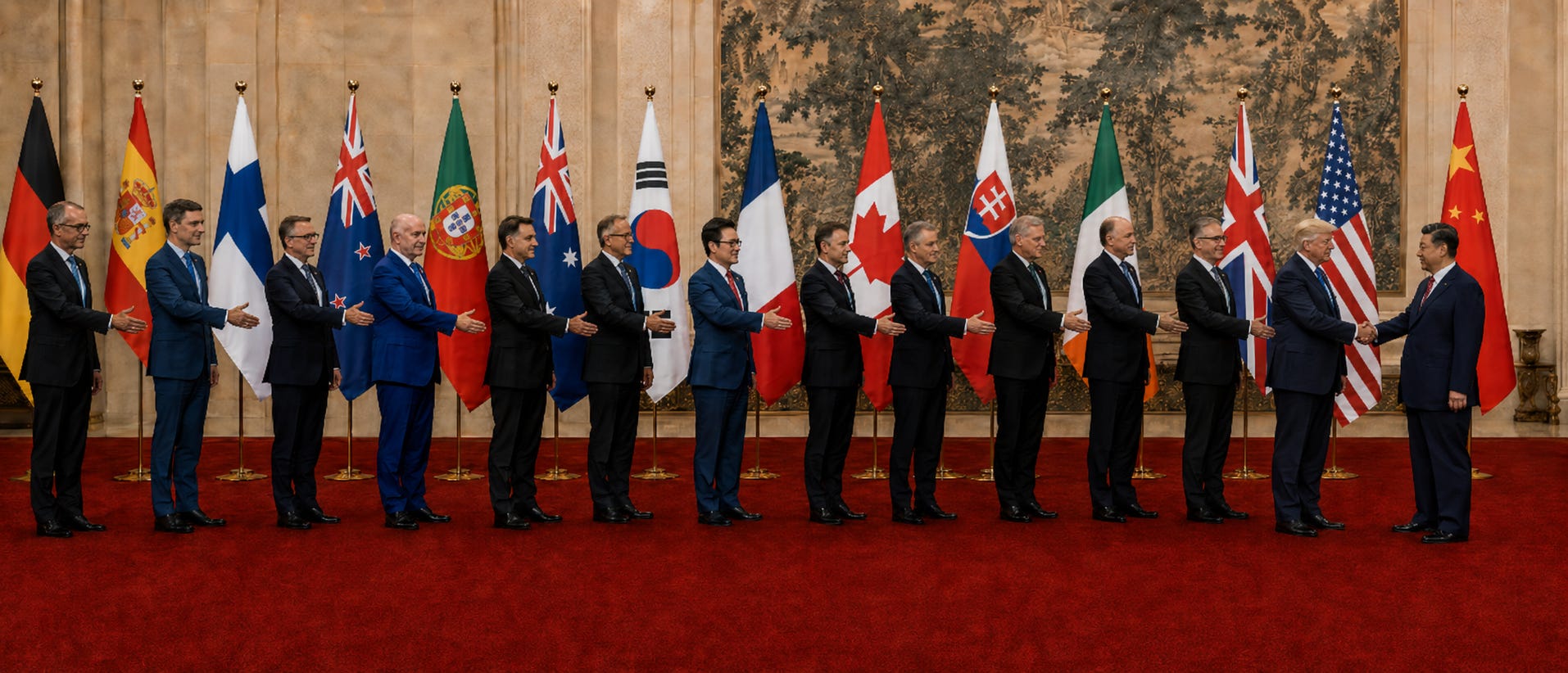
Donald Trump was in Beijing last week for a summit with General Secretary Xi Jinping. A lot has changed since the last American state visit to China in 2017. Then he was still seen as the de facto leader of an admittedly disoriented West. Nine years later, as Trump sat at that long table in the Great Hall of the People, he did so only as the president of the United States. “America First” is eroding Washington’s strategic position toward America alone.
This is Part II of a series of posts expanding on my essay in Foreign Affairs, Trump’s China Trap. I invite you to read it (or the archived version) and Part I. It takes some time for the real results of summits to manifest in the tea leaves. So while everyone else does hot takes, here we’re going to continue exploring the dynamics that shape these visits. We’ll drink the Trump-Xi tea once it’s properly steeped.
The United States’ greatest advantage over China isn’t technology, military power or the dollar. It’s allies. The Global West is half the world economy and the largest concentration of advanced manufacturing, capital markets, universities, and intelligence-sharing in human history. China has no equivalent. And yet Trump has spent the past year systematically dismantling that advantage, and in so doing, weakened his own hand in negotiations with Xi.1 PRC officials have spent a year watching this and exploiting their growing leverage with every other visitor they receive accordingly.
The result has been a succession of Western leaders parading to Beijing in pursuit of various prizes, only to find themselves cast as supporting characters in the Chinese Communist Party’s propaganda theatre. If insanity is doing the same thing over and over again and expecting different results, why do these politicians—now including Trump—keep acting like this?
The prevailing narrative is of a long-term geopolitical shift in the relative power of the United States and China, and with that a shift in the international system from unipolarity toward bipolarity or multipolarity (the remaining debate centres on which it will be: G-Zero, G-2 or multiplex). The immediate driver is Trump’s own neopatrimonial self-dealing, bully’s impulsive aggression toward weaker countries, and insecure vacillation in the face of PRC pushback. For lesser powers, that toxic combo has further stoked anxiety about America’s flagging willingness to shoulder the burden of hegemony, and resentment of Washington’s increasingly insistent demands on allies and partners to do more. Trump has his own reasons, which we’ll come back to another time. First, the analytical framework.

Most commentaries amount to saying that these Western visitors to China are hedging under duress. In other words, they’re cultivating competing relationships to keep options open; shoring up a vulnerable flank with Beijing so they can focus on managing pressure from a newly truculent Washington. As Suzanne Nossel recently observed:
States are no longer hedging within a system that is episodically volatile but out of a recognition that there no longer is much of a system at all. The rise of what we might call “hedgemony” is both a response to the reshuffling of the global order and an accelerant of this transformation.
That framing’s broadly correct in aggregate and consistent with my own argument, (and I wish I’d thought of “hedgemony”) but both essays blur distinctions that matter. International relations theory offers a more precise set of lenses for sorting through what these leaders are actually doing—and why most of it isn’t working. Let’s shine five theoretical spotlights, each of which illuminates a different layer of the problem.
The classic neorealist binary—balance against threats, or bandwagon with them—has been pushed back on for decades by historians of actual diplomatic practice. Paul Schroeder’s 1994 International Security essay, “Historical Reality vs. Neo-Realist Theory,” is the canonical statement against neorealism. Surveying centuries of European diplomacy, Schroeder argued that states facing the same threat regularly chose among the following distinct strategies:
Balancing: forming counter-coalitions against the threat;
Bandwagoning: joining the stronger side for protection and payoffs at the cost of some independence—at essence, Thucydides’ “the strong do what they can and the weak suffer what they must”;
Hiding: declaring neutrality, withdrawing into isolation, or seeking quiet protection without alliance commitments;
Transcending: trying to escape the conflict altogether through new institutional arrangements involving consensus, norms, and shared procedures; and
Specializing: surviving by claiming distinctive functional roles in the international system.
Two of Schroeder’s observations particularly matter here. First, bandwagoning is historically more common than balancing for smaller powers, particularly when the cost of resistance looks high and the rewards of accommodation look immediate. Second, in every era he studied, states facing the same threat chose divergent strategies, and those divergences often mattered more than systemic constraints did.
That second point describes the parade of visits exactly. Beijing isn’t facing a coherent Western response. It’s facing over three dozen different government responses.2 Each is running its own variant of hiding, bandwagoning, and balancing—and PRC officials are calibrating their responses to each.
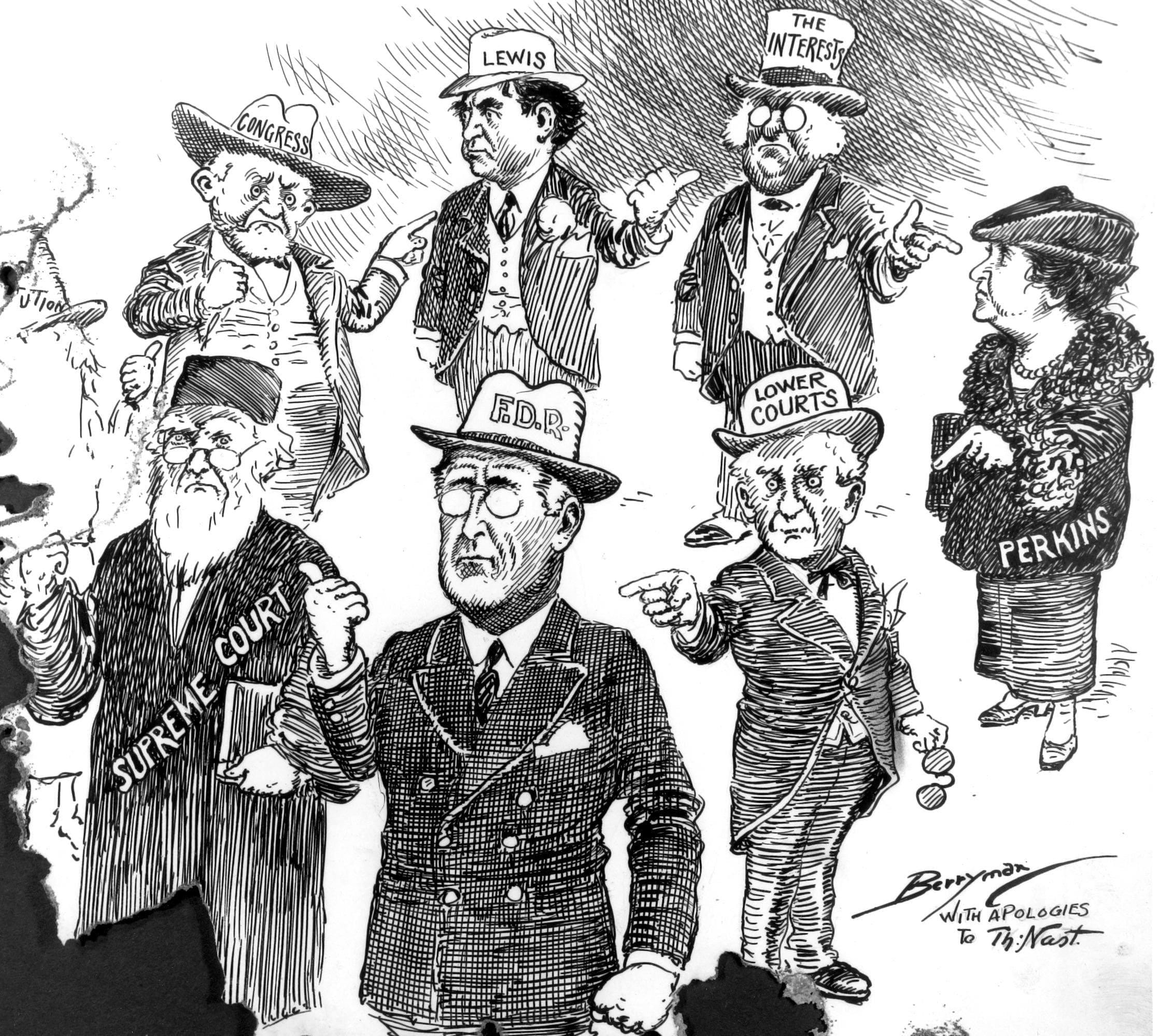
Schroeder’s typology is the lens for sorting individual leaders. But the deeper diagnosis of why so many of them are converging on accommodation comes from an earlier essay, Thomas Christensen and Jack Snyder’s “Chain Gangs and Passed Bucks: Predicting Alliance Patterns in Multipolarity.” They argued against Kenneth Waltz’s neorealist theory that multipolarity is inherently unstable. Their move was to add a variable: the perception of the offence–defence balance. Two distinct alliance pathologies follow from it:
Chaining into a gang: When states perceive offence as dominant, when they believe an attack on any ally rapidly degrades everyone’s security, they form tight, unconditional commitments. The pathology is chain-ganging: the alliance pulls members into wars they wouldn’t otherwise have chosen. 1914 is the classic example.
Passing the buck: When states perceive defence as dominant, when they believe they can survive without immediate balancing, they free-ride. They hope someone else will bear the costs of confronting the rising power. The pathology is buck-passing. The interwar 1930s is the searing historical case: Britain and France passed the buck to the USSR; the USSR tried to pass it back; everyone hoped someone else would handle Hitler.
Christensen and Snyder also made a crucial, less remembered point: those perceptions of the offence–defence balance are usually wrong, and the source of the misperception is structural. Pre-1914 leaders thought offence was dominant because 19th-century European wars had been short and decisive; but machine guns, barbed wire, and entrenched defences already favoured defenders. Pre-1939 leaders thought defence was dominant because they remembered the trenches; but mechanized warfare had restored offensive advantage, which they didn’t recognize until France fell in six weeks. The category they ended up in was the one their experience had taught them not to expect.
Let’s apply that to 2026: The formative experience of the current generation of Western policymakers was the post-Cold War era: economic integration, sanctions diplomacy, the inherited Cold War lesson that engagement transformed authoritarian behaviour, the apparent victory of liberal globalization. That experience produced a perception that defence would be successful against PRC mercantilism and coercion; that liberal economies can absorb the costs, strategic patience pays and any individual sector lost is recoverable. This perception is the engine of the buck-passing visible across the wave of visits.
But if Christensen and Snyder are right about the mechanism, then the perception is probably wrong. The Second China Shock, the CCP’s simultaneous coercion of Australia, Lithuania, and Canada, its October 2025 demonstration of rare-earth chokepoint control, the €310 billion EU–China goods trade deficit overtaking the U.S.–China trade deficit: these all suggest that when it comes to economic coercion, offence is more dominant than Western leaders have expected. French President Macron’s “matter of life and death for European industry” formulation is an attempt to correct the misperception. Whether other leaders accept—and act on—the correction is the exam question. Christensen and Snyder would predict they probably won’t, until a triggering event forces them to.
That’s the structural worry the interwar parallel actually carries: not that Xi is Hitler or Trump is Chamberlain, but that the same misperception of the relative power of offence and defence could produce the same window of consolidation by a revisionist power (China) that buck-passing always opens. It’s what keeps me and many likeminded China hands up at night.
Schroeder himself noted his “hiding” category may be related to buck-passing, but insisted hiding is broader, and can involve “a search for some method of handling the threat apart from being drawn into the power-political fray, often by a very active foreign policy.” It’s a meaningful distinction. The four visits of Spain’s Pedro Sánchez we discussed in Part I of this series are active foreign policy, not passive free-riding. Hiding captures agency in seeking accommodation in a way buck-passing doesn’t. The two categories overlap but aren’t identical. Buck-passing illuminates the approach of most visiting leaders more clearly: they acknowledge the threat exists while counting on someone else to bear the cost of confronting it.
A predictable critique of the typology is that several of these leaders “aren’t really bandwagoning” because they don’t face a security threat from China in any conventional sense. Randall Schweller’s 1994 essay “Bandwagoning for Profit: Bringing the Revisionist State Back In” dismantles that objection. Schweller argues that realist scholar Stephen Walt’s balance-of-threat theory—in which states either balance against a threat or bandwagon by capitulating to it—systematically excludes the most common form of bandwagoning: aligning with a rising power to gain, not because you have to.
In Schweller’s vocabulary, “balancing is driven by the desire to avoid losses; bandwagoning by the opportunity for gain.” He distinguishes “jackal bandwagoning”—toadying to a rising expansionist power to share the spoils—from defensive “piling-on” bandwagoning with a status-quo coalition once an outcome is already determined. The first decreases system stability; the second can enhance it.
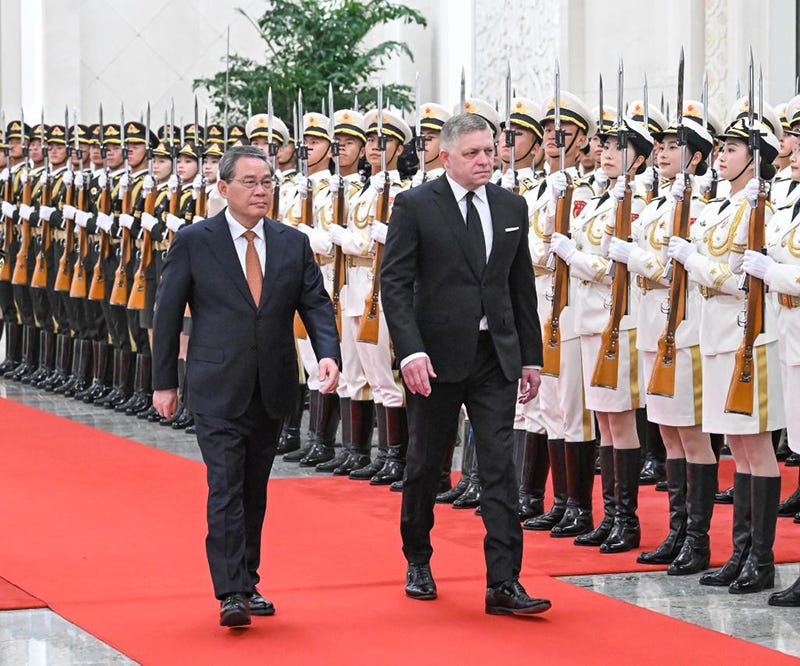
This is the move Slovakia’s PM Robert Fico and (less openly) Spain’s Sánchez are making. Fico attending a WWII anniversary parade alongside Vladimir Putin and Kim Jong-un while attracting a Chinese battery factory with €214 million in Slovak state support while giving the EU the finger is jackal bandwagoning: not a defensive response to threat but an offensive bet on the rising side of an order in motion. Spain’s Chery-Ebro plant is bandwagoning and free-riding in a Chinese electric vehicle: Sánchez accepted investment from Chery that undermines the EU’s own economic security defences, on the bet that Brussels will absorb the systemic cost. South Korea’s Lee softening the semiconductor coalition while asking Xi to mediate with Pyongyang has the same flavour: trade short-term security goods for accommodation gains.
Schweller’s point is that this kind of behaviour isn’t an aberration. Bandwagoning, he argues, is more common than balancing because it “rarely involves costs and is typically done in the expectation of gain.” Balancing is costly. Most states would rather not do it. The cases that look puzzling under Walt’s framework—why is country X accommodating when it isn’t under direct threat?—stop being puzzling under Schweller’s: because there are gains on offer and someone else is paying the systemic cost.
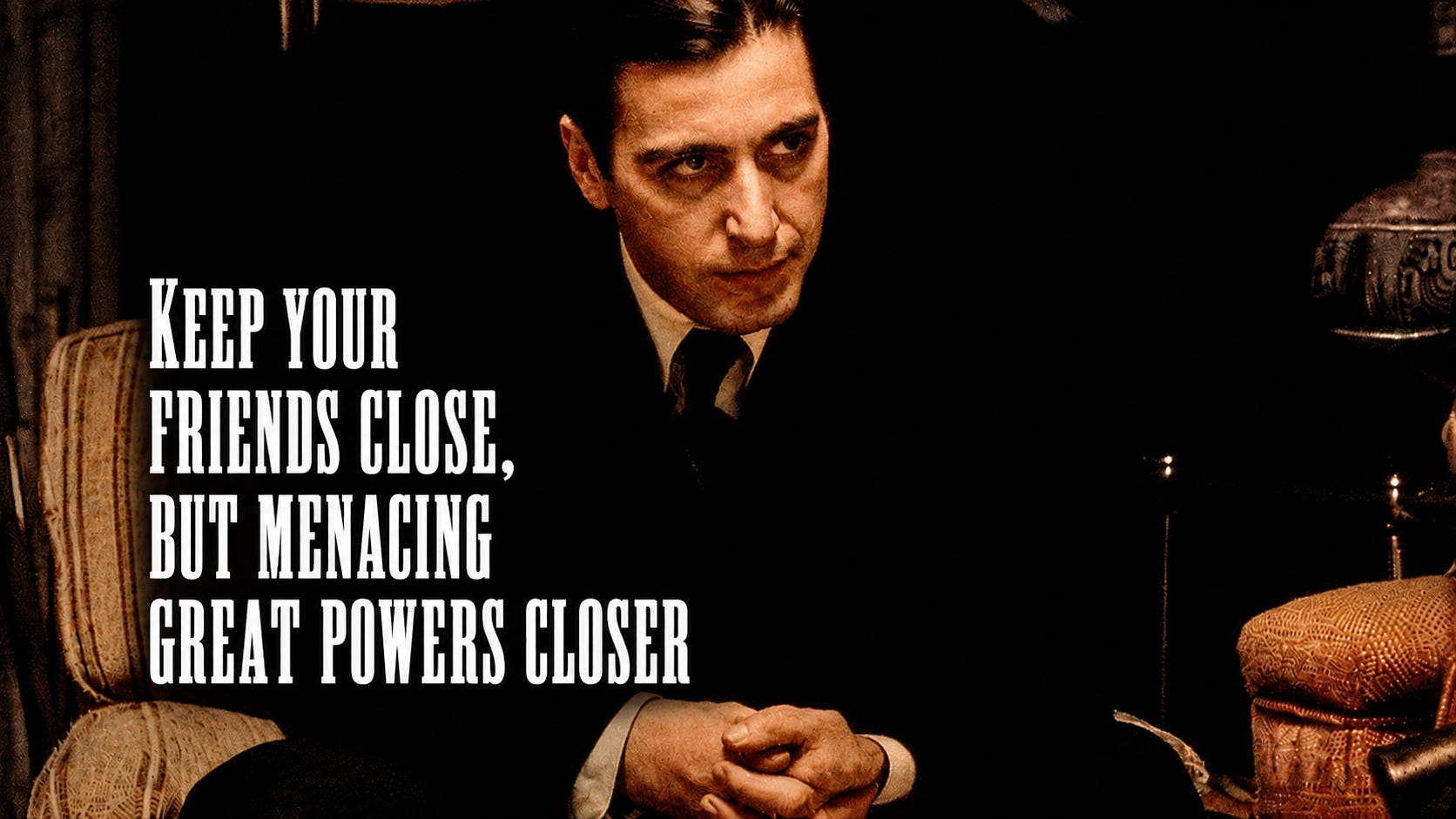
All these leaders seem to be following the Corleone family maxim: keep your friends close, but menacing great powers closer. They hope proximity will unblock channels for dialogue and enable early warning of intentions. But with the ultra-secretive Leninist Party-state, proximity is never symmetric. Most guests seek influence in vain, reveal far more than they learn, and risk being co-opted into its agenda and narratives.
A fourth lens, Glenn Snyder’s 1984 “The Security Dilemma in Alliance Politics,” names what each of these leaders is actually navigating in real time. Every ally faces two opposed risks: entrapment, being dragged into a partner’s conflicts and positions you’d rather avoid; and abandonment, the partner walking away from commitments when you need them. The risks are inversely related. Pushing back hard against a patron reduces entrapment but increases abandonment. Hugging the patron close reduces abandonment but increases entrapment. U.S. allies are living this.
Trump has rewritten both sides of that trade-off simultaneously. He’s raised abandonment risk by publicly questioning NATO Article 5, treating allies as transactional counterparts, and conceding the Nvidia H200 semiconductor framework after years of allied coordination. And he’s raised entrapment risk in a particular American way: not entrapment into a hot war, but entrapment into volatile tariff escalations, secondary sanctions exposure, and rhetorical flourishes allies are embarrassed to be associated with.
Carney, Starmer, Merz, and Lee are all visibly making entrapment/abandonment trade-offs in their Beijing conduct. Meeting Xi in China is a form of insurance against U.S. abandonment (“we’ll keep this channel warm in case Washington erupts”) and partly an effort to reduce entrapment in Trump’s next escalation (“we’re a separate diplomatic actor with our own China relationship”).
The trouble is that when every junior partner runs the same play simultaneously, as my essay argued, the collective effect is to weaken the alliance system the abandonment fear is responding to. Each individual hedge is rational. The aggregate is the disintegration Macron warned Xi about. Mao thought chaos is a ladder. Xi’s handling of the Trump visit suggests he may worry it’s more of a pit—but don’t expect him to lift a finger to stop others falling into it.
Finally, the more recent IR literature on hedging—most cleanly articulated in Fabio Figiaconi’s 2025 paper “Choosing not to choose”—helps explain why “hedging under duress” so often produces incoherence. Figiaconi reconceptualizes hedging as a new category of neutrality: adopted voluntarily by secondary states when they perceive a rise in great-power tensions and a possible power transition; grounded in the state’s own strategic calculations rather than law or morality; never declared explicitly; and easily abandoned when conditions change.
The distinguishing feature, in Shakthi De Silva’s phrase that Figiaconi cites, is the contingency element: hedging isn’t just keeping options open, it’s actively developing fallback options in case the system becomes more polarized. As my high school chemistry teacher used to say, if the experiment doesn’t work, “you gotta have a backup plan”.
That contingency element is what most of the Beijing paraders aren’t actually doing. They’re taking the bilateral commercial gains now and trusting that systemic contingencies—EU-level countervailing duties, U.S. security guarantees, the WTO—will be supplied by someone else. That’s not hedging in Figiaconi’s strict sense. It’s buck-passing play-acting as hedging.
Real hedging would mean each leader returning from Beijing with a parallel investment in the institutional fallback mechanisms. Few of them are.
International Relations 201 class dismissed. Want more? Here’s some recent media coverage of my essay and its arguments:
Konrad Yakabuski, “On his second China trip, a weakened Trump comes face to face with the new world order”, The Globe & Mail, 2026-05-13 (archived)
Michael Koziol, “The ‘big danger’ for Australia as Trump meets Xi”, Sydney Morning Herald, 2026-05-14 (archived)
Baptiste Gauthey, “Donald Trump a poussé ses alliés dans les bras de Xi Jinping” : l’analyse de Michael Kovrig,” L’Express, 2026-05-14 (archived)
Next: Trump and Xi at the Temple of Thymos
With the assistance of Patricia Xavier and Joseph Widacki
Military relations are arguably an important exception. For example, the just-concluded “Balikatan” exercises in the Philippines involved U.S. troops training alongside forces from the Philippines, Australia, Canada, France, Japan, and New Zealand. Another 17 countries attended as observers. But relations need more than security cooperation to remain robust.
NATO’s 32 members + the Indo-Pacific 4 (Australia, Japan, South Korea, New Zealand) = 36. We could also add developing country U.S. allies, e.g. the Philippines.
Comments
Nothing yet. Say the first thing.
Sign in to join the conversation.